
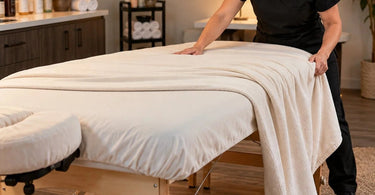
Quality you'll stock again and again... especially when it comes to massage blankets and professional spa bedding that actually stay where you put them! Picture this: your treatment room looks absolutely gorgeous, the lighting is soft, the music is soothing, and your client is drifting into relaxation heaven. Then, halfway through the massage, the blanket starts inching toward the floor like it has somewhere more important to be. Before you know it, one side is practically sweeping the tile while the other barely covers your client. If you have ever wondered why massage blankets slide off one side of the table, you are definitely not alone. This surprisingly common treatment room annoyance usually comes down to fabric friction, uneven weight, table setup, draping technique, or movement during the service. The good news? You can often solve it without replacing every blanket in your linen closet.
A wandering massage blanket might seem like a tiny inconvenience, but professional massage therapists know that little interruptions add up. Repeatedly rescuing a slipping blanket can disrupt treatment flow, create unwanted drafts, interfere with proper draping, and make an otherwise luxurious service feel a little less polished. Understanding what causes the problem helps you create a more dependable setup for every appointment.
Why Does a Massage Blanket Keep Sliding to One Side?
The simplest explanation is that the blanket is experiencing an uneven balance of forces. Gravity pulls downward on the portions hanging over the table, while friction between the blanket, sheet, clothing, and other surfaces helps resist movement. When one side becomes heavier, smoother, or more frequently disturbed than the other, the blanket may gradually migrate toward that side.
Unlike a blanket spread across a large household mattress, a massage blanket rests on a relatively narrow treatment surface. Its sides often hang freely, and the therapist repeatedly adjusts sections during the session. That combination makes even small changes in weight distribution more noticeable.
There is rarely one magical explanation. Instead, several ordinary setup details may be working together to create your blanket's very dramatic escape attempt.
1. One Side of the Blanket Has More Overhang
One of the most common causes is also the easiest to overlook: the blanket was not centered correctly when the table was prepared.
If one side extends farther below the tabletop, it may have more fabric hanging freely. That additional weight can create a stronger downward pull, particularly when the blanket rests against a slippery top sheet.
A small difference in overhang might not cause immediate movement. However, as the client shifts and the therapist adjusts the draping, the imbalance can become more pronounced.
Easy fix: Center the blanket before every service. Compare the overhang on both sides and confirm that the client has adequate coverage. Use the table's centerline rather than a nearby wall or decorative furniture as your visual reference.
For thicker blankets, check the balance after placing any pillows or bolsters. A blanket that looks symmetrical on an empty table may hang differently once the treatment area is fully arranged.
2. Your Massage Blanket and Top Sheet Are Too Slippery Together
Some fabric combinations simply do not provide enough friction to resist movement.
A smooth polyester blanket placed over a slick microfiber or satin-like sheet may glide sideways more readily than a textured blanket over a compatible cotton or flannel surface. Neither fabric is necessarily defective. They may simply be an awkward match.
Think of it as a tiny fabric skating rink. Beautiful? Absolutely. Stable? Not necessarily.
The interaction between materials matters more than the label on either product. Fabric weave, surface finish, laundering history, and overall condition can all influence how easily two layers move against each other.
Easy fix: Test the actual blanket and top-sheet combination before deciding what to replace. Gently pull the blanket sideways across the prepared table. If it moves with very little resistance, experiment with a different compatible fabric pairing.
Explore massage blankets, massage sheets, and Salon & Spa Bedding when evaluating professional linen options.
3. The Blanket Is Too Large for Your Massage Table
Bigger is not always better, especially when oversized bedding is draped over a narrow treatment table.
An excessively wide blanket may create heavy side panels that hang far below the treatment surface. If the client is slightly off-center or one edge is adjusted during the session, the extra material can begin pulling the blanket sideways.
Oversized blankets can also interfere with the therapist's movement around the table. A blanket catching against a knee, stool, supply cart, or clothing can receive a small tug that starts the slipping process.
Easy fix: Measure the table width and length, then account for the amount of fabric needed to cover the client comfortably while supporting proper draping. Choose blanket dimensions based on the complete treatment setup rather than assuming that the largest available size will provide the best experience.
Always evaluate the blanket with a person or appropriate training model on the table. A flat, empty table does not show how much material will be needed to accommodate the client's body.
4. The Client Is Positioned Slightly Off-Center
Sometimes the blanket is centered perfectly, but the client is not.
Clients naturally settle into positions that feel comfortable. Someone may lie a little closer to the side where they entered, shift their hips during a longer session, or turn slightly while relaxing.
When the body sits closer to one edge, the blanket may follow the body's contours unevenly. This changes the amount of fabric resting on each side and may increase the pull toward one edge.
Easy fix: Before beginning the massage, check that the client is positioned comfortably and safely on the table. Make any necessary positioning adjustments with the client's knowledge and consent, rather than pulling the blanket aggressively to compensate.
A well-positioned client and properly centered blanket work together. Neither should be adjusted at the expense of comfort, accessibility, or professional draping.
5. Your Massage Table Topper Is Changing the Surface Shape
Extra padding can make a massage table feel wonderfully inviting. However, thick fleece pads, foam toppers, and other cushioning accessories can change how blankets sit over the edges.
A plush topper may round the corners of the treatment surface, reducing the amount of flat area available for the blanket to rest against. If the topper shifts sideways, the bedding above it may gradually follow.
Improperly fitted padding can also create slopes or raised sections that encourage fabric movement.
Easy fix: Inspect the entire bedding stack, starting with the table upholstery and working upward. Make sure every layer sits evenly, fits the intended equipment, and remains properly positioned during normal use.
When shopping for Massage Table Warmers & Toppers, check dimensions, material compatibility, and installation instructions. If a topper does not fit securely, correct that issue before trying to solve the problem with heavier blankets.
6. The Blanket Gets Pulled During Draping Adjustments
Professional draping requires attention, precision, and a little choreography. Unfortunately, your blanket did not attend dance class.
During a typical massage, the therapist may uncover and recover individual treatment areas several times. If these adjustments consistently pull fabric toward the therapist's working side, the blanket can gradually shift in that direction.
This is especially noticeable during full-body services that involve repeated transitions between the back, shoulders, arms, and legs.
The problem may have nothing to do with the quality of the blanket. It may simply reflect how the fabric is being handled.
Easy fix: Use controlled, deliberate draping movements. When adjusting coverage, avoid dragging the entire blanket toward one side. Reposition the fabric as needed while maintaining secure coverage and client privacy.
Professional draping procedures should always follow applicable licensing requirements, facility policies, and the client's informed preferences. Blanket stability is important, but appropriate coverage is essential.
7. A Bolster Is Creating Uneven Tension
Massage Bolsters are useful for supporting comfortable positioning, but they can also influence how bedding falls around the body.
A bolster placed beneath the knees or ankles lifts part of the client's body and changes the path the blanket must follow. Depending on its dimensions and position, it may shorten the available overhang in one area or create an uneven fold.
If a therapist repeatedly moves the bolster or adjusts the covering around it, the blanket may begin traveling sideways.
Easy fix: Arrange bolsters before finalizing the blanket placement. Smooth the top sheet and blanket around the supported body position without pulling either layer excessively tight.
If the blanket becomes unstable only when a particular bolster is used, compare its size and placement with another suitable option. The goal is to preserve the client's positioning needs while making the draping easier to manage.
8. The Blanket Has Changed Shape After Repeated Washing
Professional spa linens work hard. They are washed frequently, dried repeatedly, folded, stacked, and placed back into service throughout the week.
Over time, certain fabrics may shrink, stretch, twist, or develop uneven edges. Some blankets also have stitched borders that behave differently from the main fabric during laundering.
If a once-symmetrical blanket now has a slightly distorted shape, it may no longer distribute its weight evenly across the table.
Easy fix: Lay the blanket flat and compare its opposite edges. Look for permanent distortion, curled borders, uneven corners, damaged stitching, or noticeable differences in length.
Follow the manufacturer's care instructions for washing and drying. Do not assume that every blanket tolerates high heat, aggressive agitation, or the same cleaning chemicals.
If one blanket consistently slips while identical newer blankets remain stable, wear or distortion may be contributing to the issue.
Keeping an organized supply of professional spa towels and replacement linens makes it easier to retire damaged textiles without disrupting treatment room operations.
9. The Massage Table Is Not Completely Level
Before blaming the blanket, take a close look at the table itself.
An uneven floor, incorrectly adjusted table legs, worn components, or improper setup can create a slight sideways slope. That slope may encourage bedding to migrate, especially when paired with low-friction fabric.
A table can appear level at a glance while still having a noticeable imbalance.
Easy fix: Check the equipment using the manufacturer's setup instructions. Confirm that all legs and supports are properly adjusted, locking mechanisms are engaged where applicable, and the table sits securely on the floor.
Never place improvised objects beneath table legs or attempt unauthorized equipment modifications to correct a stability problem.
If the table rocks, tilts, or appears damaged, stop using it until the issue has been properly addressed. Structural safety matters far more than keeping a blanket looking pretty.
Professionals evaluating treatment room equipment can browse Top Quality Massage Tables & Chairs and Portable Massage Tables for configurations suited to their services.
10. Your Own Movement Around the Table Is Tugging the Fabric
Here is one of the sneakiest causes: the therapist may be moving the blanket without realizing it.
When leaning across the table, repositioning supplies, adjusting a stool, or walking around a narrow treatment room, clothing or equipment can brush against the hanging blanket.
One tiny tug may do very little. Repeated tugs during a 60-minute or 90-minute appointment can gradually pull the fabric out of place.
If the blanket always slides toward the same side, pay attention to where the therapist spends the most time working.
Easy fix: Observe the treatment room workflow during a practice setup. Look for places where the blanket touches clothing, stools, carts, cords, or surrounding furniture.
Keep adequate working clearance around the table and arrange frequently used supplies within comfortable reach. A tidy room makes it easier to move safely and helps prevent accidental contact with the draping.
How to Tell Which Problem Is Making Your Massage Blanket Slide
Rather than replacing every piece of bedding and hoping for the best, identify the pattern.
If the blanket slides before the client gets on the table: Start by investigating fabric friction, excessive overhang, table levelness, and loose underlying layers.
If it slides only after the client turns over: Examine body positioning, movement-related tension, blanket dimensions, and draping adjustments.
If it slides only on one particular table: Compare that table's dimensions, padding, accessories, and levelness with your other treatment stations.
If it slides only when using certain blankets: Look for differences in material, weight, size, laundering wear, or shape.
If it always slides toward the therapist's working side: Observe draping technique and accidental fabric contact during treatment.
If it started after installing a new warmer or topper: Check whether the added accessory changed the surface shape, friction, or alignment of the bedding.
This simple pattern-based approach saves time because it helps you make targeted adjustments instead of purchasing supplies that may not address the actual problem.
Should You Use Blanket Clips, Straps, or Fasteners?
It can be tempting to solve the problem with a clip, elastic strap, or makeshift fastening system. After all, a blanket cannot slide away if it is attached to something, right?
Not so fast.
Improvised fastening devices may create pressure points, interfere with draping adjustments, snag fabric, damage upholstery, or complicate quick removal of the covering. Clips with exposed metal or sharp components can also introduce unnecessary risks.
Never attach a blanket in a way that restricts the client's ability to move, prevents appropriate access, interferes with table mechanisms, or creates an entanglement hazard.
If a commercial linen-retention accessory is being considered, verify that it is specifically suitable for the equipment, fabric, and treatment procedure. Follow the manufacturer's instructions and applicable professional standards.
For most ordinary sliding problems, correcting fabric compatibility, sizing, layer placement, and draping technique is a better starting point than adding hardware.
Do Heavier Massage Blankets Stay in Place Better?
Not automatically. This is one of the biggest misconceptions about slipping massage blankets.
A heavier blanket may provide additional contact and friction across the client, but it also creates more hanging weight along the edges. If one side has greater overhang, that additional weight can increase the downward pull.
Blanket performance depends on more than thickness or total weight. Surface texture, dimensions, flexibility, and the way the blanket interacts with the top sheet all influence stability.
A lighter blanket with suitable dimensions and a compatible fabric surface may stay positioned better than a heavier blanket that is too wide or slippery.
Client comfort must also guide your selection. Some clients prefer lightweight coverings, while others appreciate additional warmth. Avoid assuming that extra weight is appropriate for everyone.
When evaluating professional massage blankets, consider the actual treatment environment and ask whether the fabric behaves predictably during repositioning and draping.
Can a Massage Table Warmer Make Blankets Slide?
A table warmer can contribute indirectly, although warmth itself is not necessarily the cause.
Installing a warmer may add another layer beneath the fitted sheet, alter the total thickness of the treatment surface, or change how the linens interact with the padding.
If the warmer is not positioned according to its instructions, other bedding layers may shift more easily. A loose sheet over a smooth warmer cover can make the complete setup less stable.
Easy fix: Follow the warmer manufacturer's installation and layering requirements. Confirm that compatible sheets and coverings fit securely over the equipment without creating bunching or uneven tension.
Never improvise with nonapproved insulating layers or place accessories where they could interfere with temperature regulation, electrical safety, or intended operation.
Explore Massage Table Warmers & Toppers with both comfort and equipment compatibility in mind.
Choosing Massage Blankets That Work for Professional Spa Services
A beautiful color and a luxurious texture are wonderful, but professional buyers need linens that also perform reliably through repeated treatments and laundering.
Before purchasing replacement blankets, consider these practical factors.
Dimensions: Choose an appropriate length and width for the table, client coverage requirements, and draping method. Measure rather than relying on generic size labels.
Fabric texture: Consider how the blanket interacts with the sheets already used in your treatment rooms. Very smooth surfaces may require additional attention to positioning.
Weight: Select a comfortable weight that provides the intended warmth without creating excessive hanging fabric or unnecessary pressure.
Laundering requirements: Choose materials that can be cleaned according to your facility's hygiene procedures and manufacturer instructions. Commercial laundry compatibility may be especially important for high-volume spas.
Durability: Examine edge finishing, stitching, shape retention, and overall construction. Consistent dimensions can help simplify routine table preparation.
Service compatibility: A blanket that works beautifully for a relaxing Swedish massage may not be the preferred option for every body treatment, warmer setup, or service requiring frequent draping adjustments.
Pure Spa Direct offers professional beauty and wellness supplies from multiple manufacturers, allowing spa owners and massage therapists to compare options for their treatment rooms. Browse Salon & Spa Bedding and Professional Massage & Wellness Products when planning your next linen purchase.
A Five-Minute Pre-Service Blanket Stability Check
One of the easiest ways to prevent slipping is to make blanket positioning part of your regular treatment room preparation routine.
Step 1: Inspect the table. Confirm that the table is stable, properly adjusted, and ready for service. Make sure the upholstery and any approved protective accessories are correctly positioned.
Step 2: Smooth the lower layers. Check that the topper, warmer, fitted sheet, and top sheet are aligned and free from unnecessary folds. Correct any loose or shifting layers.
Step 3: Center the blanket. Place the blanket evenly across the table and compare both side overhangs. Check coverage at the head and foot ends as well.
Step 4: Account for accessories. Arrange pillows and bolsters according to the client's needs, then reassess how the blanket falls over the prepared surface.
Step 5: Perform a gentle movement test. Adjust the blanket as you normally would during draping. Notice whether one side immediately shifts or pulls the other side out of position.
Once the client is comfortably positioned, make any final adjustments while maintaining privacy, comfort, consent, and appropriate coverage.
This quick routine helps catch obvious setup problems before they turn into distractions halfway through an appointment.
How Spa Owners Can Reduce Blanket Slipping Across Multiple Treatment Rooms
For spas with several therapists or treatment rooms, blanket slipping can become an operational problem rather than a one-table annoyance.
Different tables may have different widths, padding arrangements, and linen requirements. If staff members rotate between rooms, inconsistent setups can make it difficult to understand why certain blankets behave differently.
Standardizing compatible linens where practical can simplify room preparation and purchasing. However, standardization should account for genuine differences in equipment and treatment services.
Consider organizing linen inventory by size, fabric type, and intended use. Identify which blankets work best with each table configuration and keep damaged or distorted textiles out of active service.
It also helps to include basic blanket positioning in staff training. A consistent preparation procedure can reduce unnecessary adjustments and make the client experience feel more uniform.
Use a small trial before making a large purchase. Test a proposed blanket with the sheets, toppers, and treatment procedures already in use, then evaluate its fit, draping performance, laundering requirements, and client comfort.
For broader room planning, explore Spa Essentials for Professionals and Must-Have Supplies for Salon & Spa Business Success.
Why Proper Blanket Positioning Matters for the Client Experience
Clients do not usually arrive for their appointment thinking about fabric friction or blanket dimensions. They simply want to feel comfortable, covered, and cared for.
A blanket that repeatedly slips can expose areas that were intended to remain covered, create temperature changes, or require disruptive adjustments. Even when the therapist handles the situation professionally, repeated interruptions may detract from the relaxing atmosphere.
Stable, properly arranged bedding supports smoother transitions between treatment areas and allows the therapist to focus attention on the service.
It also contributes to a consistent visual presentation. A treatment room with fresh, neatly arranged linens communicates care and preparation before the first massage stroke begins.
Of course, a perfectly centered blanket is never more important than client comfort or appropriate draping. The objective is to use dependable linens and thoughtful techniques that support both.
Frequently Asked Questions About Massage Blankets Sliding Off Tables
Why does my massage blanket always slide off the same side?
Repeated movement toward one side often points to uneven overhang, consistent pulling during draping, client positioning, accidental contact, or a table setup issue. Observe when the movement begins and check the underlying layers before replacing the blanket.
Are fleece massage blankets less likely to slide?
Some fleece fabrics provide more surface grip than very smooth materials, but results depend on the specific blanket and sheet combination. Fabric weight, finish, dimensions, and washing history also matter.
Should massage blankets hang over the sides of the table?
Appropriate overhang depends on the blanket size, client, treatment method, and draping requirements. The blanket should provide adequate coverage without creating excessive loose fabric that interferes with movement or equipment.
Can a loose fitted sheet make the top blanket slide?
Yes. If the fitted sheet or other bedding layers shift beneath the client, the upper blanket may move along with them. Check fit, elastic condition, and the compatibility of any toppers or protective covers.
Will washing a blanket make it less slippery?
Laundering can change fabric texture and performance, but it is not a guaranteed solution. Always follow the care label. Excessive heat or inappropriate laundry products can damage fibers or change the blanket's dimensions.
Is a heavier blanket better for keeping massage draping secure?
Not necessarily. Additional weight can increase the pull from hanging fabric. Proper sizing, balanced placement, appropriate friction, and sound draping practices are generally more useful considerations.
Should I replace the blanket or the massage table sheets first?
Test the current setup before buying replacements. If the fitted sheet moves easily, correct that issue first. If the sheet stays secure but a particular blanket slides, compare the blanket's dimensions and fabric with a more stable option.
Keep the Cozy Atmosphere, Not the Blanket-Chasing Routine
Massage blankets sliding off one side of the table can feel like one of those mysterious treatment room problems that simply refuses to cooperate. Fortunately, the explanation is usually practical rather than mysterious. Uneven fabric weight, slippery material combinations, oversized blankets, shifting toppers, client movement, and routine draping adjustments can all contribute to the problem.
Start by centering the blanket, checking the underlying linens, and observing exactly when the slipping begins. Make one adjustment at a time so you can identify what actually improves stability. If the blanket is worn, improperly sized, or incompatible with the rest of the setup, consider replacing it with a more suitable professional option.
For spa owners and massage therapists refreshing their treatment rooms, Pure Spa Direct makes it convenient to explore professional massage sheets and blankets, Massage Bolsters, and Massage Table Warmers & Toppers from suppliers serving the professional wellness industry.
Because your clients should be floating away into relaxation, not watching their cozy blanket make a dramatic exit off the side of the table!
