
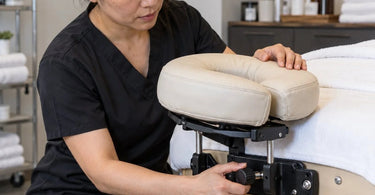
The smarter way to work... sometimes starts with noticing the tiny equipment quirks that quietly creep into a busy treatment room. A massage table face cradle that felt rock solid when it was new can gradually develop a little movement, a little wiggle, or that unmistakable feeling that says, "I swear I tightened you five minutes ago." For massage therapists and spa professionals who adjust a face cradle repeatedly throughout the day, that change is not especially mysterious: adjustable hardware is designed to move, lock, release, and move again, and thousands of those little cycles eventually add up.
The good news is that a loosening face cradle does not automatically mean your entire table is ready for retirement. In many cases, the issue involves the adjustable platform, locking mechanism, knobs, dowels, connection points, or ordinary wear in components that receive constant hands-on use. Knowing where the movement originates helps you decide whether the answer is a simple adjustment, a replacement component, or a closer inspection of the table itself.
Why Massage Table Face Cradles Loosen Over Time
Adjustable face cradles are mechanical components, and mechanical components experience repeated stress. Every time a practitioner releases a lever, changes the angle, alters the height, tightens a knob, or supports a client's head on the platform, the hardware goes through another work cycle.
Multiply that by several appointments per day, five or six days per week, and suddenly that innocent little headrest has been busier than half the staff.
Professional face cradle platforms commonly use combinations of cam locks, levers, knobs, hinges, pins, rods, or dowels. Different manufacturers approach adjustment differently, but the basic job is similar: allow the practitioner to position the client comfortably and then hold that position securely under normal treatment use.
Repeated locking and unlocking can gradually change how tightly mating components engage. Screws or fasteners may need attention. Friction surfaces can wear. Knobs can become less effective if threads are damaged. Plastic or metal parts can develop play. Even the connection between the face cradle dowels and the table's headrest outlets can contribute to a loose sensation.
The Locking Mechanism Is Often the First Place to Look
If the face cradle changes angle during a service, the adjustable platform deserves an inspection. Many professional platforms use a cam-style lever that releases the mechanism for positioning and then clamps it into place.
The lever should move through its intended range and secure the platform firmly without requiring heroic levels of force. If the practitioner has progressed from "close the lever" to "wrestle the lever like it owes me money," something deserves attention.
Some professional equipment manufacturers specifically recommend periodic inspection of face rest locking mechanisms for looseness. That is an important reminder for busy spas: do not wait until a client points out the wobble. Build a quick equipment check into your regular room maintenance routine.
Browse Top Quality Massage Tables Chairs for Relaxation & Wellness when you are reviewing treatment-room equipment, or search for massage table headrests and related components when an existing setup needs attention.
Repeated Adjustments Create Normal Wear
A stationary component generally has an easier life than an adjustable one. Face cradles are repeatedly moved to accommodate differences in body size, chest depth, neck position, treatment style, and client preference.
That adjustability is exactly what makes a quality face cradle useful. A practitioner can alter the height and angle instead of asking every client to conform to one fixed position. But each adjustment involves contact between moving parts.
Over time, the cumulative effects may include minor wear at pivot points, locking surfaces, handles, knobs, hinges, and threaded connections. The result can be movement that was not noticeable when the equipment was new.
This is especially relevant in high-volume massage practices, resorts, spas, schools, and wellness facilities where the same massage table may see multiple clients and multiple practitioners every day.
Overtightening Can Be Just as Problematic as Undertightening
When something feels loose, the natural instinct is to tighten it harder. And then harder. And perhaps give it one last twist for emotional closure.
That is not always the best approach.
Knobs and threaded hardware can be damaged when excessive force is repeatedly applied. Manufacturer guidance for some professional face rest systems specifically warns against overtightening knobs because too much force can damage or strip components.
The goal is secure engagement according to the equipment manufacturer's instructions, not maximum possible hand strength. If a knob must be continually overtightened just to hold the cradle still, investigate the hardware rather than treating more force as the permanent solution.
Do Not Forget the Dowels and Table Outlets
Sometimes the platform itself is locking correctly, but the entire face cradle assembly still feels loose. In that situation, look at where the face cradle attaches to the table.
Many removable face cradle systems use two dowels or rods that slide into outlets at the end of a portable or stationary massage table. A small amount of movement may come from that connection rather than from the platform's angle adjustment.
Check whether the dowels are straight, properly inserted, compatible with the table, and seated as intended. Inspect the table outlets for damage or unusual movement as well. Face cradle dimensions and attachment systems are not necessarily universal, so a replacement platform should be confirmed as compatible with the specific table.
This matters when purchasing replacement face cradle platforms, cushions, or related parts. "It looks about right" is not quite the equipment specification we want running the treatment room.
Client Weight Should Be Supported the Way the Equipment Was Designed
A face cradle supports the head and face during prone positioning, but it should be used according to the manufacturer's intended setup and working limitations. Clients should not use an adjustable face cradle as a grab handle when getting on or off a table unless the manufacturer specifically indicates that type of use.
Unexpected loading can place additional stress on adjustable joints and attachment points. Likewise, leaning heavily on the platform while making adjustments may put force on the hardware in a direction it was not designed to handle.
Practitioners should follow the setup and positioning instructions for their particular table and headrest combination. If you manage multiple rooms with different table brands or models, this is one of those situations where a standardized staff reminder can prevent unnecessary equipment abuse.
Loose Hardware Can Affect More Than Client Comfort
A small amount of unexpected movement can quickly become distracting during massage. A client who is trying to relax should not have to wonder why the headrest just shifted.
Position also matters ergonomically. Face cradle height and angle influence the position of the client's head, neck, shoulders, and upper back. A platform that will not reliably maintain the chosen angle makes consistent positioning harder for the practitioner.
This is why professional equipment checks belong alongside all the other less glamorous but essential treatment-room routines. We love beautiful oils, fluffy linens, calming music, and perfectly arranged retail displays, but the humble locking lever deserves love too.
For a broader treatment-room refresh, explore Professional Massage & Wellness Products, Massage Bolsters, and Salon & Spa Bedding.
A Simple Face Cradle Inspection Routine
Before the first client of the day, give adjustable equipment a quick visual and hands-on check. Confirm that the face cradle is seated correctly in the table, adjust the platform through its normal range, lock it in position, and apply gentle pressure to verify that it remains secure.
Look for unusual gaps, cracked components, damaged threads, bent rods, loose hardware, or changes in the way the locking mechanism feels. Compare the movement with another identical unit if your spa owns several of the same model.
Periodically inspect removable cushions too. The platform may be perfectly secure while the cushion's attachment material has weakened, creating a different type of shifting sensation.
If the mechanism has an adjustment or tightening procedure specified by the manufacturer, follow those directions precisely. Do not improvise repairs to weight-bearing or positioning components with tape, random hardware, or the treatment-room equivalent of "this should probably hold."
Cleaning Habits Matter Around Moving Hardware
Massage equipment must be cleaned between clients according to appropriate professional protocols and manufacturer instructions, but adjustable hardware should not be flooded with cleaning solution. Excess liquid, residue, or products that are incompatible with the equipment materials can potentially affect components and finishes.
Pay attention to what the equipment manufacturer allows for cleaning, particularly around upholstery, handles, hinges, platform joints, and moving parts. Avoid assuming that every disinfectant is appropriate for every surface.
You can browse Professional Cleaners & Disinfectants for Salons and Spas for professional facility needs, while always matching products and procedures to the cleaning requirements of the equipment being serviced.
When Is It Time to Replace the Face Cradle?
There is a big difference between a mechanism that needs adjustment and a component that is damaged or worn beyond reliable use. If the platform cannot hold its position after correct adjustment, a locking mechanism is damaged, a knob has stripped threads, the dowels are bent, or any structural component is cracked, stop using the questionable component until it can be evaluated or replaced.
Do not make client safety depend on "it usually stays put."
Replacement can also make sense when an older platform has become difficult to adjust consistently, particularly in a high-volume practice where staff members need equipment to work predictably from one appointment to the next.
Pure Spa Direct is a distributor serving professional spa, salon, massage, and wellness businesses, so practitioners can shop across equipment, treatment supplies, linens, accessories, and everyday room essentials in one place. Explore Top-Quality Equipment & Furniture for Spas & Salons or search for massage table accessories when reviewing your setup.
Make Equipment Checks Part of Opening and Closing Duties
The easiest equipment issue to address is the one you notice before the client notices it.
Add massage table and face cradle checks to your opening or closing checklist. It can be as simple as confirming that adjustment mechanisms lock securely, attachments are seated correctly, upholstery is intact, and no unusual movement has developed.
For businesses with several therapists sharing rooms, encourage staff to report small equipment changes immediately rather than assuming someone else already knows. A face cradle does not usually go from perfect to dramatically loose in one cinematic moment. More often, a tiny amount of play develops and gradually becomes more noticeable.
Catching that progression early gives the business time to inspect the mechanism, consult manufacturer instructions, order an appropriate replacement part, or rotate equipment out of service without creating a frantic scramble five minutes before a fully booked Saturday.
A Little Wobble Is Worth Your Attention
Massage table face cradles loosen over time largely because they are hardworking adjustable components. Repeated positioning, locking and unlocking, pressure, normal mechanical wear, connection movement, and occasionally overtightened or damaged hardware can all contribute.
The professional response is not to panic, and it is definitely not to develop an increasingly elaborate ritual for tightening the same lever between every client. Inspect the entire face cradle system, identify where the movement actually originates, follow the manufacturer's adjustment and maintenance guidance, and replace worn or damaged components when necessary.
Your clients may never compliment you on the beautifully secure locking mechanism beneath their face cushion. That is fine. In this particular case, silence is the review you want.
