
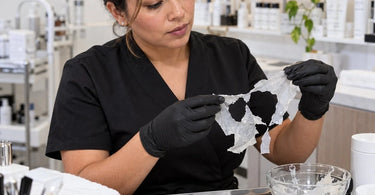
Let your work shine with the right tools... because nothing steals the spotlight from a beautiful facial quite like a peel-off facial mask that decides to leave in seventeen separate pieces. You have cleansed, prepped, mixed, applied, and given your client a blissful few minutes of relaxation. Now comes the grand finale: one satisfying, smooth removal that makes you look like the skincare professional you are. Except the mask tears at the chin, crumbles around the nose, and leaves little fragments clinging to the cheeks like unwanted party guests. Sound familiar? Don't worry. There are practical reasons peel-off masks break apart, and understanding them can make your facial services noticeably smoother.
For professional estheticians, a clean mask removal is more than a visually satisfying moment. It affects treatment timing, client comfort, cleanup, and the overall impression of a polished facial. Whether you use rubberized alginate masks, professional jelly masks, or film-forming peel-off formulas, application technique and product handling have a major influence on removal. The secret is knowing which factors affect the mask's flexibility, cohesion, and ability to release from the skin.
Why Peel-Off Masks Tear Into Pieces Instead of Lifting Cleanly
Most peel-off masks are designed to form a continuous layer that can be lifted away after setting or drying. For that to happen, the mask needs enough structural strength to stay together while remaining flexible enough to follow facial contours.
When the mask tears, something has usually interfered with that balance. The layer may be too thin, the formula may have been mixed incorrectly, the product may not have finished setting, or the mask may have become too dry or brittle. Sometimes, the problem starts before the mask even touches the client's face.
One important distinction: not all peel-off masks behave alike. Alginate and rubberized jelly masks typically set through a formulation-dependent gelling process, while many traditional film-forming masks develop their removable film as water or solvents evaporate. Their application thicknesses, working times, and removal instructions can differ considerably. Always follow the directions for the specific professional product rather than applying one universal technique to every mask.
1. The Mask Was Applied Too Thinly
If there is one application mistake that deserves a permanent spot on the esthetician troubleshooting list, it is spreading the mask too thin. A skimpy layer may look economical, but it often lacks the strength needed to remain intact when lifted.
Thin spots are especially common around the nose, upper lip, jawline, and outer edges of the face. These areas become weak points where the mask can split during removal.
For professional alginate and jelly masks, a substantial, even layer helps create a connected sheet. Some products specify a thickness of approximately 3 millimeters, but others have different requirements. Traditional film-forming masks may call for a thinner application, so manufacturer instructions should always take priority.
Professional fix: Use an appropriate facial mask spatula to distribute the product evenly without repeatedly scraping material away. Pay attention to the perimeter and areas where the face changes direction.
Think of the layer as a supportive blanket rather than a whisper of product. A mask that is too thin can turn your satisfying peel into a tiny skincare confetti parade.
2. The Mixing Ratio Was Incorrect
Powder-based peel-off masks require accurate mixing. Adding too much water can produce a runny consistency that spreads unevenly or creates a weaker gel. Too little water can leave the mixture excessively thick, lumpy, or difficult to distribute before it begins setting.
Either problem can contribute to irregular thickness and unpredictable removal.
Professional alginate formulations often contain ingredients that develop a gel structure after mixing. Changing the recommended liquid ratio can affect how that structure forms.
Professional fix: Measure powder and liquid according to the manufacturer's instructions rather than relying on an enthusiastic splash-and-hope approach. Use clean mixing bowls and suitable applicators and spatulas to create a uniform mixture.
Water temperature also matters. Some masks require room-temperature water, while others specify warmer water. Do not assume that warmer automatically means better, because temperature can change the working time and setting behavior of certain formulas.
3. The Mask Started Setting Before Application Was Finished
Professional facial treatments are all about timing, and peel-off masks certainly have opinions about it.
Many alginate and jelly masks provide a limited working window after mixing. If you spend too long stirring, adjusting the treatment bed, looking for a spatula, or chatting about weekend plans, the mixture may begin thickening before application is complete.
Once that happens, later sections may not blend smoothly with the first sections. Instead of one connected sheet, you can end up with uneven patches and weak seams that separate during removal.
Professional fix: Prepare the workstation before adding liquid to the powder. Position the bowl, spatula, measured ingredients, protective materials, and cleanup supplies within easy reach.
Mix according to the product directions, then apply promptly using deliberate, continuous strokes. Avoid going back over partially set areas unless the manufacturer's protocol specifically permits it.
Efficiency is helpful here, but rushing is not the goal. A calm, prepared esthetician can work quickly without making the facial feel hurried.
4. The Product Was Removed Before It Fully Set
A peel-off mask may appear ready on the surface while remaining soft or incompletely set underneath. When removal begins too early, the unsupported areas can stretch, separate, or break instead of lifting together.
This is particularly relevant for masks applied over curved areas or in thicker sections.
Professional fix: Follow the product's recommended processing time and readiness indicators. For certain rubberized masks, a firm, non-tacky surface can help indicate that setting has progressed, but visual and tactile cues should supplement rather than replace manufacturer instructions.
If the mask feels unusually soft or starts separating immediately, do not force the removal. Check the remaining processing time and determine whether additional setting time is appropriate for that formula.
Also remember that a thicker layer does not always set at exactly the same rate as a thinner one. Consistent application helps make the entire mask ready for removal at approximately the same time.
5. The Mask Was Left On Too Long
On the opposite end of the timing spectrum, some film-forming peel-off masks can become excessively dry or brittle when left beyond their recommended processing period. Instead of staying flexible, the material may crack and break into little pieces.
However, this behavior depends on the formulation. Alginate masks do not necessarily behave like traditional drying films, and leaving every mask on longer will not automatically cause brittleness.
Professional fix: Use a treatment timer and follow the directions for the specific mask. Do not extend processing simply because the client is enjoying the relaxation portion of the facial.
If additional rest time is part of the service, structure it around other compatible treatment steps rather than making the mask perform overtime.
Professional skincare should feel indulgent, but the processing schedule is not a suggestion box.
6. The Skin Was Not Properly Prepared
Clean, appropriately prepared skin helps many peel-off formulas perform more consistently. Excess oils, heavy cream residues, or unevenly applied treatment products can interfere with contact between the mask and skin.
On the other hand, some professional alginate treatments are specifically designed to be layered over a serum or another skincare product. In those cases, the underlying product is part of the treatment protocol rather than an application mistake.
The challenge is distinguishing intentional layering from unwanted residue.
Professional fix: Begin with suitable professional cleansing and skin assessment. Browse Premium Skincare Products for Spas and Salons for supplies that support customized facial protocols.
Remove incompatible excess products before applying the mask. When working with a layered treatment, use only the preparatory products and quantities recommended for the mask system.
Also protect areas that should not come into contact with the product. Hairlines, brows, facial hair, and delicate skin around the eyes require attention. Eye and lip coverage should never be improvised; follow the specific product's safety guidance and obtain appropriate client consent.
7. The Edges Were Too Thin or Irregular
The perimeter of a peel-off mask has an important job. It gives the esthetician a place to begin lifting the material without digging into the skin or pulling at an unsupported section.
If the edges are feathered into extremely thin strips, they may tear before the main portion of the mask begins to release.
This is especially noticeable around the jawline, temples, and upper forehead.
Professional fix: For rubberized masks designed for substantial application, establish a defined, adequately supported border according to the product instructions. Avoid thin, wispy edges that are likely to crumble or split.
Keep the mask away from the hairline and other prohibited areas. More product is not automatically better; the goal is a smooth, uniform perimeter that the chosen formulation can support.
A well-shaped border can make the difference between an elegant lift and a facial mask that requires a search-and-rescue mission.
8. The Removal Technique Was Too Aggressive
Even a properly prepared mask can tear if the removal technique puts excessive stress on one section.
Pulling sharply, lifting from a small corner, or tugging against strong resistance concentrates force in a narrow area. The result can be a break in the mask and unnecessary discomfort for the client.
Professional fix: Gently loosen an appropriate edge using the technique recommended by the manufacturer. Support the mask as it separates and lift with steady, controlled movement.
Some professional alginate protocols direct removal from the jawline upward, while others specify a different direction. Follow the product-specific method.
If the mask begins tearing, avoid yanking harder. Support a broader area, reassess whether the product has set correctly, and remove remaining sections carefully.
For stubborn residue, follow the manufacturer's cleanup procedure. A damp, soft compressed sponge or appropriate professional wipe may be useful when compatible with the formula.
The client should leave feeling pampered, not as though their facial included an unexpected tug-of-war.
9. The Formula or Storage Conditions Are Working Against You
Sometimes, the esthetician follows the application instructions beautifully and the mask still behaves poorly. This is when product condition deserves a closer look.
Powder-based products can be affected by moisture exposure, improper sealing, contamination, or storage outside the manufacturer's recommended conditions. Prepared formulations may also change as they age or approach their labeled expiration date.
Storage problems can influence texture, mixing performance, and overall consistency.
Professional fix: Check expiration dates, packaging integrity, batch information, and storage directions. Keep powders properly sealed between services and use clean, dry tools when dispensing.
Do not return unused mixed product to its original container. Unless the manufacturer explicitly provides a validated storage procedure, prepare fresh portions for each service and discard leftovers.
If multiple properly performed applications from the same batch continue to fail, document the mixing ratio, water temperature, timing, and observed results. Contact the manufacturer or supplier for product-specific guidance.
How to Troubleshoot a Peel-Off Mask That Keeps Breaking
Rather than changing five things at once, identify the pattern of failure. The way a mask tears can provide useful clues about which part of the application process needs attention.
If it breaks into tiny, dry fragments: Check for overly thin application, excessive drying in film-forming formulas, and product-condition issues.
If it stretches and falls apart: Check the setting time, mixing ratio, and whether the mask was ready for removal.
If it splits around the nose or mouth: Examine the thickness and continuity of application across curved facial areas.
If the edges crumble: Review perimeter thickness, application precision, and processing time.
If large sections separate along visible lines: Consider whether the product began setting before adjacent sections were connected.
If the mask sticks unusually firmly: Review skin preparation, product compatibility, hairline protection, and removal instructions. Never force a mask away from resistant skin.
These patterns are troubleshooting clues, not definitive diagnoses. A mask can fail for several reasons simultaneously, and different formulas may produce similar-looking problems.
A Better Professional Peel-Off Mask Application Routine
Consistency is one of the easiest ways to improve facial service quality. Establishing a reliable mask protocol helps staff deliver predictable results and makes unusual problems easier to investigate.
Step 1: Assess the client's skin. Review sensitivity, visible irritation, recent exfoliation, and any treatment contraindications. Choose a mask appropriate for the client's skin and the services already performed.
Step 2: Prepare the workstation. Arrange the mixing bowl, measured ingredients, applicator, protective supplies, timer, and removal materials before beginning.
Step 3: Prepare the skin. Cleanse and follow the mask manufacturer's preparation instructions. Protect facial hair and delicate areas as directed.
Step 4: Measure accurately. Use the specified amount of powder and liquid for the treatment area. Avoid guessing measurements or substituting liquids without approval from the manufacturer.
Step 5: Mix properly. Blend for the recommended duration until the consistency meets the product directions. Avoid unnecessary delays between mixing and application.
Step 6: Apply an even layer. Use smooth strokes and maintain the thickness appropriate for the specific mask. Pay attention to curved areas and perimeter edges.
Step 7: Respect processing time. Start the timer at the point specified by the manufacturer and monitor the mask's readiness.
Step 8: Remove gently. Loosen the designated edge and lift using controlled, supported movements. Stop if the client reports discomfort or the product resists removal unexpectedly.
Step 9: Finish thoughtfully. Remove any remaining product according to directions and follow with appropriate finishing skincare, such as moisturizer and daytime sun protection.
For busy facial rooms, having reliable Spa Tools & Implements for Professionals conveniently organized can reduce interruptions and keep the treatment flowing smoothly.
Why Professional Mask Tools Matter More Than You Think
It is tempting to focus exclusively on the formula when a peel-off treatment goes wrong. However, the tools used for mixing, measuring, and spreading can make consistency much easier to achieve.
A suitable flexible bowl allows thorough mixing without leaving significant unmixed powder along the sides. A properly sized spatula helps distribute the mask across broader facial areas without excessive back-and-forth movement.
Accurate measuring tools reduce variation between treatments, particularly when several estheticians use the same mask system.
Cleanliness matters, too. Residual product in a bowl or on a spatula can interfere with fresh mixing and creates avoidable sanitation concerns.
Explore Spa Essentials for Professionals for practical treatment-room supplies that support organized, repeatable services.
And remember: tools and reusable bowls should be cleaned and disinfected as required for their material and intended use. Single-use supplies should be discarded appropriately rather than saved for another client.
Should You Switch to a Different Peel-Off Mask?
If consistent application adjustments do not resolve the problem, it may be worth evaluating whether the mask formulation is the right match for your service menu.
Professional peel-off masks vary in texture, elasticity, setting speed, skin compatibility, and removal characteristics. Some are designed for relatively quick services, while others fit longer facial protocols. A formula that works beautifully for one treatment sequence may be less convenient for another.
Consider how much working time your staff needs, which facial areas are treated, whether the mask is applied over other products, and how comfortably clients tolerate removal.
You can explore alginate masks, jelly masks, and the broader Advanced Facial Treatment Products for Salons & Spas collection to compare professional facial treatment options.
When introducing a new formula, test the complete protocol according to manufacturer instructions before adding it to the regular service menu. Staff should be familiar with mixing, application, contraindications, processing, removal, and cleanup.
How Cleaner Mask Removal Improves the Client Experience
Clients may not know the details of alginate chemistry, but they certainly notice how a facial feels.
A smooth, gentle removal contributes to the sense that the treatment is controlled and professionally delivered. It can also reduce time spent picking at stubborn fragments, wiping the same area repeatedly, or interrupting relaxation to correct application problems.
For the spa business, reducing unnecessary product waste and cleanup time can support a more efficient service schedule. However, the solution should never be to apply less product than recommended simply to stretch inventory.
It is better to calculate the correct product quantity for each facial and build that amount into service pricing. Reliable results and client comfort are more valuable than saving a small scoop of mask powder.
Training matters as well. If one team member consistently achieves smooth removals while another struggles, compare their actual techniques. Measuring habits, water temperature, application speed, layer thickness, and removal direction are all worth reviewing.
A shared written procedure can help keep facial treatments consistent across the team.
Frequently Asked Questions About Peel-Off Masks
Why does my alginate mask keep tearing?
Common causes include applying the mask too thinly, using the wrong mixing ratio, allowing the mixture to begin setting during application, or removing it before the gel has properly formed. Check the manufacturer's specific instructions before adjusting your technique.
Should a professional peel-off mask always come off in one piece?
Not necessarily. Many alginate and rubberized masks are designed for removal as a continuous sheet, but other peel-off formulas have different handling characteristics. The appropriate expectation depends on the specific product.
Can adding more water stop a jelly mask from tearing?
Adding extra water without manufacturer guidance is not a reliable solution. It can alter the mixture's consistency, setting behavior, and final strength. Accurate measurement is a better starting point.
Can I apply another layer over a mask that is already setting?
Only if the product instructions specifically allow it. New material may not bond consistently to a partially set layer, potentially creating another separation point.
What should I do if a peel-off mask gets caught in facial hair?
Stop pulling and follow the manufacturer's gentle residue-removal method. Avoid forcing product away from brows, eyelashes, or other hair-bearing areas. Protecting these areas appropriately before application is the best prevention.
Does a broken mask mean the facial treatment failed?
No. Fragmented removal does not automatically mean that every aspect of the treatment was ineffective. However, it can indicate an application or product-handling issue worth correcting. Assess the client's skin response and overall treatment outcome rather than judging results solely by whether the mask came away in one sheet.
Make Every Facial Finish Feel Effortless
When peel-off masks tear into pieces instead of lifting cleanly, the solution is usually found in the details: correct mixing, appropriate thickness, prompt application, proper processing time, good skin preparation, and gentle removal.
A polished facial does not require theatrical perfection, and occasionally a mask will still leave a few stubborn pieces behind. What matters is having a reliable technique that keeps the client comfortable and the treatment running smoothly.
Pure Spa Direct helps beauty and wellness professionals shop for the supplies they need to create efficient, high-quality services. From professional facial masks and skincare products to bowls, spatulas, sponges, and treatment-room essentials, the right supplies can make consistent application easier.
Explore professional skincare supplies and professional facial masks for your spa or salon. Because the only thing that should fall apart during a relaxing facial is your client's stressful day, not the mask you're trying to remove.
