
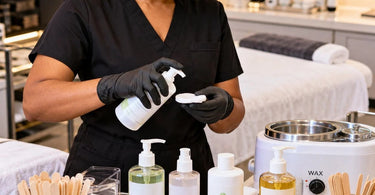
The smarter way to work starts with knowing exactly what every waxing appointment costs your business. You probably know how much you spend on your favorite hard wax, and you might even have a pretty good handle on your gloves, applicators, and waxing strips. But what about the cleanser you use before the first strip of wax goes on? Or that lovely soothing lotion you apply after the last stubborn hair has surrendered? Those products might seem like tiny expenses, but when you multiply them by dozens or hundreds of appointments, they can quietly nibble away at your profits like a client who keeps asking for just one more little touch-up.
Professional waxing involves much more than melting wax and removing hair. Every successful appointment includes preparation, hair removal, cleanup, and aftercare. Each stage requires supplies, and every supply has a cost. If your pricing calculations only account for wax, strips, and applicators, you may be underestimating the actual expense of providing your services.
Understanding the complete cost of your professional waxing supplies helps you set profitable service prices, make smarter purchasing decisions, and deliver consistent treatments without feeling pressured to cut corners.
Why Wax Alone Does Not Tell the Whole Cost Story
Imagine charging $65 for a Brazilian wax and calculating your product expense based entirely on the amount of hard wax used. Your spreadsheet might look fantastic. Your profit margin might look even better. Unfortunately, your spreadsheet has conveniently forgotten half the products sitting on your treatment cart.
Before the wax touches the skin, you may use a cleansing solution, cotton pads, and a specialized pre-wax product. During the service, you will use wax, applicators, gloves, and other disposable supplies. Afterward, you may apply a wax residue remover, soothing treatment, or moisturizing lotion.
These finishing products are not mysterious little bonuses that appear from the beauty supply fairy. Your business purchases them, stores them, dispenses them, and eventually replaces them.
A complete waxing service cost calculation should account for:
- Pre-wax cleansing solutions and skin preparation products.
- Pre-wax oils, powders, or other products required by the waxing system.
- Hard wax, soft wax, or roll-on wax consumed during treatment.
- Disposable applicators, strips, gloves, cotton, and protective materials.
- Wax residue removers and post-wax cleansing products.
- Soothing gels, lotions, and other finishing treatments.
- Cleaning, sanitation, and laundry expenses.
- Labor, payment processing, and an appropriate allocation of business overhead.
Not every service uses every product, and that distinction matters. A quick eyebrow wax should not automatically carry the same product allowance as a full-leg waxing appointment. The goal is to build realistic costs around the actual treatment procedure rather than guessing.
Pre-Wax Products Are Part of the Service, Not an Optional Extra
Skin preparation has an important job. It helps create suitable conditions for the waxing system, supports consistent application, and contributes to a professional treatment experience.
A pre-wax cleanser is commonly used to remove surface oils, perspiration, makeup, and other residue. Depending on the wax formulation and manufacturer instructions, the technician may also apply a very small amount of pre-wax oil or another skin preparation product.
For example, a professional using Professional Stripless Hard Wax might follow a preparation procedure different from one used with Soft Strip Wax. Some systems call for a light protective oil application, while others require clean, dry skin without oil. Always follow the specific product manufacturer's directions rather than treating every waxing system as interchangeable.
Every time a cleanser or preparation product is dispensed, the salon consumes inventory. Even if the amount seems insignificant, the cumulative expense belongs in the service calculation.
And using less product than the procedure requires is not a clever profitability strategy. Appropriate preparation supports the quality and consistency your clients expect. The smarter approach is to measure product usage and price services to cover it.
Post-Wax Products Complete the Professional Treatment
Think about the final moments of a waxing appointment. The hair removal is finished, the technician checks the treated area, and the client is ready to admire the results. That finishing step matters.
Depending on the waxing system and the client's skin needs, the technician may use a compatible wax residue remover followed by a soothing or moisturizing product. These products can help remove remaining residue and improve the comfort and feel of freshly treated skin.
The Pre & Post-Waxing Products collection offers professional options for preparing skin and completing waxing treatments. When choosing products, consider formulation, application instructions, skin compatibility, and how the items fit into your established service protocol.
Some salons use separate products for residue removal and skin finishing. Others use a multifunctional product designed for both stages. Neither approach automatically delivers the lowest cost. What matters is how much product you use, what it costs, and whether it performs appropriately.
Leaving finishing products out of your calculations creates an unpleasant choice: absorb the expense without recognizing it, or eventually become tempted to reduce a valuable part of the service.
Neither is ideal. Properly accounting for aftercare allows you to provide the complete experience your service price promises.
How to Calculate the Actual Cost of Pre-Wax and Post-Wax Products
You do not need a complicated accounting system to understand product costs. A measuring cup, a spreadsheet, and a little attention to detail can accomplish quite a bit.
The basic formula is straightforward:
Product cost per service = Product purchase cost divided by the number of services the container supports.
For greater accuracy, calculate cost per milliliter or ounce first, then multiply that figure by the amount actually used during an appointment.
Consider a hypothetical 500 mL bottle of professional pre-wax cleanser costing $24. If you use approximately 3 mL per service, the calculation looks like this:
- Bottle cost: $24.00.
- Bottle volume: 500 mL.
- Cost per mL: $0.048.
- Average usage: 3 mL per service.
- Pre-wax cleanser cost per service: approximately $0.14.
Now suppose a 500 mL bottle of post-wax lotion costs $30 and the average treatment uses 4 mL:
- Bottle cost: $30.00.
- Bottle volume: 500 mL.
- Cost per mL: $0.06.
- Average usage: 4 mL per service.
- Post-wax lotion cost per service: $0.24.
These two products alone contribute approximately $0.38 to each appointment. These figures are illustrative, not advertised product prices or universal usage recommendations.
That amount might sound tiny, but multiply it by 1,000 appointments and you have $380 in product expenses that could disappear from your accounting if you only track wax consumption.
And remember, this example includes just two products. Any additional pre-wax oil, residue remover, finishing gel, or other treatment-specific supply needs its own allowance.
A Realistic Example of Waxing Service Costs
Let's look at a hypothetical Brazilian waxing appointment priced at $65. The following figures demonstrate how individual expenses can add up. Your actual costs will vary based on wholesale prices, technique, appointment length, product selection, and business location.
- Hard wax: $3.20.
- Pre-wax cleanser: $0.14.
- Pre-wax preparation product: $0.18.
- Post-wax residue remover: $0.16.
- Post-wax soothing lotion: $0.24.
- Gloves, applicators, cotton, and disposables: $1.45.
- Cleaning and laundry allocation: $0.55.
Total estimated supplies and related consumable costs: $5.92.
If the salon had calculated only the hard wax and disposable supplies, it would have recorded $4.65 instead of $5.92. That is a $1.27 difference per appointment.
At 100 Brazilian wax appointments per month, the missing expense becomes $127. At 500 appointments, it becomes $635. Across an entire year, that is a meaningful amount of money to overlook.
And the $5.92 figure is not the total cost of delivering the service. It excludes technician compensation, rent, utilities, insurance, scheduling software, credit card processing, equipment depreciation, and other operating expenses.
For a truly useful profitability calculation, add those expenses before comparing the total against the service price. Revenue minus consumable cost is not the same thing as net profit.
Why Product Dispensing Habits Matter More Than You Think
Have you ever watched someone dispense enough lotion to moisturize a small rhinoceros when the client only needs a modest amount? Generosity is lovely, but uncontrolled dispensing can create surprising inventory expenses.
The amount of cleanser, oil, or post-wax product used should be based on the treatment area, the manufacturer's instructions, and the needs of the service. More product does not necessarily mean better results.
Excessive pre-wax oil can interfere with adhesion in systems that require careful oil application. Too much finishing lotion may leave an unnecessarily heavy residue. Overuse also increases supply consumption without creating corresponding value.
Consider using consistent dispensing procedures throughout your team. A measured pump, clearly identified treatment bottles, or standardized application guidance can help technicians maintain appropriate usage.
Professional Bottles & Jars may be useful for organizing compatible products when manufacturer instructions and sanitation requirements permit dispensing into secondary containers. Any secondary container should be properly labeled, and product handling should follow applicable regulations and facility procedures.
The objective is not to ration products. It is to eliminate unnecessary waste while maintaining professional treatment standards.
Different Waxing Services Need Different Product Cost Allowances
A ten-minute lip wax and a full-leg wax are not identical services, so why would they have identical product budgets?
Smaller treatment areas generally require less cleanser and finishing product. Larger areas may involve greater consumption, additional disposable materials, and more time.
Create separate product allowances for your most common services:
- Facial waxing: Track small quantities of suitable cleanser, wax, applicators, and finishing products.
- Underarm waxing: Account for cleansing, the selected wax system, disposables, and appropriate post-wax care.
- Bikini and Brazilian waxing: Include the full preparation and finishing protocol, along with protective supplies and appropriate sanitation expenses.
- Arm and leg waxing: Measure consumption across larger treatment areas, particularly when lotion or residue remover usage increases.
- Back and chest waxing: Consider coverage area, product consumption, and potential variation in treatment time.
Different hair densities, skin conditions, and service techniques can create variability even within the same appointment category. Use averages drawn from actual appointments rather than assuming every treatment consumes precisely the same amount.
This approach makes pricing more realistic and provides useful information when evaluating packages, discounts, or promotional offers.
Professional Product Selection Affects Both Cost and Performance
Comparing products only by bottle price is a little like comparing shoes only by the size of the box. The number on the label tells you something, but it does not tell you everything.
A higher-priced professional cleanser may require less product per application. A concentrated formula could deliver more usable treatments per container. Conversely, a lower-priced lotion may still be economical if it performs well and provides an appropriate number of applications.
Evaluate the cost per completed service, not simply the purchase price.
Pure Spa Direct carries professional waxing products from established industry brands, including ItalWax - Pre/Post, Cirepil, and Lycon.
These brands offer waxing-related products and systems, but product compatibility should always be checked individually. A cleanser or pre-wax oil designed for one protocol should not automatically be substituted into another without reviewing the relevant instructions.
When comparing options, consider container size, dispensing control, suitability for your technique, expected service yield, and the experience your clients receive.
A product that costs slightly more but produces consistent results with controlled usage may fit your business better than the least expensive container on the shelf.
Do Not Confuse Retail Aftercare With In-Service Aftercare
There is an important difference between the finishing products included in a waxing appointment and the aftercare products clients purchase to use at home.
The lotion or gel applied during the appointment is an expense associated with delivering that service. A separately sold retail product is inventory purchased for resale and should be tracked through your retail accounting.
For example, a technician might apply a suitable soothing lotion immediately after waxing and then discuss a home-care routine that includes moisturizing or properly timed exfoliation. Appropriate Ingrown Hair Products may be part of the retail selection for clients seeking guidance about their between-appointment routine.
However, not every product is appropriate immediately after waxing. Recommendations should be matched to the product instructions, treatment area, and client's skin condition. Recently waxed skin may be sensitive, so aggressive exfoliation and irritating products should generally be avoided during the immediate recovery period.
If you provide a complimentary take-home sample, that sample has a cost too. Record it as a service-related promotional expense or in another consistent category within your accounting system.
Retail sales can generate additional revenue, but they should never be used to disguise an underpriced treatment.
How Bulk Purchasing Changes the Math
Wholesale purchasing can make an enormous difference to a busy waxing studio. Larger containers and economical purchasing arrangements may reduce the per-service cost of regularly used products.
However, bigger is not automatically better.
Before placing a large order, estimate how many appointments your salon completes during a typical month and how much product those appointments require. Then compare that expected consumption with the product's shelf life, storage requirements, and any period-after-opening guidance.
Consider the following purchasing questions:
- How much product does the team actually consume each month?
- Will the larger container reduce cost per usable application?
- Can the salon use the product within its recommended usable period?
- Are shipping charges or order minimums affecting the savings?
- Will a larger purchase tie up cash needed for other supplies?
- Does the dispensing format support hygienic, consistent usage?
For businesses with steady demand, reviewing Bulk Wax Deals alongside regularly used preparation and finishing products can help create a coordinated purchasing strategy.
But purchasing enough inventory to survive three winters and a small apocalypse is not necessarily efficient. Inventory sitting unused on a shelf is money that cannot support other parts of your business.
Build a Simple Service Cost Tracking Sheet
A straightforward spreadsheet can turn vague product expenses into useful numbers. You do not need a fancy system with seventeen colorful dashboards to get started.
Create columns for the following information:
- Service name.
- Product or supply category.
- Specific product used.
- Container size and purchase cost.
- Average quantity used per appointment.
- Calculated cost per service.
- Date of the most recent price update.
Record the purchase cost of a product divided by its usable quantity, then multiply that amount by average service usage. If bottles contain unusable residual product or dispensing creates measurable waste, account for that in your expected usable yield.
For disposable materials, multiply the unit cost by the number typically consumed. For example, if one applicator costs $0.04 and a service uses twelve, applicator expense is $0.48.
To establish realistic usage averages, observe a representative sample of appointments for each service type. Tracking ten or more appointments can provide an initial picture, although additional observations may be needed when usage varies significantly.
Update the sheet when suppliers change prices, your staff changes procedures, you introduce a new wax system, or you revise service packages.
Once these figures are documented, you can make purchasing and pricing decisions based on evidence instead of intuition.
Turn Accurate Product Costs Into Better Service Pricing
Knowing what an appointment costs is useful only if you apply that information to your pricing strategy.
Start with direct consumables, including pre-wax and post-wax products. Then add the labor cost of the time required to perform the appointment, including any necessary setup and cleanup. Account for applicable payroll expenses, overhead, and transaction fees.
Once you understand the fully loaded service cost, you can establish a price that supports your desired profit margin and reflects local market conditions, service expertise, and client experience.
For illustration, suppose a service has a fully loaded cost of $32 and the business targets a 30% profit margin on the selling price. The calculation is:
Required price = $32 / (1 - 0.30) = approximately $45.71.
A selling price of approximately $45.71 would produce the targeted margin under those assumptions. The example is not a recommended price for a particular waxing service.
Also remember that a 30% profit margin is not the same as adding a 30% markup to costs. Confusing those two calculations can produce lower margins than intended.
Accurate pricing helps you preserve your standards without quietly sacrificing profitability every time you finish a service with the products your clients expect.
Train Your Team to Protect Consistency and Profitability
Even a beautifully designed service cost sheet becomes less useful if every technician follows a completely different product routine.
One team member might dispense two pumps of cleanser while another uses six. One might carefully measure finishing lotion, while another applies an enthusiastic puddle of product that could moisturize the entire waiting room.
Establish written treatment protocols that identify the appropriate products for each waxing system, recommended application procedures, and relevant hygiene requirements.
Training should emphasize proper technique and product compatibility rather than simply minimizing supplies. Technicians should know how to recognize situations requiring an adjustment to the normal procedure, when to avoid waxing because of a contraindication, and when a client should be referred for appropriate medical advice.
Keep Protective Gloves & Masks, Professional Wax Spatulas and Applicators, and suitable Professional Cleaners & Disinfectants available as required by your procedures and applicable regulations.
Cost control must never compromise sanitation. Avoid contaminating shared product containers, follow safe dispensing practices, and never reuse disposable items in ways that violate professional hygiene standards.
Consistency creates more reliable inventory forecasts, helps technicians deliver predictable services, and reduces unnecessary differences in product consumption.
Watch for the Hidden Signs That Your Product Costs Are Rising
Some inventory problems announce themselves with an empty shelf. Others quietly drain your budget for months before anyone notices.
Watch for these common warning signs:
- Pre-wax cleanser is being reordered more frequently even though appointment volume has not increased.
- Post-wax lotions regularly run out before the corresponding wax inventory.
- Technicians use noticeably different amounts of the same product for comparable services.
- Service prices have remained unchanged despite repeated wholesale cost increases.
- Promotional packages generate strong booking numbers but weak contribution margins.
- Opened bottles accumulate in treatment rooms without clear inventory tracking.
- Products expire or become unusable before the salon finishes them.
A monthly review of product consumption and completed appointments can help identify these issues before they turn into expensive habits.
One useful measurement is average product cost per completed service. Divide the total cost of products consumed for a particular service category by the number of services completed during the same period. Compare the result with your expected allowance, then investigate meaningful differences.
This is especially helpful for studios with multiple treatment rooms or several technicians using the same inventory.
Frequently Asked Questions About Pre-Wax and Post-Wax Service Costs
Should pre-wax cleanser be included in every waxing service calculation?
Yes, when cleanser is part of the professional treatment protocol, its expected consumption should be recorded as a direct service expense. The amount will vary by treatment area and application method.
How much should a salon budget for post-wax products?
There is no universal dollar amount. Divide actual product cost by expected usable applications and calculate separate allowances for different waxing services. Larger treatment areas may require more product.
Can a salon charge separately for post-wax lotion?
A salon can structure its prices around a standard treatment and clearly disclosed optional upgrades, subject to applicable requirements. However, products necessary to complete the advertised standard service should already be reflected in the base price. Avoid surprising clients with unexpected charges for routine finishing steps.
Is a larger bottle always more economical?
No. A larger container may offer a lower unit price, but actual value depends on usage, storage, shelf life, waste, and whether the salon can finish it within the recommended period.
How often should waxing product costs be reviewed?
A monthly consumption review and periodic purchasing cost updates work well for many businesses. Recalculate promptly after meaningful supplier price changes, new product introductions, or changes in treatment procedures.
Should take-home aftercare products count toward the waxing appointment cost?
Products sold separately belong in retail inventory accounting. Complimentary samples or products included in a service package should be accounted for in that offer's economics.
Small Product Costs Deserve a Place in Your Big Business Decisions
Profitable waxing services are built on dozens of thoughtful decisions, including the ones involving products that cost only a few cents per application.
Pre-wax cleansers and preparation products support the beginning of the treatment. Post-wax removers, gels, and lotions help complete the service. Their costs belong right alongside wax, applicators, and every other supply your technicians use.
By measuring real consumption, standardizing procedures, reviewing wholesale purchasing options, and updating your service calculations, you can create prices that support both professional treatment standards and financial sustainability.
Explore Pre & Post-Waxing Products, Waxing Supplies for Professionals, and Complete Waxing Kits for Salons & Spas at Pure Spa Direct to compare products for your treatment protocols. As a professional beauty and spa supply distributor, Pure Spa Direct helps salon and spa businesses source the supplies they need to deliver consistent services.
Because your waxing clients deserve a complete, comfortable, professional experience, and your business deserves to know exactly what it costs to provide one. That is a much better ending than discovering your favorite post-wax lotion has been quietly eating your profit margin for the past six months.
