
Achieve more with less effort... and fewer unpleasant surprises. If you are like most spa and salon professionals, your days are a beautiful blur of manicures, massage oils, and the satisfying sound of a wax warmer doing its thing. You have your disinfection routine down to a science, and you are proud of the spotless, welcoming environment you have created. But here is a little secret from the pros at Pure Spa Direct that might make you gasp louder than a client seeing a stray eyebrow hair: the disinfection step, as important as it is, is not the very first thing you should do with your reusable tools. The real magic, the step that separates a good salon from a truly safe one, happens before the blue liquid ever comes into play. It is called inspection, and it is the unsung hero of your infection control routine.
We get it. You are busy. Between Pedicure Chairs that need adjusting and Professional Gel Polish that needs to cure, taking an extra thirty seconds to squint at a pair of cuticle nippers might feel like a luxury. But trust us, skipping this step is a bit like putting a bandage on a broken nail without checking if the nail bed is okay first. It looks fine on the surface, but underneath, there is trouble brewing. Let us dive into why inspecting your Spa Tools & Implements before disinfection is non-negotiable for any serious beauty professional.
Disinfection is Not a Magic Eraser (Sorry to Burst Your Bubble)
Let us start with a little reality check about how disinfectants actually work. It is easy to think of your Professional Cleaners & Disinfectants as a magical potion that instantly obliterates anything gross on your tools. While they are incredibly powerful, they are not miracle workers. An EPA-registered hospital-grade disinfectant is designed to kill a specific range of bacteria, viruses, and fungi on surfaces that are already clean.
Here is the catch: the label on your disinfectant almost certainly says something like, "For use on pre-cleaned surfaces." This is not just a suggestion; it is a requirement for the product to actually work. The official rules in many states, including Georgia's regulation on sanitation, are very clear: all multi-use tools must be cleaned of all visible debris after each use and then disinfected. That order is no accident. If you skip the cleaning and inspection step and dunk a tool covered in nail dust, skin cells, or dried wax directly into your disinfectant, you are essentially making a very unappealing soup. The organic matter in that soup can actually shield pathogens from the disinfectant, rendering your expensive hospital-grade solution completely useless. You might as well be soaking your tools in a fancy bottle of blue water.
The Three Enemies of Reusable Implements (and How to Spot Them)
So, what exactly are you looking for when you inspect your tools? Think of yourself as a detective, a beauty forensic scientist. You are on the hunt for three main culprits: debris, damage, and wear. Each one is a dealbreaker for safe reuse.
Enemy Number One: Hidden Debris
This is the most obvious one, but it is also the sneakiest. We are not just talking about a blob of ItalWax - Wax on a spatula. We are talking about the microscopic stuff you cannot see. The hinge of a pair of cuticle nippers is a notorious hiding spot. So is the textured grip on a pair of tweezers, the spring mechanism on a pair of shears, or the rough surface of a reusable nail file. If any of these areas are not thoroughly cleaned, the debris becomes a fortress for germs. The rule is simple: if you can see or feel any foreign matter, it is not ready for the disinfectant. It needs to go back to the scrubbing station.
Enemy Number Two: Damage and Deterioration
This is where inspection gets really important. The Joint Commission, a major healthcare accreditation organization, notes that careful inspection for things like bioburden, oxidation, corrosion, pitting, discoloration, cracking, peeling, chipping, or etching is a critical step in protecting people from cross-contamination. Your tools go through a lot. They get dropped, they get bent, they get exposed to harsh chemicals. All of that takes a toll. A tiny nick in the blade of a pair of Professional Shears, Clippers & Trimmers for Barbers or a crack in the coating of a metal tool creates a perfect little pocket for bacteria to hide in. A disinfectant might not be able to fully penetrate a deep scratch or a corroded hinge. If a tool is damaged, it is compromised. It cannot be reliably cleaned or disinfected, no matter how long you soak it.
Enemy Number Three: General Wear and Tear
Tools do not last forever, even the high-quality ones you buy from Top-Quality Equipment & Furniture for Spas & Salons. Over time, metal dulls, plastic gets brittle, and protective coatings wear away. A screw might loosen on a pair of nippers. The alignment of shears might be off. A Professional Wax Spatula might develop a rough edge. These are not just quality issues for your service; they are safety issues. A rough edge is harder to clean. A loose screw is a place for gunk to accumulate. Your inspection is your quality control for both your client's safety and the quality of your work.
The Correct Order of Operations: Clean, Inspect, Disinfect
To make this super easy, let us walk through the gold-standard process for handling your reusable tools. It is a three-step dance that should become second nature.
Step 1: Clean and Scrub. After using a tool on a client, the very first thing you do is remove all visible debris. Wash it thoroughly with warm water and soap or detergent, using a brush if necessary to get into all those little crevices. Rinse it well and dry it thoroughly. A wet tool can dilute your disinfectant.
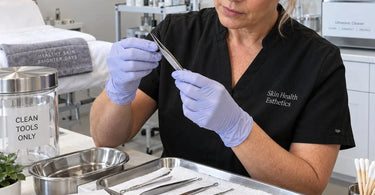
Step 2: Inspect Like You Mean It. Now, before you even think about the disinfectant jar, hold that tool up to the light. Look at it from every angle. Check the hinges, the edges, the tips, and the handles. Is it spotless? Is it free of any scratches, nicks, or corrosion? Is it still in good working order? If the answer to any of these questions is no, do not disinfect it. Either give it a more thorough cleaning or, if it is damaged, retire it. A worn-out tool belongs in the trash, not on your client.
Step 3: Disinfect Completely. Only once you are satisfied that the tool is clean and undamaged should you fully immerse it in your EPA-registered, hospital-grade disinfectant. Make sure it is completely submerged and let it soak for the full contact time specified on the label, which is typically ten minutes. This is the final, crucial step that ensures any remaining pathogens are killed.
The Tiny Flaws That Cause Big Problems
Let us put this into perspective with a few very relatable scenarios. Imagine you have a pair of Nail Files & Buffers that you use for multiple clients. You scrub them, but you miss a tiny bit of debris stuck in a groove. You drop them in the disinfectant. Ten minutes later, they come out looking clean. But that little pocket of debris protected a bacterium. Now, you use that file on the next client, and you have just transferred that bacterium. It is a microscopic problem with a very real-world impact.
Or consider a pair of tweezers with a slightly bent tip. The bend creates a tiny crevice that your brush cannot reach. Debris builds up there over time. The disinfectant cannot fully penetrate that crevice. The tweezers look clean, but they are not truly disinfected. This is the kind of thing that keeps health inspectors and savvy clients up at night.
Now imagine you have a Professional Wax Warmer that has a small crack in the inner pot. That crack is a nightmare to clean. Wax and debris get stuck in it. No amount of soaking will get it truly clean. The only safe thing to do is to replace that pot. It is a small cost compared to the potential risk to your clients and your reputation.
Protect Your Clients, Your Business, and Your Peace of Mind
Inspection is not just about following a bunch of boring rules. It is about the heart of your business: the trust your clients place in you. When a client sits in your Pedicure Chair or lies on your Massage Table, they are trusting you with their health and well-being. They assume that the tools you are using on their skin, nails, and brows are not just clean, but safe.
Taking the extra few seconds to inspect your tools before they go into the disinfectant is a powerful way to honor that trust. It shows that you are a true professional who cares about the details. It protects your clients from potential infections, and it protects your business from the devastating consequences of a health and safety violation. A single lapse in your disinfection protocol can lead to a bad reputation that is very hard to shake.
Furthermore, inspecting your tools regularly helps you manage your inventory more intelligently. You will know exactly when a tool is reaching the end of its life, and you can replace it before it becomes a hazard. This saves you money in the long run by preventing you from wasting disinfectant on a tool that cannot be properly sanitized anyway.
Your Toolkit for a Safer Salon or Spa
Ready to make inspection a seamless part of your routine? You do not need a lot of fancy equipment, but having the right supplies makes the process easier and more effective. Here are a few things that can help:
- A good scrub brush: A dedicated brush for cleaning your tools is essential. It helps you get into all those hard-to-reach places.
- Bright lighting: A LED Bright Lamp or a Magnifying Light can be a game-changer. It lets you see the tiny details that might otherwise be invisible.
- Proper storage: Once your tools are disinfected, they need to be stored in a clean, covered container. Having a designated space for clean and dirty tools helps prevent cross-contamination. Our Bottles & Jars and other storage solutions can help keep your station organized.
- A replacement plan: Accept that your tools have a lifespan. When you spot damage or excessive wear, be ready to replace the item. It is an investment in your business and your client's safety.
At Pure Spa Direct, we are passionate about providing you with the high-quality Spa Essentials for Professionals you need to run a safe, successful business. We know that the little things, like inspecting a pair of nippers, make a huge difference in the overall experience you provide. So, the next time you are about to drop your tools into the disinfectant, take that one extra moment. Give them a good look. It is a tiny habit that speaks volumes about your commitment to excellence.
