
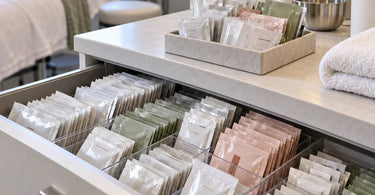
Efficiency drives profits with this tool... but apparently nobody told the mountain of skincare samples quietly taking over your spa. You started with a few complimentary packets from a favorite skincare brand, and somehow they have multiplied into an entire drawer of mysterious little envelopes. There are cleansers, serums, moisturizers, masks, and at least six products you cannot remember requesting. One packet has been sitting behind the reception desk so long that it practically deserves an employee anniversary celebration. If you operate a spa, salon, waxing studio, or beauty business, you probably know exactly which drawer we are talking about.
Sample packets are supposed to make professional life easier. They allow estheticians to evaluate new formulas, introduce clients to products, and explore potential retail opportunities without purchasing every full-size item available. Yet somewhere between trade shows, distributor orders, brand promotions, and enthusiastic sales representatives, those adorable little packets can become a surprisingly large organizational problem.
The good news? You do not have to declare war on samples. You simply need a system that ensures the products entering your business have a purpose, a place, and a reasonable chance of actually being used.
Why Do Sample Packets Multiply So Quickly in Spas and Salons?
The explanation is surprisingly simple: samples arrive in small quantities from many different sources, but nobody consistently tracks their combined volume. A few packets from one order seem harmless. Another handful from a skincare training session feels like a bonus. A promotional bag from a beauty trade show is practically irresistible.
Individually, none of these deliveries appears significant. Collectively, they can overwhelm your available storage space.
Unlike your regular Advanced Facial Treatment Products for Salons & Spas, which typically have designated storage locations and predictable usage patterns, samples often arrive without an established workflow.
They are placed wherever someone finds room: a drawer, a cabinet, a retail display, a treatment cart, or that decorative basket that was originally supposed to hold something attractive.
And because each individual packet takes up so little space, there is rarely a sense of urgency about dealing with it. That is how twenty samples become fifty, fifty become a hundred, and the supply cabinet develops a personality of its own.
The Five Reasons Your Sample Drawer Never Seems to Get Smaller
1. Everyone saves samples for the perfect occasion.
A facial serum sample might be useful for a future client consultation. A moisturizing cream could be perfect for someone with dry skin. A specialty mask seems worth keeping because it might fit a seasonal treatment promotion.
The problem is that a possible future use is not the same as an actual plan. Without a designated purpose, those packets may never leave the drawer.
2. Complimentary products feel too valuable to discard.
Beauty professionals understand the cost of quality formulations. Throwing away an unopened packet can feel wasteful, even when the product is expired, unsuitable for the business, or no longer relevant to the services offered.
Unfortunately, keeping unusable samples does not recover their value. It simply transfers the cost into storage space, clutter, and staff time.
3. Samples arrive faster than the team can evaluate them.
A busy esthetician performing back-to-back facials does not necessarily have time to test every newly introduced moisturizer. Nail technicians, massage therapists, and waxing specialists face the same challenge.
Professional evaluations should be deliberate. Testing products simply because another packet arrived is not an efficient use of treatment room time.
4. Nobody officially owns the sample collection.
When everyone can add samples to a drawer but nobody is responsible for reviewing them, accumulation becomes inevitable. The drawer effectively operates without a manager, a budget, or any meaningful performance expectations.
5. The packets are easy to forget.
Small packaging disappears behind larger containers, retail boxes, and equipment accessories. A product that is not visible or categorized is much less likely to become part of a thoughtful client recommendation.
The Hidden Costs of Keeping Every Complimentary Beauty Sample
Samples may be free, but managing them is not. Every unnecessary item occupies space, and professional spa storage is valuable real estate.
Consider the time spent searching through unidentified packets for a particular moisturizer. Add the effort required to check product information, determine whether an item is still suitable for use, and reorganize overflowing containers.
Those minutes could be spent preparing treatment rooms, assisting clients, maintaining equipment, or helping customers select appropriate retail products.
Clutter can also interfere with inventory visibility. If sample packets get mixed into your regular supply of Premium Skincare Products for Spas and Salons, staff may struggle to distinguish promotional items from products intended for professional treatments.
More importantly, unidentified or outdated products can introduce avoidable safety and quality concerns. Packaging integrity, storage conditions, expiration dates, and manufacturer instructions matter just as much with a tiny packet as they do with a full-size container.
A complimentary product is never worth compromising a professional treatment or a client's confidence.
Create a Sample Management System That Actually Works
The solution does not require expensive software, a complicated spreadsheet, or a ceremonial burning of the sample drawer. A simple, repeatable process is usually enough.
Start by removing every sample from its hiding place and placing the packets on a clean, organized work surface. You may be surprised by the collection. You may also discover three nearly identical moisturizers from different brands and a face mask nobody remembers receiving.
Sort everything into four categories:
- Evaluate: Products that may be suitable for upcoming professional testing or a possible addition to your service menu.
- Client sampling: Appropriate, properly labeled retail samples that can support a specific home-care recommendation.
- Training: Products intended for staff education, demonstrations, or manufacturer-approved practice.
- Remove: Expired, damaged, unidentifiable, unsuitable, or otherwise unusable items.
Check all manufacturer labeling, storage requirements, and applicable hygiene rules before deciding what can remain in circulation. Products without adequate identification or reliable safety information should not be used on clients.
Next, assign a designated storage location to each category. Simple organizers, bins, and clearly labeled containers can make an enormous difference.
Browse Spa Essentials for Professionals and Bottles & Jars when planning an organized supply area or appropriate manufacturer-permitted product sampling system.
Remember that transferring formulas into separate containers requires proper labeling and compliance with manufacturer directions and applicable regulations. Prepackaged samples should generally remain in their original labeled packaging until use.
Give Every Sample Packet a Job Before It Gets a Drawer
One of the easiest ways to prevent sample overload is to require a clear purpose for every new packet.
Before adding a sample to inventory, ask three questions: Who is this intended for? When will it be used? What decision or client need will it support?
If nobody can answer those questions, the sample probably does not need permanent storage.
For example, a new hydrating serum might be assigned to an esthetician who is evaluating products for a seasonal facial menu. A retail cleanser sample might be reserved for clients who have already received a consultation and would benefit from trying the product before selecting a full-size option.
A sample of massage lotion could be scheduled for therapist evaluation, while a new cuticle oil sample might be evaluated by the nail team for possible retail use.
Specific assignments create accountability. Instead of existing indefinitely, each packet becomes part of an actual business decision.
Use a First-In, First-Out System for Your Sample Inventory
Professional salons and spas often use first-in, first-out inventory rotation for regular supplies. The same principle can help manage sample packets.
Place older usable samples toward the front of their designated storage areas and newer arrivals behind them. However, always prioritize the manufacturer's expiration, shelf-life, and storage guidance. If an item has an earlier expiration date, it may need to be evaluated sooner regardless of when it arrived.
Record important details such as product name, brand, arrival date, expiration date when provided, assigned staff member, and intended use.
A simple inventory sheet might include the following categories:
- Product and brand name
- Quantity received
- Date received
- Expiration or use-by information
- Assigned treatment category
- Staff member responsible
- Evaluation or distribution deadline
- Final decision
That final decision is especially important. A sample should eventually be approved for a defined purpose, distributed appropriately, or removed from inventory.
Otherwise, you are not managing samples. You are operating a very small beauty product retirement community.
Turn Useful Samples Into Better Client Consultations
Not every packet belongs in the discard pile. Well-chosen samples can be valuable when they are connected to a specific client need.
Consider an esthetician who recommends a suitable home-care cleanser after a professional facial. Providing an authorized sample of that cleanser, together with clear usage instructions, can help a client become familiar with the product before considering a retail purchase.
Similarly, a waxing professional may discuss appropriate post-service home care and provide a manufacturer-approved sample when the formula is suitable for the client's skin and the timing of application.
Explore Pre & Post-Waxing Products when evaluating options for professional waxing aftercare recommendations.
The key is relevance. A client who just received a calming facial does not necessarily need four unrelated anti-aging samples, a mystery exfoliant, and a promotional hand cream simply because those packets are available.
Choose samples according to the consultation, product suitability, and the manufacturer's directions. Explain what the product is, how it should be used, and whether any precautions apply.
Never distribute professional-use-only formulas for unsupervised home application. Products intended exclusively for licensed professional services should remain within their authorized use.
Thoughtful sampling makes the client experience feel personalized. Randomly handing out whatever is closest to the register makes the interaction feel more like clearing out a junk drawer.
How Spa Samples Can Support Retail Sales Without Creating More Clutter
A sample becomes more valuable when its purpose is connected to an actual retail strategy.
Instead of placing miscellaneous packets beside the checkout counter, consider coordinating a small selection of approved samples with the products your team already recommends.
For example, a spa introducing a new professional skincare range could create a structured evaluation period for staff before adding selected retail products to its shelves.
Collections such as Must-Have Spa Retail Products for Enhanced Client Experience can help salon owners explore categories that complement established treatments and home-care recommendations.
Train employees to explain why a particular product may be appropriate rather than treating samples as automatic giveaways.
Staff should also know the difference between a manufacturer-provided retail sample, a professional-use demonstration product, and a formula that should not be distributed independently.
Track whether clients return with questions or decide to purchase full-size products after trying an authorized sample. You do not need an elaborate reporting dashboard. A brief note in an appropriate client management system may be enough, provided your business follows its privacy practices.
Over time, these observations can help identify which samples support real conversations and which simply occupy space.
The Weekly Five-Minute Sample Drawer Reset
A small maintenance habit can prevent another impressive collection of tiny packets from developing.
Choose one consistent time each week for a quick sample inventory review. Friday afternoon, before closing duties, might work for one business. Monday morning, before the first appointment, might be easier for another.
During the review, check for new arrivals, misplaced packets, upcoming expiration dates, damaged packaging, and products awaiting evaluation.
Confirm that staff assignments are still relevant and move approved samples into their proper locations.
If an evaluation has repeatedly been postponed, determine whether the product is truly worth keeping. A sample that has sat untouched through multiple review cycles may simply not fit the services or retail strategy of your business.
Make the routine part of general inventory organization, alongside checking Professional Cotton, Sponges, and Wipes for Salons & Spas, treatment disposables, and other frequently used supplies.
A few minutes of consistent attention is much easier than an annual archaeological excavation of the supply closet.
How Many Sample Packets Should a Professional Spa Keep?
There is no universal magic number. A solo esthetician working from one treatment room will have different needs from a busy day spa with multiple treatment providers and a substantial retail department.
Instead of setting a random quantity, establish a storage limit based on the number of products your team can realistically evaluate or distribute within a defined period.
A simple starting policy might be to keep only the samples required for active evaluations and near-term client consultations, with a clearly defined review date for everything else.
You can also designate a single small bin for products awaiting evaluation. Once that bin is full, new samples should not enter until existing items have been reviewed or removed.
This creates a physical limit that is easy for everyone to understand.
For larger spas, separate the sample collection by department. Facial treatment products should not be mixed indiscriminately with hair care, waxing, massage, or nail supplies.
Proper separation also makes it easier to identify products that require different storage conditions or handling precautions.
What to Do With Expired, Damaged, or Unwanted Samples
Not every unopened packet can safely be used, and not every unwanted sample should be passed along to someone else.
Start by checking the product label and manufacturer guidance. Remove expired products, leaking packets, items with compromised seals, and samples that cannot be reliably identified.
Do not use appearance or fragrance alone to decide whether a cosmetic product remains suitable. Some forms of deterioration may not be obvious.
For unwanted but intact products, determine whether the manufacturer permits their intended transfer or distribution. Avoid donating professional-use-only products to individuals who are not authorized or trained to use them.
Dispose of unsuitable products according to the manufacturer's instructions and applicable local requirements. Certain chemical products may require specific disposal procedures rather than ordinary trash disposal.
When in doubt, contact the manufacturer for guidance rather than improvising.
And please resist the temptation to create a clearance basket full of unlabeled mystery packets. That is not a promotion. That is a beauty-themed guessing game nobody needs.
Prevent Sample Overload Before Your Next Trade Show
Trade shows, educational events, and product demonstrations are wonderful opportunities to explore professional beauty innovations. They are also extremely effective at filling tote bags with samples.
Before attending, identify the product categories your business is actually considering.
If your spa is exploring new Spa Body Treatments, focus your attention on relevant brands, formulas, and training opportunities instead of collecting every packet available.
Ask suppliers about ingredients, manufacturer instructions, treatment compatibility, retail availability, and minimum ordering requirements.
Choose samples that answer a real purchasing or service-development question.
When you return, sort the samples immediately and assign evaluation dates. Do not leave them in the event bag until the following season.
The goal is to return with useful information, not enough miniature moisturizer packets to open a tiny shopping mall.
Make Your Sampling Strategy Work for Your Business
Pure Spa Direct understands that professional beauty businesses need access to products that support reliable treatments, efficient workflows, and thoughtful retail recommendations. As a distributor serving spa, salon, barber, waxing, nail, and massage professionals, Pure Spa Direct offers a broad selection of professional supplies and beauty product categories to explore.
Whether you are comparing professional skincare, organizing treatment room essentials, or reviewing your retail offerings, the best purchasing decisions begin with knowing what your business already has and what it genuinely needs.
Samples can support those decisions, but only when they are managed intentionally.
Keep your evaluation process focused, establish clear inventory responsibilities, follow product safety guidance, and give every new packet a specific purpose.
You might even discover that the most valuable improvement to your treatment room is not another storage cabinet. It is simply being able to open the cabinet you already own without an avalanche of tiny envelopes greeting you.
Frequently Asked Questions About Spa and Salon Sample Packets
Why do beauty professionals accumulate so many sample packets?
Samples arrive from multiple sources, including supplier orders, educational events, promotional campaigns, and product demonstrations. Because individual packets take up little space and often lack assigned usage dates, they can accumulate faster than staff can evaluate or distribute them.
What is the best way to organize skincare samples in a spa?
Sort samples by purpose, product category, and suitability for use. Store them in labeled containers, retain original product information, monitor expiration dates, and assign responsibility for regular reviews.
Should spas give every client free skincare samples?
No. Samples are most useful when they are appropriate for the client's needs and connected to a professional recommendation. Always follow manufacturer instructions and ensure products are authorized for the intended use.
Can professional skincare samples be used during facial treatments?
Only when the product is appropriate for the specific service, the packaging and storage conditions are acceptable, and the manufacturer permits the intended professional use. Follow all applicable sanitation procedures and never use compromised or expired products.
How often should salon owners review their sample inventory?
A quick weekly review can help maintain organization, while a more thorough monthly inventory check can identify outdated products, incomplete evaluations, and unnecessary accumulation. The ideal frequency depends on how quickly your business receives and uses samples.
Are sample packets good for spa retail sales?
They can support retail education and client decision-making when products are selected thoughtfully, properly labeled, and distributed according to manufacturer guidance. Their usefulness should be evaluated through client feedback and actual purchasing patterns rather than the number of packets handed out.
Small Packets, Smarter Spa Operations
Sample packets are not the enemy. They can be practical tools for exploring products, educating staff, supporting consultations, and identifying worthwhile additions to your professional inventory.
The challenge begins when collecting samples becomes an activity without a clear endpoint.
By limiting unnecessary accumulation, establishing simple inventory routines, and connecting samples to meaningful business decisions, spa and salon professionals can reclaim storage space and make their treatment rooms easier to manage.
Explore Must-Have Supplies for Salon & Spa Business Success at Pure Spa Direct for professional products and practical essentials that complement an organized beauty business.
And the next time someone offers you twelve complimentary serum packets, remember: you are allowed to accept only what your business can actually use. Your supply drawer will appreciate the boundaries.
