
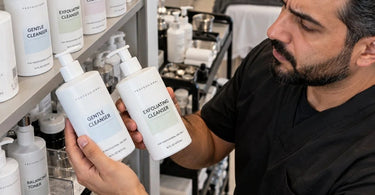
Top products pros can't live without deserve a beautiful place on the shelf, but there is one little detail that can turn a perfectly organized treatment room into a guessing game: bottles that look almost identical. Picture three matching white pump bottles lined up beside your treatment bed. One contains facial cleanser, another holds massage lotion, and the third contains a completely different professional product. They look gorgeous together, but grabbing the wrong one during a busy appointment is easier than anyone wants to admit. In a spa or salon, attractive packaging should never make product identification harder. That is why smart storage, clear labeling, and thoughtful workstation organization deserve just as much attention as your favorite professional formulas.
Whether your business specializes in facials, waxing, massage, nails, hair color, or lash services, the containers you use every day can directly affect workflow and client safety. A few changes to your Bottles & Jars, product placement, and labeling practices can help prevent mistakes before they reach the treatment table. And no, the solution does not require turning your beautiful spa into a laboratory with a clipboard stationed beside every serum.
Why Similar-Looking Bottles Increase the Risk of Product Mix-Ups
Professional beauty services involve dozens of products that may share similar packaging. Many manufacturers use matching bottles throughout a product line to create a consistent appearance. While this makes retail displays attractive, it can make products harder to distinguish during fast-paced services.
Think about the products an esthetician might keep within arm's reach during a facial. There could be a cleanser, toner, enzyme preparation, exfoliating solution, hydrating mist, massage medium, and finishing product. If most of these arrive in similar white or amber bottles, their labels become the primary way to tell them apart.
Unfortunately, technicians do not always approach their workstations with unlimited time and perfect lighting. Appointments run behind, clients ask questions, coworkers interrupt, and treatment-room lighting may be deliberately dimmed. Under those conditions, people can recognize a familiar bottle shape and reach for it before carefully reading the label.
This is especially important when products have different purposes, concentrations, application procedures, or safety precautions. Two bottles might look nearly identical while containing formulas that should never be used interchangeably.
Your Brain Loves Shortcuts, Especially During Busy Appointments
Experienced beauty professionals develop efficient routines. After performing the same service hundreds of times, the location, shape, and feel of a container become familiar. That familiarity helps technicians work smoothly, but it can also encourage automatic reaching.
Imagine a waxing specialist who always keeps pre-wax cleanser on the left and post-wax oil on the right. After restocking, another employee accidentally switches the bottles. The technician reaches toward the familiar position without noticing that the products have traded places.
Nothing looks dramatically different. Both containers have similar pumps, both belong to the same professional collection, and both fit neatly on the cart. Yet the familiar workstation arrangement is no longer reliable.
Color, container height, cap style, and shelf location all become visual cues. When those cues are too similar, or when staff rely on them instead of reading labels, mistakes become more likely.
The lesson is simple: familiarity is helpful, but it should never replace product verification. Your hands may know the workstation by heart, but your eyes still need to check the label.
The Product Categories Most Vulnerable to Bottle Confusion
Some professional beauty categories are particularly vulnerable because technicians use several related liquids during one appointment.
Waxing services: Pre-wax cleansers, skin preparation products, post-wax oils, soothing lotions, and wax residue removers may appear in similarly shaped containers. Products from Pre & Post-Waxing Products collections should be clearly identified by their intended purpose. A product formulated to remove wax from equipment or surfaces must never be confused with one intended for client skin.
Facial treatments: Cleansers, toners, exfoliating solutions, professional peels, neutralizers, and hydrating treatments can occupy the same trolley. Stronger professional products deserve particularly deliberate separation and verification. Explore Advanced Facial Treatment Products for Salons & Spas with their individual instructions and application requirements in mind.
Massage services: Massage oils, lotions, creams, and aromatic preparations may be stored in matching pump bottles. Although these products can look interchangeable, their ingredients, intended uses, and suitability for particular clients can differ. Organize your Massage Oils, Lotions, and Creams for Therapists so each formula is immediately recognizable.
Nail services: Cleaners, removers, primers, dehydrators, and other liquids may arrive in compact containers with similar caps. Even small bottles can create significant confusion when several products are used in sequence. Arrange Professional Nail Care Collections by service step and product identity.
Hair color services: Developers, color preparations, treatments, and chemical processing products require careful identification. Similar packaging must not distract from checking product names, strengths, mixing instructions, and compatibility before use. Keeping Professional Hair Color products clearly organized is especially important when multiple clients are being served.
Why Matching Refillable Bottles Can Create Additional Challenges
Refillable containers can be convenient in professional environments. They may simplify dispensing, improve workstation consistency, and allow staff to organize appropriate products for frequent use. The problem starts when appearance becomes more important than identification.
Consider a row of identical clear spray bottles. Without complete, durable labels, staff might have difficulty identifying which contains a permitted surface cleaner, which contains water, and which contains another solution.
That uncertainty becomes a serious concern when hazardous chemicals or disinfectants are involved. Workplace chemical containers must comply with applicable labeling requirements, and transferred products must be handled according to their manufacturer's directions. Certain immediate-use labeling exceptions may apply, but salons should not assume that an unlabeled bottle is acceptable merely because someone remembers filling it.
Never transfer products into miscellaneous containers unless the product instructions and applicable safety requirements permit it. Avoid reusing containers that previously held incompatible substances, and never use food or beverage containers for professional chemicals.
For suitable products that can be transferred, choose compatible containers, preserve the required identification and hazard information, and establish a reliable system for tracking what each container holds.
A matching bottle collection can still look elegant. The secret is making every bottle unmistakably identifiable without asking your staff to develop psychic powers.
Build a Labeling System That Works at a Glance
Labels should be easy to read in the actual conditions where technicians use products. A tiny handwritten abbreviation might make sense to the employee who created it, but it may confuse someone working the next shift.
A practical product identification system should prioritize the following details:
- Complete product identification: Use a clear name that distinguishes the product from other formulas in the same category.
- Intended use: Where helpful, identify whether the product is for skin, hair, nails, equipment, or environmental surfaces.
- Required hazard information: Hazardous chemical labels must contain the information required under applicable workplace safety rules.
- Preparation information: Where applicable, identify the dilution, preparation date, expiration, or discard date according to manufacturer directions and facility procedures.
- Readable placement: Position the label where it remains visible when the bottle is stored or being selected.
- Durable materials: Choose labels appropriate for the surrounding moisture, oils, and cleaning practices without obscuring required manufacturer information.
Color coding can provide an additional visual cue, but it should never be the only identification method. Staff may interpret colors differently, labels may fade, and a colored sticker cannot communicate all necessary product information.
For example, a spa might add category markers to distinguish massage mediums from facial preparations while maintaining the full original product identities. Any supplemental system should support, rather than replace, required labeling.
Separate Client Products From Cleaning Chemicals
One of the most important organizational decisions involves keeping treatment products separate from environmental cleaning supplies.
Professional Cleaners & Disinfectants for Salons and Spas serve entirely different purposes from skincare, massage products, and cosmetic preparations. Even when packaged in familiar spray bottles or pump containers, cleaning chemicals must not be stored in a way that invites confusion with products intended for clients.
Use designated storage areas for cleaning and disinfecting chemicals. Follow label directions for storage conditions, handling, protective equipment, dilution, and surface contact times. Keep applicable safety data sheets readily accessible to employees.
Do not combine leftover chemicals, top off containers with unidentified solutions, or assume two cleaning products can be mixed. Chemical combinations can create dangerous reactions or interfere with product performance.
Staff should also understand that disinfectants are not interchangeable. A product designed for one surface or application may be unsuitable for another, and correct contact time matters.
A separate cleaning supply zone reduces the chance that someone will accidentally bring a surface disinfectant into a facial service or mistake a treatment preparation for a housekeeping product.
Organize Treatment Carts Around the Service Sequence
A well-organized treatment trolley can reduce the number of decisions a technician makes throughout an appointment.
Instead of arranging every bottle by height, color, or packaging style, consider arranging products according to the treatment sequence. Items used first belong in one clearly defined area, while finishing products occupy another.
For a facial, this might mean grouping the appropriate cleansing products together, keeping professional treatment formulas in a designated location, and placing finishing products in a separate section. Products requiring special handling should remain appropriately stored and protected until needed.
For waxing, preparation products can occupy a dedicated area away from finishing lotions and equipment-cleaning supplies. Technicians working with Waxing Supplies for Professionals should be able to distinguish every product before making contact with the client.
Massage therapists can use a similar approach by separating their standard massage medium from specialized formulations and clearly identifying each container.
Consistency matters across shared workstations. If several employees use the same cart, everyone needs to follow the same placement system. A carefully designed arrangement loses its value when products migrate to different shelves every afternoon.
And while a beautifully arranged cart is a lovely sight, remember that the goal is not winning a shelving competition. The goal is helping professionals locate the correct product quickly and confidently.
Lighting and Label Position Make a Bigger Difference Than You Think
Spas often favor soft lighting because it creates a relaxing atmosphere. Unfortunately, dim treatment rooms can make small print, similar label colors, and subtle product names difficult to distinguish.
There is no need to flood every facial room with bright overhead light throughout the appointment. Instead, provide adequate task lighting where staff prepare and verify products.
Adjustable LED Bright Lamps can support tasks that require clearer visibility, provided they are positioned appropriately for the service and client comfort.
Label orientation matters, too. If product names face the wall, technicians may reach for a bottle based on its shape rather than its identity. Position containers so labels face outward and can be checked without moving several other items.
Keep the most important wording unobstructed by decorative sleeves, storage bins, or dispensing accessories.
A lovely amber bottle becomes much less charming when the label is facing backward and the technician has to play twenty questions to identify its contents.
Restocking Is a Common Moment for Product Confusion
Not every product mix-up happens during a treatment. Some begin when supplies arrive, shelves are reorganized, or employees prepare bottles before the next appointment.
New inventory might include packaging that resembles an existing product. Manufacturers may also update bottle designs while keeping the same formula name, or introduce new formulas with similar branding.
Before placing a shipment into active use, staff should verify each product's identity, intended purpose, instructions, condition, and expiration information where applicable.
Products with similar appearances should be separated or clearly differentiated. Do not assume that two containers are identical simply because the manufacturer, bottle color, and cap design match.
In shared salons, designate responsibility for restocking treatment stations. Employees should know where each product belongs and should not relocate unfamiliar bottles without confirming their identities.
When someone discovers an unidentified or incorrectly labeled container, remove it from use until its contents can be established reliably. If the contents cannot be confirmed, follow the appropriate disposal procedure rather than guessing.
Train New Employees Before They Develop Bad Habits
Experienced technicians often recognize professional packaging instantly. New employees may not have that familiarity, especially when they are learning several product lines at once.
During onboarding, explain how your business identifies, stores, and selects products. Show employees how to distinguish products with similar packaging, where to find manufacturer instructions, and when to ask for assistance.
Training should cover more than memorizing shelf locations. Staff need to understand why product differences matter and why reading labels remains necessary even for familiar formulas.
Use realistic service examples during training. Present two similar-looking bottles and ask employees to identify their intended uses, required precautions, and storage locations using the labels and available instructions.
Supervisors can also build a simple verification habit into daily operations: identify the product, confirm its purpose, check instructions when appropriate, and only then proceed with preparation or application.
That habit may take a few extra seconds, but it is easier than explaining why a bottle of the wrong formula somehow became the surprise guest at a facial appointment.
What to Do When Someone Grabs the Wrong Bottle
If an employee realizes that they have selected the wrong product, the first step is to stop before using it. Read the label, identify the intended product, and correct the selection.
If the wrong product has already been applied or a chemical exposure has occurred, stop the service and follow the relevant product instructions, safety data sheet, and exposure-response procedures. If necessary, contact Poison Control or obtain prompt medical assistance. Do not improvise neutralization methods or apply another chemical in an attempt to fix the mistake.
Document the incident according to workplace procedures, including the products involved and the circumstances that contributed to the error. Review the workstation setup to identify practical improvements.
A product mix-up should be treated as an opportunity to improve the process, not simply as evidence that someone was careless. Similar packaging, poor lighting, confusing storage, and inconsistent training can all contribute.
When a business improves those underlying conditions, everyone benefits, including employees who have never made a product selection mistake.
A Five-Minute Bottle Safety Audit for Busy Salon Owners
You do not need to reorganize your entire business to identify obvious problems. A short inspection of each treatment area can reveal opportunities for improvement.
- Scan for look-alikes. Identify bottles that are difficult to distinguish by appearance.
- Read every label. Confirm that containers are correctly identified and that required hazard information is present.
- Check product separation. Make sure cleaning chemicals are appropriately stored away from client treatment products.
- Review workstation placement. Arrange products consistently by function and treatment sequence.
- Confirm staff understanding. Ask employees how they verify products and what they do when a container is unidentified.
Repeat this review after major restocking, workstation changes, or the introduction of new product lines. Include it in routine opening or closing procedures where practical.
As you update your organization system, consider professional Spa Essentials for Professionals and appropriate storage accessories that help support a cleaner, more functional treatment environment.
Beautiful Packaging and Professional Safety Can Work Together
There is nothing wrong with wanting a cohesive, attractive workspace. Matching bottles, tidy shelves, and coordinated accessories can contribute to the professional experience clients expect.
But presentation should complement safety rather than compete with it. The best workstation is one where every product has a clear identity, a designated location, and a purpose that staff understand.
That is particularly important in businesses offering several services under one roof. A full-service spa may stock Premium Skincare Products for Spas and Salons, massage formulas, waxing preparations, nail products, and disinfectants within the same facility. A thoughtful organization system helps keep those categories distinguishable.
At Pure Spa Direct, we know professionals rely on a wide variety of supplies to deliver efficient, high-quality services. As a wholesale distributor serving spa, salon, massage, waxing, and beauty businesses, we offer product categories that help professionals equip and organize their workspaces. Choosing appropriate supplies is one part of the equation; using, labeling, and storing them correctly is equally important.
The Bottom Line: Read the Label, Not Just the Bottle
Similar-looking bottles increase the risk of grabbing the wrong product because people naturally use familiar shapes, colors, and locations to guide everyday actions. In a busy professional environment, those shortcuts can become unreliable.
Clear identification, consistent storage, proper chemical separation, adequate lighting, and employee training can help reduce that risk without sacrificing the polished appearance of your salon or spa.
Before your next appointment, take a quick look at the bottles on your treatment cart. Can you identify every product immediately from its readable label? Would another trained employee be able to do the same?
If the answer is no, a few organizational changes may be in order. Browse Pure Spa Direct for professional supplies that support your services, and build a workstation where the correct product is always easy to identify.
Because the only surprise your client should experience during a spa treatment is just how wonderful they feel afterward, not discovering that two suspiciously identical bottles were involved in an accidental product swap.
