
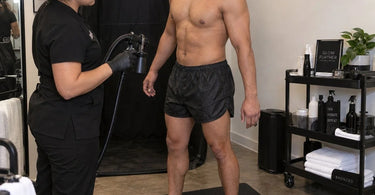
Let quality drive your results, but let's be honest for a second: nothing tanks the quality of your spray tan service faster than a client doing a wobbly, barefoot, slippery little dance in the middle of your booth. You know the dance. It's the one where they're trying to turn around without falling, and suddenly your flawless application turns into a game of Twister where everybody loses. A stable place to stand isn't just a nice-to-have; it's the unsung hero of every professional sunless tanning appointment.
Here's the thing nobody tells you when you're learning to spray tan: the application itself is only half the battle. The other half is managing a human being who is standing in a confined space, wearing nothing but a paper thong, and trying not to slip on a floor that's been lightly misted with solution. It's a recipe for disaster if you haven't set yourself up for success.
The Barefoot Balancing Act Nobody Warns You About
Think about what happens during a typical spray tan appointment. Your client starts facing you. Then they need to turn around so you can get their back. Then they need to lift one leg. Then the other. Then they might need to lean forward. Then they turn again. That's a lot of movement for someone who is standing on a surface that could be slick with overspray.
If you're using a pop-up tent on a smooth floor, that surface can get surprisingly slippery. Add in the fact that your client is barefoot (they should be, because socks and tan lines are enemies), and you've got a perfect storm for a slip-and-fall incident. And nothing kills the vibe of a luxury experience faster than your client ending up on the floor of your treatment room.
The solution isn't complicated, but it does require intentionality. A stable, non-slip surface inside the booth gives your clients the confidence to move the way you need them to move. When they're not worried about falling, they can actually relax. And when they relax, their muscles aren't tense, which means the solution goes on more evenly. It's a beautiful chain reaction that starts with something as simple as making sure they have a safe place to plant their feet.
Position Changes Are the Enemy of a Perfect Tan
Every time your client shifts position, you're rolling the dice on your application. If they wobble, the solution lands in the wrong place. If they tense up because they're afraid of slipping, you get streaks. If they hesitate to move because they don't feel stable, you can't reach that tricky spot under the bum cheek or behind the knee.
Experienced spray tan artists know that certain positions are essential for a comprehensive tan. You need your client to lean forward to get the back of the legs and under the glutes . You might need them to do a lunge to access the crease between the thigh and bottom . For older clients or those with mobility issues, a chair or stability aid inside the booth can make all the difference .
But here's the catch: all of these position changes require trust. Your client has to trust that they won't fall, and you have to trust that they'll move exactly how you need them to. A stable standing surface builds that trust. It says, "I've got you. You can move freely. I'm not going to let you eat it on my watch."
The Real Cost of a Wobbly Client
Let's talk about what happens when a client doesn't feel stable. First, there's the safety risk. A fall in a spray tan booth is a nightmare scenario. Your client could get hurt, you could be liable, and your reputation could take a hit. No one wants to be the salon where a client slipped in a puddle of tanning solution.
Second, there's the quality issue. A client who is tense and nervous doesn't hold positions well. They fidget. They shift their weight. They do that thing where they try to turn around without actually turning around, resulting in a weird half-turn that makes it impossible to get an even spray on their sides. You end up with missed spots, streaks, and a tan that looks patchy before they even leave the building.
Third, there's the experience factor. Spray tanning is supposed to feel luxurious. It's a beauty treatment. Your client is paying good money to feel pampered, not to feel like they're navigating an obstacle course. If they spend the whole appointment worried about falling, they're not going to book a return visit. And they're definitely not going to recommend you to their friends.
What Makes a Stable Standing Surface
So what should you actually be looking for when you're setting up your spray tan station? The answer depends a little on your setup, but there are some universal principles.
First, the surface should be non-slip. This is non-negotiable. Whether you're using a dedicated booth or a pop-up tent, the floor inside should have some texture or grip. If you're using a tent on a hard floor, consider placing a non-slip mat underneath. If you're in a dedicated booth, check that the floor surface isn't polished or slick. A quick test: put on some socks and walk around inside. If you feel even a little unstable, your barefoot clients will feel it too.
Second, the surface should be easy to clean. Spray tan solution overspray is inevitable. You need a surface that you can wipe down between clients without a huge hassle. This is where hygiene meets practicality. A surface that's grippy but impossible to sanitize is a problem. Look for materials that are both non-slip and non-porous.
Third, the surface should be comfortable. Your clients are standing for the duration of the appointment, which can be 15 to 30 minutes depending on your technique and equipment . A little cushioning can make a big difference in their comfort level, especially for older clients or those with foot issues. Standing on a hard, unforgiving surface for half an hour is not a great experience.
Position Changes That Require Stability
Let's get specific about the positions that make stability essential. When you need your client to lean forward to tan their back and the back of their legs, they're shifting their center of gravity . If the floor is slippery, that lean can turn into a slide.
When you ask a client to do a lunge to access the under-bum area, they're balancing on one leg . That's already a challenge for some people. Add a slippery surface, and you're asking for trouble.
For plus-size clients, accessing certain areas can require them to hold positions for longer periods . The longer they have to hold a position, the more stability matters.
For older clients or anyone with mobility concerns, a chair or stability aid inside the booth isn't just helpful; it's essential . They need something to hold onto, something that grounds them while you work.
Client Communication: Setting Expectations for Stability
Part of your job as a professional is communicating with your client about what to expect during the appointment. This includes letting them know that they'll need to move through a series of positions.
A simple script can work wonders: "I'm going to have you turn a few times during the appointment, and I might ask you to lean or lift a leg. The floor is non-slip, so you can move confidently. If you ever feel unsteady, just let me know and we'll adjust."
That little speech does two things. First, it prepares them for the movements, so they're not caught off guard. Second, it reassures them that their safety is your priority. That reassurance allows them to relax, which improves your application.
You might also want to offer a stability aid proactively. Something as simple as a sturdy stool or a chair inside the booth gives clients a sense of security . Even if they don't end up using it, just knowing it's there can help them feel more confident.
The Hygiene Connection: Disposables and Stability
Here's a bonus tip that ties into the stability conversation: disposables. When your client is moving through positions, you want to minimize the opportunities for contamination and mess.
Disposable bikini panties are a standard part of professional spray tanning, and for good reason. They protect your client's modesty while also keeping the treatment hygienic . Sticky feet are another essential. They protect the soles of your client's feet from overspray and also add a layer of grip between their feet and the floor .
When you combine a non-slip surface with the right disposables, you're creating a safer, more professional environment. Your client feels taken care of. You feel confident in your setup. Everyone wins.
Equipment Considerations for Stability
If you're in the market for a new spray tan setup, consider how the equipment itself contributes to stability. Pop-up tents are a popular choice for mobile and salon settings because they're portable and affordable . But not all tents are created equal. Look for one with a floor that offers some grip.
Some tents come with built-in flooring, while others are designed to sit on top of whatever surface you're using. If your tent doesn't have a floor, you'll need to provide a non-slip mat or another stable surface inside.
If you're using a dedicated booth, the floor should be a non-porous, textured material. Many professional booths are designed with this in mind, but it's worth checking. If the floor is slick, you can add a non-slip mat without too much trouble.
For mobile artists, portability is key. You need a setup that's easy to transport but doesn't sacrifice stability. The Sunless Spray Tan Business Kit Elite Evo includes a pop-up tent that's designed for quick setup and reliable performance, along with disposables and barrier cream to complete your professional kit .
The Bottom Line: Stability Is Professionalism
At the end of the day, ensuring your spray tan clients have a stable place to stand is about more than just safety. It's about professionalism. It's about creating an environment where your client can relax and trust you. It's about delivering results that make them want to come back.
A wobbly client is a nervous client, and a nervous client doesn't get a great tan. A stable client is a relaxed client, and a relaxed client is a canvas you can work with. The next time you're setting up for an appointment, take a moment to check the floor. Is it non-slip? Is it comfortable? Does your client have everything they need to feel secure?
If the answer is yes, you're setting yourself up for success. If the answer is no, it's time to make some changes. Your clients will thank you. Your results will thank you. And your reputation as a professional who cares about the details will thank you too.
)