
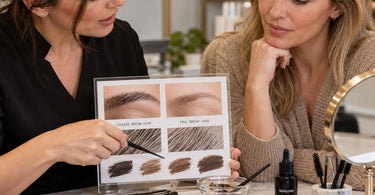
Let's get to work on your success... because understanding why professional brow tint develops differently on coarse and fine brow hair can make the difference between beautifully balanced brows and a client giving the mirror that suspicious little squint. You know the look. One eyebrow appears perfectly defined while the other seems to have received a considerably more enthusiastic application of color. The good news? Uneven tint development is not necessarily a reflection of your technique. Hair texture, porosity, natural pigmentation, and product processing all influence how brow tint performs, and understanding these variables gives beauty professionals considerably more control over their results.
For estheticians, brow artists, and salon professionals, the secret to consistent eyebrow tinting is recognizing that not all brow hairs behave the same way. Fine hairs may develop visible color quickly, while coarse hairs can sometimes resist tint penetration or require more careful saturation. Add varying hair density, previous chemical treatments, and different natural brow colors to the equation, and suddenly those two little strips of hair above the eyes become a surprisingly sophisticated color project.
Fortunately, you do not need to become a cosmetic chemist to master the process. You simply need to understand the characteristics of the hair you are treating, choose appropriate professional products, and follow a consistent service protocol.
Why Brow Hair Texture Changes Tint Development
Every eyebrow hair has a physical structure that affects its interaction with cosmetic color. The outermost layer, called the cuticle, consists of overlapping cells that help protect the inner portion of the hair shaft. Beneath this protective layer is the cortex, which contains much of the hair's natural pigment and contributes to its strength and structure.
Professional oxidative brow tints generally rely on a compatible developer to activate color-forming ingredients. During processing, the formulation interacts with the hair and develops the intended shade. The effectiveness of this process depends on the specific tint system, the condition of the cuticle, and the characteristics of the individual hair.
Fine and coarse hairs differ primarily in strand diameter, but thickness is only part of the story. Hair porosity, previous treatments, natural pigment, and product saturation can be just as important.
That distinction matters because coarse hair is not automatically resistant, and fine hair is not automatically porous. A thick, previously processed brow hair may accept color differently from a thick, untreated hair. Similarly, fine hair with an intact cuticle may behave differently from fine hair that has experienced repeated chemical services.
Think of hair texture as the introduction to the story, not the entire plot.
Fine Brow Hair: Why Color Can Develop So Quickly
Fine eyebrow hairs have a smaller diameter than coarse hairs. Depending on their condition and the tint formulation, these delicate strands may show noticeable color changes relatively quickly. This can be especially apparent when the client has naturally light-colored brows.
Because fine hairs are narrow, even a modest increase in color depth can create a significant visual transformation. A client with barely visible blonde brow hairs may suddenly appear to have substantially fuller eyebrows after tinting.
That transformation is one reason professional eyebrow tinting is so popular. The treatment can make existing hairs more noticeable without requiring the client to apply brow makeup every morning.
However, fine hair presents several practical challenges.
First, very light or delicate hairs can become visually too dark if the selected shade or processing time creates more intensity than the client wants. Second, sparse areas may look uneven because fewer hairs are available to create consistent coverage. Third, fine hairs can be easy to overlook during application, especially near the brow tails.
Professionals should carefully evaluate the desired color depth and monitor development within the manufacturer's recommended processing window. Choosing a lighter shade when appropriate and ensuring complete but controlled application can help produce softer, more natural results.
Remember, the objective is not necessarily to make every eyebrow hair as dark as possible. It is to create flattering definition that complements the client's features.
Coarse Brow Hair: Why Some Strands Resist Color
Coarse eyebrow hairs have a larger strand diameter and can sometimes be more challenging to saturate evenly. Certain coarse hairs also have relatively resistant cuticles, which can affect how readily a tint formulation interacts with the hair.
This resistance is particularly noticeable when working with thick, wiry, or very dense eyebrows. A professional may apply the correct shade and follow the recommended procedure, yet discover that some hairs appear less intensely colored than others.
One common culprit is incomplete product contact. Dense eyebrows contain numerous overlapping hairs, and simply brushing tint across the surface may leave some strands insufficiently coated.
Careful application matters. A professional brow tint brush can help distribute product through the hair while maintaining precision around the desired shape.
For resistant coarse hairs, follow the manufacturer's guidance on processing and evaluate whether the product is appropriate for the hair type. Some professional systems permit different processing times within a specified range, but longer processing is not automatically better.
Extending development beyond the manufacturer's stated limits may increase the risk of unwanted color, irritation, or hair damage without reliably improving coverage.
Patience is valuable in the treatment room. Improvising with extra developer or an unauthorized processing time is not.
Hair Porosity: The Hidden Variable Behind Uneven Tint
Porosity describes the hair's tendency to absorb and retain moisture and other substances. It is influenced by the condition of the cuticle and previous exposure to chemical, environmental, and mechanical stress.
Hair with lower porosity often has a more compact cuticle structure. Depending on the tint chemistry, this can make color interaction less straightforward. Hair with higher porosity may allow certain formulations to interact more readily, potentially creating faster or less predictable visible color development.
Importantly, porosity cannot be determined from strand thickness alone.
A client may have coarse but highly porous brows because of previous chemical treatments. Another client may have naturally fine hairs that remain relatively resistant to color.
Before applying tint, ask about recent eyebrow services, previous color treatments, and any history of irritation or unexpectedly dark results.
Products used during brow lamination can alter hair characteristics, so tinting immediately after lamination requires special attention. Only combine services when the manufacturers explicitly permit the sequence, and follow their modified timing and application instructions.
Never assume that a tint intended for untreated brows should be processed for the same duration after a chemical restructuring service.
Why the Same Tint Shade Looks Different on Two Clients
Even when brow hairs develop color evenly, the finished shade can appear different from one client to another.
Natural hair pigmentation provides the starting point for the color result. A light brown tint applied to naturally blonde brows may produce a noticeable change, while the same product on dark brown brows may create only subtle additional definition.
Hair density also changes the visual impression. A thick eyebrow with numerous overlapping hairs can appear darker than a sparse eyebrow containing the same color on fewer strands.
Skin tone, lighting, and the contrast between the eyebrows and surrounding features contribute to the perceived intensity.
This explains why selecting a tint based exclusively on the client's scalp hair color can be misleading. Brow color should also complement skin undertones, existing brow pigmentation, and the client's preferred makeup style.
A client who loves defined, dramatic brows may appreciate a different result from someone requesting the softest possible enhancement.
Professional brow tinting is part chemistry, part artistry, and part excellent listening skills.
How to Assess Brow Hair Before Applying Tint
A thorough consultation should begin before the tint container is opened. Understanding the client's natural brow characteristics makes it easier to select the right approach and establish realistic expectations.
Start by examining several areas of each eyebrow. The hair near the inner brow may be finer or lighter than the hair through the arch, while the tail may have a different density or growth pattern.
Look for differences in strand diameter, existing color, hair condition, and coverage.
Discuss previous tinting experiences, recent brow lamination, chemical treatments, skin sensitivity, and relevant allergies. Perform the allergy alert test or patch test required by the specific manufacturer at the prescribed interval. A negative test does not guarantee that a reaction cannot occur, and any contraindications in the product instructions must be respected.
Professional brow dyes are intended for use in accordance with their specific labeling. Never substitute ordinary scalp hair dye for a product that is not expressly approved for eyebrow use.
Finally, discuss the desired finish. Some clients want stronger definition through the arch and tail. Others prefer a delicate, naturally graduated appearance.
This conversation helps prevent the classic salon misunderstanding in which the client requests natural brows but imagines something entirely different from the artist.
Preparing Fine and Coarse Brows for Consistent Results
Product preparation and brow cleansing have a substantial influence on tint consistency.
Makeup, skincare residue, oils, and styling products can interfere with even application or product contact. Cleanse the eyebrow area using a preparation product compatible with the tint system, then follow the manufacturer's instructions regarding drying and application.
A suitable brow cleanser can help create a clean starting surface. Professional cotton, sponges, and wipes are useful for controlled cleansing and removal.
For coarse, dense eyebrows, gently arrange the hairs to expose overlapping sections. This makes it easier to distribute tint throughout the brow instead of applying a thick layer only to the visible surface.
For fine or sparse eyebrows, concentrate on careful placement and coverage without allowing unnecessary product to spread onto the surrounding skin.
If the product instructions call for a protective barrier around the brow perimeter, apply it precisely. Different tint systems have different expectations for skin staining, so the preparation protocol should match the formulation.
Proper preparation is not the glamorous part of brow artistry, but it often determines whether the glamorous part goes according to plan.
Choosing Professional Brow Tint Products for Different Textures
Professional tint systems differ in formulation, shade selection, developer requirements, processing instructions, and intended results.
At Pure Spa Direct, beauty professionals can explore Lash & Brow Service Supplies and compare professional color options that fit their treatment menus.
Popular professional collections include Refectocil Original, Intensive Tint, and Berrywell Cream Dye.
Professionals can also explore Combinal Cream Dye and ViBROWLASH when evaluating options for their service offerings.
Each system has its own manufacturer-established directions. Tint shades, developer strengths, mixing ratios, and processing times should not be assumed interchangeable across brands.
When selecting a system, consider the available shades, the intended color effect, the condition of the client's brows, and the amount of flexibility permitted by the instructions.
Some color products are designed primarily to tint the hair, while other professional brow systems may also create a temporary skin-staining effect. These results should not be confused, particularly when evaluating sparse or fine brows.
Pure Spa Direct supplies professional beauty products from multiple manufacturers, making it easier for salons and spas to build a tinting inventory that supports different client needs.
Application Techniques That Improve Color Uniformity
Even the most thoughtfully selected tint cannot deliver predictable results if application is inconsistent.
Use clean mixing bowls and suitable applicators and spatulas, following the tint manufacturer's requirements for mixing equipment and developer compatibility.
Measure ingredients according to the product directions rather than estimating proportions by appearance. A mixture that looks creamy is not necessarily mixed at the correct ratio.
Apply the product evenly and thoroughly so that every intended hair receives adequate contact.
On coarse brows, work carefully through the denser sections to reach hairs beneath the surface. On fine brows, use precise movements to prevent excess product from accumulating beyond the planned shape.
Consider application order. If one section consistently develops darker or lighter because of differences in hair characteristics, review whether the manufacturer permits adjustments to placement or removal timing.
The goal is controlled, even processing, not arbitrarily changing the formulation.
Use a timer and record when application begins. Follow the manufacturer's definition of processing time, whether measured from initial application or completion of application.
Once processing is finished, remove the tint using the specified method. Check the brow under consistent lighting before deciding whether further correction is appropriate.
Accurate technique is especially important when two neighboring hair textures respond differently. Eyebrows may be sisters rather than twins, but there is no need to encourage sibling rivalry.
Should Coarse Brow Hair Process Longer Than Fine Hair?
This is one of the most common questions in professional brow tinting, and the answer requires some nuance.
Fine brow hair often shows visible changes relatively quickly, while some coarse or resistant hair may need more time to achieve the desired depth. However, those observations are general tendencies, not universal rules.
The correct processing time depends on the approved tint formulation, manufacturer instructions, hair condition, and desired result.
If the manufacturer provides a processing range, professionals may be able to choose an appropriate point within that range based on the client's characteristics. Fine or previously processed hair may warrant a more conservative approach, while resistant hair may require careful development within the allowed limits.
Other systems specify fixed timing or special rules for particular treatment combinations.
Never borrow a processing time from a different tint brand, and never use brow lamination processing guidelines as a substitute for tint instructions. These are different chemical processes.
If the product has reached its maximum approved processing time without sufficient coverage, investigate application technique, product suitability, hair condition, and shade selection rather than simply leaving it on longer.
Why Brow Tails Sometimes Develop Unevenly
The outer ends of the eyebrows can be especially challenging because the hairs may be finer, shorter, lighter, or less densely distributed than those closer to the center.
Even if every hair develops the same color, a sparse tail can look less defined because there are fewer pigmented strands creating visual coverage.
In other clients, the tails may contain previously treated or more porous hairs that develop a stronger color than expected.
To improve results, inspect the tails before mixing the tint. Use precision application tools and ensure the selected product reaches the intended hairs without spreading unnecessarily onto the surrounding skin.
If the client expects a filled-in appearance where few natural hairs exist, explain that a hair-focused tint cannot create new hairs. A system specifically designed to provide temporary skin staining may offer a different cosmetic effect, provided it is appropriate for the client.
Good consultations prevent unrealistic expectations and help clients appreciate the actual benefits of the service.
Common Brow Tinting Problems and How to Troubleshoot Them
Problem: Fine brows become darker than expected. Reevaluate shade selection, hair porosity, application coverage, and the processing time permitted by the manufacturer. A more conservative color choice may be appropriate during future services.
Problem: Coarse brows appear patchy. Check whether the tint reached the inner layers of dense hair. Review cleansing, product saturation, developer measurements, and any signs of resistance.
Problem: The brows develop different color intensity. Examine differences in hair density, natural pigmentation, previous treatments, and application order. Do not automatically assume that both eyebrows have identical characteristics.
Problem: The brow tails appear lighter. Determine whether the issue is reduced hair density, incomplete coverage, or genuinely lighter color development. Each requires a different solution.
Problem: Tint fades unevenly. Consider differences in hair condition, the natural hair growth cycle, aftercare habits, and exposure to cleansing or exfoliating products. Fading patterns vary by client and formulation.
Problem: Color looks warm, cool, or otherwise different from expectations. Revisit natural pigmentation, shade selection, underlying tones, and the characteristics of the tint system. Avoid attempting an unapproved chemical correction.
If an unexpected reaction, significant irritation, or other contraindication appears during the service, discontinue treatment and follow the product's safety instructions. Cosmetic results should never take priority over client safety.
How Brow Lamination Can Change Tint Results
Brow lamination and eyebrow tinting are frequently offered together, but combining the treatments requires careful attention.
Lamination changes the internal bonds of the hair through a controlled chemical process, helping the brow hairs become more flexible and easier to arrange into a desired position.
This treatment may also change the way the hair interacts with subsequent color.
Recently laminated hairs can exhibit altered porosity and sensitivity, making the usual tinting routine inappropriate in some cases. Certain systems specifically provide shorter tint processing instructions after lamination, while other manufacturers may discourage particular combinations entirely.
The safest professional approach is to follow the directions for both systems and confirm that the products are compatible.
Do not mix components from unrelated systems unless the manufacturers approve their combined use.
For salons offering multiple brow enhancement services, keeping detailed treatment records helps prevent accidental overprocessing and supports consistent results during return appointments.
The Importance of Professional Brow Tinting Supplies
Successful brow tinting requires more than a dependable color formula. Reliable supplies make service preparation, precise application, sanitation, and cleanup considerably easier.
A thoughtfully stocked station may include manufacturer-approved tint and developer, disposable applicators, precision brow brushes, mixing containers, skin protection materials when required, cleansing supplies, and appropriate protective gloves.
Explore Protective Gloves & Masks and Professional Cleaners & Disinfectants to support a clean, organized service environment.
Reusable tools should be cleaned and disinfected according to applicable professional standards, local requirements, and equipment instructions. Disposable tools should be discarded after their intended use.
Organizing tint supplies by product system can also reduce the risk of pairing an incompatible developer with the wrong color formulation.
A few extra minutes of preparation may save considerably more time than troubleshooting inconsistent results after the service.
And as every busy brow professional knows, discovering that the correct applicator is missing while a client is waiting is nobody's favorite salon adventure.
Aftercare Tips for Longer-Lasting Brow Tint Results
Client aftercare influences how the brows look as the tint gradually fades.
Provide instructions based on the specific product used, since different formulas have different recommendations regarding cleansing, moisture exposure, skincare products, and post-treatment activities.
Clients should avoid aggressive rubbing and unnecessary exfoliation around the brow area. Strong exfoliating skincare products may also affect the appearance and longevity of certain tint results, particularly when temporary skin staining is part of the service.
Encourage gentle brow grooming and explain that color fades gradually as the hair is cleansed, exposed to everyday conditions, and naturally replaced through the growth cycle.
Fine, light-colored brow hairs may appear to lose their enhanced definition sooner as the color fades, while denser brows can retain a stronger visual impression even as individual hairs become lighter.
Actual longevity depends on the tint formula, hair characteristics, cleansing routine, and individual client factors.
Give realistic maintenance guidance rather than promising a specific number of weeks for every client.
Build a Consistent Brow Tinting System for Your Salon
One of the smartest ways to improve professional tinting results is to document what works.
After each appointment, record the brand, shade, developer, approved mixing ratio, processing time, observed hair texture, prior treatment history, and final color result.
Include notes about whether the brow hairs were predominantly fine, coarse, dense, sparse, or mixed. Photographs taken with client permission under consistent lighting can make these records even more useful.
Over time, patterns may emerge. A particular client's fine brow tails might consistently require more delicate application, while another client's coarse brows may need especially thorough product saturation.
These observations help professionals refine their methods within the approved product instructions rather than relying on guesswork.
Consistent service records are also valuable when multiple estheticians work with the same client. They make it easier to reproduce successful results and identify changes in hair condition.
A repeatable system allows brow artists to deliver personalized treatments while maintaining the consistency that helps build client confidence.
Why Understanding Hair Texture Makes You a Better Brow Artist
Learning why tint develops differently on coarse and fine brow hair is ultimately about becoming more observant and intentional during professional services.
Rather than treating every eyebrow with an identical routine, successful brow professionals consider strand diameter, porosity, natural pigmentation, density, previous treatments, and the capabilities of the selected tint system.
Fine hairs may produce dramatic visual changes with relatively subtle color development. Coarse hairs may require particularly careful saturation and attention to product compatibility. Mixed-texture eyebrows may demand even more thoughtful application.
None of these situations requires guesswork or pushing chemical processing beyond approved limits. They require careful assessment, suitable products, precise application, and an understanding of the science behind the service.
Whether you are perfecting a natural everyday brow or creating a more defined salon finish, that knowledge helps you deliver results clients can appreciate.
Give Every Brow Texture the Professional Attention It Deserves
Beautiful brow tinting starts long before the color develops. It begins with a careful consultation, an understanding of the individual hair, and a professional approach to selecting and using the right supplies.
At Pure Spa Direct, we help estheticians, brow specialists, salons, and spas find the professional products they need to support their services. Explore our Lash & Brow Enhancement Services for Professionals collection to discover supplies for building a versatile, reliable brow treatment menu.
From professional tinting essentials to application tools and complementary brow services, having the right inventory supports smoother appointments and more consistent client experiences.
Coarse brows, fine brows, sparse tails, stubborn little hairs with minds of their own... every eyebrow brings something different to the treatment chair.
With the right knowledge, preparation, and professional products, you can turn those differences into an opportunity to demonstrate your expertise. Because beautiful brows should look intentionally designed, not like the tint decided to freelance.
