
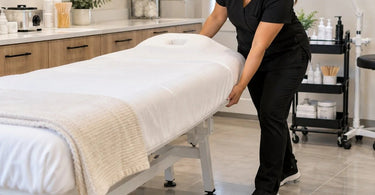
Make every moment count... especially the ones when your treatment bed stays exactly where you put it! You carefully arrange your treatment room, line up your equipment, position your rolling cart, and create a beautiful space for your next client. Then, somewhere between a relaxing facial and a vigorous massage, your treatment bed decides it has other plans. Suddenly, it has traveled a few inches across the floor like it is quietly auditioning for a dance competition. If you have ever wondered why treatment beds creep out of position on smooth floors, you are definitely not alone. This surprisingly common frustration affects professional spas, massage studios, waxing rooms, and esthetic treatment spaces, and understanding why it happens can help you protect your equipment, improve client safety, and keep your treatment room running smoothly.
A treatment bed that gradually shifts during services might seem like a minor annoyance, but persistent movement deserves attention. Even small changes in position can affect practitioner ergonomics, interfere with nearby equipment, and create an uncomfortable or potentially unsafe experience for clients. The good news? Most cases can be traced to a combination of floor conditions, bed construction, foot design, and the forces created during everyday treatments.
The Sneaky Science Behind Sliding Treatment Beds
The simplest explanation involves friction. Friction is the resistance that helps two surfaces remain in place when a force tries to move them against each other. When a treatment bed rests on a smooth floor, its feet must provide enough grip to resist the sideways forces created during services.
Polished tile, sealed concrete, luxury vinyl, and certain laminate floors can provide less grip than textured surfaces, depending on the materials and conditions involved. A bed with firm plastic feet, worn rubber pads, or improperly adjusted supports may slide more easily than one equipped with properly maintained, high-grip contact points.
Here is where things get interesting. A bed does not need one dramatic push to travel across the room. Repeated small forces can cause tiny shifts that accumulate throughout the day. This phenomenon is sometimes described as creeping or walking, and it can happen even when the equipment seems perfectly stable at first glance.
Think of it as the spa furniture equivalent of a chair gradually scooting away from the dining table. Nobody invited it to move, but here we are.
Why Smooth Spa Floors Make the Problem Worse
Modern treatment rooms frequently feature beautiful, easy-to-clean flooring. Smooth surfaces look professional, support efficient cleaning routines, and help create the polished atmosphere clients expect from an upscale spa.
Unfortunately, a floor that looks fabulous does not automatically provide ideal traction for heavy furniture.
Glossy porcelain tile, polished stone, sealed concrete, and luxury vinyl can all behave differently depending on their surface finish and the materials touching them. A rubber foot that grips one flooring material effectively may perform differently on another.
Cleaning products can also influence the situation. Residual moisture, accumulated massage oil, spilled lotion, or certain floor-care products may reduce traction. Even a thin film that is barely visible can make a difference.
That makes housekeeping an important part of equipment stability. Proper use of Professional Cleaners & Disinfectants for Salons and Spas, combined with floor-specific cleaning instructions, helps prevent unwanted buildup around treatment equipment.
Be careful not to assume that a stronger cleaning product automatically improves grip. Some finishes require particular cleaning methods, and incompatible chemicals can damage flooring or leave unwanted residue.
Worn Rubber Feet Are Often the Real Culprits
One of the first places to inspect when a treatment bed starts wandering is underneath the frame.
Many professional beds and massage tables use rubberized feet, protective end caps, or specially shaped supports designed to create stable contact with the floor.
Over time, these components can wear down, harden, crack, loosen, or become contaminated with cleaning residues and treatment products.
A rubber foot that once provided excellent grip may become significantly less effective after years of daily use. Missing or damaged end caps can also expose harder materials that slide more easily.
Inspect every contact point for visible deterioration, uneven wear, missing pieces, and accumulated debris. Make sure each foot sits flat against the floor and remains securely attached.
If replacement components are necessary, use parts approved for the particular bed model. Universal accessories are not automatically suitable for professional treatment equipment, especially when the bed supports clients during hands-on services.
For serviceable equipment, explore appropriate replacement parts for spa and salon equipment while confirming compatibility with the manufacturer.
Uneven Floors Can Create Movement Without You Noticing
A floor can look perfectly level while containing tiny variations that affect how a treatment bed rests on it.
Tile edges, grout joints, uneven concrete, and subtle changes in the subfloor can prevent all supporting feet from sharing the load evenly.
When one foot carries less weight than the others, ordinary treatment pressure may cause the frame to rock or shift. Repeated rocking can gradually change the bed position.
This becomes particularly noticeable during massages, body treatments, and services involving repeated pressure toward one side of the bed.
Check whether the bed rocks when gently tested without a client present. If your model has adjustable leveling feet, follow the manufacturer's instructions to make the appropriate corrections. Not every model offers this feature, and an improperly adjusted support can create more problems than it solves.
Never improvise with folded towels, cardboard, loose wooden wedges, or stacks of disposable supplies under the bed legs. Those temporary solutions can shift unexpectedly and introduce additional safety hazards.
Massage Techniques Can Slowly Push a Bed Across the Room
Massage therapists know that effective bodywork often involves more than gentle downward pressure.
Deep tissue techniques, sustained compressions, assisted stretching, and broad gliding strokes can create forces that travel horizontally through the treatment surface.
When those forces exceed the grip available at the floor contact points, the entire table may shift slightly.
Repeated movements in the same direction can produce gradual travel, particularly on slick floors.
This is why a bed might remain completely stationary during a facial but move noticeably during a massage appointment.
Professional Massage & Wellness Products help practitioners provide comfortable treatments, but the furniture itself must also be appropriate for the type and intensity of service being delivered.
Changing massage technique solely to compensate for unstable equipment is not a reliable solution. The bed should be properly designed, installed, and maintained for its intended workload.
Rolling Treatment Beds Need Special Attention
Some professional treatment beds feature casters that make it easier to reposition furniture or rearrange service rooms.
That flexibility can be wonderful when changing the room layout. During an appointment, however, unlocked or malfunctioning wheels can become a significant problem.
Some caster systems include locks that prevent wheel rotation, while others also limit swiveling. Their exact performance depends on the design. A locked wheel does not necessarily eliminate all movement if the caster assembly or frame has additional play.
Before beginning a service, verify that every caster and stabilizing mechanism is configured according to the manufacturer's instructions.
On certain models, retractable wheels must be raised so that fixed feet can contact the floor. Other designs require multiple wheel locks to be engaged.
Never assume that a brake is working simply because the lever appears to be engaged. Inspect and test the equipment before placing a client on it.
If a locking mechanism fails or the bed continues to move despite correct setup, remove the equipment from service until the issue has been resolved.
Could Your Treatment Bed Be Too Lightweight?
Bed weight and construction can influence stability, but heavier does not automatically mean safer.
Lightweight portable tables are designed to balance strength, portability, and convenient storage. Their performance depends on secure leg assemblies, proper bracing, suitable floor contact materials, and adherence to the manufacturer's working load limits.
A lightweight table with excellent rubberized feet and proper construction may remain stable on a smooth floor, while a heavier bed with damaged supports may slide.
For professionals who regularly deliver firm massage techniques, the ideal solution is to choose equipment specifically rated and designed for that kind of work.
Explore Portable Massage Tables for mobile or flexible treatment setups, or consider stationary options within Luxury Spa Furniture when a permanent treatment room arrangement makes more sense.
Pay attention to working weight capacity, manufacturer instructions, frame stability, floor-contact design, and overall suitability for the services offered.
How Cleaning Residue Makes Treatment Beds Slide
Let us talk about the slippery little secret hiding in many hardworking treatment rooms: product residue.
Massage oils, body lotions, massage creams, and other professional products are fantastic where they belong. Under the feet of a treatment bed? Not so much.
A small amount of product transferred to the floor can change the friction between the flooring and the bed supports.
Repeated cleaning may not completely remove oily films if the chosen method is unsuitable for the substance involved. Likewise, cleaning products that are improperly diluted or rinsed can leave behind residues.
Businesses using Massage Oils, Lotions, and Creams for Therapists should pay particular attention to spills and product transfer near furniture legs.
Establish a routine that includes checking the floor around and beneath the bed, not just wiping the treatment surface between clients.
Follow both the flooring manufacturer's care instructions and the cleaning product label. Never mix cleaning chemicals, and allow surfaces to dry fully before returning the room to service.
A clean, dry floor is an important starting point for stable treatment equipment.
How to Stop Treatment Beds From Creeping on Smooth Floors
Solving the problem starts with identifying the actual cause rather than immediately reaching for the nearest adhesive pad.
Step 1: Remove the bed from service if it is moving unexpectedly. Do not continue treating clients on equipment that feels unstable or shifts during normal use.
Step 2: Inspect the floor. Look for moisture, oily residue, damaged flooring, uneven joints, or debris under the supports. Clean and dry the area using a flooring-compatible method.
Step 3: Examine every foot and caster. Check for cracked rubber, missing caps, loose attachments, worn pads, bent components, or brakes that fail to engage properly.
Step 4: Verify the setup. Confirm that legs, braces, locking mechanisms, and leveling adjustments are configured according to the equipment manual.
Step 5: Evaluate the bed without a client. Following manufacturer guidance, check for rocking, rolling, or unexpected movement. If stability remains questionable, do not use the bed.
Step 6: Contact the manufacturer or a qualified service technician. Persistent movement may indicate a structural, mechanical, or component problem requiring professional attention.
This process helps distinguish an ordinary traction issue from an equipment condition that needs repair.
Are Non-Slip Pads Safe Under Spa Treatment Beds?
Non-slip furniture pads sound like an easy fix, and some professionally approved accessories may improve traction under suitable equipment.
However, using an arbitrary household pad beneath a treatment bed is not necessarily safe.
Some pads compress unevenly, become slippery when contaminated, deform under concentrated loads, or create instability by changing the height of individual supports.
Others may react with flooring finishes or fail to remain in place during repeated side-loading.
Before adding any anti-slip accessory, confirm that it is appropriate for the bed's weight, movement patterns, support design, and floor material. Check whether the equipment manufacturer permits the accessory.
A properly engineered solution should preserve the bed's intended contact points and stability. If an accessory cannot be verified as compatible, replacing worn manufacturer-approved feet or correcting the underlying equipment issue is a better approach.
Also avoid attaching a bed to the floor or altering its base without explicit manufacturer authorization. Improvised modifications may damage the equipment and compromise safety.
Why Treatment Bed Position Matters for Practitioner Ergonomics
There is another reason to take unexpected bed movement seriously: your body.
Professional treatment rooms are usually arranged to support efficient movement, comfortable reaching distances, and appropriate practitioner positioning.
When a treatment bed drifts away from its intended location, those carefully planned distances change.
A massage therapist may begin reaching farther across the client. An esthetician might twist awkwardly to reach equipment that was originally positioned nearby. A waxing professional could find that a once-convenient workstation now requires repeated unnecessary steps.
Those adjustments may seem small, but consistency matters during a busy schedule.
Proper bed stability works alongside suitable table height, organized supplies, and thoughtfully positioned spa equipment and furniture to support a more comfortable work environment.
Your shoulders and lower back already have enough to manage. They do not need a roaming treatment bed adding surprise challenges to the workday.
Different Services Create Different Stability Demands
Not every treatment exposes furniture to the same forces.
Facial treatments: Most facial services involve relatively controlled movements, but clients getting on or off the bed and adjustments to reclining sections can introduce shifting forces. Stability is especially important when working with adjustable facial beds and nearby equipment.
Massage therapy: Repeated horizontal pressure, firm bodywork, and assisted stretching can place greater demands on the table's traction and frame.
Waxing services: Clients frequently reposition their legs or turn their bodies during appointments. Sudden movements may reveal loose supports or inadequately secured wheels. Well-organized Waxing Supplies for Professionals should be placed where accidental contact with furniture is less likely.
Lash and brow appointments: Precision services benefit from consistent client positioning and predictable access to tools. Even slight bed movement can disturb an otherwise carefully arranged workspace.
Body treatments: Scrubs, wraps, and other hands-on services may involve sustained pressure and repeated client repositioning, making a secure treatment surface especially important.
The takeaway is simple: furniture should be selected and maintained according to how it will actually be used, not just how attractive it looks in the treatment room.
When It Is Time to Replace the Bed Instead of Repairing It
Some movement problems can be corrected by cleaning the floor, replacing approved wear components, or adjusting the equipment as directed.
Other problems indicate that the bed may no longer be suitable for professional use.
Watch for structural damage, persistent frame movement, cracked supports, malfunctioning casters, damaged welds, loose joints that cannot be secured properly, or movement that continues after authorized maintenance.
Unusual noises, visible bending, and inconsistent operation of powered sections also deserve immediate attention.
Do not continue using an unstable bed while waiting for a convenient repair appointment. Client safety takes priority over keeping every treatment room occupied.
If the bed cannot be restored to its intended operating condition, replacement may be the more appropriate long-term choice.
Pure Spa Direct offers access to professional equipment from established manufacturers, including collections such as Earthlite, Oakworks, and Living Earth Crafts. Compare available models based on intended use, manufacturer specifications, space requirements, and support features rather than assuming that any particular brand or model will eliminate movement on every floor.
Create a Simple Treatment Bed Stability Checklist
The easiest equipment problems to manage are often the ones discovered before an appointment begins.
Consider building a short stability inspection into your treatment room opening routine.
Before the first client arrives, verify that the floor is clean and dry, the bed is positioned correctly, the support feet are intact, and all applicable wheel locks or stabilizing mechanisms are properly engaged.
Check for visible frame damage, loose components, unusual movement, and obstructions around the bed.
Make sure electrical cords and foot controls on powered models are positioned according to the manufacturer's instructions, away from areas where they could interfere with safe operation.
Throughout the day, remain alert to changes in how the bed feels during normal use. A new squeak, small wobble, or unexpected shift is worth investigating.
Schedule more detailed inspections according to manufacturer recommendations and your facility's maintenance procedures. Document recurring problems and any completed repairs so that staff members are not repeatedly troubleshooting the same issue without identifying its cause.
For shared treatment rooms, a simple staff reporting process can be particularly valuable. One therapist may notice movement during deep tissue work that an esthetician does not experience during a facial.
Sharing those observations helps management evaluate the equipment more effectively.
Choosing Better Treatment Beds for Smooth-Floor Treatment Rooms
If your spa has polished tile, sealed concrete, or luxury vinyl flooring, include floor compatibility in your equipment purchasing decisions.
Ask about the bed's foot materials, available leveling adjustments, caster design, approved floor-contact accessories, and intended service applications.
For portable equipment, look closely at the design of the legs, rubberized feet, bracing, and adjustment mechanisms. For stationary or electric beds, consider the stability of the base, wheel-locking configuration, and manufacturer maintenance requirements.
Also review the working load capacity and the types of forces the equipment is designed to accommodate. Static weight capacity alone does not tell you everything about how a bed performs during active services.
A bed that fits your room beautifully but cannot remain stable during its intended use is not a good match for the business.
Explore Top-Quality Equipment & Furniture for Spas & Salons and compare professional options that align with your floor conditions, treatment menu, and workflow.
Keep the Relaxation Flowing, Not the Furniture
Understanding why treatment beds creep out of position on smooth floors can save spa professionals from a surprising amount of frustration. Worn rubber feet, slippery residue, uneven flooring, unlocked casters, and repeated treatment pressure are all potential contributors to unexpected movement.
The solution is not necessarily a heavier bed, a random rubber mat, or another attempt to shove the furniture back into place between appointments. Effective prevention starts with identifying the cause, following manufacturer instructions, maintaining the equipment, and choosing furniture suited to your services.
At Pure Spa Direct, we understand that professional treatment rooms need equipment that supports both client comfort and efficient daily operations. As a wholesale distributor of professional spa, salon, and wellness supplies, we help beauty businesses explore equipment and accessories from a variety of manufacturers.
Whether you are updating an existing treatment room, replacing aging furniture, or planning an entirely new spa space, explore our Luxury Spa Furniture, Professional Massage Tables, and Spa Essentials for Professionals to find options worth considering for your business.
Because the only thing that should be drifting during a spa treatment is your client's stress level. Your treatment bed should stay exactly where it belongs!
