
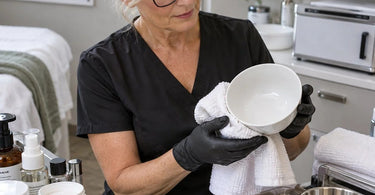
Because every detail matters... even the tiny water droplets hiding at the bottom of your treatment bowls! That freshly washed bowl might look perfectly ready for your next facial, brow service, or color treatment, but a little leftover moisture can turn certain professional products into a frustrating mess before the service even begins. Some powders begin reacting the moment they contact water, while other formulas depend on carefully measured liquid ratios for proper consistency and performance. And nobody wants to explain to a client why their luxurious treatment suddenly resembles a science fair experiment gone sideways.
For busy estheticians, cosmetologists, brow artists, nail technicians, and spa owners, preparing clean, properly dried mixing tools is one of those small professional habits that makes a surprisingly big difference. It helps protect product integrity, reduces unnecessary waste, and supports consistent service results. Best of all, it takes very little effort once it becomes part of your treatment room routine.
But here is the important distinction: not every professional beauty product requires a completely dry bowl. Some products are designed to be mixed with water, and certain techniques specifically call for adding measured water before the powder. The real goal is to eliminate unplanned moisture so that every ingredient enters the bowl at the correct time and in the correct amount.
Why Does a Little Water in a Treatment Bowl Matter?
Water might seem harmless. After all, it is involved in countless professional beauty treatments, from facial masks to hair color preparation. However, water is also an active participant in the chemistry of many products.
Depending on the formulation, introducing moisture can begin hydration, change viscosity, initiate a setting reaction, dilute an ingredient, or interfere with a carefully balanced mixing ratio. Some mixtures are forgiving, while others have very specific preparation requirements.
Imagine measuring the correct amount of liquid for a powdered treatment, only to discover that your bowl already contained an additional teaspoon of water. That unexpected liquid changes the final proportion of ingredients, even though you followed the measuring instructions perfectly.
For products that set quickly, moisture may cause portions of the powder to begin reacting before the rest of the ingredients are incorporated. Instead of a smooth, uniform mixture, you could end up with stubborn lumps, inconsistent texture, or a shorter working time.
This is why a dry starting bowl can be particularly valuable when working with products that require precise preparation. It gives the professional control over exactly when hydration begins.
Powdered Facial Masks: When Moisture Changes the Texture
Professional powdered facial masks are one of the clearest examples of why bowl preparation deserves attention. Many alginate, rubber, and jelly masks are formulated to transform into a spreadable paste after a specific amount of water is added.
Once the ingredients are combined, the clock starts ticking. Depending on the formulation, the mixture gradually thickens or develops the structure needed to set on the skin.
If residual water is sitting inside the bowl before the measured liquid is added, the final mixture may contain more water than the manufacturer intended. This can produce a thinner texture, increase dripping, or interfere with the desired setting behavior.
There is another potential problem when dry powder touches isolated wet areas of a bowl. Those areas can begin hydrating before the rest of the powder, creating uneven patches or clumps that are difficult to incorporate smoothly.
For professional estheticians working with advanced facial treatment products, consistency matters. A properly prepared mask should spread according to its intended application technique, remain workable for the expected period, and provide the finish specified by the manufacturer.
Professional tip: Start with a clean, dry bowl when measuring dry powder, unless the product directions specify otherwise. Then add the exact amount of water at the stage directed by the manufacturer. Some alginate mask instructions recommend placing measured water in the bowl first, followed by the powder. That is perfectly appropriate because the water is intentional, measured, and introduced at the correct step.
The goal is not to keep water away from a water-activated mask forever. It is to make sure water arrives on schedule, rather than sneaking into the treatment like an uninvited guest.
Hair Lighteners and Color Products: Precision Is Everything
Professional hair services provide another reason to pay attention to mixing equipment. Powder lighteners, color formulations, and chemical processing products often require specific ratios of product to developer or another designated mixing component.
Many professional lighteners are mixed with an appropriate peroxide developer rather than plain water. Adding unexpected moisture can change the intended consistency and introduce a variable that was not part of the manufacturer's formulation.
For example, a lightener mixed at an incorrect ratio may become too thin or too thick for the intended application. This can affect handling, placement, and the consistency of the service.
That is why professionals working with hair bleaches and lighteners should use clean, suitably dry, manufacturer-approved mixing tools and carefully measure every component.
It is also essential to follow the product's instructions regarding bowl material. Certain formulations require nonmetallic bowls, and mixing tools must be chemically compatible with the product being prepared.
Explore professional hair color and compatible hair color mixing bowls when outfitting a salon color station.
Remember: A dry bowl does not replace accurate measuring, suitable ventilation, protective equipment, or correct processing procedures. It is one practical part of a complete professional preparation system.
Brow and Lash Services: Small Batches Require Extra Attention
Brow and lash professionals often prepare very small quantities of product. That makes consistency especially important because even a small amount of unintended liquid can represent a noticeable portion of the mixture.
Consider a brow tint service that requires a carefully measured amount of tint and its designated developer. If the mixing dish contains leftover rinse water, the intended proportions may no longer be accurate.
Depending on the product, this could affect texture, application control, or performance. Rather than attempting to compensate by adding extra tint or developer, professionals should follow the specified mixing directions and prepare a fresh batch when necessary.
The same attention applies to products used in lash lift and perm services and brow lamination. However, preparation requirements vary considerably between systems.
Some products are supplied ready to use and should not be mixed with anything. Others require a separate developer or a specific activation procedure. Never assume that two products should be prepared the same way simply because they are used for similar services.
Professionals shopping for professional lash and brow tint should also consider dedicated tint mixing dishes, appropriately sized applicators, and designated preparation tools.
And yes, that adorable little tint dish deserves a thorough drying, too. Being tiny does not give it permission to sabotage your formula.
What About Acrylic Nail Products?
Nail technicians already understand the importance of controlling liquid and powder interactions. Acrylic enhancement systems rely on specific chemistry, proper product compatibility, and careful handling of liquid monomer and polymer powder.
Unintended water contamination in an acrylic preparation container or product can interfere with normal handling and may affect the resulting enhancement.
However, acrylic nail products are not all mixed in treatment bowls. Many traditional systems involve a brush, a dappen dish containing the designated monomer, and a separate powder container.
For these systems, the practical lesson is to keep containers and implements clean, dry when required, and free from incompatible substances. Use the manufacturer's specified technique rather than transferring facial mask mixing procedures to nail enhancement products.
Professionals can explore acrylic nail supplies, nail brushes and tools, and manicure essentials to support an organized nail service station.
How Residual Moisture Can Increase Product Waste
For salon and spa owners, a mixing mistake is not simply an inconvenience. It can also become an unnecessary operating expense.
Consider what happens when a professional preparation goes wrong. The original portion may need to be discarded, another portion must be measured, additional applicators may be required, and the technician spends valuable appointment time correcting a preventable problem.
Now imagine the same issue occurring repeatedly across several treatment rooms. Those small losses accumulate, particularly when working with premium professional products.
Starting with appropriately prepared tools helps reduce avoidable variation. It also makes troubleshooting easier because technicians can be more confident that the ingredients were not affected by hidden moisture.
Businesses investing in spa essentials for professionals should consider bowl preparation and maintenance part of their broader inventory management strategy.
After all, the goal is to use your products on paying clients, not sacrifice them to the mysterious puddle at the bottom of a mixing bowl.
Clean and Dry Are Not the Same Thing
Here is an especially important distinction for professional beauty environments: a dry bowl is not automatically a sanitary bowl, and a clean-looking bowl is not necessarily ready for professional use.
Proper sanitation involves following applicable state board requirements, product labeling, and the appropriate cleaning and disinfection procedures for reusable implements.
Cleaning removes visible debris and product residue. Disinfection, when required, involves using an appropriate disinfectant according to its label instructions, including correct dilution, application method, and contact time.
Afterward, tools must be handled according to the disinfectant instructions and the requirements of the next product being prepared.
Some products or regulations require rinsing after disinfection, while others specify different procedures. Drying should occur only at the appropriate stage and should never shorten a required disinfectant contact time.
For professionals maintaining treatment rooms, professional cleaners and disinfectants for salons and spas are an essential part of the service preparation process.
Important: Drying an improperly cleaned or disinfected bowl does not make it safe for reuse. Proper cleaning, appropriate disinfection, and suitable drying are separate steps that work together.
The Best Way to Dry Professional Mixing Bowls
Fortunately, keeping your preparation bowls dry does not require a complicated new procedure. A few consistent habits can make the process more efficient.
1. Complete the required cleaning and disinfection process. Remove all product residue and follow the relevant sanitation requirements for the tool and service. Pay special attention to bowls used with products that harden, stain, or leave buildup.
2. Follow any required rinsing instructions. If the disinfectant label or applicable procedure requires rinsing, complete that step with the specified type of water before drying.
3. Allow the bowl to dry thoroughly. Air-dry the bowl in a clean, protected location when appropriate. If a drying material is permitted, use a clean, lint-free, single-use option that will not introduce residue or contamination.
4. Check the bottom and inner edges. Water frequently collects around curved bases, rims, seams, and textured surfaces. A bowl can appear dry from above while droplets remain in less visible areas.
5. Inspect the mixing implement. Your spatula, brush handle, whisk, or applicator must also be properly prepared. A completely dry bowl will not help much if the mixing tool carries water into the product.
6. Store prepared implements correctly. Follow state board rules and the manufacturer's instructions for storage after disinfection. Use a clean, designated area that protects implements from contamination and allows any required drying to finish.
Professionals can browse professional mixing bowls and applicators and spatulas to assemble a practical preparation station.
Choosing the Right Bowl for Different Services
Not all mixing bowls are created equal. The best option depends on the product, service, cleaning requirements, and manufacturer recommendations.
Flexible silicone bowls: These can be convenient for certain facial masks because their flexible sides make mixing and removing set product easier. Always confirm that the material is compatible with the formulation and required cleaning or disinfection method.
Rigid plastic bowls: Lightweight plastic bowls may work well for compatible professional preparations. Inspect reusable versions regularly for scratches, cracks, or deterioration that could interfere with effective cleaning.
Glass mixing dishes: Glass dishes can offer a smooth, nonporous surface for certain small-batch products. Choose appropriate professional-use designs and avoid chipped or damaged containers.
Manufacturer-approved color bowls: For hair lighteners and color systems, select the mixing material specified by the manufacturer. Do not substitute metal containers when the product directions require nonmetallic equipment.
Dedicated service dishes: Small dishes for brow tinting and other precision services can help technicians control portions and maintain a more organized workspace.
Where practical, keeping separate preparation tools for different product categories can simplify workflow and reduce the risk of incompatible residues transferring between services.
That last point is especially helpful when your spa offers everything from facial treatments to brow tinting. Your mixing station should be organized, not auditioning for a crossover episode of every beauty service in the building.
When a Bowl Does Not Need to Start Completely Dry
Although dry equipment is important for many preparations, there are situations where a manufacturer intentionally directs the professional to begin with liquid in the mixing bowl.
For example, certain powdered facial masks require measured water to be poured into the bowl before the powder is added. This technique can support more uniform hydration and make the ingredients easier to incorporate.
Other products may be designed to combine with a specific liquid base or activating solution.
In these situations, the key is to start with a properly cleaned bowl that contains no uncontrolled moisture, then introduce the exact liquid required by the directions.
It is also important to distinguish products that are formulated for mixing from those supplied ready to use. Adding water to a ready-to-use treatment can dilute the formula, introduce contamination, or undermine the intended product performance.
Do not improvise by replacing a required activator with water or changing the recommended liquid amount simply because the consistency looks different than expected.
Following manufacturer directions is always more reliable than guessing.
Signs That Unwanted Moisture May Have Affected Your Mixture
Sometimes a preparation does not behave as expected even when the ingredients appear to have been measured correctly. Depending on the product, possible warning signs include:
- Unexpected clumps forming before normal mixing is complete.
- A mixture that appears unusually thin or watery.
- Inconsistent texture between batches prepared using the same instructions.
- Premature thickening or setting in a water-activated formulation.
- Difficulty applying the mixture using the normal professional technique.
- Visible separation or other unexpected changes in appearance.
These symptoms do not automatically prove that water contamination occurred. Incorrect ratios, water temperature, expired materials, improper storage, incompatible tools, and deviations from manufacturer instructions can produce similar problems.
If a mixture behaves unexpectedly, stop and check the product directions. Do not attempt to rescue a questionable formula by randomly adding more powder, developer, or water.
When product integrity or client safety is uncertain, discard the questionable mixture according to the manufacturer's disposal guidance and prepare a fresh batch with properly prepared equipment.
A Simple Mixing Station Routine for Busy Spas and Salons
One of the easiest ways to prevent avoidable preparation problems is to develop a consistent workstation routine.
Before beginning a service, confirm that your mixing bowl and implements have completed the required cleaning and disinfection process. Verify that they are dry when the formulation requires dry equipment.
Next, review the product's mixing directions and gather every required component. Prepare measuring tools, designated liquids, applicators, protective equipment, and a suitable work surface before opening the product.
Measure the ingredients using the method specified by the manufacturer. Introduce each component in the recommended order, mix for the appropriate duration, and begin application within the stated working time.
After the service, remove product residue promptly when safe and permitted. Follow the required cleaning and disinfection procedures before returning reusable implements to their designated storage location.
For spa owners managing multiple treatment rooms, a short written preparation procedure can help maintain consistency between team members.
Keeping essential spa tools and implements available in sufficient quantities also reduces the temptation to rush the cleaning or drying process between appointments.
Why Having Extra Mixing Bowls Can Be a Smart Business Decision
Running a successful beauty business involves balancing sanitation, appointment timing, service quality, and product costs.
One properly maintained mixing bowl might be adequate for an occasional service. However, a busy facial room or color station may benefit from several compatible bowls so that one can complete the required cleaning, disinfection, and drying process while another is ready for use.
This is particularly helpful when the same treatment room provides consecutive services requiring freshly prepared mixtures.
Having enough bowls and applicators available can reduce workflow interruptions without encouraging technicians to skip important preparation steps.
When evaluating supplies, consider how frequently each bowl is used, whether the material is suitable for the products involved, how it must be sanitized, and how much storage space is available.
Professionals can explore must-have supplies for salon and spa business success alongside mixing bowls and other everyday preparation essentials.
The right number of bowls is not necessarily the largest number you can fit into a cabinet. It is the number that supports safe, efficient service without creating unnecessary clutter.
Training Your Team to Catch the Small Details
Experienced professionals often develop preparation habits automatically, but newer team members may not recognize why certain steps matter.
Instead of simply instructing employees to use dry bowls, explain how moisture can influence different formulations.
Demonstrate the correct preparation process for each service category. Show technicians how to identify residual water, measure ingredients accurately, inspect mixing tools, and recognize unusual product behavior.
Make manufacturer instructions readily accessible, especially when introducing new treatment products or changing professional brands.
It is also worth explaining that dry tools are not a universal substitute for proper product handling. Staff should understand when a formula requires measured water, when a specific developer must be used, and when a product should never be diluted.
For teams offering a wide variety of professional spa body treatments and skincare services, these habits help establish a repeatable standard across the business.
And the best part? Once everyone understands the reason behind the procedure, it becomes a professional habit rather than another mysterious rule posted beside the sink.
Frequently Asked Questions About Dry Treatment Bowls
Can a few drops of water really affect a professional facial mask?
Yes, depending on the formulation and batch size. In products requiring a precise liquid ratio, additional water can alter consistency or setting behavior. The effect depends on how much water is present and how the product is designed to work.
Should every mixing bowl be completely dry before use?
Not necessarily. A bowl should be properly cleaned and prepared for its intended service. For products that require a dry starting container, eliminate residual moisture. When the directions call for adding measured water first, follow those instructions.
Can I use the same mixing bowl for facial masks and hair color?
Separate, dedicated tools are generally a practical choice for different service categories. Product compatibility, sanitation requirements, and the risk of residue transfer should guide equipment selection. Follow the manufacturer instructions and applicable licensing regulations.
Is a paper towel enough to dry a mixing bowl?
Only use a drying method permitted by the applicable sanitation procedures. Clean, lint-free, single-use drying materials may be appropriate in some circumstances, while air-drying may be required or preferred in others. Avoid introducing lint, residue, or contamination.
What should I do if a product was mixed in a wet bowl by mistake?
Check the product instructions and assess whether the preparation remains within the specified requirements. If the mixture is outside the required ratio, behaves abnormally, or raises safety concerns, discard it appropriately and prepare a fresh batch.
Can residual moisture affect brow tint or hair lightener?
Yes. Unintended water can change a precisely measured mixture and may affect handling or performance. Use the designated developer or mixing component and follow the product-specific directions.
Make Better Bowl Preparation Part of Every Professional Service
The difference between an effortless beauty treatment and an avoidable mixing mishap sometimes comes down to something as small as a drop of water.
For professional estheticians, salon owners, brow artists, and nail technicians, keeping mixing equipment appropriately clean, dry, and ready for its intended purpose is a simple way to support dependable results.
That does not mean every product must be kept away from water. It means professionals should control when moisture enters the process, measure ingredients accurately, and follow the instructions developed for each formulation.
Whether you are preparing an alginate facial mask, mixing professional hair lightener, or creating a precise brow tint mixture, paying attention to your tools helps protect both your service quality and your product investment.
Explore mixing bowls for salon and spa treatments, professional applicators and spatulas, and spa essentials at Pure Spa Direct to keep your treatment preparation station organized and service-ready.
Because a gorgeous treatment deserves a great formula, a confident professional, and a mixing bowl that knows better than to bring its own water to the party.
