
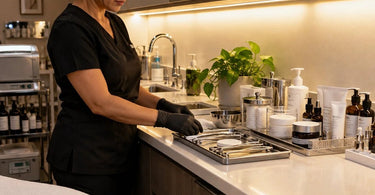
Upgrade your offerings with this now... because sometimes the smallest treatment room improvement is the one that makes you wonder why you worked without it for so long. Strategic spa lighting can make a surprisingly big difference in how comfortably and efficiently professionals prep products, organize supplies, clean work surfaces, and move through a service. Under-cabinet lighting is especially useful because it puts illumination close to the place where the work actually happens instead of asking one lonely ceiling fixture to handle every job in the room.
Overhead lighting absolutely has a role in a professional spa. It provides general illumination, helps clients and staff move safely through the room, and contributes to the overall atmosphere. The trouble begins when overhead lighting is expected to be ambient lighting, task lighting, detail lighting, cleaning lighting, product-prep lighting, and mood lighting all at once. That is a lot to ask from a few fixtures several feet above your head.
Why Under-Cabinet Lighting Can Be More Useful Than Overhead Lighting in a Spa
The biggest advantage of under-cabinet lighting is simple: it brings light closer to the work surface. Cabinets, shelves, equipment, and even the professional standing at a counter can interfere with illumination coming from above. You can have a treatment room that looks beautifully bright from the doorway while still discovering that the countertop where you actually pour, mix, measure, organize, or sanitize products is sitting in a shadow.
Under-cabinet lighting fills that gap. Mounted beneath upper cabinetry or shelving, it can illuminate the countertop directly and create a more usable prep zone. That makes it particularly valuable around back bars, esthetician work counters, nail stations, waxing prep areas, and other spaces where professionals routinely handle small items.
Think of overhead lighting as the room's big cheerful sun and under-cabinet lighting as the focused coworker who actually remembers where you put the tweezers.
Better Light Right Where Products Are Prepared
Professional spa services often involve a surprising amount of countertop work. Estheticians may dispense cleansers, serums, masks, exfoliants, or other Premium Skincare Products for Spas and Salons. Waxing professionals organize applicators, pre-wax products, post-wax products, and supplies from their Waxing Supplies for Professionals. Nail technicians need clear visibility when selecting products, cleaning implements, or preparing detailed service supplies.
A targeted light source immediately above a counter can make those routine tasks easier to see without dramatically increasing brightness throughout the entire room. This is especially helpful in spas that intentionally maintain softer ambient lighting to create a relaxing client experience.
After all, the client may want candlelight vibes. The professional trying to distinguish two nearly identical bottles absolutely does not.
It Can Reduce Annoying Countertop Shadows
One of the weaknesses of ceiling light is that anything between the fixture and the work surface can create a shadow. Upper cabinets themselves may block part of the overhead illumination. Then the service provider steps up to the counter and can block even more.
Properly positioned under-cabinet lighting approaches the task from much closer to the surface, helping illuminate areas that overhead fixtures may not reach evenly. A continuous light source can also provide broader coverage across a workstation than relying on a single concentrated ceiling fixture.
This can be useful anywhere staff routinely handle Spa Tools & Implements for Professionals, Professional Cotton, Sponges, and Wipes for Salons & Spas, applicators, bowls, bottles, or other small service supplies.
Layered Lighting Lets a Spa Feel Relaxing Without Making Staff Work in the Dark
Spa lighting has two jobs that occasionally behave like coworkers who cannot agree on the thermostat. Clients typically appreciate warm, comfortable, subdued surroundings. Professionals need enough usable light to perform services, inspect work areas, prepare products, and clean properly.
Layering different types of lighting helps solve that conflict. Instead of making every overhead fixture blazing bright during an otherwise relaxing service, a spa can use softer ambient illumination while activating task lighting only where it is needed.
That flexibility can be especially useful in multifunction treatment rooms. During consultation and setup, the workspace might need additional light. During a relaxing mask or massage portion of the appointment, ambient light can remain softer. When the professional returns to the back bar to organize products or reset the room, targeted lighting is available again.
Pairing built-in task lighting with movable professional lighting such as LED Bright Lamps or Magnifying Lights can create an adaptable lighting setup for rooms performing several types of services.
Under-Cabinet Lighting Is Particularly Helpful at the Back Bar
The back bar may not be the glamorous part of the spa room, but it is frequently command central. Products are stored there. Supplies are staged there. Containers are opened, closed, dispensed, wiped, and reorganized there approximately seventeen thousand times a week. Fine, that number may be emotionally accurate rather than mathematically accurate.
Good task lighting can make this area considerably easier to use. Products stored beneath cabinets become easier to identify, countertop surfaces are more visible, and employees can quickly see what needs to be restocked or cleaned.
Consider pairing good lighting with organized Bottles & Jars, Mixing Bowls, and Applicators & Spatulas. A well-lit, thoughtfully arranged workstation reduces visual clutter and can help professionals develop a smoother service rhythm.
Cleaning Is Easier When You Can Actually See the Surface
Soft lighting is wonderful for relaxation. It is considerably less wonderful when you are inspecting a countertop after a busy day.
Direct workspace lighting can make residue, drips, dust, product splatter, and other messes easier to spot during room turnover. This does not replace proper cleaning procedures or professional Professional Cleaners & Disinfectants for Salons and Spas, of course. It simply gives staff better visibility while they carry out those routines.
A useful workflow can be surprisingly simple: complete the service, turn up the task lighting, clear disposables, clean and disinfect appropriate surfaces and tools according to applicable instructions and regulations, restock the workstation, and then return the room to its client-ready lighting level.
Consider Color Quality, Not Just Brightness
More light is not automatically better light. A professional workspace should be designed so that the illumination is comfortable and useful rather than glaring or visually harsh.
Color rendering is particularly relevant in beauty settings because professionals frequently evaluate skin tones, cosmetics, nail colors, hair colors, wax application areas, and other details where visual accuracy matters. Selecting high-quality lighting with good color rendering can help materials and skin appear more natural than they may under inexpensive lighting that distorts color.
Color temperature matters too. Very warm lighting can create a cozy atmosphere but may not be ideal for every detail-oriented task. Very cool light can provide a crisp appearance but may feel overly clinical in a relaxation-focused room. Many facilities therefore benefit from separating ambient and task lighting so each layer can serve its own purpose.
Watch Out for Glare
The goal is to illuminate the counter, not create a miniature interrogation room beneath the cabinets.
Placement matters because an exposed strip or poorly positioned fixture can become visible to staff or clients and create uncomfortable glare. Reflective countertops, glossy cabinetry, mirrors, metal containers, and other shiny spa surfaces can also bounce light in unintended directions.
Fixtures with diffusers can help soften visible points of light, while thoughtful placement helps direct illumination toward the work surface. In many installations, positioning a linear fixture so it distributes light broadly across the counter produces a more useful result than creating one intensely bright spot.
Before committing to a permanent layout, evaluate the proposed lighting from the positions where both the professional and client will actually be. Sit down. Stand up. Recline on the treatment table. Look toward the workstation. If the client gets an eyeful of tiny LED suns every time she turns her head, some adjustment may be warranted.
Separate Controls Can Make the Room Much More Flexible
One of the smartest choices for a treatment room is giving different lighting layers their own controls. Under-cabinet task lighting is much more valuable when staff can turn it on during setup, consultation, detailed work, cleaning, or restocking without changing the entire mood of the room.
Dimming can add additional flexibility where appropriate. A bright setting may work during preparation or cleanup, while a lower setting can provide subtle illumination without disrupting a relaxing environment.
This approach can be particularly useful in rooms equipped with Top-Quality Equipment & Furniture for Spas & Salons because the lighting can be planned around actual workstations, cabinetry, storage, and equipment rather than simply spreading identical fixtures across the ceiling.
Plan Lighting Around the Service Flow
Before installing anything, watch how professionals actually move through the room. Where do they prepare products? Where are clean supplies stored? Where do used implements go? Which counter gets crowded halfway through the service? Where does someone repeatedly lean closer because visibility is poor?
Those observations are more useful than choosing lighting based exclusively on what looks attractive in an empty room.
A facial treatment room may benefit from additional light beneath cabinetry near the skincare preparation area. A waxing room may need targeted illumination near its Professional Wax Warmers for Salons & Spas and product station. A manicure area can benefit from focused workstation illumination in addition to general room lighting. Lash and brow professionals may still need specialized service lighting, but under-cabinet fixtures can improve visibility at the nearby supply and preparation station.
The point is not to install lights beneath every horizontal object in the building. The point is to identify real working zones and illuminate them intentionally.
Do Not Forget Installation and Electrical Considerations
Because professional spas are commercial environments, permanent lighting installations should be selected and installed with applicable electrical requirements, fixture specifications, local codes, and the conditions of the room in mind. Areas exposed to moisture or other special conditions may require fixtures specifically suitable for those locations.
Wiring and power supplies should also be planned so they remain practical to access for maintenance without creating visual clutter around the client area. Nobody wants to create a beautifully organized back bar and then finish it off with a cable situation that resembles spaghetti night.
If you are remodeling or building out a new spa, planning lighting while cabinetry and electrical work are being designed can produce a much cleaner result than treating task lighting as an afterthought.
Overhead Lighting Still Matters
Under-cabinet lighting is not a replacement for every ceiling fixture. A well-designed treatment room generally works best with layers. Overhead or indirect lighting supports general visibility and circulation. Task lighting supports specific work. Accent lighting can contribute to the atmosphere and presentation of the room.
The advantage comes from allowing each layer to do the job it does best.
That philosophy applies throughout a spa. A beautiful Luxury Spa Furniture arrangement deserves comfortable ambient illumination, while a working counter deserves practical task light. The client can enjoy the atmosphere without the esthetician having to identify a product label using the glow from a diffuser and pure optimism.
A Small Upgrade That Can Improve the Whole Workstation
Under-cabinet lighting is one of those details that may not immediately command attention, and that is part of its charm. Good task lighting quietly makes a workspace easier to use. It illuminates products without flooding the whole room, reduces frustrating shadowed areas, supports cleaning and setup, and allows softer ambient lighting to remain part of the client experience.
For spa owners evaluating treatment room improvements, look beyond equipment alone and consider the environment surrounding that equipment. Lighting, cabinetry, storage, Spa Essentials for Professionals, linens, tools, and furniture all influence how smoothly a professional can move through a service.
The next time you notice someone leaning over a back bar, squinting at a label, or using a phone flashlight to find something beneath a cabinet, consider it your treatment room sending up a tiny illuminated distress signal. A thoughtfully placed layer of task lighting might be exactly what that workspace has been asking for.
