
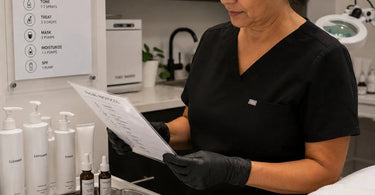
Make excellence your standard...and for goodness' sake, write it down! Let's be real for a hot second. You didn't open a spa or salon to become a detective, constantly hunting down missing bottles of your expensive serum or wondering why you're ordering wax twice as often as you did last month. But here you are, watching your hard-earned profits seemingly evaporate into thin air (or down the drain, literally). The culprit isn't some mysterious force of nature; it's the insidious creep of product waste. And the superhero you need isn't a new piece of expensive equipment; it's a simple, unassuming, and incredibly powerful tool: the written protocol. Think of it as the instruction manual for your business' profitability and your team's sanity.
We get it. The word 'protocol' can sound a bit clinical, conjuring images of sterile labs and stiff procedures. But in the vibrant, fast-paced world of beauty and wellness, a written protocol is your best friend. It's the secret ingredient that ensures your team delivers a consistent, high-quality experience while simultaneously keeping your product costs in check. It bridges the gap between the brilliant service in your head and the flawless execution by your team. A well-crafted protocol is the difference between a chaotic, expensive free-for-all and a streamlined, profitable business where everyone knows the game plan.
The concept isn't new. Industry leaders have long recognized that standardizing processes is key to success. As early as 2014, organizations like the American Med Spa Association (AmSpa) were releasing Standard Operating Procedures (SOPs) to help medical aesthetic businesses not only improve service standards and customer satisfaction but also actively reduce costs associated with waste and inefficient processes . This isn't just about being neat; it's about the bottom line. By standardizing how services are performed, you gain control over how much product is used for each service . You transform guessing into knowing, making it easier to track usage, manage inventory, and ultimately, boost your profitability.
The Great Product Drain: How Waste Sneaks into Your Spa
Before we dive into the solution, let's have a little fun at the expense of our common (and expensive) problems. Picture this: a therapist who loves your organic serum a little too much and uses a 'generous' amount on every client, treating it like it's bottomless. Or a new esthetician who's unsure of the exact steps for a High Facial and ends up using three times the necessary product just to be safe. Maybe it's a well-meaning but distracted team member who leaves a cap off a massage oil, resulting in an oily puddle of regret on the counter. We've all been there, haven't we?
This isn't malicious; it's often just a lack of clarity and a touch of creative interpretation. When everyone has their own 'style' of performing a service, consistency goes out the window, and product usage goes through the roof. These little 'extras' might seem insignificant on their own, but when multiplied by dozens of services a week, they add up to a significant, and entirely preventable, drain on your resources. According to modern inventory management experts, when you standardize mix ratios and usage, waste naturally decreases because teams set realistic goals and can measure their progress over time .
Written Protocols: Your Best Defense Against Waste
So, how exactly does putting pen to paper (or fingers to keyboard) stop the product exodus? Let's break down the superpowers of a written protocol.
1. Standardization: The Key to Consistency
A written protocol is your business' official recipe. It spells out exactly what products are to be used, in what order, and in what quantities. It eliminates the 'eyeballing' method of dispensing products. For instance, instead of 'use a dollop of cleanser,' your protocol might specify 'dispense one pump of cleanser onto a damp sponge.' This simple instruction ensures that every client receives the same amount of product, and you know exactly how much is being used per service . This level of detail is crucial for managing costs and ensuring a consistent experience that keeps clients coming back.
2. Training and Accountability: Empowering Your Team
Training a new team member can be daunting, especially when you're trying to transfer years of intuitive knowledge. A written protocol serves as a clear, comprehensive training manual . It removes the guesswork, so new hires can learn the ropes quickly and correctly, preventing costly mistakes from the get-go. It also establishes a standard for accountability. When everyone follows the same protocol, it's easy to identify deviations and provide feedback. If your color hair color usage spikes, you can look at your protocols and see if the standard mix was followed, making it easier to pinpoint and correct the issue .
3. Streamlined Inventory Management: Know What You Have and What You Need
When you know exactly how much of each product you use per service, your inventory management becomes a breeze. You can accurately forecast your needs, preventing both overstocking (which ties up capital and risks product expiration) and stockouts (which lead to service interruptions and unhappy clients). This knowledge gives you control. You can track stock availability, usage, and suppliers, preventing shortages and maintaining full control over your salon products . For example, if your protocol requires four ounces of pre-wax cleanser per service, you can instantly calculate how much you'll need to order for the month, eliminating waste and ensuring you're always prepared.
How to Write a Protocol That Actually Works
Creating a protocol is like writing a recipe for your most popular service. Don't overcomplicate it. Here's a step-by-step guide to get you started.
Step 1: Observe and Document
First, watch your best team member perform the service from start to finish. Write down every single step, every product used, and every tool needed. Be excruciatingly specific. What kind of cotton rounds? How many? How much pressure? What is the exact duration for steaming? You're not just writing a to-do list; you're capturing the perfect execution of the service .
Step 2: Include Product Names and Quantities
This is the money-saving part of your protocol. List the exact product names and the precise amount to be used for each step. Do you apply a specific serum using a dropper? Specify the number of drops. Are you applying a massage lotion? Specify the number of pumps. If you use a professional waxing kit, specify the amount of wax to be applied per area. This eliminates waste and ensures consistency across your team .
Step 3: Don't Forget the 'Why'
Briefly explain the purpose of each step. This helps your team understand the science and art behind the service, empowering them to make minor adjustments based on a client's unique needs without straying from the core protocol. For example, note that a specific massage stroke is to promote lymphatic drainage or that a particular skincare product is used for its calming properties. This builds a deeper understanding and appreciation for the service.
Step 4: Make it Accessible and Get Feedback
A protocol locked in a drawer is useless. Keep it in a central, accessible location, or better yet, use a digital platform where your team can easily reference it on a tablet or phone. Once you've drafted it, review it with your team. They are the ones performing the service, so their feedback is invaluable. Let them test it and provide input to make the protocol even better. This process of creating protocols can empower your team of service providers to deliver a consistently excellent service .
Real-World Proof: This Isn't Just a Theory
This isn't some pie-in-the-sky concept. Major companies are using similar strategies to save serious money and resources. Look at the world of hospitality, for example. One luxury hotel group switched to refillable dispensers for their amenities and saw a 73.5% reduction in bottle consumption, saving over 60,000 bottles a year . While the scale is different, the principle is the same: standardizing how a product is dispensed leads to massive reductions in waste. In the salon and spa world, modern inventory platforms that track product usage at the service level have been shown to help reduce hair color waste. Consistent portioning, formula tracking, and real-time deductions help make usage more visible and predictable .
Start Saving Today
Look, we know you're passionate about your craft. You got into this industry to make people feel beautiful and relaxed, not to be a forensic accountant. But the reality is, to keep the doors open and continue doing what you love, you need to be profitable. Written protocols are the bridge between your passion and your profit.
Ready to take control of your product waste and your bottom line? At Pure Spa Direct, we're more than just a distributor; we're your partner in building a more efficient and profitable business. From wax warmers and spatulas to massage oils and nail care, we have everything you need to stock your treatment rooms. And we're here to support you in using them wisely. Start writing those protocols today, and watch your waste (and your stress levels) shrink. You've got this!
