
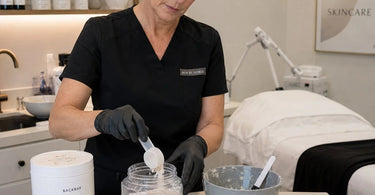
Start strong, finish stronger... especially when it comes to your backbar mask powder. Nothing kills the vibe of a luxurious facial faster than reaching for your favorite powder mask, scooping out a portion, and realizing it has turned into a lumpy, cement-like brick. Suddenly, your relaxing treatment room feels more like a construction site. You are left chipping away at a rock-hard chunk of what was once a silky, botanical powder, all while your client gives you that \"are you okay?\" look. It is a spa professional's version of a horror movie. We have all been there, staring into a jar of perfectly good product that has been ruined by the silent enemies of humidity, heat, and improper storage. But fear not, because today we are going to turn that frown upside down.
Welcome to your ultimate guide on keeping your backbar mask powders as fresh and flowy as the day you cracked open that brand new container. At Pure Spa Direct, we have talked to thousands of estheticians, spa owners, and facialists who have asked, \"Why is my powder hard?\" or \"How do I keep this from happening?\". The answer is simpler than you think, and it does not require a degree in chemistry. It requires a little common sense, a few affordable tools, and a commitment to making your backbar area a sanctuary for your products, not a swamp. Whether you are a solo esthetician working out of a cozy room or managing a high-volume spa with dozens of treatments a day, these best practices will save you money, reduce waste, and keep your services consistently excellent. After all, a happy mask powder makes for a happy esthetician, and a happy esthetician gives a killer facial. Let's dive into the nitty-gritty of keeping your powders pristine.
Why Your Backbar Mask Powder is Betraying You
Before we start solving the problem, we need to understand the villain of our story: moisture. Yes, that innocent little H2O floating around in the air is actually the arch-nemesis of your dry mask powders. Most professional mask powders are formulated with natural clays, botanical extracts, and active ingredients like Vitamin C or Colloidal Oatmeal. These ingredients are hygroscopic, which is a fancy way of saying they love to attract and absorb water molecules from the environment. When that happens, the powder begins to hydrate prematurely, causing the particles to stick together. This creates clumps, then hard chunks, and eventually a full-on brick.
Think of it like that time you left a sugar bowl open on a humid summer day. The same principle applies, except your mask powder is way more expensive and a lot less tasty. High humidity is the primary culprit, but it is not the only one. Temperature fluctuations (like storing your masks right next to a towel steamer) can create condensation inside the container. Also, good old-fashioned cross-contamination from a damp scoop or wet hands is a surefire way to introduce moisture directly into the mix. So, are we doomed to a life of chunky masks? Absolutely not. With a few simple changes to your backbar routine, you can keep your powders performing perfectly for their entire shelf life.
First Things First: The Container Crusade
The vessel you choose to store your mask powder in is your first line of defense. That lightweight plastic tub it came in? It is probably not doing you any favors. While manufacturers do their best, those containers are often designed for shipping and initial display, not for long-term, heavy-duty storage in a humid spa environment. The screw-top lids can wear out, the plastic can become brittle, and the seals are rarely air-tight. Our top recommendation is to transfer your bulk powders into high-quality, airtight containers.
Look for containers made of thick glass or heavy-duty, BPA-free plastic with a true airtight seal, like a latch jar with a rubber gasket or a container with a locking lid. Amber or cobalt blue glass jars are excellent choices because they also protect light-sensitive ingredients from UV degradation. You can find amazing options in our Bottles & Jars section. Make sure the container is completely dry before you add the powder. We mean bone-dry. Run it through a UV sterilizer or let it air dry for hours. A single drop of water at the bottom of a new jar will spell disaster over time. And please, label that jar clearly with the product name and the date you opened it. Future you will be very grateful when you are not sniffing mysterious white powders trying to figure out what is what.
The Scoop on the Scoop (Literally)
Okay, you have your super-secret-agent-level airtight jar. You feel good. But do not let your guard down, because the most common way moisture enters your mask powder is through the tool you use to get it out. I am talking about the scoop. How many times have you washed your spatula, thought it was dry, and then plunged it into the powder? Even a microscopic film of water is an invitation for clumping. Worse, using the same scoop for a wet mask mixture and then dipping it back into the dry powder for a second client? That is a hygiene no-no and a moisture disaster.
The solution is simple and cheap: designated dry scoops. Invest in a set of high-quality, stainless steel or plastic spatulas and applicators specifically for your dry powders. Keep them in a separate, dry container or a sanitized jar right next to your mask powder. Never, ever wash a scoop and use it immediately. Have a rotation of scoops so they have ample time to dry completely before their next encounter with the powder. Also, train your staff (or yourself, if you are a one-woman army) to never, ever pour leftover mask mixture back into the dry powder container. I know it hurts to throw away product, but doing that is like throwing a water balloon into a room full of cotton candy. It ruins the entire batch for everyone. Be brave. Let it go.
Location, Location, Location (Your Backbar is Not a Swamp)
Where you keep your mixing bowls and powders matters almost as much as the container they are in. Your backbar is a busy place, often filled with heat, steam, and splashing water from basins, steamers, and sinks. Do not store your mask powders directly next to your Facial Steamers. I know it is convenient to have everything in one spot, but that steam is going to find its way into your powder every single time you open the lid. The same goes for above or below a sink, or in a cabinet that houses a hot water line. Heat and humidity are a tag team of destruction.
Instead, find a cool, dry, dark place for your powder storage. A closed cabinet away from the treatment area is ideal. If your treatment room is naturally humid, consider investing in a small, portable dehumidifier. It is a game-changer for both your products and your client's comfort. Also, avoid storing powders on high shelves near the ceiling, as heat rises. A low, sturdy shelf inside a temperature-controlled cabinet is your powder's happy place. For spas located in notoriously humid climates (looking at you, Florida and the Gulf Coast), you might even consider storing bulk backstock of unopened powder in a temperature-controlled storage room or even a sealed bin with silica gel packets (just make sure the packets do not break open).
Don't Forget the Unopened Backstock
Your hoard of unopened mask powder is an investment, and you should treat it like one. Those sealed bags and bottles are not invincible. If you stock up on a great deal from our Bulk Deals (hey, smart shopping!), you need to store the unopened cases properly. The same rules apply: cool, dry, and dark. Do not stash your backstock in a hot garage, a damp basement, or a closet that shares a wall with the boiler room. Extreme temperature swings can degrade the ingredients and compromise the seal over time, even if the package is not opened yet. Rotate your stock using the First-In, First-Out (FIFO) method. Put your newer purchases in the back and bring the older cases to the front. This ensures you are always using the oldest product first and minimizing the chance of something sitting around for two years before you even open it.
Recognizing the Signs of a Powder That Has Gone Bad
Sometimes, despite your best efforts, a mask powder will turn. It is a fact of life, like death, taxes, and clients who show up ten minutes late. The key is to recognize when a powder is past its prime so you do not serve it to a client. A ruined mask is not just about clumps; it can also lose its efficacy. Here is what to look for. First, the smell test. Does it smell musty, sour, or just \"off\"? That could indicate mold or bacterial growth, even if you cannot see it. Do not use it. Second, the visual test. Are there dark spots, discoloration, or fuzz? Obviously, that is a hard no. Third, the touch test. If the powder has changed texture entirely and is no longer able to be broken up into a fine dust with a whisk or your fingers, it is compromised.
Now, what about minor clumping? If you open your jar and find a few small, soft clumps that crumble easily at the touch, you can usually salvage the batch. Use a fine-mesh sieve or a small whisk to break up the clumps and aerate the powder. Do this right before you mix the mask for a client. However, if the powder is hard as a rock or has a foul odor, do not try to save it. It is a loss. Take it as a learning experience and double-check your storage methods. The cost of a new bag of powder is far less than the cost of a client complaint or a skin reaction. When in doubt, throw it out. Your clients' beautiful faces will thank you.
Product Spotlight: Powders That Love a Good Home
At Spa Masters, we believe that the best products deserve the best care. While we do not make them, we are thrilled to distribute some of the finest backbar mask powders on the planet. These beauties are packed with high-performance ingredients, and they are just begging to be stored properly. For instance, a colloidal oatmeal and honey powder is a godsend for sensitive skin, but those soothing ingredients can become a sticky mess if not stored correctly. The same goes for highly active charcoal and clay blends used for deep-cleansing Hydrodermabrasion preps. And let's not forget the brightening powers of a Turmeric Mask – a phenomenal treatment, but one that can degrade quickly in light and humidity.
Check out our curated selection of Premium Skincare Products to see the amazing mask powders we have in stock. From hydrating marine collagen masks to purifying French green clay, we have something for every skin concern you treat in your spa body treatments or facial services. When you receive your shipment from us, immediately inspect the packaging. If it looks damaged or if the seal seems compromised, let us know. But if it is pristine, follow these storage guidelines immediately. Do not leave that box sitting in a hot delivery truck or on a sunny loading dock for hours. Get it inside, open it up, and transfer that powder to its forever home – a clean, dry, airtight container in a cool, dark cabinet. Your product's performance and longevity depend on it.
Creating a Staff Protocol (Because Teamwork Makes the Dream Work)
If you have employees, you need a written protocol for backbar product storage. I know, I know, it sounds like corporate overkill. But trust me, one well-meaning employee using a damp scoop can undo weeks of careful storage. Create a simple, one-page guide that covers the essentials: always use dry, designated scoops; never double-dip; always close the lid tightly immediately after use; and store containers in the designated cool, dry area. Make it a part of your onboarding process and your monthly training refreshers.
You could even make it fun. Gamify it. The \"Powder Protection Prize\" for the employee who goes the longest without ruining a mask. Or make it a part of the nightly closing checklist: \"Wipe down containers, check lids, ensure scoops are dry.\" When your team understands the \"why\" behind the rules – that you are saving money, reducing waste, and providing a better service – they are much more likely to comply. Explain that clumpy, hard masks are harder to mix, take longer to apply, and do not spread as evenly, leading to a less-than-stellar client experience. When they realize that good storage equals happy clients (and potentially better tips), they will be on board. You can even put a humorous sign on the cabinet: \"Moisture is the enemy. Dry scoops only, or feel the wrath of the clumpy mask.\" A little humor goes a long way in a busy salon or barber shop environment.
What About Other Professional Powders? (Wax, Sugaring, and More)
While we are focusing on mask powders, these best practices apply to nearly every dry product in your professional arsenal. Your Dipping Powder Systems for Salons? Humidity is a nail tech's worst enemy, causing powder to harden in the jar and ruining the application. Your Soft Strip Wax for Effective Salon Hair Removal? While wax is different, keeping your ItalWax - Wax beads or pellets in a dry environment prevents them from absorbing moisture and becoming brittle or ineffective. Even your Natural Sugaring Products – while a paste – can be affected by ambient humidity in the room. The core lesson is universal for beauty pros: control the environment, control the product. If you treat your backbar with the same respect you treat your top-quality equipment and furniture, everything will last longer and perform better.
Think about your Brow Lamination Supplies and Professional Lash and Brow Tint powders as well. These are often sensitive to both moisture and light. The same airtight container rule applies. For small quantities of lash or brow tint powder, consider using tiny, amber glass jars with tight seals. And for the love of all that is beautiful, do not store them next to your Towel Steamers! That is a recipe for a brow tint that applies patchy and unevenly, and nobody has time for that. Take a walk through your entire spa or salon and identify every dry product you use. Make a plan to upgrade its storage situation. Your future self, and your bottom line, will be incredibly proud of you.
Final Thoughts & A Dash of Humility
Let's be real for a moment. You are a busy professional. Sometimes, you are going to forget to close the lid tightly. Sometimes, a new hire is going to use a wet scoop. Sometimes, a client is going to knock a jar off the shelf and it is going to explode into a dusty cloud of sadness. It happens. The goal is not perfection; the goal is progress. By implementing even half of these best practices, you will see a dramatic reduction in product waste and an improvement in the quality of your masks. Your clients will notice that their masks mix smoother, apply creamier, and rinse off easier. They will not know why, but they will know it feels better. And that, my friend, is the secret sauce.
So, take a deep breath. Assess your backbar today. Are your powders in airtight containers? Are your scoops dry and dedicated? Is your storage area cool and dark? If you answered \"no\" to any of those, you have a fun little project ahead of you. Head over to our Bottles & Jars section and grab some beautiful storage containers. Pick up a few extra spatulas while you are there. And maybe treat yourself to a new mixing bowl for good measure. You have earned it. Your powder will thank you, your clients will thank you, and your accountant will definitely thank you when you are not constantly reordering product that turned into a brick. Now go forth and store that powder like the boss you are!
)