
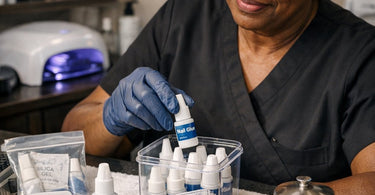
Start every task with confidence... and maybe a sniff test if your nail glue is acting up. Let's be real: few things are as panic-inducing in the middle of a full set than reaching for your trusty bottle of Professional Strength Nail Glue only to find it has turned into a stringy, unusable mess. You shake it, you squint at it, and you pray to the beauty gods that it will somehow magically bond that tip to the nail plate. Spoiler alert: it won't. When nail glue goes bad, it's not just annoying; it is a direct hit to your bottom line and your schedule. But here is the hilarious (and slightly tragic) truth—most of the time, we are the ones doing the dirty work. We leave that little bottle baking in the sun like a tourist in Miami, or we store it next to the Towel Steamers (which, love them as we do, are basically mini volcanoes). If you are tired of throwing away expensive product and muttering under your breath, you have come to the right place. Today, we are saving your sanity and your stockroom.
Here at Pure Spa Direct, we talk to nail techs every day who are ready to pull their hair out over wasted product. You spend good money on professional supplies, and it breaks our hearts to hear that a $20 bottle of glue is turning into a solid brick after two weeks. The issue is rarely the quality of the glue (though we always carry the good stuff). Usually, it's a classic case of bad storage hygiene. Think of your nail glue like that one friend who is super dramatic and sensitive to everything. It hates the light. It loathes the heat. It breaks down if you leave the cap off for five seconds. It is high-maintenance, but when you treat it right, it sticks by you (pun absolutely intended). Let's fix your storage game so you can get back to doing what you do best—creating stunning, durable nails without the drama.
Why Your Nail Glue is Ghosting You (The Science-y Bit, But Make It Fun)
Before we dive into the \"where\" and \"how,\" let's gossip about the \"why.\" Professional nail glues are primarily made of cyanoacrylate. Fancy word, right? It basically means this stuff is designed to bond instantly in the presence of moisture (like the natural nail bed). But that same reactivity means it is always looking for an excuse to set off. Heat, light, and humidity are its arch-nemeses [citation:1]. When you expose the bottle to high temperatures, the chemical reaction speeds up. It starts curing right inside the bottle, turning that lovely liquid into a thick, goopy, or rock-hard solid. Similarly, UV light acts like a trigger. Even ambient sunlight or the stray rays from a salon window can start the polymerization process [citation:5]. We aren't asking you to build a bomb shelter for your supplies, but a little awareness goes a long way. And humidity? Oh boy. If you work in a spa that is steamy (literally) or you are doing waxing in the next room, that moisture in the air is sneaking into your glue bottle every time you open it, causing it to cure faster.
The \"Goldilocks\" Zone: Temperature Control for Nail Glue
If you take nothing else away from this blog, remember this number: room temperature. We aren't trying to refrigerate this stuff like it's a six-pack of soda. In fact, putting nail glue in the fridge is a massive no-no unless you enjoy condensation and ruined product. When you take a cold bottle out into a humid salon, condensation forms on the inside and outside of the bottle. That water mixes with your glue, and bam—instant curing disaster [citation:10]. Your goal is a consistent, cool, dry environment. Ideally, you want storage between 65°F and 75°F (18°C - 24°C) [citation:1][citation:5].
Look around your workspace right now. Is your glue bottle sitting on a windowsill? Is it right next to the vent of your Facial Steamer? Is it baking under the hot lights of your Nail Tables and Manicure Stations? If you answered yes to any of these, you have found your culprit. Move your adhesives to a drawer away from direct heat sources. If you have a medication cabinet or a closed shelving unit that stays shaded, that is the perfect spot. During summer heatwaves, you might need to move your stock to an interior room or even a basement if you have one, just to keep that ambient temperature stable. Your glue wants to be comfortable, not sweating or shivering.
Darkness is Your Friend (And Your Glue's Bestie)
We know you love a bright, Instagram-worthy salon. Those pot lights and big windows are fantastic for taking photos of your latest Nail Art Rhinestones masterpieces. But for your chemical products? Not so much. Light exposure, specifically UV rays, is a silent killer for professional adhesives. It doesn't take much. Even repeated exposure to bright fluorescent lights can degrade the molecular structure of the glue over time [citation:5].
This is why so many professional glues come in opaque or dark-colored bottles. That isn't just for aesthetics; it is a built-in shield. But even that shield fails if you leave the bottle sitting on your desk for a month. The solution here is cheap and easy: buy a small, opaque container or a dedicated drawer organizer. If you are a mobile tech using a Top Quality Massage Tables Chairs for Relaxation & Wellness kit, make sure your glue is tucked away in a dark pouch, not the clear plastic window pocket. Treat light like the enemy. Keep those bottles in the dark, and they will stay sticky (in the good way) for much longer.
Air Tight: Stop Letting Oxygen Ruin Your Vibe
Okay, this one might seem obvious, but we are all guilty of it. You are in the zone. You are cranking out sets left and right. The salon is busy. You use the glue, set the bottle down, and forget to twist the cap back on for... oh, ten minutes? Maybe twenty? Every second that cap is off, the solvent in the glue is evaporating and the glue is reacting with the moisture in the air [citation:6]. Before you know it, you pick up the bottle to do a refill, and the brush is stuck, or the liquid has turned into a spiderwebby mess.
The fix is discipline, but also preparation. Make it a habit: apply glue, cap immediately. It should be as automatic as breathing. Furthermore, keep the nozzle and the cap clean. Dried glue crusties on the rim prevent the cap from sealing properly, creating a gap for air to sneak in. Keep a Professional Cotton, Sponges, and Wipes for Salons & Spas and some acetone nearby to wipe the nozzle clean before you screw the lid on. That tight seal is the only thing standing between you and a bottle of useless rubber.
Humidity: The Silent Saboteur
We saved the sneakiest villain for last. You might have perfect temperature and perfect light control, but if you work in a humid environment (looking at you, salons near the beach or those with indoor hot tubs), you are fighting an uphill battle. Nail glue cures via a reaction with water vapor. High humidity essentially triggers the glue to harden the second it leaves the bottle—or worse, while the bottle is still open [citation:9][citation:10].
If you are using ItalWax - Wax services that require a warm, steamy room, try to keep your nail station separated by a door or at least a barrier. If that isn't possible, invest in a small dehumidifier for your station area. Some techs even store their glues in an airtight plastic bag with a silica gel packet (those little \"do not eat\" packets) inside their drawer [citation:10]. This creates a microclimate of dry air around the bottle. It sounds extra, but it works. Every time you open that bag, the air inside is dry, and your glue stays happy.
Common Storage Fails (And How to Fix Them Fast)
Let's play a game of \"Is this you?\" Scenario one: You keep your backup stock on a high shelf near the ceiling. Heat rises, friend. That shelf could be 10 degrees warmer than the floor. Scenario two: You throw your glue in your car between mobile appointments. Unless it is a perfect 70-degree day, your car is either an oven or a freezer. Stop it. Scenario three: You have been using the same bottle for six months. Even with perfect storage, most professional glues have a shelf life of about 6 to 12 months once opened [citation:1][citation:4]. You need to be rotating your stock! Use a Sharpie to write the date you opened the bottle on the side. Implement a \"First In, First Out\" (FIFO) system [citation:1]. When you order your Bulk Wax Deals or new adhesives, put the fresh stock in the back and the older stock up front.
The Ultimate Pure Spa Direct Storage Checklist
We want you to print this out and stick it on your station. Ready?
- **Find the Shade:** Store bottles in a drawer or opaque container. No sunlight. No grow lights.
- **Keep it Cool:** Maintain 65-75°F. Move stock away from radiators, steamer vents, and ovens.
- **Seal the Deal:** Cap on tight. Every. Single. Time. Wipe the nozzle clean first.
- **Beat the Sweat:** Don't refrigerate. Condensation kills.
- **Label Everything:** Write the \"open date\" on the bottle. If it's older than 6 months and acting weird, toss it.
- **Stock Up Smart:** Don't hoard 20 bottles at once unless you have perfect storage. Buy what you will use in a reasonable time. Check out our Professional Nail Care Collections to find the perfect adhesive for your workflow.
What About Other Salon Staples?
Since we are cleaning out your cabinets, let's talk about the other sensitive souls in your collection. While glue is the diva, your Professional Gel Polish is also a huge fan of the dark. Never store gel polish where it can catch UV rays, or it will start curing in the bottle [citation:9]. Similarly, your Acrylic Nail Supplies—specifically the liquid monomer—should be kept tightly sealed and away from heat to prevent evaporation and thickening [citation:1]. Your Premium Nail Polish lasts longer when stored upright and cool. Basically, treat your chemical storage room like a wine cellar: cool, dark, and dry. And for goodness' sake, keep your Nail Files & Buffers away from the liquids—dust and glue don't mix well.
When to Say Goodbye: Recognizing Spoiled Glue
Sometimes, despite your best efforts, the glue just gives up the ghost. Don't be that tech who keeps using \"kinda thick\" glue and then wonders why the tips are popping off after two days. You need to know when to cut your losses. Fresh, high-quality Cuccio or CND glue should flow like water—smooth and consistent. If it looks stringy, like melted cheese, toss it. If it has turned yellow or brown, toss it. If the brush is stuck in the cap, toss it. If it smells unusually sharp or acidic (beyond the normal chemical scent), toss it [citation:4]. Forcing a bad product to work wastes your time and loses you clients. Trust us, the $10 you save by squeezing the last drop out of a bad bottle is not worth the hour you will waste doing a repair later. Dispose of hardened glue in the regular trash, as it is inert once fully cured [citation:4].
Time to Glue Like a Pro
You have the knowledge. You have the power. And now, you have no excuse for sticky fingers (the bad kind). By implementing these storage hacks, you will extend the life of your products, save a ton of money, and avoid those mid-service meltdowns. At Pure Spa Direct, we are not just here to sell you the gear; we are here to help you master it. We carry the best brands, from Tuel Skincare to Berodin, and we believe that how you treat your tools matters as much as which tools you buy. So, go clean out that hot drawer by the Pedicure Chairs/Spas. Move those glues to a cool, dark cupboard. Label your bottles. Your future self—the one who isn't crying over a ruined set of lashes or a popped-off tip—will thank you. Now, get out there and make some nails stick!
)