
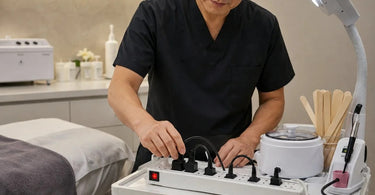
Upgrade treatments with this one simple trick that most spa owners overlook until it is too late. Surge protection. It is not the most glamorous topic, I know. You would rather talk about the latest sunless tanning formula or that new ItalWax scent that makes your waxing room smell like a tropical vacation. But let us have a real talk for a second. You know that sinking feeling when your facial steamer just... stops working mid-service? Or when your high-frequency machine starts flickering like a disco ball from the 70s? That is not just a bad day. That is a power surge that just ate your equipment budget for the month.
I have been in this industry long enough to see grown professionals cry over a fried microcurrent machine. And not pretty, single-tear-down-the-cheek crying. I mean full-on, mascara-smudged, ugly-cry in the supply closet because you just lost a $2,000 piece of equipment that you cannot replace until next quarter. But here is the tea: most of those meltdowns could have been prevented with a $30 surge protector. So today, we are going to talk about how to choose the right surge protection for your professional beauty equipment, save your gear, your money, and your sanity.
Why Your Beauty Equipment is a Lightning Rod for Disaster
Let us get nerdy for a hot second. Professional beauty equipment is expensive because it is powerful. Your ultrasonic skin scrubbers, radio frequency (RF) machines, and even your humble towel steamers contain sensitive circuit boards and motors. Power surges happen all the time. We are not just talking about a dramatic lightning strike that makes you jump out of your massage table. Everyday fluctuations, from the air conditioner kicking on to the local power grid having a tantrum, are slowly degrading your equipment.
Think of it like this: every tiny surge is taking a little chip out of your machine's lifespan. One big surge is like taking a sledgehammer to it. And here is the kicker—most salon equipment warranties do not cover electrical damage. So, while you think you are protected because you bought the "premium" brand, your insurance is probably laughing all the way to the bank. I have a friend who runs a busy waxing studio, and she learned this the hard way when her wax warmer shorted out during a double-booked Saturday. She had to run to the store with a client waiting and buy a cheap drugstore warmer that ruined her wax consistency. The horror. The sheer horror.
Joules, Clamping Voltage, and Response Time: The Boring Stuff You Actually Need to Know
Okay, honey, let us break down the specs without the jargon headache. You are standing in the store or scrolling online, staring at a wall of surge protectors that all look like boring gray bricks. But they are not all created equal. First up is Joules. This is the amount of energy the protector can absorb before it gives up. For your professional equipment, you do not want anything under 2000 joules. That little $10 strip from the grocery store? That is for your phone charger, not your galvanic machine. You need the big guns. Look for something in the 2000 to 4000 joule range. It is like the difference between a paper umbrella and a reinforced steel one.
Next up is Clamping Voltage. This is the voltage level that causes the surge protector to start doing its job. You want a clamping voltage of 330V or lower. A lower clamping voltage means it reacts faster and protects your gear better. Some cheap protectors have a clamping voltage of 400V or higher, which means they let a lot of the bad stuff through before they even start working. That is like closing the barn door after the horse has already bolted.
Finally, let us talk about Response Time. This is measured in nanoseconds. The faster, the better. You want a response time of less than 1 nanosecond. All the quality protectors have this, but it is always good to check. These three numbers are the holy trinity of surge protection. Ignore them at your own peril (and your equipment's expense).
Where to Put Your Surge Protectors (and Where NOT to)
This is the part that makes me want to pull my hair out. I have walked into so many salons and spas and seen every single piece of equipment plugged into one, cheap, daisy-chained power strip. You know what I am talking about. The octopus of cords behind the counter, all plugged into a strip that is plugged into another strip. This is not just a surge protection issue; it is a fire hazard. For one, advanced spa equipment needs to be directly plugged into a wall outlet whenever possible. If you absolutely must use a surge protector, plug it directly into the wall. Do not daisy-chain.
You should also consider getting a whole-house or whole-salon surge protector installed. This is installed at your electrical panel and protects every outlet in the building. It is a bit of an investment, but if you own your space, it is a no-brainer. It is the first line of defense. Then, you layer on the point-of-use surge protectors for your most sensitive equipment. That way, you have double the protection. It is like wearing two pairs of Spanx. Just extra security.
And for the love of all things holy, do not plug your UV sterilizers into the same strip as your pedicure chairs. Those things draw a lot of power. Your circuit breaker will thank you. Spread the love (and the plugs) around. I have seen a Vichy shower system trip a circuit because someone plugged a hair dryer into the same outlet, and the surge protector just gave up and died. It is never just one thing. It is a cumulative effect.
Product Picks: What to Look For When You Shop
Alright, let us pretend you are shopping. You know the specs, but what are you actually looking for on the box? First, buy UL 1449 certified. That is the safety standard for surge protectors. Do not buy a no-name brand from a discount store that looks like it was designed in a basement. Spend the extra ten bucks on a reputable brand. It is literally protecting thousands of dollars of equipment.
You also want indicator lights. Most good surge protectors have a light that turns off when the protection has been used up. Surge protectors degrade over time. They have a limited lifespan. Just because it is still providing power does not mean it is still protecting. That little light is your friend. When it goes out, it is time to replace the unit. Do not ignore it. I have seen studios using surge protectors that were older than their interns. It is not a legacy piece; it is a consumable.
Consider the layout of your salon. Do you need right-angle plugs so they do not block other outlets? Do you need long cords to reach those awkwardly placed outlets behind your nail tables? Do you need flat plugs to keep your salon furniture flush against the wall? These details matter. Aesthetics matter. And most importantly, safety matters. Your clients are trusting you with their skincare and relaxation. They are not trusting you to burn the building down with a faulty electrical setup.
Common Mistakes (and Why My Favorite Wax Warmer Almost Died)
I have made all the mistakes, so you do not have to. I used to think that a power strip and a surge protector were the same thing. They are not. A power strip just gives you more outlets. A surge protector actually protects. It is a subtle difference that cost me a beautiful Waxness warmer when a storm rolled through. I was so mad, I could have spit. That was the day I learned to read the box.
Another common mistake is not having enough protection. You buy one surge protector for your front desk and forget about the back room where the salon equipment is. Every room needs protection. Every single piece of sensitive equipment needs protection. I knew a tech who lost three hair styling tools in one day because she thought her front desk protector covered the whole building. Electricity does not work that way, honey.
Also, never, ever plug a surge protector into an extension cord. That is a recipe for disaster. The extension cord cannot handle the load, and it negates the safety features of the surge protector. It is like putting a race car engine in a golf cart. It just does not work. If the cord does not reach, move the equipment or get a longer surge protector cord. They make them in 8-foot, 10-foot, and even 15-foot lengths.
Protect Your Investment and Your Reputation
At the end of the day, you are a professional. You have invested thousands of dollars in top-quality equipment to provide top-quality service. You have chosen brands like Earthlite for your tables, Equipro for your machines, and Amber Products for your disposables. Do not let a $30 power surge ruin that reputation. A fried steamer means a cancelled service, which means a disappointed client, which means lost revenue, which means you are eating ramen for a week. And we are too old and too successful for ramen (unless it is fancy ramen from that hipster place downtown).
So, go forth. Shop smart. Look at the joule rating. Look for the UL seal. Replace your old protectors. And sleep soundly knowing your oxygen facial machine is safe from the evil gremlins of the power grid. You can thank me later when you are not crying in the supply closet.
