
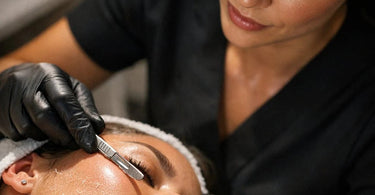
Solutions designed with professionals in mind... like dermaplaning, have a way of sparking both delight and utter panic in your clients. The delight? Instant baby-soft skin that makes makeup glide on like a dream. The panic? The age-old myth that the hair will grow back darker, thicker, and with the stubbornness of a reality TV star refusing to leave the villa. Let's set the record straight with some professional-grade knowledge and a dash of humor. Dermaplaning is not your boyfriend's rusty razor hack job. It's a precise, controlled exfoliation treatment that removes vellus hair (the fancy term for "peach fuzz") and dead skin cells in one elegant swipe. And for the love of glowing complexions everywhere, no, the hair does not grow back like a villain's beard. It grows back exactly as it was—soft, fine, and blonde. Let's dive into why this treatment should be a staple in your service menu and how to master it.
Think of dermaplaning as giving your client's face a fresh canvas. You're sweeping away the fuzzy, dusty top layer to reveal the radiant masterpiece underneath. It's like power-washing a driveway—dramatically effective and deeply satisfying. The immediate results are what keep clients coming back: unparalleled smoothness, enhanced product absorption, and a complexion so bright it could guide ships to shore. It's the perfect prep for a hydrodermabrasion treatment, a chemical peel, or even just a supremely effective at-home skincare routine.
The Science (& Sense) Behind the Blade
So, why the confusion with shaving? The tool looks similar, but the intention and technique are worlds apart. A standard razor is designed to cut hair at the skin's surface, often with multiple blades that can irritate. A professional dermaplaning tool is a single, sterile, surgical-grade scalpel blade held at a precise 45-degree angle. Your trained hand glides it across the skin, expertly removing not just the vellus hair, but also the top layer of dead, built-up keratinocytes. This is physical exfoliation at its most refined. It does not affect the hair follicle, its structure, or its growth cycle. The hair will regrow from the same follicle with the same color, texture, and growth rate. Period. End of story. Tell your clients to thank genetics, not you, for their hair's behavior.
Building the Ultimate Dermaplaning Service
This isn't a slap-dash add-on. To command premium prices and ensure stellar results, you need to create an experience. Start with impeccable skin prep. A thoroughly cleansed face is non-negotiable. Using a facial steamer for a few minutes can help soften the hair and open pores slightly, making the blade's job easier. Always pull the skin taut and use short, feather-light strokes in the direction of hair growth. Your movements should be confident and fluid. After removing every trace of fuzz and debris, follow up with a soothing, hydrating mask. This is the perfect time to infuse the fresh skin with potent serums—they'll absorb up to 70% more effectively! Finish with a broad-spectrum SPF. You've just removed their natural sun barrier, so protection is paramount.
Dermaplaning Dream Team: Tools & Supporting Products
Your skill is the star, but the supporting cast matters. Stock your station with the best. You'll need a steady supply of single-use, sterile dermaplaning blades—never, ever double-dip. Quality matters for safety and results. Have a rich selection of post-treatment soothers on hand, like calming aloe vera gels or hydrating hyaluronic acid serums. Consider pairing dermaplaning with other modalities. Use a ultrasonic scrubber beforehand for a deeper cleanse, or follow it with a microcurrent facial for amplified lifting effects. The retail opportunity is huge: clients will want the gentle cleansers, moisturizers, and sunscreens you recommend to maintain that glorious glow.
Tackling Client Concerns with Confidence (and Comedy)
You will get the questions. "Will it grow back like a werewolf?" "Will it blunt my hair?" Arm yourself with facts and a friendly demeanor. Explain the vellus hair follicle is untouched. Use an analogy: "Trimming the grass in your yard doesn't make the roots grow thicker or change the type of grass, does it?" As for blunting, the hair tapers to a fine point as it grows, so the tip may feel slightly more blunt for a millisecond, but it's imperceptible. The key is to position dermaplaning as a *skincare treatment* that *happens* to remove hair, not a hair-removal service that *happens* to exfoliate. This shifts the value proposition entirely.
Why Dermaplaning is a Business Goldmine
Let's talk numbers. It's a relatively low-cost service to perform (blades are inexpensive), but you can charge a significant premium for the expertise and results. It has a quick treatment time (30 minutes or less), allowing you to book it as a luxurious add-on to a signature facial or as a standalone lunchtime refresh. It appeals to a massive demographic: anyone with peach fuzz, dull skin, or makeup that cakes. It builds incredible loyalty because the results are immediate and undeniable. Clients will pre-book their next session every 3-4 weeks like clockwork. Plus, it dramatically boosts your retail sales of serums, masks, and SPF. It's the gift that keeps on giving.
So, embrace the blade! With proper training, top-tier tools from Pure Spa Direct, and the confidence to educate your clients, dermaplaning can become one of your most requested—and profitable—services. It banishes myths, delivers bliss, and reveals the most radiant version of your client's skin. Now that's a smooth move for any business.
