
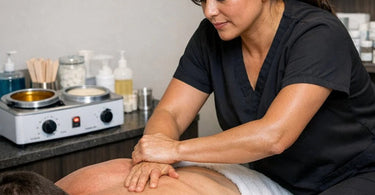
Make every moment count, especially the ones where you feel like a tiny mechanic trying to change the oil on a monster truck. We have all been there. The door opens, they walk in, and suddenly the room feels a little smaller. You smile, introduce yourself, and internally whisper, Oh honey, those are some long legs. Performing deep tissue work on tall clients presents a unique set of challenges that can throw even the most seasoned therapist’s alignment out the window. If you do not adjust your approach, you will end the week walking like you just got off a horse. But fear not, because saving your career (and your lumbar spine) is totally doable with the right ergonomic strategy.
Whether you are working out of a high-end spa or a cozy professional massage studio, the principles of leverage and physics do not change. You cannot fight a six-foot-seven frame with sheer willpower. That is a one-way ticket to Snap City, population: you. Instead, we need to work smarter, get lower, and use the equipment at your disposal to turn a potential injury hazard into just another Tuesday. Let’s break down exactly how to keep your hands happy, your back straight, and your tall clients fully kneaded into a puddle of relaxation.
Why Tall Clients Wreck Your Normal Flow
Let us be honest for a second. Standard massage tables and massage bolsters are built for averages. If you are a therapist of average height working on a client of above-average height, the biomechanics get weird. You find yourself reaching, leaning, and hyperextending your shoulders just to reach the erector spinae. Suddenly, you are no longer using your legs; you are using your rotator cuff as a lever.
When a tall client lies supine, their head is way up there, but their feet are hanging off the end of the table like a sleepy giant. When they turn prone, you are often left standing at their knees trying to reach their upper back. This distance forces you into forward head posture and thoracic flexion. Over time, this leads to the dreaded massage therapist slump, back injuries, and carpal tunnel issues that could have been avoided simply by adjusting your setup .
The #1 Fix: Lower That Table
If you take nothing else away from this blog post, remember this: Lower the table. I know, it seems counterintuitive. You think raising the table brings them closer to you, but when dealing with thick glutes and high muscle mass tall clients often have, you need leverage. You need to be able to get your center of gravity above the tissue you are working on.
For deep tissue, you want the table low enough that your knuckles or elbows can sink in while your shoulders stay relaxed. If the table is too high, you will shrug your shoulders to apply pressure. Shrugging for an hour while doing glute work on a tall client is a fast track to levator scapulae syndrome . Ideally, the table should be around mid-thigh level or slightly lower when standing. This allows you to lean in using your body weight rather than pushing with your muscles. As the pros say, lock and stack your joints, then let gravity do the heavy lifting .
Get Personal With The Leg Extension
One of the biggest ergonomic traps with tall clients is the foot rest or leg section. If the client’s feet are hanging off the end of the table, you are going to naturally stand at a weird angle to clear their heels. Many high-end electric tables, like those from Living Earth Crafts or Oakworks, have articulating foot sections. If you are using a Portable Massage Table without an extension, consider purchasing a bolt-on leg extension or sliding the client further up the table (though this puts their face in the headrest hole).
By extending the length of the table, you allow the client to lie naturally, and you can stand at the foot of the table to work on hamstrings and calves without doing the Texas Two-Step around their heels. This keeps your hips squared to your target, which is essential for proper kinetic chain activation .
Stance and Lunge: The Tall Client Dance
Forget the narrow stance you use for a 5’2" client. For the tall client, you need to get into a wider stance and use lunges. When working on the lumbar spine or mid-back of a long-bodied individual, step back into a slight lunge. This brings your torso forward while keeping your spine straight. If you stand square and reach out, your back rounds. If you lunge forward, your core engages, and you drive pressure from your quads and glutes, not your spine.
Use your Massage Table Warmers to keep the muscles pliable, but for the actual mechanics, imagine you are a fencer. Lunge in for the stroke, then push back. This rhythmic movement saves your smaller hand muscles and prevents fatigue.
Tool Time: Ditch The Thumbs
I am going to say something controversial: Put your thumbs away. Seriously. When you are trying to sink into the dense erector muscles of a tall, athletic client using just your thumb, you are asking for De Quervain’s tenosynovitis. Tall clients usually have the surface area to match their height. Trying to cover that much real estate with thumbs is like shoveling a driveway with a spoon.
Transition to forearms, elbows, and knuckles . These tools allow you to apply broad or specific pressure without hyperflexing your wrist joints. Use your ulnar border (the side of your forearm) to strip the paraspinals. Use your olecranon (elbow) for trigger points in the glutes and rhomboids. By using these larger levers, you can stand further away (thanks to your lunge stance) and still apply effective pressure without compromising your wrist alignment. Keep those wrists straight!
The Sitting Option: Floor Level Work
Sometimes, even with the table as low as it will go, working on the upper traps and neck of a very tall person while standing is awkward. If you have an electric hi-lo table that drops down to 20 inches, great. But if you are stuck with a standard portable, consider dropping the table all the way down and sitting on a rolling stool to work the head, neck, and shoulders.
Sitting changes your angle. You are no longer looking down; you are looking forward. This allows you to pull the client’s head toward you in a gentle traction or work the suboccipitals without straining your own neck looking down. There is no rule that says you must stand for the whole massage. In fact, integrating sitting into your routine adds variety to your own joint stresses .
Equipment That Saves Your Bacon
You do not have to do this alone. In fact, relying solely on your raw strength is a rookie move. We sell the gear that keeps you working past 50. Here is what you need to make tall clients a breeze:
- High-Quality Massage Tables: Specifically, those with easy height adjustments. If you are cranking a wheel for five minutes between clients, you will stop adjusting it. Go electric or go home.
- Hot & Cold Therapy Products: Heat the tissue first so you don’t have to dig as hard.
- Massage Bolsters: Use them under the ankles to tilt the pelvis, or under the chest to open the axilla.
- Aromatherapy Supplies: Relax them (and yourself) with calming scents.
Resistance Bands and Self-Care
After you have folded yourself like a pretzel trying to reach the distal IT band of a basketball player, you must have a reverse stretch protocol. Keep resistance bands in your treatment room. Between clients, do thoracic extension stretches over a foam roller. Open up your chest. The tall client forces you into internal rotation; you have to actively force yourself back into external rotation, or you will harden into a question mark shape.
Conclusion: You’ve Got This (And So Do We)
Working on tall clients does not have to be a death sentence for your hands and back. It requires a shift in strategy: lower the table, widen your stance, use your tools, and sit down when you need to. Your body is your most valuable asset in this business. Treat it like the luxury sports car it is, not a rental sedan you are willing to trash.
Remember, we are always here to help you find the right Professional Massage & Wellness Products to support your longevity. Upgrade your gear, protect your body, and keep kneading those giants until they melt.
%20When%20The%20Legs%20Keep%20Going)