
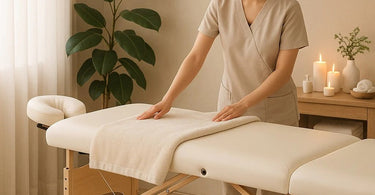
Quality you can’t ignore… especially when it comes to protecting the most valuable tool in your treatment room: YOUR body. Let’s talk about something that seems ridiculously simple but could literally determine whether you’re still doing the work you love in ten years or searching for a new career while nursing a chronic shoulder injury. We’re diving deep into the ergonomics of your table—specifically, how those tiny height adjustments you might be skipping are quietly plotting against your career longevity. Think of your massage table as your dance partner; if it’s not at the right height, you’re both going to stumble, and one of you is going to end up with back pain that makes getting out of bed feel like an extreme sport.
I’ve watched too many talented therapists develop what I call “therapist hunch”—that permanent forward lean that makes them look like they’re still working even when they’re just waiting in line for coffee. The culprit? Almost always improper table height. Your table isn’t just furniture; it’s an extension of your body mechanics. When it’s too low, you compensate by rounding your shoulders and leaning forward, transferring all that stress to your lumbar spine. When it’s too high, you’re hiking your shoulders up to your ears, creating tension that would make a rock seem relaxed.
The Golden Rule of Table Height (That Everyone Ignores)
Here’s the secret they should have taught you on day one of aesthetics school: your table height should allow you to keep your elbows slightly bent when your hands are resting flat on the client’s back. No shoulder hiking, no back bending—just comfortable, neutral alignment. For most therapists, this falls somewhere between their hip bone and just below their waistline, but it varies based on your height, arm length, and whether you’re performing dermaplaning or a deep tissue massage.
The crazy part? I see therapists using the SAME table height for a facial that they use for a full-body massage. Honey, no. Your facial bed should be higher than your massage table because you’re working with smaller muscles and need more precision. Your waxing table? That needs to be high enough that you’re not bending over and risking back strain every time you reach for your ItalWax.
Your Body’s Silent Protest Signs
Your body has been trying to tell you about your table height issues for years—you just haven’t been listening. That nagging wrist pain after a long day of lash extensions? Probably because your table is too low, forcing your wrists into awkward angles. The tension between your shoulder blades after performing hydrodermabrasion treatments? Your table is likely too high, making you elevate your shoulders continuously.
Even something as simple as applying cuticle oil during a manicure can become a repetitive strain injury if your nail table isn’t positioned correctly. The cumulative effect of these micro-injuries adds up faster than negative online reviews—and they’re much harder to recover from.
The Investment That Pays in Pain-Free Years
I know what you’re thinking: “But high-quality adjustable tables are expensive!” Let me ask you this: how much is your ability to work pain-free worth? How many income-generating years do you want to have in this industry? That properly adjustable table isn’t an expense—it’s an investment in your career longevity.
Look for tables with easy-to-use hydraulic systems or smooth crank handles. Test them out in person if possible—you want something that adjusts quickly between clients without requiring a engineering degree to operate. Brands like Earthlite and Living Earth Crafts offer exceptional ergonomic options that will make your body sing hallelujah at the end of a long day.
Little Tweaks, Big Results
Beyond table height, consider these ergonomic game-changers: A table warmer not only makes clients happy but allows you to use lighter pressure, reducing strain on your hands and wrists. Proper bolstering elevates client body parts to better angles, preventing you from overreaching. Even something as simple as hygienic table paper that doesn’t bunch up can prevent those annoying micro-adjustments that add up to macro-injuries.
For my waxing specialists, the height of your wax warmer matters too—if you’re constantly bending down to scoop wax, you’re asking for trouble. Position it at elbow height whenever possible. And for heaven’s sake, invest in a comfortable stool for those long lash lift sessions rather than perching awkwardly on the edge of your station.
Your Future Self Will Thank You
Take five minutes before your next client to really assess your table height. Close your eyes, settle into your working stance, and notice what your body is telling you. That slight tension in your neck? The subtle ache in your lower back? Those are red flags waving frantically, begging you to make an adjustment.
Your career is a marathon, not a sprint—and proper table ergonomics are the hydration station that keeps you going strong mile after mile. The tiny time investment it takes to adjust your table between clients is nothing compared to the months of recovery time from a repetitive strain injury. Your future self—the one who still loves going to work and isn’t popping ibuprofen like candy—will look back and thank you for paying attention to the small stuff that makes the big difference.
