
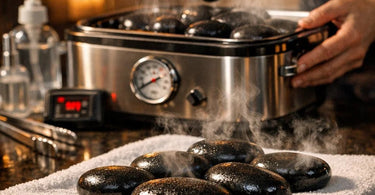
Pros pick quality every time, but even the fanciest basalt rocks in the world won't save you if your hot stone massage protocol resembles a game of culinary roulette. We've all heard the horror stories—the therapist who thought a crockpot was a suitable substitute for a professional warmer, or the one who confused "hot stone therapy" with "branding the client like cattle." Listen, we're in the business of bliss, not burns, and mastering your hot stone massage protocol is the only way to keep your clients coming back for more of that melt-y, puddle-of-happiness feeling instead of running for the hills (or a lawyer).
Let's be real: nothing says "luxury spa experience" quite like the gentle, radiant heat of smooth stones gliding over tense muscles. It's a service that commands higher prices and inspires fierce loyalty. But with great heat comes great responsibility. This isn't just about looking like a rock star (though you will); it's about creating a safe, sanitary, and sublime experience that has your clients forgetting their own zip codes. So, grab your hot stones and warmers, put on your favorite diffuser blend, and let's dive into the nitty-gritty of doing hot stones right—because nobody wants to be known as the therapist who served up a side of second-degree burns with their relaxation.
The Golden Rule of Heat: Temperature & Testing
First things first: let's talk about the heat. Your goal is therapeutic warmth, not achieving the perfect sear on a tuna steak. The sweet spot for your professional stone heater is generally between 120°F and 130°F . Some practitioners push it to 135°F, but that's the absolute top of the charts and requires serious vigilance . Anything above that, and you're entering the danger zone where skin can burn in under a minute . Never, ever crank the heat to warm them up faster—this creates a stone with a hot exterior and a cold, treacherous core that will cool down unevenly on the table . It's a recipe for a disappointed (or injured) client.
And please, for the love of all things holy, invest in a calibrated thermometer . Don't just trust the dial on your warmer. They can be finicky! Use a second thermometer to double-check the water temp . But your most important tool? It's attached to your wrist. Test every single stone on your inner forearm before it touches a client . Your palms can get desensitized from handling hot tools, but your inner arm is a much more honest judge . If it feels too hot for you, it's too hot for them. Period. No exceptions. This is the cardinal rule of burn prevention, right up there with "don't leave your towel steamer running with a towel stuffed inside it" .
Stone Care 101: Sanitizing Your Smooth Operators
Okay, you've mastered the heat. But what about the icky factor? Your beautiful basalt stones are porous little sponges just waiting to soak up massage oils, lotions, and... well, whatever else might be lingering on a client's skin. If you're not scrubbing them down like you're prepping for surgery, you're basically marinating last week's client in this week's hot stone oil. Sanitizing stones between every single use is non-negotiable . Here's your post-massage cleanup protocol:
- Scrub-a-dub-dub: Wash each stone with hot water and a good antibacterial dish soap . A dedicated scrub brush can help you get into any little nooks and crannies . A few drops of tea tree oil in the wash water adds a nice antimicrobial punch .
- Rinse and Repeat: Rinse thoroughly with hot water to remove all soap residue.
- Disinfectant Dip/Spray: After they're dry, give them a good spritz with a disinfectant like 99% alcohol . This ensures any lingering bacteria are shown the door.
- Don't Forget the Warmer! Dump the old water, wash the reservoir with antibacterial soap, rinse, and spray with disinfectant . The little mat or towel at the bottom? Replace it with a clean one every time . A clean warmer equals happy, non-funky stones.
Pro tip from the trenches: using a water-soluble massage oil or lotion makes this whole process a million times easier . Thick creams and heavy oils like jojoba are a nightmare to scrub off and will turn your stones into greasy, grimy gunk-magnets. Stock up on some high-quality, lightweight massage oils from brands like Biotone or Bon Vital to make your life easier and your stones cleaner . And if you're back-to-back booked? Consider having a second set of stones and a second warmer . It's an investment in your sanity and your hygiene standards.
Burn Prevention: The Art of Not Cooking Your Client
So, you've got clean stones at the perfect temp. Now, let's make sure you use them without incident. Burn prevention isn't just about the thermometer; it's about technique and awareness. First up: the two-barrier rule for placement stones . Those big, flat stones you nestle along the spine or in the palms? They never, ever go on bare skin. Place them over a sheet and a blanket, or a sheet and a thick towel. This protects the skin from direct, prolonged heat and gives you a crucial buffer.
And where do these stones go? Updated protocols recommend retiring placement stones from certain areas. For instance, no more facial stones or stones between the toes—you just can't get a proper two-barrier barrier there . Also, avoid placing stones on the abdomen, and never, ever have a client lie on top of a stone . That's a disaster waiting to happen. For working stones—the ones you're gliding across muscles—keep them moving! Constant motion prevents heat from building up in one spot and causing damage . If you find a knot you want to focus on, hold the stone there for just 20-30 seconds, but keep checking in . And a word to the wise: never wear gloves during a hot stone massage . If a stone is too hot for your bare hand, it's too hot for the client, no matter what the thermometer says. Your hands are your best safety device.
Client Communication: It's a Two-Way Street
You could have the best massage table in the world and a $500 stone warmer, but if you're not talking to your client, you're flying blind. It is absolutely imperative that you empower your clients to speak up . Tell them, straight up, "If any stone feels too hot, please tell me immediately. I can adjust or remove it. No one gets a medal for being tough, only a potential burn." But here's the kicker: you can't only rely on them to speak up . Clients can be so relaxed they're practically in a coma, or they might not want to be a bother. You need to be proactive. Check in frequently, especially when you move to a new area like the legs or arms . Lift up that barrier and take a peek at their skin. Is it an angry, blotchy red? Does it feel overly hot to the touch? If so, cool it down . Your eagle eyes and constant communication are the ultimate safety net.
Beyond the Burn: When to Just Say No (or Go Slow)
Hot stones are amazing, but they're not for everyone. A thorough intake form is your best friend here . You need to know if your client has conditions that make hot stone therapy a bad idea. We're talking about diabetes (which can cause neuropathy or loss of sensation), poor circulation, heart disease, pregnancy, or any condition where heat could be problematic . If a client is on medication that affects their heat sensitivity, or if they've had recent surgeries, it's a hard pass . Also, think about their skin. Sunburned, irritated, or broken skin is a definite no-go zone for hot stones . And for our older clients? Turn the temp down a notch—around 115°F is a safer bet, and be extra gentle with their delicate skin . Remember, our goal is to make people feel better, and sometimes that means knowing when a service isn't the right fit. If you're ever in doubt, the motto is "less time, less temperature" . You can always offer a modified version with cooler stones or skip the heat altogether and just use the stones at room temperature for a unique sensory experience . And while we're on the topic of safety, make sure you're stocked up on all the essentials, from protective gloves for cleanup to high-quality spa bedding for those all-important barriers.
So there you have it—the complete guide to running a hot stone practice that's safe, sanitary, and seriously impressive. Master your Hot Stone Massage Protocol: Stone Care, Sanitizing, and Burn Prevention for Pros, and you'll be the therapist everyone trusts with their relaxation. Now go forth, heat those basalt beauties with confidence, and give your clients the kind of warmth that melts stress, not skin. They'll be so relaxed, they might even forget to ask about your retail specials. (But don't worry, we have plenty of spa retail products to tempt them with next time!)
)