
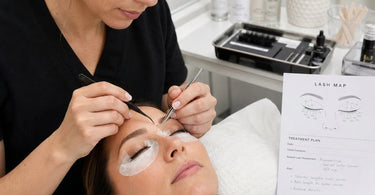
The first step to better outcomes is admitting that Mother Nature has a wild sense of humor. Let's be real for a second: perfect, identical, mirror-image eyes exist only in cartoons and maybe on that one annoyingly symmetrical influencer we all secretly envy. In the real world, where our clients live (and where they pay our bills), uneven lash growth is about as common as a stylist who doesn't have a million half-used water bottles in their treatment room. Whether it's one eye that's slightly more hooded than the other, lashes that grow straight down on the left but curl perfectly on the right, or an eyelid that seems to have its own unique gravity field, ocular asymmetry is the silent struggle of lash artists everywhere. But here's the good news: you don't need to be a plastic surgeon to fix this. You just need a killer strategy, the right tools, and a willingness to stop applying lashes like a robot and start acting like the true artist you are.
Welcome to the masterclass nobody asked for but everyone needs. We are about to dive deep into the dark arts of making uneven eyes look like they were born best friends. At Pure Spa Direct, we have seen thousands of Lash & Brow Enhancement Services for Professionals fly out the door, and the pros who come back for more are the ones who know how to troubleshoot the tricky stuff. So grab your Magnifying Lights, pour yourself a giant coffee, and get ready to learn how to turn lopsided into luxury. Spoiler alert: it involves less guesswork and more science, but I promise to keep the boring bits to a minimum.
Face It: Nobody Is Perfect (And That's Where We Make Money)
Before we get into the nitty-gritty of curl mapping and adhesive wizardry, let's normalize the struggle. Your client's eyes are not identical. They never were. One eyebrow is usually the "sassy" one that sits higher, one eye might be slightly more deep-set, and yes, the lashes on one side might grow like a lush forest while the other side looks like a sparse prairie after a long winter . This isn't a disaster; it's a job opportunity. If every client had perfect, uniform lashes, they wouldn't need a ninja-level Lash Artist to work their magic. They'd just buy drugstore glue and cry into the wind.
The first rule of Fight Club—er, Lash Club—is to stop applying the exact same map to both eyes. I know it feels efficient, but copying and pasting a lash design from the right eye to the left is like trying to fit a square peg in a round hole and hoping it works out. It won't. Uneven lash growth requires a bespoke approach. We aren't just putting on lashes; we are architects of optical illusions. We are using Premium Lash Extensions & Supplies for Pros to build a house where the foundation is a little crooked, and we are going to make it look like a palace.
The Anatomy of "Why Is One Eye So Dramatic?"
To fix the problem, you have to diagnose it. You cannot just throw a Professional Lash and Brow Tint for Spas & Salons on uneven terrain and call it a day. You need to put on your detective hat. Asymmetry usually falls into three annoying categories . First, we have the Palpebral Fissure Variance—fancy talk for "one eye is shaped differently than the other." Maybe one is more round, or one is a classic almond while the other has a slight droop. Second, we have the dreaded Hooded vs. Open situation. One eyelid has a little extra skin weighing it down, making the lashes look shorter and sadder than their counterpart on the other side. Third, and most common in our world, is Growth Angle Disparity. This is where the natural lash follicle itself is rebellious. On the right eye, the lashes shoot out at a perfect 80-degree angle, ready for their close-up. On the left? They point straight down, mocking you. Or they grow so close to the water line they might as well be swimming.
I once had a client we affectionately nicknamed "The Rebel." Her left eye lashes grew straight down and crisscrossed like they were in a punk rock band. Her right eye lashes were perfect angels. If I had used the same curl on both eyes, one side would have looked like gorgeous curtains, and the other would have looked like wet spaghetti. It is our sacred duty to identify these quirks during the consultation. Ask your client to look up, look down, look side to side. Study the lash line under that Magnifying Light. Knowing the "why" is half the battle.
Mapping For Mortals: The Mixed Curl Protocol
Alright, you have identified the villain (asymmetry). Now, let's talk about the hero: Mixed Curl Mapping. This is the technique that separates the hobbyists from the high-earning pros. The golden rule here is what I call the "One-Level Rule" . If you have a hooded eye, you usually need to go up one curl level to get it to match the visual height of the more open eye.
For example, let's say Eye A (the good one) is rocking a lovely Lash Curl of C. Eye B (the problem child) has a heavy lid. Do not slap a D curl on there and pray. That is the "panic move," and it usually results in lashes that look like they are trying to escape the client's face. Instead, use a CC curl on the hooded side . This subtle shift provides just enough extra lift to counteract the weight of the lid without looking alien.
Now, what if the lashes grow straight down? This is where physics comes into play. A downward-pointing natural lash needs a stronger curl just to reach the same visual line as a standard lash. You might need a D curl on the downtrodden side and a C on the other. It feels wrong, but trust the process. The goal is to align the *tips* of the extensions, not the bases. When the client closes their eyes, you want to see a uniform horizon. When they open them, you want the eyes to look balanced. This is high-level artistry, and it requires you to have a solid inventory of varied curls. Check out our Lash & Brow Service Supplies to make sure you have every curl letter in the alphabet ready to go.
Adhesive Engineering: Because Glue Matters (A Lot)
Let's talk about the sticky stuff. You cannot use a one-size-fits-all adhesive when you are doing corrective mapping. When you apply a stronger curl (like a D or DD) to a downward-growing natural lash, that synthetic fiber wants to snap back to its original shape. It has tension, also known as "spring-back" . If your adhesive cures too slowly, that natural lash is going to win the tug-of-war. The extension will droop, and your symmetrical dreams will die a slow, sad death.
For the eye that needs the extra lift (the hooded or downward-growing side), you need a fast-setting adhesive. We are talking rapid polymerization, people. Something like a 0.5 to 1-second drying glue will lock that strong curl in place before the natural lash even knows what hit it . For the standard eye that doesn't require corrective tension, you can use a slightly slower adhesive (1-2 seconds) to give you that precious working time to fan perfectly.
Yes, this means using two different glues on one client. Yes, it is a little extra work. But yes, it will make you look like a freaking miracle worker. You can browse our massive selection of adhesives to find the perfect fast-set and slow-set dynamic duo. And for the love of all that is holy, store your adhesive correctly. Toss it if it gets stringy. You are a professional, not a macrame artist.
Lash Lifts: Fluffing What God Gave Them
Now, what if your client doesn't want extensions? What if they just want to work with what they have, but what they have is a hot mess of uneven growth? Enter the Lash Lift & Perm. A lash lift is a game-changer for asymmetrical lashes because it physically restructures the hair. You can literally train the stragglers to stand at attention.
However (and this is a big however), you cannot use the same rod size on both eyes if the growth patterns are different. If one eye has short, stubby lashes and the other has long, luscious ones, using the same rod will give you vastly different results. You might need a smaller rod on the sparse side to get a tighter curl that visually matches the length of the other side .
Also, pay attention to the Korean lift style versus the traditional round rods. For clients with heavy, downward-growing lashes (common in many ethnicities), a teardrop shield or a tighter "L" curl shield might be your best friend . These lift from the root rather than just curling the tip. It creates a straighter, more elongated lift that actually opens the eye rather than just making the lashes look like curly fries. We have all the Lash Lift & Perm supplies you need to experiment. Just remember: timing is a guideline, but lash behavior is the law. Check those lashes every few minutes!
Tinting: The Great Equalizer
Sometimes, the issue isn't the curl of the lash; it's the visibility. If a client has blonde or light tips on their uneven lashes, the asymmetry is visually screaming at you. A quick Professional Lash and Brow Tint can solve about 50% of your problems before you even pick up a pair of tweezers. When you tint the natural lashes, you darken the roots and the tips, creating a shadow that hides slight irregularities in growth direction. It gives you a darker, more defined base to work with.
When mixing your tint, don't be afraid to layer. If one eye has sparser lashes due to an old injury or a bad extension job in the past, a tint will make those baby hairs pop, giving you more to grab onto later. Brands like Refectocil and Brow Henna are excellent for this. Just make sure your mixing is sanitary. Use Mixing Bowls and dedicated Applicators & Spatulas because double-dipping is gross, and your clients deserve better.
Retail Therapy: Selling The Fix
You can do the most amazing corrective lash job in the history of the world, but if your client goes home and sleeps on her face like a sack of potatoes, the asymmetry will come back. We need to arm our clients for success. This is where Must-Have Spa Retail Products for Enhanced Client Experience come in.
First, sell them a Lash Elixir or a growth serum. Uneven growth often means one side is weaker or more damaged than the other. A serum with peptides and biotin will strengthen the follicle over time, making your job easier at the next fill . Second, sell them a lash shampoo. Oil buildup weighs down lashes, especially on the side with a heavier hood. If they keep the lashes clean, the curl lasts longer. Third, educate them. Tell them, "Janet, your left eye is a little sassier than your right, so if you could just sleep on your back and stop using that oil-based makeup remover, we would be golden." You will sound like a genius, and they will buy the products because you diagnosed a problem they never knew they had.
Final Pep Talk (You've Got This)
Dealing with uneven lash growth can be frustrating. There will be days when you finish a set, take a step back, and want to scream because one eye looks bomb and the other looks like it lost a fight. But those are the days you learn the most. Do not be afraid to mix curls, use two adhesives, or walk away from the classic mapping rules. The human face is not a coloring book; you are allowed to color outside the lines.
At Pure Spa Direct, we have your back. From ItalWax for your body services to the finest lash supplies, we are the wholesale distributor that helps you look like a hero. So take a deep breath, grab your Professional Cotton, Sponges, and Wipes, and go make those uneven eyes look symmetrical as heck. Your clients are going to be obsessed, and honestly? So are you. Now get off the computer and go lash something. You're welcome.
