
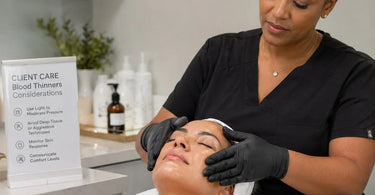
Professional-grade results made easy... most of the time. But sometimes, being a professional means knowing when to put the brakes on the “deep tissue destruction” and switch into a lighter, safer, and arguably more skillful gear. If you’ve got a client who mentions they’re on blood thinners—whether it’s for a heart condition, a history of stroke, or other medical reasons—your standard facial massage routine just got a VIP upgrade. Welcome to the art of the whisper-light touch, my friend. We’re about to turn your “I think I can fix this knot” energy into “I am a serene, healing cloud” vibes. Because when it comes to blood thinners and facial massage, pressure isn’t your friend; technique is. Let’s dive into how you keep those clients relaxed, glowing, and bruise-free, shall we?
First, a quick reality check: we aren’t doctors here at Pure Spa Direct, and we aren’t playing one in a blog post. But as the ultimate B2B distributors for everything spa, salon, and wellness, we talk to a lot of pros. And one question that keeps popping up is, “My client is on blood thinners, can I still do a facial massage?” The short, safe answer is: Yes, usually, but you must adjust your pressure significantly or risk turning your relaxing facial into a bruise factory . Nobody wants that. Not you, not their significant other who has to look at them, and definitely not the client who came in for zen, not a shiner.
Why the Heavy Hands Have to Take a Holiday
Let’s get nerdy for just a second—don’t worry, I’ll keep it painless. Blood thinners (anticoagulants) work by decreasing your blood’s ability to form clots . That’s great for preventing strokes or DVT, but it also means that when tiny blood vessels (capillaries) under the skin get squished or stretched, they break easier. And because the blood isn’t clotting quickly, that little break turns into a visible bruise or, in extreme cases, deeper internal bleeding .
Now, imagine your usual facial massage. You’ve got your knuckles doing that “raking” motion under the jawline? Yeah, that’s a bruise waiting to happen. You love a good pinching maneuver on the forehead? Not today, Satan. Traditional Deep Tissue and even some firmer Swedish movements create shear and pressure on those delicate facial vessels. For a client on blood thinners, even a moderate facial treatment that feels fine to you might leave them looking like they went ten rounds with a prize fighter . So, we adapt. We evolve. We become ninjas of gentle touch.
The Golden Rules of Thinner-Friendly Facial Massage
Before you even warm up your towel steamer, there are some non-negotiable rules to follow. Think of these as your pre-flight safety checklist.
1. The Intake Form is Your Bible (and Your Liability Shield): You know that line on your intake form that asks about medications? Yeah, that’s the money question. If they check “blood thinners,” it’s time for a chat. Ask which one (Warfarin, Eliquis, Xarelto, etc.) and, more importantly, why. The “why” matters. A healthy person on a low-dose aspirin is different from someone with a recent DVT . When in doubt, get a physician’s clearance. And always, always document that you discussed the risks of bruising. Cover your bases, gorgeous.
2. Communication is Queen: Before you even lay a finger on their face, tell them, “Because you’re on a blood thinner, I’m going to use a much lighter, gentler technique today. It’s going to feel amazing—like a butterfly landing—but it won’t be that deep kneading sensation. Let me know immediately if anything feels uncomfortable or too intense.” This sets expectations and builds trust. It also makes you look like the super-pro you are.
3. The Visual Scan: Look at their skin before you start. Are they already prone to bruising? Do they have any existing petechiae (tiny red dots) or unexplained marks? If you see active bruising or swelling, that’s a red flag. Maybe stick to just a cool Hydrodermabrasion treatment and skip the manual manipulation entirely that day.
Techniques to Use (And Which to Absolutely Avoid)
Alright, you’ve done the paperwork, you’ve had the chat. It’s go time. But what does a “gentle” facial massage actually look like? Spoiler: It’s not just doing your normal routine with less pressure. It’s a whole different vibe.
Ditch These Moves Immediately:
- Tapotement (Slapping/Percussion): That rapid-fire finger tapping on the cheeks and forehead? Absolutely not. It’s basically a bruise-creating machine gun on thinned blood .
- Pinching and Rolling: Any move that lifts and rolls the skin between your fingers is too aggressive. It creates deep shear forces that we want to avoid.
- Deep Friction: Those little circles that dig into a knot at the temporalis muscle or under the jaw? Nope. Too much focused pressure.
- Knuckle Work: Keep those knuckles in your pockets. They concentrate pressure into a small area, which is a recipe for disaster.
Embrace These Soothing Substitutes:
Now for the fun part. Just because it’s gentle doesn’t mean it’s boring. In fact, a skilled light-touch massage is often more relaxing than deep work because it doesn’t trigger any “fight or flight” responses.
- Effleurage (The Glide): This is your new best friend. Long, slow, superficial gliding strokes. Start at the center of the chin, glide out towards the ears, up the cheekbones, and across the forehead. Think of smoothing frosting on a cake—even pressure, no digging. Repeat 4-6 times . Use your whole palm for broader, more diffused pressure.
- Passive Holding (Energy Harmony): Don’t underestimate the power of just holding. Cup their face in your hands for 10-15 seconds. Place your palms gently on their temples. This is incredibly grounding and feels luxurious without any mechanical force .
- Vibration/Trembling: Using your fingertips or palms, create a fine, rapid shaking motion. This can release tension without friction or deep pressure. It’s tricky to master, but clients love it.
- Feathering: Finish your strokes by “feathering” off the skin—light, fast, and barely there touches at the end of a glide. It signals the nervous system to relax deeply .
- Lymphatic Drainage Influence: This is the secret weapon. True Lymphatic Drainage uses very light, specific stretching of the skin (about the weight of a nickel). It’s perfect for clients on blood thinners because it moves fluid without damaging vessels. Focus on the gentle sweeping motions along the neck and jawline .
Tools & Products to Enhance (Not Aggravate)
Your hands aren’t the only tools in the shed. This is the perfect time to pull out the big guns that don’t involve squeezing.
- Cold and Hot Hammer Machines: These are a godsend. The cold hammer can depuff and soothe without any rubbing. The hot hammer (used gently) can relax muscles with vibration instead of kneading.
- Ultrasonic Skin Scrubbers: Instead of manually exfoliating (which can be too harsh), use an ultrasonic spatula to gently lift impurities. It’s effective and non-traumatic.
- High Frequency Machines: Using an argon gas electrode (the neon one) can increase oxygenation and kill bacteria without any pressure at all. Just glide it over the skin.
- The Right Massage Lotion or Cream: You want maximum slip and glide. A rich cream like Biotone or a silky oil from Soothing Touch ensures your fingers don’t drag across the skin. Dry friction is the enemy. Bonus points if the product contains arnica (though check with their doctor first, as it can sometimes interact).
- Massage Table Warmers: Heat relaxes the muscles. If the muscles are relaxed via heat and vibration, they require less manual pressure to release. Crank that table to a comfy warm setting before they even get on it.
Imagine replacing a heavy knuckle kneading with a gentle, warm basalt stone glide. The heat does the work, the weight of the stone is gentle, and the pressure is diffused across a larger surface area. It’s magic, and it’s safe.
When to Say “Not Today”
Look, sometimes you have to be the bad guy. There are scenarios where you should absolutely skip the massage portion of the facial entirely, no matter how fancy your facial steamer is. If the client has an active or suspected blood clot (DVT, history of pulmonary embolism) or if they are in the first few weeks of a new, high-dose blood thinner regimen, the risk is too high. Massage near a clot could dislodge it, leading to a life-threatening embolism . Also, if they have any open wounds, a rash they can’t explain, or if they just got Botox or fillers in the last two weeks, put the massage oil away and stick to cool globes and mask application .
The Bottom Line (Because Your Client is Worth It)
Working with clients on blood thinners isn’t scary; it’s an opportunity to show off your versatility. Anyone can push hard. It takes a true artist to relax using almost no pressure at all. You are shifting from “mechanic” to “sensor.” You’re listening to the tissue, watching the skin, and creating a custom experience that is safe, effective, and deeply nurturing.
And hey, if you need the gear to pull this off—whether it’s a whisper-quiet ultrasonic machine, the world’s most glide-y massage lotion, or just super-plush towels to prop up their head—you know where to find us. We’ve got the tools, you’ve got the talent. Now go forth and provide the gentlest, safest, most relaxing facial of your career. Your clients will thank you (and so will their unbruised faces).
