
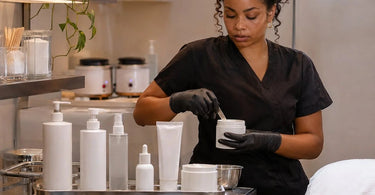
Great results are within reach... and your facial backbar does not need to resemble a skincare department store to deliver them! Building a streamlined facial backbar around a limited number of versatile products can help professional estheticians control expenses, simplify treatments, and create beautifully customized facial experiences. The secret is choosing products that earn their valuable shelf space by working across multiple services, skin types, and treatment goals. After all, that expensive mask collecting dust behind three other expensive masks is not exactly contributing to your spa's financial wellness.
Whether you operate a solo esthetics studio, manage a busy day spa, or oversee several treatment rooms, a thoughtful backbar strategy makes everyday operations easier. You can reduce unnecessary inventory, improve product turnover, simplify staff training, and protect your treatment margins without sacrificing professional quality. The objective is not to own the fewest products possible. It is to stock the right products for the services your clients actually book.
Start With Your Facial Menu, Not Your Shopping Cart
Before purchasing another beautiful bottle of professional skincare, take a close look at your service menu. Which facial treatments generate the most appointments? Which skin concerns appear most frequently during consultations? Which products are consistently used, and which ones seem to enjoy a very long vacation on the backbar shelf?
Most general facial menus involve a combination of cleansing, exfoliation, hydration, facial massage, treatment masks, and finishing products. Although individual clients require different approaches, several of these treatment steps can be supported by versatile formulas.
For example, a gentle cleanser suitable for several skin types may work in a basic customized facial, a hydrating facial, and a relaxing express treatment. A carefully selected hydrating serum may complement multiple protocols, while a soothing mask can serve clients experiencing temporary dryness or discomfort when appropriate for their skin condition.
Review your services and identify overlapping product needs. This simple exercise can reveal that several different facial treatments rely on the same foundational supplies.
Explore Premium Skincare Products for Spas and Salons when comparing professional formulas that can support multiple treatment protocols.
Choose One Dependable Everyday Cleanser
A versatile cleanser is one of the hardest-working products in any professional treatment room. It begins the facial experience, prepares the skin for subsequent steps, and may be used across a significant percentage of appointments.
For a streamlined backbar, consider starting with a gentle cleanser appropriate for the skin types most commonly seen in your practice. A non-stripping cream, lotion, or gel cleanser may provide flexibility depending on its formulation and manufacturer recommendations.
Evaluate the cleanser based on several practical considerations:
- Compatibility with the skin types frequently treated in your business.
- Ability to remove ordinary surface debris without excessive dryness.
- Ease of application and removal during professional services.
- Fragrance content and potential sensitivity considerations.
- Cost per treatment and available professional container sizes.
One cleanser does not need to handle every possible situation. If your clientele includes significant numbers of oily or congestion-prone clients, a second targeted cleanser may be worthwhile. Similarly, a dedicated option for particularly sensitive skin may be necessary.
The goal is to avoid purchasing five nearly identical cleansers simply because each one has an irresistible name. Your clients are booking facials, not attending a cleanser family reunion.
Select Exfoliation Products That Offer Controlled Flexibility
Exfoliation is an important part of many professional facial protocols, but it also requires careful product selection and individualized skin assessment.
A versatile, manufacturer-approved enzyme exfoliant may work across several service types, provided the client's skin condition, contraindications, and treatment goals support its use. Some practices may also benefit from a separate gentle exfoliation option for clients who are not suitable candidates for more active formulas.
When comparing professional facial exfoliants, consider the recommended application time, removal requirements, intended skin types, and compatibility with other treatment steps.
A stronger exfoliant is not automatically a better investment. A product that requires substantial screening, specialized training, or additional recovery considerations may be appropriate for advanced services but less suitable as a universal backbar staple.
Professional exfoliation should always follow manufacturer instructions, licensing requirements, and established treatment protocols. Never combine exfoliating products or modify application times simply to make one formula perform additional functions.
For practices offering specialized resurfacing services, explore the Advanced Facial Treatment Products for Salons & Spas collection while keeping those specialty products separate from everyday essentials.
Make Hydration a Core Backbar Priority
Hydration is a common objective across many professional facial services. Clients with different skin types may benefit from properly selected hydrating products, even when their broader treatment goals differ.
A versatile hydrating serum can therefore be one of the most useful additions to a compact facial backbar.
Look for formulas containing humectants or barrier-supporting ingredients appropriate for your clientele. Depending on the product, ingredients such as glycerin, hyaluronic acid, and panthenol may help support skin hydration and comfort.
Rather than stocking several nearly identical hydrating serums, begin with one formula that performs consistently within your established protocols. Add a more specialized product only when client demand and clinical suitability justify it.
Consider how the serum behaves during application. Does it absorb comfortably? Does it leave a finish that works with your moisturizer? Is it compatible with the massage medium or finishing products used in your treatments?
Testing products together within manufacturer-approved protocols can help prevent unpleasant surprises. Nobody wants the grand finale of a luxury facial to involve mysterious little product flakes rolling across a client's forehead.
Build Your Mask Selection Around Two or Three Clear Functions
Facial masks can be wonderful tools for customization, but they are also a common source of backbar clutter.
Instead of collecting a different mask for every possible marketing description, organize your selection around meaningful treatment functions.
A compact mask collection might include:
- A hydrating or soothing mask: Suitable for appropriate clients seeking additional moisture and comfort.
- A clarifying mask: Intended for suitable oily or congestion-prone skin types, with careful consideration of sensitivity and dryness.
- An optional specialty mask: Selected for a frequently requested service that cannot be adequately supported by the first two formulas.
These categories can support a surprisingly flexible menu when paired with professional assessment and appropriate complementary products.
However, avoid treating masks as interchangeable simply because their textures look similar. Ingredient profiles, manufacturer directions, contraindications, and intended uses still determine which formulas belong in each service.
Browse Professional Facial Masks to compare options that align with your most frequently booked treatments.
Choose a Facial Massage Medium That Works Hard
Facial massage contributes to the relaxing, luxurious experience many clients expect from professional facials. The product used during massage should provide appropriate glide while supporting the treatment protocol.
A versatile facial massage cream or gel can potentially serve several massage-focused treatments, reducing the need for multiple specialized products.
Consider the amount of slip, working time, texture, removal requirements, and compatibility with different skin types. A product that performs beautifully during a brief massage may not provide the same experience during a longer relaxation treatment.
Review Facial Massage Cream options based on your actual service duration and technique.
Do not automatically substitute body massage oils for facial massage products. Formulas should be evaluated for their intended use, client tolerance, and suitability for facial application.
If facial massage is included in most appointments, this category deserves careful consideration because even small amounts of excess product usage can accumulate across a busy schedule.
Keep Moisturizer and Sun Protection Simple but Appropriate
Finishing products are another opportunity to streamline the backbar.
A lightweight moisturizer and a richer moisturizer may be sufficient for many general facial menus, depending on client needs and the formulas selected. Some businesses may find that one adaptable moisturizer covers most routine treatments, while a second option supports clients who need a different texture or level of emollience.
Sun protection should also be considered when designing daytime finishing protocols. Keep an appropriate broad-spectrum sunscreen available, following product labeling and application directions. Do not assume a moisturizer provides sun protection unless it is specifically labeled and formulated to do so.
Professional treatment recommendations should also reflect the services performed. Certain exfoliation or resurfacing procedures may require additional aftercare and sun protection guidance.
The point is to provide the right finishing care without purchasing an entirely different moisturizer for every facial listed on the menu.
Create Multiple Facial Experiences From the Same Core Products
Here is where a streamlined backbar becomes especially useful. Rather than building each facial around an entirely separate collection of skincare, organize your services around a shared foundation with thoughtfully selected variations.
Example One: The Classic Customized Facial
Use an appropriate cleanser, a suitable exfoliation step when indicated, a selected treatment mask, facial massage where appropriate, and finishing products. Adjust the treatment based on consultation findings rather than automatically following the same sequence for every client.
Example Two: The Hydrating Facial
Begin with the same compatible cleanser, then emphasize hydration through an appropriate serum, hydrating mask, and moisturizing finish. Exfoliation may be reduced or omitted when skin conditions warrant.
Example Three: The Express Facial
Use selected foundational products in a shorter protocol that prioritizes cleansing, an appropriate treatment step, and finishing care. This approach can create an accessible service without requiring an entirely separate inventory.
Example Four: The Clarifying Facial
Use the foundational cleanser when suitable, adding targeted clarifying products only for clients whose skin assessment supports their use. Avoid assuming that every oily-skinned client requires aggressive exfoliation or drying treatments.
These examples demonstrate how product versatility can support service variety. Each protocol still needs clear instructions, appropriate timing, professional judgment, and manufacturer-approved product combinations.
Calculate Cost Per Facial Instead of Focusing Only on Container Price
A larger professional bottle may look expensive initially, but the more useful number is the actual amount spent on product during each treatment.
Consider a hypothetical 16-ounce cleanser costing $48. If an average treatment uses approximately 0.25 fluid ounces, the container could provide about 64 treatments, assuming usable yield matches the estimate.
That produces an estimated cleanser cost of $0.75 per facial.
Now imagine a smaller specialty cleanser costing $28 for 4 ounces. At the same usage rate, its estimated product cost becomes $1.75 per treatment.
Both products might have a place in your business, but the difference matters when purchasing for frequently performed services.
Use this basic calculation:
Product cost per treatment = Container purchase cost divided by estimated number of usable treatments.
For greater accuracy, measure actual portions in grams or milliliters, use consistent units, and account for product remaining in containers, dispensing losses, and expiration-related waste.
A low cost per ounce is not automatically a bargain if your spa cannot use the product before its recommended expiration or period after opening.
Make Professional Package Sizes Work for Your Business
Choosing larger containers can reduce purchasing frequency and sometimes improve the cost per treatment. However, backbar sizes should be selected according to actual demand.
For products used in nearly every appointment, larger professional sizes may make financial sense. For a specialty mask used only twice a month, smaller packaging may be more economical despite a higher unit price.
Estimate monthly usage by multiplying your expected appointment volume by the average amount required per service. Compare that estimate with manufacturer shelf-life and storage requirements before selecting a container size.
For example, a spa performing 80 facials per month may consume its everyday cleanser much faster than a solo provider completing 12 treatments monthly.
Both businesses can maintain efficient backbars, but their purchasing strategies should look different.
Explore professional skincare selections from collections such as Tuel Skincare Collection and Murad when evaluating appropriate product formats and treatment-system options.
Keep Tools and Consumables as Organized as Your Skincare
A compact product assortment does not automatically create an efficient treatment room. Applicators, mixing containers, towels, and other supplies also affect workflow.
Organize your most frequently used supplies so they are easy to access without interrupting the service.
Useful categories may include Mixing Bowls, Applicators & Spatulas, Professional Cotton, Sponges, and Wipes, and High-Quality Towels.
Consistent station layouts can make treatments easier to prepare and help staff identify missing supplies quickly.
Maintain proper hygiene by dispensing products without contaminating shared containers. Use clean implements and follow product-specific handling directions. Never return unused product from a treatment bowl to its original container.
Reusable equipment and implements must be cleaned and disinfected as required between clients. Appropriate Professional Cleaners & Disinfectants for Salons and Spas remain essential even when the skincare assortment is intentionally minimal.
A streamlined backbar should mean less clutter, not fewer hygiene precautions.
Standardize Product Usage Without Eliminating Customization
If several estheticians share the same backbar, written treatment protocols can make a substantial difference.
Document the usual product quantity, dispensing method, application sequence, timing, and finishing steps for each service. Include guidance for when providers should modify or omit a step based on skin assessment, client history, contraindications, and product instructions.
For example, one esthetician may consistently use twice as much cleanser as another without improving the treatment. Standard portions can help identify unnecessary variation while still allowing appropriate adjustments.
Keep a simple reference sheet near the treatment area with product names, recommended usage ranges, and sanitation procedures.
Training should focus on understanding why each product is selected. A versatile backbar only works when providers know its strengths and limitations.
The goal is professional consistency, not turning talented estheticians into skincare dispensing robots.
Review Your Backbar Every Month
A simplified inventory should evolve with your business. What works during a slow introductory period may need adjustment as your appointment volume and service mix change.
Schedule a monthly review of product consumption, remaining inventory, expiration dates, and upcoming purchasing requirements.
Ask a few practical questions:
- Which products are used in the greatest number of treatments?
- Which products are repeatedly running low?
- Which containers remain mostly untouched?
- Are certain products being used more generously than protocols require?
- Do upcoming appointments justify additional specialty inventory?
- Are any products approaching their expiration or recommended disposal date?
Use a first-expiring, first-out approach where appropriate, and follow manufacturer guidance for storage and product disposal.
Establish reorder points based on average usage and supplier lead times rather than waiting until the last drop disappears. A streamlined backbar should simplify purchasing, not create a weekly emergency cleanser situation.
Know When a Specialty Product Deserves a Place
Keeping inventory limited does not mean refusing every specialized product.
A specialty formula may deserve space when it supports a frequently booked treatment, addresses a meaningful gap in your existing protocols, or provides a clear financial return.
Before adding one, consider how many treatments will realistically use it, whether providers require additional training, and whether the product has specific storage or expiration requirements.
For example, a practice introducing professional Dermaplaning or Hydrodermabrasion may need dedicated products and supplies that cannot safely be replaced with general backbar items.
That is perfectly reasonable. Versatility should never override treatment safety, equipment compatibility, or manufacturer directions.
Introduce specialty products when the associated service, training, and projected usage justify the investment.
Build a Backbar That Supports Better Margins and Better Facials
A successful facial backbar is not measured by how many products fit on the shelves. It is measured by how effectively those products support professional services, client needs, and the financial health of the business.
Start with dependable cleansing, carefully selected exfoliation, versatile hydration, a focused mask assortment, appropriate massage products, and reliable finishing care. Add specialty formulas only when there is a clear professional reason to do so.
With smart purchasing, accurate portion control, thoughtful protocols, and regular inventory reviews, even a relatively small backbar can support a varied facial menu.
Pure Spa Direct helps spa owners, estheticians, and beauty professionals source the supplies and products needed to keep treatment rooms operating efficiently. Explore Spa Essentials for Professionals and Must-Have Supplies for Salon & Spa Business Success as you refine your setup.
Remember, the perfect backbar is not the one with the most impressive collection of bottles. It is the one where every product has a purpose, every purchase makes sense, and your clients leave feeling fabulous. Less shelf clutter, more treatment-room confidence, and fewer mysterious half-used jars? Now that sounds like a beautiful business decision!
