
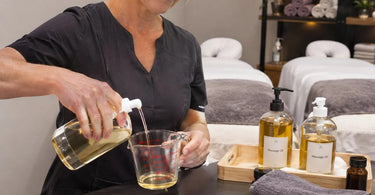
The right products for every professional make it easier to deliver a luxurious couples massage without watching your supply budget disappear one pump at a time. Learning how to calculate massage oil usage for couples sessions helps spa owners and massage therapists plan inventory, establish consistent treatment costs, and avoid those awkward moments when a dispenser runs empty halfway through a perfectly relaxing appointment. After all, the only surprise during a couples massage should be how relaxed the clients feel afterward, not how quickly your gallon of massage oil vanished. With a few simple measurements and a repeatable system, your team can deliver beautiful treatments while keeping product consumption under control.
Couples massage requires a slightly different approach to inventory planning than individual appointments. Two clients receive treatments simultaneously, usually from two therapists, and each therapist may have different product preferences and application habits. Fortunately, calculating the actual amount of professional massage oil used during each service is surprisingly straightforward. The secret is measuring what happens in your treatment rooms rather than relying on guesses, complicated spreadsheets, or the mysterious belief that massage oil somehow evaporates between appointments.
Why Tracking Massage Oil Usage Matters for Couples Treatments
Couples massage is frequently positioned as a premium spa experience. Clients expect thoughtful preparation, coordinated service, comfortable surroundings, and seamless transitions. Behind that relaxing atmosphere, however, spa managers must account for every supply used during the appointment.
Massage oil is a variable treatment expense. Unlike a massage table or room furnishing, it must be replenished as appointments occur. Small differences in how much each therapist applies can become meaningful when multiplied across two clients, several appointments per day, and an entire month of bookings.
Tracking consumption helps your business estimate treatment expenses, create realistic purchasing schedules, compare product performance, and reduce waste. It also supports more consistent service standards across therapists and treatment rooms.
Most importantly, understanding your usage allows you to purchase the appropriate quantities instead of discovering that your favorite oil is running low just before a fully booked Saturday.
Start With a Realistic Massage Oil Baseline
Before calculating couples massage consumption, establish an estimated quantity for one individual treatment. Every therapist works differently, and oil requirements depend on technique, treatment duration, skin characteristics, body surface area, and the product itself.
For preliminary budgeting, a spa might begin by testing an allowance of approximately 20 to 30 milliliters of massage oil per person for a 60-minute full-body session. This is an illustrative planning range, not a universal professional standard. Some therapists and massage techniques require considerably less, while others may require more.
For a couples massage involving two clients, that example produces an initial combined estimate of 40 to 60 milliliters per appointment.
Remember that 1 U.S. fluid ounce equals approximately 29.57 milliliters. Therefore, a combined estimate of 60 milliliters represents slightly more than 2 U.S. fluid ounces.
The goal is not to require every therapist to use exactly the same quantity. Instead, establish an initial measurement that can be adjusted using actual treatment-room experience.
The Simple Formula for Calculating Couples Massage Oil
Once you know your average product consumption per client, the calculation becomes easy.
Total massage oil per couples session = Average oil per client x 2.
For example, suppose each therapist uses approximately 25 milliliters of oil during a 60-minute treatment.
Client one requires 25 milliliters, and client two requires another 25 milliliters. Your combined consumption equals 50 milliliters for the couples appointment.
Now imagine your spa schedules six couples massage appointments during a busy day.
50 milliliters x 6 couples sessions = 300 milliliters of massage oil.
At that consumption rate, your spa would use approximately 300 milliliters of massage oil across those six appointments, before accounting for dispensing losses or other waste.
For inventory forecasting, you can extend the same calculation across a week or month.
Average oil per couples session x Expected number of couples sessions = Projected oil consumption.
If you expect 100 couples sessions during a month and each appointment uses 50 milliliters, your projected usage becomes 5,000 milliliters, or 5 liters.
That is roughly 1.32 U.S. gallons. Suddenly, ordering massage oil becomes a matter of arithmetic instead of crossing your fingers and hoping the supply closet has another bottle hiding behind the towels.
How to Measure Actual Usage Without Interrupting Treatments
Estimates are useful for initial planning, but actual measurements provide a more reliable foundation for purchasing decisions.
Begin with a clearly measured amount of massage oil in a designated dispenser for each therapist. For example, you might place 60 milliliters in each dispenser before an appointment. After the session, measure the remaining amount and subtract it from the starting quantity.
If the first therapist uses 22 milliliters and the second uses 28 milliliters, the couples session consumed 50 milliliters in total.
Another option is to weigh the dispenser before and after treatment using an accurate scale. Subtract the final weight from the starting weight to determine the mass of product consumed. If you need a result in milliliters, use the product's known density rather than assuming that one gram always equals one milliliter. Massage oils vary in density, so weight and volume are not automatically interchangeable.
For practical tracking, consider monitoring at least 10 to 20 comparable couples appointments before establishing your working average. Record the treatment duration, oil formula, therapist, and amount dispensed.
Keep separate averages for different services if their product requirements vary significantly. A relaxation massage with long gliding strokes may not use the same amount of lubricant as a focused therapeutic treatment.
You can also evaluate professional dispensing bottles and pumps that make portions easier to measure consistently.
Calculate the Massage Oil Cost Per Couples Session
Knowing how much oil you use is only half the equation. The next step is understanding what that quantity costs your business.
Begin by dividing the purchase cost of your massage oil by the total usable volume in the container.
Cost per milliliter = Total product cost / Total product volume in milliliters.
For an illustrative example, suppose a 128 U.S. fluid ounce container costs $80. That container holds approximately 3,785 milliliters.
Dividing $80 by 3,785 gives a product cost of approximately $0.0211 per milliliter.
If your average couples appointment uses 50 milliliters, the calculation becomes:
50 milliliters x $0.0211 = Approximately $1.06 in massage oil per couples session.
If you provide 100 couples sessions per month, the estimated massage oil expense would be approximately $106 before additional dispensing losses, freight, taxes, or other applicable purchasing expenses.
These figures are examples rather than current product prices. Substitute the actual amount paid for your chosen formula, including relevant purchasing expenses, to produce an accurate cost estimate.
This calculation also helps when evaluating higher-priced professional massage products. A premium formula that requires less product per treatment may deliver a competitive cost per session, even if the container price appears higher.
Compare Oils, Lotions, and Creams Before Setting Standards
Not every massage lubricant behaves the same way. Different formulations offer different levels of glide, absorption, texture, and control.
Traditional massage oils often provide extended glide, making them suitable for flowing relaxation techniques. Massage lotions may offer a balance of slip and absorption, while creams can provide more grip for certain modalities.
A therapist who switches from a rich massage cream to a lightweight oil might need to adjust application quantities. That does not automatically mean one formula is more economical than another.
The meaningful comparison is the amount of usable product required to deliver the intended treatment experience.
When reviewing massage oils, lotions, and creams for therapists, consider how each product performs during your actual service menu.
Pure Spa Direct carries professional massage and wellness supplies from established brands, including Bon Vital, Biotone, and Soothing Touch. Comparing appropriate formulas from these collections can help your team identify options that match treatment techniques, client preferences, and operating budgets.
Remember that the lowest purchase price is not always the lowest treatment cost. Product performance, dispensing efficiency, shelf life, and client experience should all influence the decision.
Adjust Your Estimates for 90-Minute Couples Massages
Many spas offer couples treatments lasting 60, 75, or 90 minutes. It might seem logical to assume that a 90-minute session automatically requires 50 percent more massage oil than a 60-minute appointment, but actual consumption is rarely that predictable.
Some therapists apply most of the required oil during the first portion of treatment. Others replenish the product as they transition between body areas or techniques.
Instead of automatically multiplying your standard oil allowance by the session duration, measure longer appointments separately.
For example, suppose your records show that a 60-minute couples session averages 50 milliliters, while a 90-minute couples session averages 65 milliliters.
The longer service uses 30 percent more product, even though treatment time increases by 50 percent.
Maintaining separate usage averages for each duration will make your forecasts more realistic.
This is especially helpful for spas offering couples packages that include additional services, customized massage techniques, or extended relaxation time.
Don't Forget Dispensing Losses and Product Waste
Even well-organized treatment rooms experience a little product waste. Oil may remain inside dispensers, spill during refilling, or be dispensed in larger quantities than the therapist actually needs.
For planning purposes, you can include a modest inventory allowance for these losses. For example, a spa might initially add 5 percent to its projected consumption, then revise that allowance based on documented experience.
If your monthly treatment forecast is 5,000 milliliters, a 5 percent allowance adds another 250 milliliters.
Your adjusted purchasing requirement becomes 5,250 milliliters.
That buffer should not become permission to waste product. Instead, it provides a practical cushion while the spa develops accurate consumption records.
Encourage therapists to dispense small amounts as needed rather than pouring an entire session's estimated quantity into an open container before treatment.
When using refillable dispensers, follow the product manufacturer's instructions and your facility's sanitation procedures. Never return dispensed or potentially contaminated oil to the original bulk container.
Keeping dispensing equipment clean, properly labeled, and in good condition helps reduce avoidable product loss.
Standardize Both Treatment Rooms Without Restricting Therapists
A couples massage typically involves two therapists working simultaneously. Consistency between treatment rooms is valuable, but product standards should support professional judgment rather than replace it.
One therapist may naturally use more massage oil than another because of technique, client characteristics, or the treatment being performed.
Start by giving both therapists access to equivalent dispensing equipment and the same selected product when appropriate.
Record average usage by therapist over several comparable appointments. If one therapist consistently uses substantially more oil, investigate the reason before making changes.
Perhaps the pump dispenses unusually large portions. Maybe one therapist performs longer gliding sequences, or certain clients require additional product for comfortable treatment.
Simple operational improvements, such as calibrated pumps and consistent refill procedures, may reduce unnecessary variation without compromising service quality.
Explore professional massage and wellness products when building a coordinated treatment-room setup.
The objective is consistency in client comfort and inventory tracking, not turning every therapist into a human measuring cup.
Plan Couples Massage Inventory Around Your Booking Calendar
Once you establish average consumption, your appointment calendar becomes a powerful inventory planning tool.
Suppose your spa anticipates 80 standard couples sessions and 20 extended couples sessions next month.
Your recorded averages are 50 milliliters for standard appointments and 65 milliliters for extended appointments.
Standard sessions require 80 x 50 = 4,000 milliliters. Extended sessions require 20 x 65 = 1,300 milliliters.
Your projected treatment consumption is 5,300 milliliters.
Applying an illustrative 5 percent allowance for dispensing losses brings the estimate to 5,565 milliliters.
That is approximately 1.47 U.S. gallons.
To determine the amount you actually need to purchase, subtract usable inventory already on hand and consider any confirmed incoming deliveries.
Then account for your desired safety stock, supplier lead times, other massage services using the same product, and upcoming booking demand.
A simple purchasing formula is:
Recommended order quantity = Forecast consumption + Desired ending safety stock - Usable inventory on hand - Confirmed incoming inventory.
If the calculation produces a negative number, you may not need to place an order. If your supplier sells only specific package sizes, round the purchasing quantity appropriately while considering product shelf life and storage capacity.
Review your forecast more frequently during busy couples massage seasons, holiday gift certificate periods, and promotional events.
Keep Aromatherapy Add-Ons Separate From Your Base Oil Calculations
Many spas offer aromatherapy upgrades during couples massages. While these enhancements can enrich the service experience, they also introduce additional product expenses and safety considerations.
Track aromatherapy products separately from your standard massage oil whenever possible. This allows you to identify the actual cost of the upgrade rather than blending everything into one general treatment expense.
For example, if a couples appointment uses 50 milliliters of finished massage lubricant, record that quantity in your base product usage. If a compatible aromatherapy ingredient is added according to an approved formulation, calculate its cost separately.
Essential oils should never be assumed safe for undiluted application. Follow the specific ingredient's dermal-use guidance, manufacturer instructions, contraindications, and appropriate dilution limits. Consider fragrance sensitivities, allergies, pregnancy-related precautions, and individual client preferences.
Browse aromatherapy supplies for professional service planning, and remember that a fragrance-free treatment should remain available when appropriate.
Aromatherapy should feel like a thoughtful enhancement, not an unexpected perfume counter arriving in the massage room.
Include Other Consumables in Your Couples Massage Budget
Massage oil is only one component of a couples treatment's supply expense.
A complete cost analysis may also include disposable supplies, laundering, sanitizing materials, treatment enhancements, and other consumables used during room preparation and turnover.
Professional spa bedding, massage towels, and professional cleaning and disinfecting supplies all contribute to the operating expenses associated with a couples appointment.
Labor, overhead, payment processing, and facility costs must also be considered when calculating the complete profitability of a service.
Tracking oil as an individual expense makes the numbers easier to manage while allowing you to combine them into a larger treatment-cost model later.
Create a Simple Monthly Massage Oil Tracking System
You do not need complicated inventory software to begin improving product accountability. A basic spreadsheet or treatment-room log can provide valuable insights.
Include the date, service duration, number of couples appointments, oil formula, beginning inventory, replenishment quantities, and ending usable inventory.
When practical, record dispensing losses separately from oil applied during treatments. This helps distinguish normal service consumption from avoidable waste.
At the end of each month, compare your actual inventory consumption with the quantity predicted from appointment records.
If the figures differ significantly, check for unrecorded refills, other services using the same supply, measurement inconsistencies, spills, or changes in treatment techniques.
Over time, the data will reveal useful patterns. You may discover that certain formulations last longer, specific services require larger quantities, or scheduled purchasing reduces the need for rushed replacement orders.
Those insights support better budgeting without adding unnecessary complexity to your team's daily work.
Small Measurements Can Make a Big Difference
Understanding how to calculate massage oil usage for couples sessions gives spa owners a practical way to protect treatment quality while managing operating expenses. Start with an estimated quantity per person, measure real appointments, calculate your cost per milliliter, and adjust purchasing forecasts using your booking calendar.
The most effective system is one that your team can maintain consistently. Accurate dispensing, clean storage practices, individualized client care, and regular inventory reviews work together to reduce waste without making your treatments feel restrictive.
Pure Spa Direct helps spa and massage professionals access the supplies needed to support organized, efficient treatment rooms. Explore our selection of professional massage oils, lotions, and creams, dispensing bottles and containers, and spa essentials to build a setup that works for your services.
Because the perfect couples massage should leave two people feeling wonderful, not leave your inventory manager wondering where an entire bottle of oil went.
