
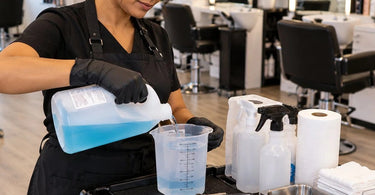
Your work, elevated... and your disinfectant inventory finally under control! Running a busy salon means juggling appointments, keeping every station looking fabulous, and making sure sanitation never becomes an afterthought. But figuring out how much disinfectant your salon actually needs can feel like solving a math problem while three clients are waiting for their appointments and someone just spilled nail polish on the counter. The good news? With a few simple calculations and a clear understanding of your cleaning routines, you can estimate disinfectant consumption, control supply costs, and keep your team prepared without turning your storage closet into a chemical warehouse.
Whether you manage five styling chairs, ten manicure tables, several waxing rooms, or a combination of beauty service stations, the goal is the same: maintain an adequate supply of properly selected professional salon cleaners and disinfectants while minimizing unnecessary waste. Here is how to build a realistic disinfectant budget based on your salon's actual workload rather than guesswork.
Why Disinfectant Planning Matters in a Multi-Station Salon
A salon with several active workstations uses disinfectant differently from a solo beauty professional. Every additional station creates more surfaces, reusable implements, and opportunities for required cleaning and disinfection.
Consider the different sanitation demands throughout a typical business day:
- Hair styling stations require attention to appropriate hard, nonporous surfaces and reusable tools.
- Manicure stations involve reusable metal implements, work surfaces, and equipment components that can be safely disinfected.
- Pedicure areas may require specialized cleaning and disinfection procedures for basins, whirlpool systems, and reusable implements.
- Waxing rooms require appropriate disinfection of treatment surfaces and eligible reusable equipment between clients.
- Facial treatment rooms may include reusable tools, treatment carts, and equipment surfaces with product-specific care instructions.
- Shared reception areas, frequently touched surfaces, and staff workspaces add to overall cleaning requirements.
The quantity needed depends on more than the number of chairs. Client turnover, service type, product formulation, application method, required contact time, and solution replacement schedules all influence consumption.
Importantly, disinfectant calculations are inventory estimates, not permission to reduce required sanitation procedures. Product labels, equipment manufacturer instructions, and applicable state board regulations always take priority.
Step 1: Count Every Station That Requires Disinfection
Begin with a workstation inventory. Walk through your salon and identify each area where disinfectant is used during daily operations.
For example, imagine a salon with:
- 6 hairstyling stations
- 4 manicure stations
- 2 pedicure stations
- 2 waxing treatment rooms
- 1 shared reception and checkout area
That gives you 15 operational areas to evaluate. However, it does not mean each area uses the same amount of disinfectant.
A busy manicure station may require multiple implement disinfection cycles, while a reception counter may need a different frequency of surface disinfection under the salon's established protocol.
Create separate categories for surface disinfection, implement immersion, and any specialized equipment procedures. Keeping these categories distinct prevents double-counting and makes your calculations much more accurate.
If you are planning a new workspace, consider how the layout of nail tables and manicure stations or salon furniture affects access to cleaning supplies and approved disinfection areas.
Step 2: Estimate Daily Client Turnover
Next, determine how many clients each station serves during a typical operating day.
Suppose your salon averages:
- 6 hairstyling stations serving 7 clients each: 42 appointments
- 4 manicure stations serving 6 clients each: 24 appointments
- 2 pedicure stations serving 5 clients each: 10 appointments
- 2 waxing rooms serving 8 clients each: 16 appointments
Your salon handles approximately 92 appointments per day.
That number is useful because many disinfection procedures occur between clients, although other tasks are scheduled before opening, during the day, or after closing.
Be careful not to equate one appointment with one identical disinfectant application. A hair color appointment and a detailed manicure may involve very different reusable tools, surfaces, and cleaning procedures.
For the most accurate estimate, track actual disinfectant use by service category for at least one representative week.
Step 3: Separate Ready-to-Use Products From Concentrated Disinfectants
This distinction is essential because the mathematics changes depending on the product formulation.
Ready-to-use disinfectants: These products arrive prepared for use according to their labels. Inventory calculations generally focus on the amount of liquid or number of wipes consumed per application.
Concentrated disinfectants: These products require dilution according to their EPA-registered label directions. Inventory calculations must distinguish the volume of concentrate from the volume of prepared working solution.
For example, one gallon of ready-to-use disinfectant provides approximately 128 fluid ounces of product. A concentrated formula may produce a much larger amount of working solution, depending on its specific labeled dilution rate.
Do not assume that every concentrate uses the same mixing ratio. Different products, applications, and required antimicrobial claims may have different directions.
Browse professional cleaners and disinfectants to compare available product formats, then review the actual label before estimating quantities.
Step 4: Calculate Disinfectant Used on Workstation Surfaces
Start with the amount of ready-to-use liquid consumed per complete surface disinfection event. You can also use this method for prepared working solutions made from concentrates.
The basic calculation is:
Daily surface solution = Number of disinfection events x Average solution volume per event
Suppose six styling stations collectively require 42 between-client disinfection events each day, and a measured trial shows that each event consumes an average of 1.5 fluid ounces of an appropriate ready-to-use product.
42 x 1.5 = 63 fluid ounces per day.
That is approximately 0.49 gallon of ready-to-use solution daily for those styling-station events alone.
Now assume four manicure stations complete 24 between-client events, averaging 1 fluid ounce each.
24 x 1 = 24 additional fluid ounces.
Combined estimated surface use for these two service categories becomes:
63 + 24 = 87 fluid ounces per day.
These figures are hypothetical planning assumptions, not recommended application rates. Actual consumption must be measured while following the selected disinfectant's directions, including sufficient wet coverage and the full required contact time.
A surface that dries before the required contact time may need additional product. Reducing the amount applied merely to meet a purchasing budget can compromise disinfection.
Step 5: Calculate Immersion Disinfectant for Reusable Implements
Immersion containers introduce a different kind of calculation. Instead of counting only individual tool disinfection cycles, estimate the working solution required to fill each container to the level necessary for complete immersion of eligible implements.
Suppose your salon uses:
- 4 covered implement containers that each require 32 fluid ounces of working solution
- 2 larger covered containers that each require 64 fluid ounces
The initial combined fill volume is:
(4 x 32) + (2 x 64) = 256 fluid ounces.
That equals 2 gallons of working solution.
If the applicable product directions and state requirements call for fresh solution daily, this example requires at least 2 gallons of prepared immersion solution per operating day, assuming every container is filled once.
Additional replacement solution must be included whenever containers become contaminated, visibly dirty, improperly diluted, or otherwise require replacement under the product label or local regulations.
The working solution must completely cover the implements for the required contact time. Never shorten immersion time to accelerate appointment turnover.
Reusable tools must also be cleaned before disinfection and handled according to the product label and tool manufacturer instructions. Not every tool is suitable for liquid immersion, and disposable single-use implements should not be disinfected for reuse.
Stock appropriate disinfectant jars and professional spa tools and implements based on your salon's service requirements.
Step 6: Convert Working Solution Into Concentrate Requirements
Here is where concentrated disinfectants can make inventory planning especially interesting.
First, calculate the total prepared working solution needed. Then use the manufacturer's exact dilution instructions to determine how much concentrate is required.
For an illustrative example only, suppose a product label specifies adding 2 fluid ounces of concentrate to 1 gallon of water for the intended application.
If your salon prepares 3 gallons of water-based dilution per day:
3 x 2 = 6 fluid ounces of concentrate per day.
For 26 operating days:
6 x 26 = 156 fluid ounces of concentrate.
156 / 128 = approximately 1.22 gallons of concentrate.
In this hypothetical situation, the salon would use approximately 1.22 gallons of concentrate over the month for that particular application.
Important: The 2-ounce dilution rate is an example, not a universal disinfectant mixing instruction. Some labels express their ratios differently, including amounts per gallon of water versus percentages of final working solution. Always calculate according to the exact label language, and use suitable measuring equipment. Never increase or decrease the concentration based on preference.
Also remember that concentrates intended for implement immersion may not automatically be approved for every surface or specialized piece of equipment in your salon.
Step 7: Include Pedicure Equipment and Specialized Treatment Areas
Pedicure equipment deserves its own inventory category because cleaning and disinfection requirements can differ substantially from ordinary workstation surfaces.
Foot spas and whirlpool pedicure units may require draining, cleaning, refilling, circulating a properly prepared disinfectant, and observing a specified contact time. Procedures vary by equipment design, manufacturer, disinfectant label, and state regulations.
For example, if a particular cleaning and disinfection procedure requires preparing 4 gallons of working solution per unit, and two units each undergo that procedure twice daily, the estimated working solution volume for those cycles would be:
2 units x 2 cycles x 4 gallons = 16 gallons per day.
This is a mathematical illustration, not a universal pedicure cleaning schedule or prescribed fill volume.
Some systems use different procedures or require additional steps between clients and at the end of the day. Actual requirements must come from the relevant equipment instructions, disinfectant label, and regulations.
Salon owners purchasing pedicure chairs and spas should factor sanitation procedures into the total operating cost, not just the equipment purchase price.
The same planning principle applies to waxing rooms, facial treatment equipment, and other specialized service spaces. Determine which surfaces are approved for the selected disinfectant and whether equipment-specific products or procedures are necessary.
Step 8: Build a Realistic Monthly Disinfectant Forecast
Once you have tracked your daily usage, calculating monthly demand becomes much easier.
Use this formula for ready-to-use products or prepared working solution:
Monthly solution volume = Average daily solution volume x Operating days per month
Consider a hypothetical salon that has measured the following daily working-solution requirements:
- Styling and manicure surface applications: 87 fluid ounces
- Other treatment-room and shared-surface applications: 41 fluid ounces
- Implement immersion solution: 256 fluid ounces
Total daily working solution:
87 + 41 + 256 = 384 fluid ounces.
384 / 128 = 3 gallons per day.
For 26 operating days:
3 x 26 = 78 gallons of working solution per month.
This estimate excludes any separately calculated pedicure equipment solutions and additional replacement requirements.
Also, 78 gallons of working solution does not necessarily mean purchasing 78 gallons of concentrate. Each product must be converted into its actual purchase quantity according to whether it is ready-to-use or concentrated.
For salons using several disinfectant formulations, maintain a separate calculation for each SKU rather than combining incompatible products into one general inventory number.
Step 9: Add a Sensible Inventory Safety Buffer
Salon operations rarely follow a perfectly predictable schedule. Walk-ins happen, service times shift, stations run at different capacities, and a busy Saturday can make an ordinary Tuesday look positively peaceful.
An additional inventory reserve helps protect your operations from unexpected demand or delayed deliveries.
For planning purposes, consider a 10% to 20% inventory buffer based on actual usage variability, supplier lead times, storage capacity, and purchasing schedules.
For example, if your measured monthly requirement is 10 gallons of a ready-to-use product and you choose a 15% buffer:
10 x 0.15 = 1.5 gallons.
Total purchasing target = 11.5 gallons.
You would then round to the available package sizes while accounting for usable stock already on hand.
This buffer is strictly an inventory reserve. It does not mean making disinfectant solutions stronger, preparing unnecessarily large batches, or keeping solutions beyond permitted replacement times.
Step 10: Compare Cost Per Usable Gallon
Looking only at the container price can be misleading, particularly when comparing concentrates with ready-to-use products.
Instead, calculate cost per usable gallon of solution prepared according to the label.
For a hypothetical concentrate costing $48 per gallon, assume the permitted dilution requires 2 fluid ounces of concentrate for each gallon of water.
One gallon of concentrate contains 128 fluid ounces.
128 / 2 = 64 one-gallon water-based dilution batches.
$48 / 64 = $0.75 of concentrate per batch.
This means the concentrate component costs approximately $0.75 per batch prepared using one gallon of water, excluding water, containers, labor, dispensing losses, and other operating expenses.
By comparison, a hypothetical ready-to-use disinfectant costing $18 per gallon has an $18 product cost per usable gallon.
That does not automatically make the concentrate the better purchase. The products may differ in intended applications, approved surfaces, contact times, required claims, material compatibility, preparation labor, and operating convenience.
A proper comparison evaluates both total cost and suitability for the specific sanitation task.
How to Reduce Disinfectant Waste Without Compromising Safety
The smartest sanitation budget does not come from using less disinfectant than required. It comes from eliminating preventable purchasing and preparation mistakes.
Measure consistently. Use suitable measuring devices and follow the precise label directions for every concentrated product.
Track actual consumption. Record how much product is issued to each area and how often working solutions must be replaced.
Use appropriately sized containers. Covered immersion containers should be large enough to fully submerge all eligible implements without unnecessary oversized batches.
Train every team member. A written sanitation procedure prevents inconsistent dilution, incomplete contact times, and accidental misuse.
Follow replacement requirements. Replace prepared solutions whenever required by the label, applicable regulations, or contamination conditions. Do not extend their useful life simply to reduce costs.
Choose the right product for the task. Cleaning products, disinfectants, and products marketed for sanitizing are not automatically interchangeable. Verify the product's EPA registration, labeled use sites, claims, and instructions where applicable.
Keep dispensers and containers properly labeled. Follow product labeling requirements and applicable workplace chemical safety procedures. Never mix different disinfectants or add other cleaning chemicals unless explicitly directed by the manufacturer.
Maintain supply organization. Store chemicals according to their labels, away from incompatible materials, and monitor expiration dates.
Helpful operational supplies may include bottles and jars, appropriate protective gloves, and cleaning materials selected for the specific task and product directions.
How Often Should You Review Your Disinfectant Calculations?
A disinfectant forecast should change as your business changes.
Review your calculations whenever you add stations, expand operating hours, introduce new services, replace equipment, or change disinfectant products.
Seasonal appointment patterns matter, too. A salon may experience increased manicure and pedicure bookings during warmer months, while holiday schedules create heavier styling demand.
A practical management routine includes checking product inventory weekly, comparing actual consumption with forecasts monthly, and reviewing service-specific usage whenever appointment volume changes significantly.
For each disinfectant SKU, record the product name, package size, approved application, dilution instructions if applicable, average daily use, purchase lead time, expiration date, and reorder point.
A simple reorder formula is:
Reorder point = Average daily purchased-product use x Supplier lead time in days + Safety stock
For example, if your salon consumes 20 fluid ounces of a particular ready-to-use product each day, supplier lead time is 7 days, and your chosen safety stock is 60 fluid ounces:
(20 x 7) + 60 = 200 fluid ounces.
You would place an order when usable inventory approaches approximately 200 fluid ounces, adjusting for anticipated demand and available packaging.
This approach helps maintain sufficient supplies without overbuying products that may expire before use.
Common Disinfectant Calculation Mistakes to Avoid
Even experienced salon managers can make inventory errors. Watch for these especially common problems:
- Multiplying station count by a random daily allowance: Different services require different sanitation procedures and quantities.
- Confusing concentrate with working solution: A gallon of concentrate and a gallon of prepared solution represent different inventory quantities.
- Ignoring immersion-container fill volumes: Implement disinfection may account for substantial solution demand even when relatively few tools are processed.
- Forgetting specialized equipment: Pedicure systems and certain treatment devices may require separate procedures and additional products.
- Assuming all products share one contact time: Contact time is determined by the specific label and intended claim.
- Overlooking solution replacement: Daily preparation, contamination, or other label requirements may increase actual usage.
- Counting every appointment as identical: Different service categories create different cleaning workloads.
- Purchasing solely by price: Product suitability, labeling, employee safety, and regulatory requirements matter more than a low cost per ounce.
The goal is not to become the salon's full-time disinfectant mathematician. It is to establish a straightforward system that keeps sanitation reliable and purchasing predictable.
Creating a Simple Disinfectant Inventory Worksheet
A spreadsheet can make calculations significantly easier, especially for larger salons with multiple service categories.
Set up columns for the following information:
- Station or service category
- Number of active stations
- Average daily disinfection events or solution preparation cycles
- Measured working-solution volume per event or batch
- Total daily working-solution requirement
- Specific disinfectant product used
- Label dilution instructions, if applicable
- Calculated daily concentrate or ready-to-use product consumption
- Monthly operating days
- Monthly purchased-product requirement
- Safety stock and current inventory
- Recommended reorder quantity
Once the worksheet is established, you can update client volumes and product usage without starting from scratch every month.
Keep separate tabs or sections for surface products, implement immersion products, pedicure disinfection supplies, and any other specialized procedures.
For a growing salon group or multi-location business, the same worksheet can be replicated across locations to compare consumption, identify unusual waste, and improve purchasing consistency.
Frequently Asked Questions About Salon Disinfectant Quantities
How much disinfectant does a 10-station salon need daily?
There is no reliable universal amount. Daily consumption depends on service types, client turnover, immersion-container requirements, product format, and equipment procedures. Measure each category separately and add the results to determine your daily total.
Is concentrated disinfectant always more economical?
Not necessarily. Concentrates may provide a lower ingredient cost per prepared gallon, but preparation labor, dilution accuracy, contact time, suitability, and waste must all be considered. Ready-to-use formats may be more practical for some salon applications.
Can prepared disinfectant be reused throughout the day?
Only as permitted by the product label and applicable salon regulations. Some solutions require daily replacement or more frequent changes when contaminated. Other products have different use-life instructions. Never assume that a solution remains effective indefinitely.
Should a salon use the same disinfectant for every station?
Only if the product's label specifically supports each intended application and the relevant surfaces and equipment are compatible. Different tasks may require different products, especially when specialized equipment procedures apply.
How can I tell whether my salon is wasting disinfectant?
Compare measured consumption with the amount reasonably required to follow product directions and applicable sanitation procedures. Look for unnecessary oversized batches, incorrect preparation, poorly organized inventory, expired products, and inconsistent staff practices rather than attempting to reduce required coverage or contact time.
Keep Your Salon Clean, Prepared, and Beautifully Organized
Calculating disinfectant needs for a multi-station salon does not require an advanced degree in mathematics. It requires a reliable count of service areas, realistic appointment data, measured product consumption, accurate dilution calculations, and a purchasing plan that accounts for busy periods.
Start by separating surface disinfection, implement immersion, and specialized equipment requirements. Calculate each category according to the actual products and procedures used, convert working-solution quantities into purchasing units, and maintain a sensible reserve.
Pure Spa Direct helps salon, spa, nail, barber, and beauty professionals source the supplies needed for efficient daily operations. Explore our professional cleaners and disinfectants for salons and spas, along with essential salon and spa business supplies, to support your sanitation and inventory planning.
Because the best salon supply strategy is simple: enough disinfectant to perform every required task correctly, enough organization to keep your team moving, and fewer surprise shopping emergencies five minutes before your first appointment. Now that is a beautiful equation.
