
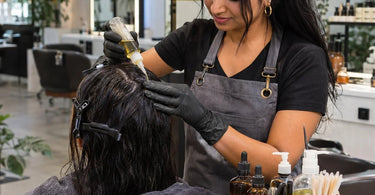
Simple changes can lead to big improvements, especially when those changes involve giving clients a relaxing scalp treatment while creating another revenue opportunity for your salon. Adding scalp treatments to a hair salon menu can be an appealing way to expand your services without completely reinventing your business. But before you start offering luxurious scalp massages, refreshing exfoliation, and nourishing treatments, there is one very important question to answer: What will each appointment actually cost in supplies? After all, a service that feels like a mini vacation for your client should not send your profit margins on an unexpected vacation of their own!
Calculating your scalp treatment supply cost involves more than dividing the price of a shampoo bottle by the number of appointments it lasts. You need to consider product quantities, disposable supplies, laundry, sanitation, product waste, and the differences between treatment packages. With a practical cost calculation, you can build a scalp treatment menu that feels indulgent to clients while making financial sense for your salon.
Why Calculate Scalp Treatment Supply Costs Before Adding the Service?
Scalp treatments can complement existing salon services, including haircuts, shampoo appointments, color services, and blowouts. Depending on your menu and staff expertise, you might offer a quick scalp refresh, an exfoliating treatment, or a longer relaxation-focused service.
Each option requires a different combination of products and supplies. A short cleansing treatment might use a clarifying shampoo and finishing serum, while a more elaborate treatment could include exfoliation, conditioning products, scalp massage, warm towels, and specialized tools.
Knowing the supply cost of each service helps you establish consistent menu prices, compare treatment options, manage inventory, and identify opportunities to improve profitability. It also prevents the familiar salon mystery of wondering where an entire container of expensive treatment cream disappeared after a busy Saturday.
Step 1: Decide Exactly What Your Scalp Treatment Includes
Before calculating expenses, write down the steps of the proposed service. A standardized treatment protocol gives your team a consistent starting point for estimating product consumption and appointment length.
For example, a basic scalp treatment might include a short consultation, scalp cleansing, a gentle massage, rinsing, and a lightweight finishing product.
An exfoliating scalp treatment could add a specialized scrub or exfoliating formula, followed by cleansing and conditioning. A premium scalp experience might incorporate additional massage time, a treatment mask, warm towels, and an extended finishing ritual.
For each service, identify which supplies are new expenses and which are already included in the original appointment. If your regular haircut already includes shampoo, for example, charging the entire shampoo expense again to the scalp treatment would inflate the incremental cost of that add-on.
When building your service protocols, explore Premium Hair Care Products for Salons & Barber Shops and Professional Hair Salon & Barber Shop Supplies to identify products and accessories that fit your treatment concept.
Step 2: List Every Product Used During the Treatment
Next, create a complete inventory of the consumable products used during one scalp treatment. This is the foundation of your cost calculation.
Depending on your service, your product list might include:
- Clarifying or specialized scalp shampoo.
- Scalp exfoliating scrub or exfoliating treatment.
- Conditioner or nourishing hair mask.
- Scalp serum or leave-in treatment.
- Massage oil or another scalp-compatible massage product.
- Finishing products used after the treatment.
Not every service needs all these products. In fact, adding more formulas simply to make a treatment seem premium can increase costs without necessarily improving the client experience.
Choose products based on their intended professional use, the needs of your clients, and the treatment results you can reasonably describe. Look through scalp treatment products, scalp scrubs, and clarifying shampoos when comparing possible supplies.
Step 3: Calculate the Cost Per Ounce of Each Product
Now comes the math. Do not worry! This is salon math, which is considerably more enjoyable when it leads to a profitable service menu.
For each product, divide its purchase price by the amount of usable product in the container.
Cost per ounce = Product purchase price / Total usable ounces
Suppose you purchase a 16-ounce container of professional scalp scrub for $32.
$32 / 16 ounces = $2 per ounce.
If your treatment uses 0.75 ounce of the scrub, multiply the amount used by the cost per ounce.
Product cost per treatment = Cost per ounce x Ounces used
$2 x 0.75 ounce = $1.50 per treatment.
That means your scalp scrub contributes $1.50 to the supply cost of each appointment.
Repeat this calculation for every product included in the service. If a manufacturer supplies dispensing instructions in milliliters rather than ounces, calculate using milliliters instead. Consistent units are what matter.
For products sold in packets, capsules, or single-use ampoules, divide the purchase cost by the number of usable units and multiply by the number used per service.
Always use your actual purchase price, including any applicable nonrecoverable taxes, shipping, or landed costs allocated to the product. The prices used throughout this article are hypothetical examples for demonstrating the calculations, not current product quotations.
Step 4: Measure How Much Product Your Stylists Actually Use
A written treatment protocol might call for half an ounce of shampoo, but your actual usage could be different. Product thickness, packaging, dispensing methods, hair length, hair density, and stylist habits can all influence consumption.
The most useful approach is to measure product usage during several practice appointments.
Weigh a product container before and after a treatment using a suitable scale, or use a measured dispenser when practical. If weighing the product, account for the product density when converting weight to fluid ounces. Alternatively, measure directly in grams and calculate your unit cost by gram.
Record the amount used across different hair lengths and densities, then establish a realistic standard portion for each treatment tier.
For example, you might discover that a short-hair treatment typically requires less cleansing product than a service performed on a client with long, dense hair. Your salon can account for this variation with defined dosage allowances or thoughtfully structured service tiers.
Consider Bottles & Jars for appropriate product dispensing and storage, and Mixing Bowls when your chosen professional formulas require preparation.
Standardized portions reduce waste and make your service costs more predictable. They also help ensure that clients receive a consistent experience regardless of which stylist performs the treatment.
Step 5: Include Disposable Supplies, Towels, and Sanitation
Products are only part of the supply expense. Every appointment also consumes smaller items that are easy to overlook individually.
Depending on the protocol, your treatment may require disposable applicators, gloves, cotton products, towels, protective coverings, and cleaning supplies.
For reusable towels, calculate the average laundry expense per treatment rather than treating the full purchase price of each towel as a single-use cost. Your estimate should consider detergent, utilities, laundry labor when applicable, and expected towel replacement.
For disposable items, divide the package price by the number of units in the package and multiply by the quantity used per appointment.
Useful supply categories include High-Quality Towels, Professional Cotton, Sponges, and Wipes for Salons & Spas, Protective Gloves & Masks, and Professional Cleaners & Disinfectants for Salons and Spas.
Follow product directions and applicable sanitation regulations. Reusable implements must be cleaned and disinfected as required, and single-use items should not be reused simply to reduce costs.
Step 6: Build a Sample Scalp Treatment Supply Cost Worksheet
Here is a hypothetical example of an exfoliating scalp treatment. The figures illustrate how a salon can calculate its variable supply expense using estimated product consumption and per-appointment costs.
| Supply Item | Example Quantity or Basis | Cost Per Treatment |
|---|---|---|
| Pre-treatment scalp cleanser | 0.5 ounce | $0.75 |
| Scalp exfoliating scrub | 0.75 ounce | $1.50 |
| Professional shampoo | 1 ounce | $1.25 |
| Conditioning treatment mask | 0.5 ounce | $1.50 |
| Finishing scalp serum | 0.1 ounce | $1.00 |
| Disposable supplies | Per appointment | $1.10 |
| Towel laundry allowance | Per appointment | $0.75 |
| Cleaning and sanitation supplies | Per appointment | $0.45 |
| Total basic supply cost | One appointment | $8.30 |
In this example, the treatment costs $8.30 in direct supplies before accounting for product waste, labor, equipment, and general business overhead.
The product portion of the example totals $6.00, while disposables, laundry, and sanitation account for another $2.30.
Keeping these categories separate makes it easier to see whether cost increases are coming from expensive formulas, excessive consumption, or other service supplies.
Step 7: Add a Realistic Product Waste Allowance
Even carefully managed salons experience some product waste. Residue left in containers, accidental overdispensing, expired products, and occasional mixing errors can increase actual consumption.
One simple planning method is to apply a waste allowance to your product subtotal.
For example, assume the five liquid and treatment products in the sample worksheet cost $6.00 per appointment.
If you use a hypothetical 15% waste allowance:
$6.00 x 0.15 = $0.90.
Add that amount to the original $8.30 supply expense.
$8.30 + $0.90 = $9.20 adjusted supply cost per treatment.
This 15% figure is an illustrative planning assumption, not a universal industry standard. Your actual waste allowance should reflect measured inventory losses and usage patterns. If you already calculate costs from actual consumption that includes normal dispensing waste, do not add the same waste a second time.
Review the allowance periodically. Improved dispensing, better team training, and consistent portion sizes may reduce unnecessary waste and lower your per-service expenses.
Step 8: Separate Supply Cost From Labor and Overhead
Here is an important distinction: Supply cost is not the same as total service cost.
If your scalp treatment requires additional appointment time, that time has a financial value even if the products are inexpensive.
Suppose a scalp treatment add-on requires 15 additional minutes and your fully burdened direct labor cost is $30 per hour.
15 minutes / 60 minutes = 0.25 hour.
0.25 hour x $30 = $7.50 incremental labor cost.
Combine that with the adjusted supply cost:
$9.20 supplies + $7.50 labor = $16.70.
If you allocate another $3.00 to equipment usage and operating overhead, the illustrative total becomes $19.70 per appointment.
These categories should remain separate in your bookkeeping so you understand which costs are genuinely variable and which are allocated. A treatment performed during an existing appointment may have different incremental time and overhead requirements than a separate booking.
When planning equipment purchases, browse Professional Salon Equipment for Top Stylists and Barbers and Towel Steamers to evaluate equipment that may support your intended service experience.
Step 9: Set a Menu Price That Protects Your Margin
Once you know your estimated total service cost, you can work backward from a target profit margin rather than picking a price because another salon has a similar number on its menu.
For a simplified pricing model, use this formula:
Required service price = Total estimated service cost / (1 - Target margin)
Suppose your total allocated cost is $19.70 and you want a 40% margin after those included costs.
$19.70 / (1 - 0.40) = $32.83.
Under those assumptions, a price of approximately $33 would meet the 40% target before any costs not included in the model.
Payment processing expenses, promotional discounts, taxes where applicable, additional overhead, and other financial obligations may affect the final price you need to charge. Your salon should also evaluate client demand, local competition, staff capacity, and the experience being offered.
Do not confuse margin with markup. Adding 40% to the $19.70 cost produces a price of $27.58, which does not deliver a 40% margin. Using the correct formula helps prevent an expensive pricing surprise.
Step 10: Create Scalp Treatment Packages With Different Cost Structures
Not every client wants the same experience, and your menu does not need to offer a single scalp service.
Consider creating three clearly differentiated tiers.
Express Scalp Refresh: A brief scalp cleansing or massage add-on designed to fit into an existing appointment. This option might use a smaller amount of cleansing product and a simple finishing treatment. Keep incremental appointment time and supplies tightly controlled.
Exfoliating Scalp Treatment: A more detailed service featuring scalp exfoliation, cleansing, conditioning, and massage. This tier may require additional products, towels, and appointment time.
Signature Scalp Ritual: A longer relaxation-focused experience that may include multiple treatment steps, warm towels, extended scalp massage, and specialty finishing products. Its higher supply and labor requirements should be reflected in the menu price.
For each tier, prepare a separate cost worksheet. Avoid assuming that the premium package simply costs twice as much to deliver because it lasts twice as long. Product consumption, laundry, equipment requirements, and cleanup time may change differently across packages.
If you are expanding your treatment space, Stylish Salon & Barber Furniture and Salon & Barber Apparel can be useful categories to consider as part of a broader service presentation.
Should You Buy Scalp Treatment Products in Bulk?
Buying professional supplies in larger quantities may improve your cost per treatment, but only when the savings outweigh the additional inventory commitment.
For example, imagine a 16-ounce treatment product costs $32, while a 32-ounce professional size costs $52.
The smaller size costs $2.00 per ounce. The larger size costs $1.625 per ounce.
At a usage rate of 0.75 ounce per appointment, the smaller size contributes $1.50 per service, while the larger size contributes approximately $1.22 per service.
That represents approximately $0.28 in savings per appointment before any differences in shipping, waste, or storage costs.
Those savings can accumulate, but only if you use the product before its applicable expiration or recommended use period.
Before increasing your order quantity, consider your booking volume, shelf life, storage requirements, supplier availability, and cash flow. A professional-size container is not automatically a bargain if half of it expires in a storage cabinet.
Pure Spa Direct is a professional beauty supply distributor, not the manufacturer of the products it carries. Salon owners can use its selection of professional supplies and brands to compare options for their service protocols while making purchasing decisions based on actual product specifications and business needs.
Forecast Your Monthly Scalp Treatment Supply Budget
Once your cost per appointment is established, estimating monthly inventory requirements becomes much easier.
Use this straightforward formula:
Monthly supply budget = Adjusted supply cost per treatment x Expected monthly appointments
If your adjusted supply cost is $9.20 and you expect to perform 60 scalp treatments per month:
$9.20 x 60 = $552 in estimated monthly supply consumption.
If appointments increase to 100 per month, your projected supply consumption rises to $920, assuming the same average treatment mix and cost.
Remember that supply consumption is different from purchasing cash flow. You may purchase a full case of products in one month and use that inventory over several months.
For a more detailed forecast, multiply each individual product quantity by expected appointment volume. Then compare your projected requirements with current usable inventory to determine your reorder needs.
If your salon offers several scalp treatment tiers, forecast them separately and add the results together. A month with mostly express appointments can have a very different supply requirement from one filled with premium scalp services.
Control Your Costs Without Making the Treatment Feel Cheap
There is a difference between reducing unnecessary expenses and stripping all the enjoyment out of a service. Clients booking scalp treatments are often paying for a combination of professional care, comfort, and relaxation.
Focus on operational consistency rather than simply cutting products.
- Standardize product portions: Establish clear amounts for each service and train staff to follow the protocol.
- Choose versatile professional supplies: When appropriate, select products that can serve multiple compatible treatment protocols without compromising their intended use.
- Track inventory: Record purchases, usage, damaged products, and expiration dates.
- Control laundry volume: Use the number of towels needed for a comfortable, hygienic service without adding unnecessary extras.
- Review treatment timing: Account for consultation, application, rinsing, cleanup, and any added styling.
- Monitor product substitutions: Update the cost worksheet whenever a different formula, size, or supplier price changes your cost per appointment.
Small savings across dozens or hundreds of appointments can make a meaningful difference. Just remember that saving a few cents should never come at the expense of hygiene, product directions, or a client's experience.
Keep Scalp Treatment Claims Professional and Appropriate
As you build your menu, describe services according to what the products and professional protocol are intended to provide.
Cosmetic scalp care may focus on cleansing, removing routine product buildup, conditioning, and creating a relaxing appointment experience. Avoid promising that a standard salon scalp treatment will cure a medical scalp condition, reverse hair loss, or deliver unproven hair growth results.
Clients presenting with significant irritation, open sores, unexplained hair loss, or other concerning symptoms may need evaluation by an appropriate healthcare professional before receiving a cosmetic scalp service.
Check your state licensing rules and the professional requirements applicable to the services you intend to provide. Not every scalp-related technique or device is necessarily within every salon professional's authorized scope of practice.
Clear service descriptions build trust, help staff make appropriate recommendations, and ensure clients understand what their appointment includes.
How Often Should You Recalculate Scalp Treatment Costs?
Your initial cost worksheet is a starting point, not a permanent record.
Recalculate whenever product prices increase, treatment formulas change, service steps are modified, or your team begins using noticeably different product quantities.
A monthly inventory review can help identify unexpected consumption, while a quarterly pricing review provides an opportunity to evaluate whether your menu still supports your business goals.
Keep a simple spreadsheet with columns for product name, package size, purchase price, unit cost, quantity per treatment, and total treatment cost. Add separate entries for disposables, laundry, sanitation, labor, and overhead.
Comparing estimated costs with actual usage helps uncover differences before they become major profit problems. If a treatment consistently consumes more product than planned, investigate the cause rather than assuming your original estimate was accurate.
Turn Scalp Treatments Into a Smart Addition to Your Salon Menu
Adding scalp treatments can be an exciting way to expand your salon's service offerings, introduce clients to new experiences, and make better use of your team's professional skills. The key is understanding the numbers before you finalize your menu.
Start by defining each service, measuring product usage, calculating the cost of every consumable, and including a realistic allowance for waste. Then evaluate labor, equipment, overhead, and your desired margin to determine an appropriate service price.
As your appointment volume grows, monitor inventory and refine your protocols so your supply budget stays aligned with actual demand.
Explore professional hair salon and barber supplies, scalp care products, and Must-Have Supplies for Salon & Spa Business Success at Pure Spa Direct as you plan your new offerings.
With a well-designed treatment experience and an accurate cost worksheet, your clients can enjoy the relaxation while your salon enjoys knowing exactly where the money goes. Now that is the kind of scalp treatment math everyone can appreciate!
