
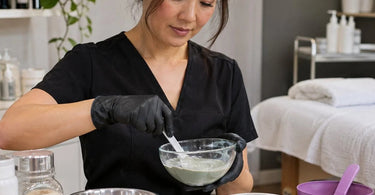
Elevate client trust with this product... or, more accurately, with the surprisingly important little bowl holding your favorite facial mask. A professional facial treatment can feature gorgeous skincare formulations, perfectly chilled towels, and an esthetician with hands that deserve their own fan club, but an awkward mixing bowl can still turn preparation into a messy production. Choosing the right mixing bowls for different facial mask formulations helps professionals achieve smoother consistency, control product portions, reduce unnecessary waste, and maintain an organized treatment room. From fast-setting alginate masks to luxurious cream masks and finely milled clay powders, different formulas have different mixing requirements. The right bowl makes those requirements much easier to manage, and your treatment room deserves tools that work as beautifully as the products inside them.
Professional estheticians often spend considerable time selecting professional skincare products, yet the equipment used to prepare those formulations sometimes receives far less attention. Bowl material, interior shape, depth, flexibility, capacity, and cleaning requirements can all influence the preparation process. Understanding these differences allows spas to build a practical mixing bowl collection that supports a wide range of services without cluttering every available countertop.
Why Facial Mask Formulations Need Different Mixing Bowls
Not every facial mask behaves the same way once it leaves its container. Some products arrive ready to apply, while others require precise measurements of powder, water, activators, or complementary skincare products. Certain formulations remain workable for an extended period, while others begin thickening almost immediately after mixing.
The bowl needs to accommodate the formula's texture, mixing technique, and preparation speed. A thick clay paste benefits from a stable bowl that stays in place during vigorous blending. A fast-setting modeling mask requires enough space to combine ingredients quickly and transfer the mixture efficiently. A delicate cream formulation may need only a small, shallow container and a gentle spatula.
Using one oversized bowl for every facial might seem convenient, but it can increase product left behind on the sides and make small portions difficult to gather. Conversely, a bowl that is too small can turn an enthusiastic mixing session into an accidental countertop facial. Neither situation belongs on the treatment menu.
Silicone Mixing Bowls: Flexible Favorites for Professional Facial Masks
Silicone bowls are particularly useful for estheticians who frequently prepare powder masks, modeling masks, and other formulations that benefit from flexible containers. Their smooth, nonstick surfaces can make it easier to release certain dried mask residues, while their flexibility allows professionals to manipulate the bowl during mixing and cleanup.
The Silhouet-Tone Silicone Facial Mask Mixing Bowls, Set of 5 offer an excellent example of features worth considering. Each bowl measures approximately 4.1 inches in diameter and 2.8 inches tall. The set features flexible silicone construction, a nonstick surface, and a nonslip bottom design intended to improve stability during preparation.
These bowls are designed for professional masks, creams, and lotions, including modeling masks. Their compact dimensions make them practical for individual facial portions, and having five bowls available gives estheticians flexibility when preparing consecutive treatments.
The manufacturer also describes these bowls as microwave and dishwasher safe and suitable for certain warming applications. However, always confirm the skincare formulation's specific temperature requirements and follow the bowl manufacturer's instructions before warming any product. A heat-tolerant bowl does not automatically mean every mask inside it should be heated.
Best uses: Alginate-style masks, modeling masks, powder-to-liquid facial masks, and small portions of compatible cream or gel formulations.
Rubber Mixing Bowls: Practical Tools for Thick Masks and Pastes
Rubber mixing bowls are another useful option for professional facial preparation, especially when working with thicker textures. Their flexible construction can provide a comfortable mixing surface, and certain rubber formulations allow dried product to be removed more easily than from rigid containers.
The Rubber Mixing Bowl - Small is designed for professional skincare applications involving masks, creams, and lotions. Its flexible construction makes it an option for estheticians who prefer a compact bowl for individual treatment preparations.
Rubber bowls can be especially convenient for formulas requiring repeated scraping and folding with a spatula. However, not all rubber materials are interchangeable. Some may be incompatible with particular ingredients, disinfectants, heat levels, or cleaning methods.
Before selecting a rubber bowl, review its material specifications and the skincare manufacturer's preparation instructions. Replace bowls that become cracked, sticky, excessively stained, or otherwise difficult to clean properly.
Best uses: Thick mask pastes, cream-based preparations, and professional powder formulations when the product and bowl materials are compatible.
Stainless Steel Mixing Bowls: Durable Options for Larger Preparations
Stainless steel bowls offer an entirely different set of advantages. They are rigid, durable, and useful when a formulation requires a stable mixing surface or a larger working capacity. Smooth, intact stainless steel is also relatively straightforward to clean when appropriate cleaning and disinfection procedures are followed.
The Stainless Steel Nesting Mixing Bowls with Airtight Lids, Set of 5 includes capacities of 0.75, 1, 1.5, 3, and 5 quarts. The bowls feature flat bases, wide rims, and nesting construction that supports convenient storage.
For facial services, the smaller capacities are generally more practical than the larger ones. The larger bowls may be useful for preparing compatible body treatment mixtures or handling approved larger-volume applications. They should not be interpreted as permission to prepare or store mixed skincare products in advance, particularly products designed for immediate application.
Although stainless steel is versatile, it is not universally appropriate for every formula. Certain ingredients, acidic preparations, or manufacturer-specific treatment systems may require nonmetal containers. Always follow the product's preparation directions rather than assuming that stainless steel is suitable simply because it is durable.
The Stainless Steel Mixing Bowl, 8 Quart is another option for larger compatible treatment preparations. Its substantial capacity makes it better suited to bulk-scale applications than routine single-client facial mask mixing.
Best uses: Larger compatible skincare or body treatment preparations, general treatment-room mixing, and situations where a rigid, durable bowl is preferred.
Choosing a Bowl for Alginate and Modeling Masks
Alginate and modeling masks deserve special attention because preparation speed can directly affect application. Many of these products begin setting shortly after the powder and liquid are combined. That means the esthetician needs a mixing bowl that supports efficient blending without unnecessary interruptions.
A flexible silicone bowl with a rounded interior and stable base is often a practical choice. The rounded surface helps the spatula reach the edges, while the flexible sides can make gathering the mixture easier.
Choose a bowl large enough for the complete recommended portion, including room to mix without spilling. Measure the powder and liquid according to the mask manufacturer's directions. Different alginate products may use different mixing ratios, liquid temperatures, and working times, so there is no universal recipe that applies to every brand.
Prepare the applicator, treatment area, and any additional materials before combining the ingredients. Once the mask begins setting, the clock is not particularly interested in your organizational challenges.
For professionals offering these services regularly, maintaining several dedicated alginate mask mixing bowls can simplify room turnover and reduce interruptions during busy schedules.
Choosing a Bowl for Clay and Mineral Masks
Clay masks vary considerably in texture and preparation method. Some arrive as ready-to-use creams, while others are supplied as powders that must be blended with an approved liquid. Depending on the formulation, the finished consistency may range from smooth and creamy to thick and spreadable.
For powder-based clay masks, select a bowl with sufficient depth to contain the ingredients while stirring. A stable silicone or compatible rubber bowl can work well, particularly for smaller treatment portions. A smooth interior is helpful because powder can otherwise accumulate in corners and remain incompletely incorporated.
Some clay formulations or treatment protocols recommend avoiding metal mixing implements or containers. This instruction is not universal, and there is no need to assume that every clay mask reacts negatively to metal. Instead, follow the specific product manufacturer's guidance.
When mixing mineral masks, begin with the recommended quantities and add ingredients in the specified sequence. Avoid improvising additional liquids, essential oils, or exfoliating ingredients unless the professional formulation explicitly permits customization.
Professional tip: Keep a dedicated mask spatula with each active mixing station. The combination of an appropriately sized bowl and a well-matched applicator improves portion control and reduces the temptation to use fingers or unsuitable tools.
Choosing a Bowl for Cream, Gel, and Hydrating Masks
Cream and gel masks typically require less aggressive blending than powder-based formulas. Many are supplied ready to use and only need to be dispensed into a clean container before application.
For these treatments, smaller bowls with smooth, accessible interiors are usually ideal. A shallow or moderately deep bowl allows the esthetician to gather the product with minimal scraping and helps keep the application process controlled.
A compact silicone bowl may be suitable for many cream formulations, while a small stainless steel bowl can work for compatible products that do not require a nonmetal container.
When using a ready-to-apply professional mask, dispense only the amount needed for the service. Do not return unused product from a treatment bowl to the original container. Once a product has been dispensed and exposed to application tools, it should be handled according to the manufacturer's hygiene and disposal instructions.
Explore advanced facial treatment products when building a service menu that includes multiple mask textures and preparation techniques.
Choosing a Bowl for Exfoliating and Specialty Treatment Masks
Enzyme masks, specialty exfoliating products, and professional treatment systems may have more specific handling requirements than traditional hydrating or clay masks. Some are ready to apply, while others involve activators or controlled preparation steps.
For these products, bowl selection should begin with the manufacturer's written treatment protocol. Confirm whether the formula requires a nonmetal container, a particular bowl material, a designated mixing implement, or immediate use after preparation.
Do not mix chemical peels, professional acids, or other reactive treatments in an ordinary facial mask bowl unless the product manufacturer expressly approves that container and procedure. Certain professional treatments require specialized equipment, protective measures, and training.
These formulations are not the place for creative substitutions. A treatment protocol is a protocol, not an invitation to freestyle.
How Bowl Size Affects Product Waste and Treatment Efficiency
Choosing the correct bowl capacity is just as important as choosing the material. An oversized bowl spreads a small quantity of product across a larger surface area. That can make it harder to gather every usable portion and may increase residue left behind after application.
A bowl that is too small creates its own problems. Vigorous stirring becomes difficult, thicker mixtures can spill over the edge, and the esthetician may struggle to incorporate ingredients evenly.
For most single-client facial masks, compact bowls are a sensible starting point. Larger bowls are useful when the recommended preparation volume genuinely requires additional space.
Evaluate bowl capacity using the actual mask amount specified by the manufacturer rather than selecting equipment solely by appearance. If a spa routinely performs several different facial services, maintaining a small range of bowl sizes provides flexibility without requiring an extensive inventory.
For operational consistency, standardize the bowl and measuring tools used for each treatment protocol. That makes it easier to train new estheticians, identify unusual product consumption, and reduce avoidable waste.
Why Bowl Shape, Stability, and Surface Finish Matter
Two bowls made from the same material can perform very differently during a facial treatment. Interior shape, rim design, base stability, and surface texture all deserve consideration.
Rounded interiors: These make it easier to incorporate powders, scrape the sides, and gather the finished mixture.
Nonslip bases: A secure base reduces unwanted movement while mixing, especially when the esthetician is working quickly.
Accessible rims: Smooth, practical rim designs make it easier to remove excess mixture from a spatula without creating unnecessary mess.
Appropriate depth: Deeper bowls help contain vigorous mixing, while shallower options may be more convenient for small portions of ready-to-use cream.
Smooth surfaces: Intact, nonporous surfaces are generally easier to clean than heavily textured or damaged surfaces, provided the bowl material tolerates the required disinfection process.
Comfortable handling: Consider how the bowl feels during preparation and application. A bowl that is easy to hold, position, and clean can make repeated treatments more efficient.
Cleaning and Disinfecting Facial Mask Mixing Bowls Between Clients
Even the most attractive treatment bowl loses its appeal if it cannot be cleaned and disinfected properly. Reusable mixing bowls should be selected with the spa's sanitation procedures in mind, not simply because they are available in a pretty color.
After each client, discard unused mixed product according to the manufacturer's directions. Remove visible residue and wash the bowl using an appropriate cleaning method. Then disinfect reusable equipment as required by applicable state regulations and the equipment and disinfectant manufacturers' instructions.
Cleaning and disinfecting are separate processes. Removing visible mask residue does not automatically eliminate microorganisms, and disinfectant effectiveness depends on correct product selection, dilution, application, and contact time.
Confirm that the chosen disinfectant is compatible with the bowl material. Some chemicals may degrade certain rubber or silicone products over time. Never assume that dishwasher-safe or microwave-safe labeling means a bowl has been adequately disinfected for professional reuse.
Allow disinfected bowls to dry and store them in a clean, protected location. Inspect reusable equipment regularly, and replace bowls that develop cracks, persistent residue, damaged surfaces, or other conditions that interfere with proper sanitation.
For additional treatment-room hygiene supplies, explore professional cleaners and disinfectants and spa tools and implements.
How Many Mixing Bowls Should a Professional Spa Keep?
The ideal inventory depends on treatment volume, available equipment, service variety, and the time required to complete cleaning and disinfection between clients.
A solo esthetician performing a limited facial menu may need only a few dependable bowls in different sizes. A multiroom spa offering consecutive facial services will generally benefit from a larger supply so clean equipment remains available during peak appointments.
A practical starting inventory might include several small silicone bowls for individual masks, a few flexible rubber bowls for compatible thicker preparations, and one or two stainless steel bowls for larger or specialized applications.
For a spa offering frequent alginate services, the Silhouet-Tone five-piece silicone bowl set can be particularly convenient. Multiple matching bowls support consistent preparation techniques and provide flexibility during busy treatment schedules.
Keep clean and used equipment clearly separated, and establish a reliable process for returning sanitized bowls to their designated storage location. Color coding may help staff organize supplies by treatment type, but it does not replace cleaning, disinfection, or manufacturer instructions.
Common Mixing Bowl Mistakes Estheticians Should Avoid
Using the same bowl material for every formula: Different ingredients and treatment protocols may require different materials. Check compatibility rather than assuming one bowl fits every situation.
Choosing bowls based only on appearance: An attractive bowl is wonderful, but a stable base, appropriate capacity, and cleanable surface are more important during actual treatments.
Preparing too much product: Mixing oversized batches can increase waste and may compromise formulas intended for immediate application.
Ignoring the manufacturer's mixing ratio: Adding extra liquid to stretch a mask or using less liquid to make it thicker can alter its intended performance.
Using damaged reusable equipment: Scratches, cracks, and deteriorating surfaces may interfere with effective cleaning and disinfection.
Confusing heat resistance with treatment compatibility: A bowl may tolerate warmth even when the product inside it should remain at room temperature.
Skipping proper sanitation between clients: A quick rinse is not a substitute for the required cleaning and disinfection process.
Building a More Efficient Facial Mask Preparation Station
A thoughtfully arranged preparation station makes it easier to maintain consistency across services. Place clean mixing bowls, appropriate measuring tools, and compatible spatulas within convenient reach of the treatment area. Store unused supplies away from splash zones and contaminated work surfaces.
For powder-based masks, keep measurement instructions accessible and use designated measuring tools. For cream masks, provide dispensing implements that prevent cross-contamination. For fast-setting masks, organize everything needed for application before the mixing process begins.
Consider keeping backup bowls and spatulas in a dedicated clean storage area so one unexpected spill does not interrupt the appointment schedule.
Complement the preparation station with professional cotton, sponges, and wipes, compressed sponges, and high-quality spa towels to support efficient facial services.
Small organizational improvements can make a meaningful difference during a fully booked day. Your treatment room should feel like a beautifully coordinated professional workspace, not the aftermath of a science fair volcano.
Quick Buying Checklist for Professional Facial Mask Mixing Bowls
Before purchasing additional bowls for your spa, consider these questions:
- Which facial mask formulations will be prepared most frequently?
- Does the mask manufacturer specify a particular bowl material?
- Is the bowl large enough for the recommended portion without being unnecessarily oversized?
- Does its interior shape support smooth, efficient mixing?
- Is the base sufficiently stable during vigorous stirring?
- Can the material tolerate the required cleaning and disinfection procedures?
- Will the bowl be comfortable to use throughout repeated treatments?
- How many clean bowls must be available during the spa's busiest appointment periods?
- Is the equipment durable enough for frequent professional use?
- Does the bowl fit conveniently into the treatment room's storage system?
Answering these questions helps distinguish equipment that merely looks suitable from tools that genuinely support daily service operations.
Where to Find Mixing Bowls and Facial Treatment Supplies for Your Spa
Pure Spa Direct supplies professional beauty, spa, salon, and wellness businesses with equipment and treatment essentials from a broad selection of brands. As a professional distributor rather than the manufacturer of every product offered, Pure Spa Direct helps businesses shop across different product options for their service requirements.
Explore the professional mixing bowls collection to compare different styles and materials. Pair your selection with professional applicators and spatulas and professional skincare products to create a more complete facial preparation setup.
Whether you are outfitting your first esthetics room, expanding a spa's facial menu, or replacing well-loved equipment that has finally earned retirement, choosing the appropriate mixing bowls is a practical investment in consistency and daily workflow.
The Bottom Line: Match the Bowl to the Mask
The best facial mask mixing bowl is not necessarily the largest, most expensive, or most decorative option. It is the bowl that accommodates the formulation, supports the required preparation technique, and can be maintained according to professional sanitation standards.
Flexible silicone bowls are excellent candidates for many modeling and powder-based masks. Compatible rubber bowls provide practical options for thicker formulations. Stainless steel bowls offer durability and useful capacity for appropriate larger-volume preparations. Cream and gel masks often need nothing more elaborate than a compact, easy-to-clean container.
Choose bowls according to the formulas you actually use, follow each skincare manufacturer's instructions, and keep enough sanitized equipment available to support a smooth appointment schedule. With the right tools in place, your estheticians can spend less time wrestling with mask preparation and more time delivering the polished, attentive facial experience clients remember.
Ready to make your facial setup more efficient? Browse mixing bowls at Pure Spa Direct and give every formulation the proper place to shine. Because beautiful skincare deserves better than a bowl that slides across the counter every time you pick up a spatula.
