
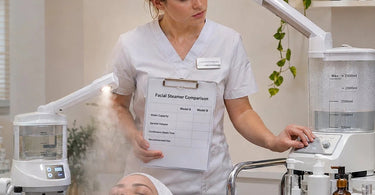
Your results deserve the best tools... and your facial steamer deserves to make it through a busy appointment schedule without demanding a water refill every five minutes. For professional estheticians, choosing the right facial steamer involves more than finding a model with an attractive price tag or a collection of impressive buttons. Water capacity, steam production time, and daily service volume all influence how efficiently your treatment room operates. A steamer that works beautifully for three facials a day may become an inconvenient little diva when your appointment book fills up. Understanding how these specifications translate into everyday performance helps you select equipment that supports your services rather than interrupts them.
Whether you operate a boutique skincare studio, manage several treatment rooms, or are upgrading equipment for a growing spa, comparing professional facial steamers requires a practical approach. The goal is not necessarily to purchase the largest water reservoir available. It is to find the right combination of usable water capacity, operating time, heating performance, service demands, safety features, and maintenance requirements.
Why Water Capacity Matters in a Professional Facial Steamer
Water capacity describes how much water a facial steamer reservoir can hold. Manufacturers typically express this measurement in ounces, milliliters, or liters. Although this sounds like a straightforward specification, it can have a significant impact on your daily workflow.
A larger reservoir may allow a steamer to operate longer before requiring a refill. This can be especially useful in treatment rooms where multiple clients receive steam-assisted services throughout the day.
However, reservoir size alone does not determine how long a machine produces steam. Heating element wattage, steam output, operating settings, and minimum water-level requirements also influence runtime.
Two steamers with similar reservoir capacities can have different operating times because they convert and release water at different rates. That is why professional buyers should evaluate water capacity alongside the manufacturer's stated steam autonomy or continuous operating time.
For example, a professional steamer with a 42-ounce reservoir and a manufacturer-rated operating time of approximately 40 minutes provides a useful planning reference. That does not mean the machine will automatically support four 10-minute treatments without interruption. Water-level restrictions, operating conditions, and the time required to prepare or reposition the equipment can affect how the machine fits into a treatment schedule.
Understand the Difference Between Water Capacity and Steam Runtime
One of the most common equipment comparison mistakes is assuming that a larger water jar always means a longer usable treatment period.
Water capacity is a measurement of volume. Steam runtime is a measurement of operating duration. They are related, but they are not interchangeable.
Consider two hypothetical facial steamers. Model A has a 30-ounce reservoir and provides 25 minutes of usable steam. Model B has a 42-ounce reservoir and provides 40 minutes. Model B offers a longer operating window, but that advantage is only valuable if it matches the way your spa actually uses steam.
A treatment room that uses steam for five minutes during each facial might comfortably operate with either model. A busy room performing longer steam-assisted services may benefit more from the extended runtime of Model B.
The essential comparison questions include:
- What is the manufacturer's stated reservoir capacity?
- How much water can actually be used between the minimum and maximum fill marks?
- How many minutes of steam does the manufacturer specify per fill?
- Does the runtime change with adjustable steam settings?
- How long does the machine take to reach usable steam output?
- What happens when the water level approaches its minimum?
- What cooling or shutdown procedures are required before refilling?
These details reveal much more about practical performance than the size of the water jar alone.
Calculate Your Spa's Actual Steam Service Volume
Before comparing models, evaluate how frequently your treatment room needs steam during a typical operating day.
Start with three measurements: the number of treatments using steam, the approximate steam duration per treatment, and the available time between appointments.
For example, suppose your studio performs eight facials per day, with an average of six minutes of steam per service. Your total planned steam usage is 48 minutes.
Eight treatments multiplied by six minutes equals 48 minutes of daily steam demand.
That figure does not mean you need a steamer capable of operating continuously for 48 minutes. Steam demand may be distributed across an eight-hour shift, allowing adequate opportunities for water-level checks and permitted refilling.
On the other hand, if four appointments are scheduled close together, the concentrated demand during that period becomes particularly important.
Look beyond total daily appointments and calculate your busiest consecutive treatment period. A machine that handles your peak workload comfortably is often more valuable than one selected only around average daily volume.
Compare Facial Steamers for Low, Moderate, and High Service Volume
Different spa environments place different demands on equipment. Matching your steamer to your service pattern helps avoid unnecessary spending while reducing operational interruptions.
Low-Volume Treatment Rooms
An independent esthetician performing two to four steam-assisted facials per day may prioritize compact dimensions, easy cleaning, adjustable positioning, and affordability over maximum reservoir capacity.
A smaller professional steamer can be perfectly suitable if its operating time comfortably covers the longest planned treatment and the manufacturer's refill procedures fit naturally between appointments.
For smaller studios, equipment footprint can matter just as much as reservoir volume. A steamer that occupies too much floor space may create more daily inconvenience than an occasional scheduled refill.
Moderate-Volume Spa Operations
Studios performing approximately five to eight steam-assisted services daily often benefit from a balance of reservoir capacity, dependable heating, adjustable steam output, and manageable maintenance.
For these businesses, a manufacturer-rated operating window of roughly 30 to 40 minutes may be a useful comparison point, depending on individual treatment duration and appointment spacing.
The ability to reposition the steam arm easily and manage water levels without complicated procedures can also improve treatment-room efficiency.
High-Volume Treatment Environments
Busy day spas, facial-focused skincare studios, and multi-provider facilities should pay particular attention to peak demand, equipment durability, warm-up time, and repeated daily operation.
A larger reservoir or longer operating window can reduce refill frequency, but it does not automatically establish that a machine is rated for continuous all-day commercial use.
Check manufacturer instructions for operating limits, required rest periods, service intervals, and warranty conditions. A high-volume facility may also benefit from dedicated steamers in individual treatment rooms rather than moving one machine between several providers.
And remember, an extra-large water jar cannot magically solve an overbooked appointment calendar. That particular miracle still requires scheduling.
Real Professional Facial Steamer Examples to Compare
Examining actual equipment specifications makes the buying process easier. The following professional models available through Pure Spa Direct illustrate how water capacity and operating features can influence equipment selection.
Classic Professional Facial Steamer by Equipro
The Classic Professional Facial Steamer by Equipro features a 42-ounce exterior PVC water jar with a handle and a manufacturer-listed operating autonomy of approximately 40 minutes.
Its specifications include a 750-watt power rating, directional adjustable head and arm, security thermostat, special no-drip nozzle, and simplified filling and draining system.
These features make it worth considering for professional treatment rooms seeking a practical balance between reservoir capacity and everyday functionality.
The adjustable steam arm helps providers position the equipment around the treatment area, while the no-drip nozzle is intended to support more controlled steam delivery.
One important purchasing detail is that the base is not included and must be selected separately. Buyers should account for the complete equipment configuration when comparing costs and treatment-room space requirements.
Vapoderm Digipro Professional Spa Facial Steamer by Equipro
The Vapoderm Digipro Professional Spa Facial Steamer by Equipro also features a 42-ounce exterior PVC water jar and approximately 40 minutes of manufacturer-listed autonomy.
What makes this model different is its additional operating flexibility. Features include an integrated timer, three steam levels, an adjustable steam arm, a security thermostat, a no-drip nozzle, and a dedicated system for essential oils.
For estheticians offering services with different steam preferences and timing requirements, adjustable output and timer controls may provide practical advantages.
Notice that both Equipro examples share similar stated reservoir capacity and operating autonomy. The decision between them therefore becomes less about water volume and more about controls, workflow preferences, features, and overall equipment cost.
The Vapoderm Digipro also requires a separately purchased base. Verify the selected configuration and current specifications before placing an order.
How to Estimate the Number of Services Per Fill
A simple calculation can help you compare models against your appointment schedule.
Estimated services per fill equals the manufacturer's usable steam runtime divided by the planned steam minutes per service.
For illustration, consider a steamer rated for 40 minutes of operation and a facial protocol that includes eight minutes of steam.
Forty minutes divided by eight minutes equals five theoretical steam segments.
That does not guarantee five complete services from one fill. Real-world operating time may be affected by water-level limits, heat-up procedures, steam settings, and the manufacturer's safety instructions.
It is better to use this calculation as an initial screening tool rather than a promise of uninterrupted performance.
For purchasing decisions, build in a practical operating margin and confirm the manufacturer's guidance about refilling, shutdown, and repeated use.
Professional estheticians should also avoid extending steam exposure simply because a machine has water remaining. Steam duration should follow the treatment protocol, manufacturer directions, and individual client considerations.
Why Heating Time Can Be as Important as Reservoir Size
Imagine two steamers with equal water capacity. One begins producing usable steam relatively quickly, while the other needs a longer warm-up period.
In a studio with generous appointment spacing, the difference may be minor. In a fully booked spa, however, repeated preparation delays can affect service flow.
Heating time is influenced by equipment design, heating performance, water volume, starting water temperature, and operating conditions.
Although wattage can provide useful context, it should not be treated as a direct measurement of heating speed. A higher-wattage model is not automatically faster or more efficient in every situation.
Ask manufacturers or suppliers for estimated heat-up time under normal operating conditions whenever that information is available.
Develop a consistent setup routine that allows the unit to reach stable steam production before directing the nozzle toward a client. Follow the equipment manual for safe startup and positioning.
Adjustable Steam Output Changes the Comparison
Some professional facial steamers provide multiple steam settings, allowing estheticians to adjust the amount of vapor produced.
These controls may be useful for adapting treatment-room operation to different service protocols, provided steam use is appropriate for the client.
However, output settings may also influence water consumption. A machine operating at a higher output can use its reservoir differently than the same machine operating at a lower setting.
When comparing adjustable models, look for manufacturer information about whether quoted runtime applies to a particular steam setting.
If the specifications do not explain this relationship, do not assume maximum runtime is available at maximum output.
For studios offering a broad range of professional facial treatments, control flexibility may be more valuable than a modest increase in reservoir size.
Water Type, Reservoir Design, and Maintenance Requirements
Water management is another important part of selecting a professional facial steamer.
Some machines specify distilled water to reduce mineral deposits and protect internal components. Others use water-level detection systems that require a particular water type and may not function correctly with distilled water.
Never assume that every professional facial steamer accepts the same water. Follow the exact manufacturer's instructions for your model.
Also evaluate how easily the reservoir can be removed, emptied, inspected, and cleaned. A removable jar with a convenient handle may simplify routine maintenance, while a well-designed filling and draining system can make daily operations more manageable.
Review these maintenance considerations before purchasing:
- Required water type and water-quality restrictions.
- Minimum and maximum reservoir fill indicators.
- Manufacturer-approved reservoir cleaning procedures.
- Recommended cleaning frequency.
- Availability of replacement water jars, seals, and other components.
- Instructions for draining and drying the unit after use.
- Restrictions on adding fragrances, herbs, or oils.
Do not add essential oils directly to a water reservoir unless the manufacturer explicitly permits it. Models with a dedicated aromatherapy compartment should be operated according to their specific instructions.
For ongoing equipment care, explore spa and salon equipment replacement parts and appropriate professional cleaning supplies. Always confirm that maintenance products and replacement components are approved for the specific device.
Safety Features Matter More Than an Extra Few Ounces
A large reservoir is convenient, but professional treatment equipment also needs reliable safety features.
Look for manufacturer-documented protections such as low-water shutoff, temperature controls, stable equipment support, and nozzle designs intended to reduce dripping or spitting.
Not every model includes the same features, so verify them individually rather than assuming that all commercial steamers have automatic protections.
Positioning is especially important. The nozzle must be kept at the distance and angle specified by the manufacturer, and the esthetician should confirm steady steam output before directing vapor toward the treatment area.
Client comfort and suitability should guide whether steam is used at all. Heat-sensitive skin, certain skin conditions, recent procedures, and other individual factors may make steam inappropriate. Follow professional treatment protocols and applicable scope-of-practice requirements.
Never refill a hot reservoir unless the manufacturer's instructions expressly describe a safe procedure. Unplugging, cooling, and handling instructions differ between equipment designs.
It is also important to recognize that steam exposure is not a substitute for proper cleaning or disinfection of tools, surfaces, or treatment equipment.
Consider Treatment Room Layout and Equipment Mobility
Even a steamer with ideal water capacity can become frustrating if it does not fit comfortably beside the treatment bed.
Evaluate the overall equipment footprint, arm reach, height adjustment, caster design, and stability of the stand.
For rooms with limited floor space, an adjustable arm can help position the nozzle without repeatedly moving the entire unit.
Mobile equipment may also support flexible treatment setups, although moving hot or water-filled equipment can create hazards. Always follow the manufacturer's transport and cooling guidance.
Consider how the steamer will interact with nearby spa equipment and furniture, magnifying lights, rolling carts, and treatment supplies.
A well-organized room should allow the esthetician to reach controls safely without stretching across the client or creating obstructions around the treatment bed.
Compare Total Cost Instead of Purchase Price Alone
Water capacity and runtime can influence labor efficiency, but the initial purchase price is only one component of equipment cost.
Before choosing a facial steamer, account for the complete setup, including any separately sold stand or mounting accessories.
Other considerations include expected maintenance, replacement parts, warranty terms, electricity use, and the time spent on permitted refilling and routine cleaning.
For example, suppose a less expensive model requires more frequent attention during your busiest service periods. Even if those interruptions are brief, they may create scheduling inconvenience for a busy esthetician.
Conversely, paying substantially more for a larger reservoir may provide little benefit if your studio performs only a handful of short steam-assisted treatments each day.
The strongest purchase decision comes from matching the equipment to actual demand rather than assuming that the most expensive or largest model is automatically the best.
Pure Spa Direct supplies professional equipment and products from manufacturers serving the spa and salon industry. As a distributor rather than a manufacturer, we encourage professionals to review individual product specifications and manufacturer instructions when evaluating equipment.
Facial Steamer Comparison Checklist for Professional Buyers
Use the following checklist when narrowing down your equipment options:
- Reservoir capacity: Compare stated water volume in consistent units.
- Usable steam runtime: Look for manufacturer-rated operating time rather than estimating from capacity alone.
- Service demand: Calculate your busiest consecutive steam-assisted treatments.
- Steam duration: Match operating capacity to your actual treatment protocols.
- Heating time: Consider how quickly the unit reaches usable steam production.
- Steam controls: Identify available output levels and timer functions.
- Safety systems: Verify documented low-water and temperature protections.
- Water requirements: Confirm the correct water type for the exact model.
- Cleaning access: Evaluate reservoir removal, drainage, and maintenance instructions.
- Positioning: Check arm movement, height adjustment, stand stability, and available floor space.
- Included accessories: Determine whether bases, stands, or mounting components cost extra.
- Support: Review warranty terms, replacement part availability, and manufacturer service guidance.
This checklist can help you compare equipment based on what matters during real appointments, rather than becoming distracted by features you may never use.
Common Mistakes to Avoid When Selecting a Facial Steamer
Several purchasing mistakes can leave even experienced spa operators with equipment that does not fit their workflow.
Choosing only by reservoir size: Capacity does not establish runtime without considering steam consumption and minimum fill levels.
Ignoring appointment concentration: Ten facials spread across a full day create different equipment demands than five facials scheduled back to back.
Assuming all steam settings use water equally: Adjustable output can change consumption, and manufacturer specifications may not cover every operating mode.
Overlooking refill procedures: A machine that requires cooling before refilling needs sufficient scheduling flexibility.
Forgetting about accessories: A steamer without an included stand can have a different total cost and setup requirement than expected.
Using the wrong water: Incorrect water selection may interfere with sensors, promote mineral accumulation, or damage components.
Buying for hypothetical growth alone: Future expansion matters, but equipment should first meet current treatment demands effectively.
And perhaps the biggest mistake is believing a complicated machine with lots of buttons must be better. Sometimes those extra controls are useful. Sometimes they simply provide more opportunities to wonder which button you pressed.
Should a Busy Spa Buy One Large Steamer or Multiple Smaller Units?
For businesses with multiple treatment rooms, equipment distribution may be just as important as water capacity.
A single larger steamer could offer extended runtime, but sharing it across rooms introduces transportation, scheduling, setup, and cleaning considerations.
Separate steamers allow individual estheticians to prepare their own treatment rooms and avoid competing for the same machine during overlapping appointments.
However, purchasing multiple units also increases initial costs, maintenance responsibilities, and the number of devices requiring inspections and replacement parts.
To make the decision, compare the number of treatment rooms actively using steam at the same time, the frequency of overlapping appointments, and the availability of suitable storage and electrical connections.
For a growing spa, a practical approach is to prioritize equipment availability during peak periods rather than buying the largest reservoir simply to compensate for a shared-device bottleneck.
Build a More Efficient Facial Treatment Setup
The facial steamer is one part of a larger professional treatment system. Efficient rooms also depend on accessible skincare products, organized tools, comfortable furnishings, and consistent sanitation procedures.
Alongside professional facial steamers, estheticians can explore spa tools and implements, professional skincare products, and spa towels to support organized services.
For treatments that include specialized exfoliation or other equipment-based steps, browse microdermabrasion equipment and advanced spa equipment according to your training and treatment menu.
The objective is to create a setup in which equipment preparation, client care, and between-service maintenance work together naturally.
Frequently Asked Questions About Facial Steamer Capacity
Is a 42-ounce facial steamer large enough for a busy spa?
It may be, depending on its manufacturer-rated runtime, the duration of each steam segment, and appointment scheduling. Some professional 42-ounce models list approximately 40 minutes of autonomy. Compare that specification against your busiest treatment periods and required refill procedures.
Does a larger facial steamer reservoir produce stronger steam?
Not necessarily. Reservoir capacity describes water volume, while steam output depends on the heating system, equipment design, and controls. A larger jar does not automatically create stronger vapor.
How many facials can one water fill support?
Divide the manufacturer's usable steam runtime by the planned minutes of steam per treatment to obtain a theoretical estimate. Allow for operating limitations and required maintenance. Do not treat the calculation as a guaranteed number of services.
Should professional facial steamers use distilled water?
Use only the water type specified by the manufacturer. Some machines require distilled water, while certain sensor-equipped models require tap water. Following the wrong water recommendation can cause operating problems.
Is a steamer with adjustable steam levels worth the extra cost?
Adjustable steam settings may be beneficial for professionals who use several treatment protocols and want additional operating flexibility. The value depends on how frequently those controls will be used and whether the remaining specifications meet your service needs.
How often should a professional facial steamer be cleaned?
Cleaning frequency and procedures depend on the model and manufacturer. Follow the manual for draining, cleaning, descaling, and drying instructions, and incorporate those steps into your treatment-room maintenance schedule.
Choose Water Capacity That Works With Your Appointment Book
The best facial steamer is not necessarily the one with the biggest reservoir or the most elaborate control panel. It is the model that provides appropriate steam runtime, safe operation, convenient maintenance, and the right features for your actual service volume.
Start by measuring how much steam your treatment protocols require. Then compare manufacturer-rated operating time, usable water capacity, heating performance, refill procedures, and peak appointment demand.
For an independent esthetician, a compact and easy-to-maintain machine may offer the best overall fit. For a busier operation, longer autonomy, adjustable controls, and dedicated equipment in multiple treatment rooms may provide greater flexibility.
Explore the selection of professional facial steamers at Pure Spa Direct to compare equipment features and find a model suited to your treatment room. The right steamer should support your services, respect your schedule, and spend considerably less time demanding attention than your clients do.
