
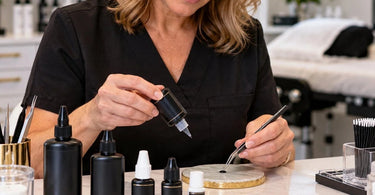
Your work deserves great tools... and that includes a bottle of lash extension adhesive that actually gets used before it needs replacing. Whether you are a solo lash artist perfecting every fan or a busy salon owner managing several treatment stations, choosing the right adhesive bottle size can make a surprising difference in your monthly supply budget. A larger bottle might look like the smarter deal on paper, but if half of it expires before you can use it, those savings disappear faster than a client who suddenly remembers she has another appointment.
The trick is to compare adhesive bottle sizes based on actual consumption, not just the price printed on the label. A 10 mL bottle might offer a lower cost per milliliter than a 5 mL bottle, but that does not automatically make it the better purchase. Your appointment volume, adhesive replacement schedule, dispensing habits, and storage conditions all influence how much product you can realistically use while it remains suitable for professional application.
Let's break down the numbers, explain what really happens after opening a lash adhesive bottle, and explore how to choose the most economical size without compromising the consistency your clients expect.
Why Lash Adhesive Bottle Size Matters More Than You Think
Professional lash extension adhesives are typically formulated with cyanoacrylate chemistry, which reacts with moisture as part of the curing process. That chemistry is exactly why adhesive performance depends on controlled application conditions and proper storage.
It also means a bottle does not remain indefinitely fresh after opening. Exposure to air and moisture, repeated handling, temperature changes, and the passage of time can affect the adhesive. Each manufacturer establishes its own recommended storage conditions, shelf life, and replacement schedule.
For a professional lash artist, the purchasing question is not simply how much adhesive comes in the bottle. It is how much of that adhesive can be used successfully before the manufacturer's replacement deadline.
Imagine purchasing a generously sized bottle because the price per milliliter looks fantastic. You open it, complete a handful of appointments, and then discover that the manufacturer recommends replacing it before you have used even half the contents. Congratulations! You purchased a bargain and a very expensive lesson in inventory management.
Understanding your consumption rate helps prevent that situation.
Start With the Most Common Lash Adhesive Bottle Sizes
Depending on the manufacturer and formulation, professional lash extension adhesive may be available in small trial bottles, standard bottles, and larger professional sizes. Common examples include 2 mL, 3 mL, 5 mL, and 10 mL options, although not every brand offers every size.
2 mL bottles: Small-format adhesives can be useful for limited testing, low-volume services, or situations where a manufacturer provides a short recommended usage window. However, some sample-size bottles have different after-opening instructions from their full-size counterparts, so always check the individual product directions.
3 mL bottles: These may appeal to newer lash artists, part-time professionals, and technicians who want to minimize unused product. Smaller quantities can also be practical when working with a specialty adhesive that is not needed for every appointment.
5 mL bottles: Often a practical middle ground, 5 mL bottles offer more working inventory without committing to the largest available size. They can be a convenient option for lash artists with regular appointments and predictable consumption.
10 mL bottles: Larger bottles may provide attractive unit pricing for high-volume professionals or busy salons. Their value depends on whether enough adhesive can be dispensed within the manufacturer's recommended after-opening period.
The important distinction is that bottle capacity and usable bottle life are separate characteristics. A larger container does not automatically receive a longer replacement window.
Calculate Your Actual Lash Adhesive Consumption
The most useful number in your purchasing decision is your average adhesive consumption per working day or appointment.
Rather than guessing how many lash sets a bottle should provide, track what happens in your own treatment room. Adhesive usage varies with application technique, service duration, the size of dispensed drops, environmental conditions, and how frequently fresh drops are needed.
For a simple starting point, record the following information:
- The bottle size and manufacturer.
- The date you first opened the bottle.
- The number of lash appointments completed while using it.
- The approximate number of fresh adhesive drops dispensed during each service.
- The date the bottle was finished or replaced.
- The estimated amount of adhesive remaining at replacement.
- Any unusual waste caused by dispensing, nozzle problems, or environmental conditions.
Tracking two or three bottle cycles provides a more realistic view than relying on one unusually busy or unusually slow month.
You can also compare bottle weight before opening and at replacement using a suitable precision scale, provided measurements are taken consistently. Account for the container and cap, and remember that adhesive mass is not identical to volume unless the product's density is known. For most salons, recording the percentage of product remaining is sufficient for an initial estimate.
Use This Simple Formula to Compare Bottle Sizes
There are two important calculations: purchase price per milliliter and effective cost per usable milliliter.
Purchase price per mL = Bottle purchase price / Bottle capacity in mL
Effective cost per usable mL = Bottle purchase price / Amount actually used before replacement
The second formula is where things get interesting.
Consider two hypothetical adhesive options with identical performance and the same manufacturer-approved usage window:
- Option A: 5 mL bottle for $25.
- Option B: 10 mL bottle for $40.
Option A costs $5 per mL based on its purchase price. Option B costs only $4 per mL. At first glance, the 10 mL bottle looks like the winner.
But suppose your actual consumption during the allowable usage period is just 4 mL.
If you purchase the 5 mL bottle, your effective cost is $25 divided by 4 mL, or $6.25 per usable mL.
If you purchase the 10 mL bottle and still use only 4 mL before replacement, your effective cost becomes $40 divided by 4 mL, or $10 per usable mL.
That supposedly economical larger bottle now costs 60% more for the adhesive you actually used.
These are illustrative prices and consumption figures, not current product quotations. The lesson applies regardless of which professional adhesive you choose: unused adhesive should not be counted as a saving.
Understand the Real Cost Per Lash Appointment
Cost per usable milliliter is helpful, but cost per completed appointment may be even more meaningful for a salon business.
Adhesive cost per appointment = Total adhesive expenditure / Number of appointments supported
For example, assume a $25 bottle supports 30 appointments during its usable period, while a $40 bottle also supports only 30 appointments because the larger bottle reaches its replacement deadline with product remaining.
The smaller bottle costs approximately $0.83 per appointment. The larger bottle costs approximately $1.33 per appointment.
That difference may appear small, but over hundreds of appointments, inefficient purchasing adds unnecessary overhead. More importantly, predictable product costs make service pricing, budgeting, and inventory planning easier.
Include shipping charges, applicable taxes, and any relevant order-level discounts when comparing your true acquisition costs. A bottle that is slightly cheaper before shipping may not remain cheaper once it reaches your salon.
How Long Does Lash Extension Adhesive Last After Opening?
There is no universal after-opening lifespan that applies to every professional lash adhesive.
Some manufacturers recommend replacing opened adhesive after approximately four weeks. Others specify longer windows, sometimes extending to several additional weeks under their stated storage conditions. Certain sample sizes may have significantly shorter use periods.
Always follow the instructions for your exact adhesive rather than assuming that a replacement schedule used for another brand applies to yours.
The unopened expiration date and the after-opening replacement deadline also serve different purposes. A bottle may have months remaining before its printed expiration date but still need replacement sooner because it has already been opened.
For inventory planning, use whichever applicable limit arrives first: the product expiration date, the manufacturer's after-opening replacement deadline, or an earlier point at which product condition makes it unsuitable for use.
Never continue using adhesive beyond the manufacturer's instructions simply because the bottle still contains product. A few leftover milliliters are not worth compromising service quality or client safety.
Match Bottle Size to Your Appointment Schedule
Your booking calendar can help turn a confusing purchasing decision into a straightforward calculation.
Start with the number of appointments you expect during the manufacturer's approved after-opening window. Then estimate how much adhesive you typically dispense for each appointment.
Expected adhesive usage = Appointments during usable period x Average adhesive dispensed per appointment
Suppose you perform 25 lash appointments in a four-week period and your measured average dispensing volume is 0.12 mL per appointment. Your expected usage is 3 mL.
In that illustrative situation, a 3 mL bottle may be worth evaluating if the manufacturer offers that size and your workflow allows for normal variation. A 5 mL bottle may provide useful extra capacity, but a 10 mL bottle would likely leave substantial unused product unless your appointment volume increases.
Now consider a busy technician completing 70 appointments during the same period, with the same 0.12 mL average.
Expected usage would be 8.4 mL. A 10 mL bottle could be a more economical option, assuming its approved usage period, formulation, and storage requirements fit the salon.
These calculations are examples rather than standard consumption rates. Measure your own usage instead of treating 0.12 mL as a universal amount per service.
Why Fresh Adhesive Drops Affect Consumption
One of the biggest sources of adhesive usage is the need to dispense fresh product during appointments.
Lash adhesive does not remain at its ideal working condition indefinitely after a drop has been exposed to the treatment-room environment. As the drop reacts with ambient moisture, its working properties change.
The interval for refreshing a drop depends on the formulation, temperature, humidity, and manufacturer's instructions. Some professional systems call for relatively frequent drop replacement.
This means a lash artist completing a lengthy volume set may dispense more adhesive than someone performing a short fill appointment, even if the final lash count does not increase proportionally.
Using a larger initial drop does not necessarily reduce waste. Excess adhesive may simply cure before it can be used.
Instead, aim to dispense an appropriate amount, refresh it according to product directions, and keep track of what your technique actually consumes.
Professionals shopping for Premium Lash Extensions & Supplies for Pros can evaluate adhesive alongside the tools and materials used in their daily application workflow.
Temperature and Humidity Can Change the Equation
Even the best bottle-size calculation becomes less reliable if your adhesive is being used outside its recommended environmental range.
Cyanoacrylate-based lash adhesives are sensitive to moisture, and humidity can influence curing speed. Temperature also affects working behavior. Different formulas are designed for different operating conditions, so a product that performs beautifully in one lash room may behave differently in another.
Monitor your treatment-room conditions and compare them with the adhesive manufacturer's specifications. Inconsistent conditions may lead to more frequent drop replacement, wasted product, and less predictable application.
Maintaining the correct environment is not just about making an adhesive bottle last longer. It helps support a consistent professional workflow.
Do not attempt to solve persistent curing problems by using more adhesive, extending an expired bottle's life, or ignoring the manufacturer's recommended temperature and humidity ranges.
Should a Solo Lash Artist Buy Smaller Bottles?
For many solo professionals, smaller bottles can offer practical advantages.
If you work part-time, have a developing client base, or alternate between several adhesive formulas, purchasing a large container of each product can create unnecessary waste.
For example, a lash artist who uses one primary adhesive for most appointments and a specialty formulation only occasionally may benefit from buying the primary adhesive in a larger size and the less frequently used product in a smaller size.
This approach aligns inventory with actual service demand.
Smaller bottles can also make it easier to evaluate a new adhesive without committing to more inventory than you are likely to use. However, trial sizes should still be purchased and handled according to the manufacturer's professional-use instructions.
The key is to avoid buying the smallest bottle automatically. If you consistently finish small bottles well before their replacement deadline, a larger size may provide better value and reduce repeated ordering.
When Does a 10 mL Bottle Make Financial Sense?
A larger bottle becomes attractive when your consumption rate consistently supports it.
Signs that a 10 mL bottle may be worth considering include:
- You complete enough appointments to use most of the adhesive within the approved period.
- Your daily usage records show predictable consumption.
- You use the same compatible adhesive formulation regularly.
- Your treatment room meets the manufacturer's environmental requirements.
- The larger size provides a meaningful discount per usable milliliter.
- Your established workflow does not generate excessive dispensing waste.
For salons with multiple lash technicians, calculate actual consumption by location, technician, or treatment station before assuming that a larger shared bottle is the best choice.
Sharing an adhesive bottle between stations can introduce extra handling, storage inconsistencies, and confusion about when it was opened. If bottles are moved between workstations, establish clear ownership, handling procedures, and opening-date records.
A busy salon may find that several appropriately sized bottles assigned to individual stations create a more consistent workflow than one large bottle traveling around the building like the office stapler nobody can find.
Proper Storage Helps Protect Your Investment
Good storage practices help preserve adhesive condition during the manufacturer's recommended usage period.
Follow the storage instructions for the particular product, since brands may differ in their guidance on refrigeration, temperature, packaging, and moisture protection.
Useful professional inventory habits include:
- Write the opening date and applicable replacement date on every bottle.
- Keep adhesive tightly closed whenever it is not being dispensed.
- Protect bottles from direct sunlight, excessive heat, and moisture.
- Use the manufacturer's recommended protective pouch or storage container when supplied.
- Keep the nozzle clean using manufacturer-approved, lint-free materials.
- Avoid cotton, tissues, and other fibrous materials for cleaning cyanoacrylate adhesive nozzles because contact can cause rapid curing and heat buildup.
- Keep bottles upright when specified by the manufacturer.
- Follow product-specific instructions for shaking, dispensing, and clearing the nozzle.
Do not assume that refrigeration is appropriate for every opened bottle. Some manufacturers recommend refrigeration only for unopened adhesive, while others specify different storage procedures.
Never freeze an adhesive unless its manufacturer explicitly permits it, and do not expose cold bottles to repeated condensation-producing temperature changes.
Professional storage is about following the product's requirements, not inventing a complicated routine involving every gadget in the supply closet.
Compare Adhesives by Performance Before Comparing Size
Price per milliliter should never be the only purchasing factor.
Two adhesive bottles with the same capacity may contain formulas designed for very different application conditions and technician experience levels.
Before comparing costs, evaluate the manufacturer's specifications for curing speed, suitable humidity and temperature, viscosity, intended technique, storage requirements, and professional application instructions.
A fast-setting adhesive that does not suit a technician's working speed may create application difficulties and unnecessary waste. A formulation designed for a different environment may also perform unpredictably in your treatment room.
Likewise, advertised retention claims should not be treated as guaranteed results. Actual lash retention depends on several factors, including correct application, natural lash cycles, client aftercare, and environmental conditions.
Compare bottle sizes within the same formulation whenever possible. Otherwise, account for meaningful performance differences before deciding that the least expensive option is the best value.
Explore Lash & Brow Service Supplies and related professional lash adhesive options when reviewing your salon's supply needs.
Build a Simple Lash Adhesive Purchasing Spreadsheet
You do not need expensive inventory software to make better adhesive purchases. A basic spreadsheet can reveal whether smaller or larger bottles are more economical.
Create columns for bottle brand, formulation, capacity, purchase price, opening date, replacement deadline, appointments completed, and estimated quantity used.
Then add three calculations:
- Usage percentage: Amount used divided by bottle capacity, multiplied by 100.
- Effective cost per usable mL: Total bottle cost divided by measured volume used.
- Cost per appointment: Total bottle cost divided by appointments supported.
For example, consider a 5 mL bottle costing $30. If you use 4.5 mL during its approved period, your usage rate is 90%, and your effective cost is approximately $6.67 per usable mL.
Now compare a 10 mL bottle costing $48. If you use only 5 mL before replacement, your usage rate is 50%, and your effective cost is $9.60 per usable mL.
The larger bottle offers a lower sticker price per milliliter, but the smaller bottle delivers better value under those particular usage conditions.
Review your records every few months, especially when appointment volume changes or you introduce a new adhesive formula.
Don't Forget Shipping, Backup Stock, and Reordering
Efficient adhesive purchasing is also about keeping enough inventory available without accumulating more product than you can use.
Running out of adhesive immediately before a fully booked day can be expensive. Ordering too many bottles can be expensive, too. The goal is a sensible balance.
Estimate how much unopened inventory you need to cover your normal supplier lead time and a reasonable contingency. Consider the manufacturer's unopened expiration dates and storage requirements when planning backup stock.
Use a first-expiring, first-out system whenever possible, rather than automatically reaching for the most recently purchased bottle.
Pay attention to shipping charges and order minimums. Coordinating adhesive purchases with other frequently used Lash & Brow Enhancement Services for Professionals supplies may help make ordering more efficient, provided it does not encourage unnecessary adhesive stockpiling.
For salon owners overseeing multiple technicians, a centralized reorder log can also prevent accidental duplicate purchases.
Common Mistakes That Make Lash Adhesive More Expensive
Several ordinary purchasing and handling habits can quietly increase adhesive costs.
Buying based only on price per mL: A lower unit price means little if a large percentage of the product is discarded.
Ignoring the opening date: Without an accurate date, it becomes difficult to follow the manufacturer's recommended replacement period.
Assuming all adhesives last equally long: Different formulations and bottle sizes may have different storage and usage instructions.
Opening backup bottles too early: Opening multiple bottles unnecessarily starts their respective after-opening usage periods.
Using oversized drops: Dispensing more adhesive than needed can increase waste without improving application.
Changing products without tracking consumption: A new formulation may require adjustments to technique and dispensing habits, making old consumption estimates less reliable.
Keeping questionable adhesive to avoid waste: Product that has expired, exceeded its approved usage window, or deteriorated should not remain in professional service.
The most effective cost-saving habits usually involve accurate tracking, suitable products, consistent conditions, and realistic purchasing decisions.
A Practical Bottle-Size Decision Guide
Before placing your next order, answer five questions.
1. How many appointments will I complete before this bottle must be replaced? Use realistic bookings rather than an optimistic estimate of your busiest possible month.
2. How much adhesive do I typically dispense? Review actual consumption from previous bottles.
3. What is the manufacturer's approved after-opening period? This determines how long you have to use the product.
4. How much adhesive will remain unused? Estimate waste for each available bottle size.
5. Which option provides the lowest cost for the amount I can actually use? Include purchasing costs and compare formulas that are appropriate for your professional technique.
If a smaller bottle consistently gets used almost completely while a larger bottle repeatedly expires half full, the smaller bottle is probably the better purchasing choice.
If you repeatedly finish small bottles well within their approved usage period, calculate whether moving up to the next size would reduce your cost without creating unnecessary waste.
Frequently Asked Questions About Lash Adhesive Bottle Sizes
Is a 10 mL lash adhesive bottle always cheaper than a 5 mL bottle?
Not necessarily. A 10 mL bottle may offer a lower purchase price per milliliter, but it only saves money if you can use enough of its contents before the adhesive needs replacing. Compare effective cost per usable milliliter rather than bottle price alone.
How many lash sets can you get from a 5 mL adhesive bottle?
There is no reliable universal number. The result depends on the adhesive formulation, application technique, treatment duration, drop size, drop replacement frequency, and other workflow variables. Track your own bottle usage to develop a meaningful estimate.
Does a larger lash glue bottle last longer after opening?
Not automatically. Bottle capacity does not determine the manufacturer's after-opening replacement period. Always consult the instructions for the exact product and size.
Should new lash artists start with smaller adhesive bottles?
Smaller bottles can be practical for professionals with limited appointment volume or those evaluating a new formulation. However, choosing an adhesive appropriate for the technician's training, working speed, and treatment environment is more important than bottle size alone.
Can I save money by using lash adhesive past its recommended replacement date?
No. Do not extend adhesive use beyond the manufacturer's instructions to avoid discarding leftover product. Replace expired or unsuitable adhesive and adjust future bottle purchases to reduce waste.
What if my salon has multiple lash technicians?
Measure actual usage across the team, then decide whether individual station bottles or another manufacturer-compatible inventory arrangement makes sense. Ensure opening dates, storage conditions, and product handling remain controlled.
The Best Lash Adhesive Bottle Is the One Your Salon Actually Uses
Choosing between 2 mL, 3 mL, 5 mL, and 10 mL lash adhesive bottles is ultimately an inventory decision shaped by your appointment schedule, product formulation, and professional technique.
The largest bottle is not automatically the smartest purchase, and the smallest is not automatically the safest bet for your budget. The best value comes from matching bottle capacity to the amount of adhesive you can realistically dispense within the manufacturer's approved usage period.
Track your consumption, calculate the true cost per usable milliliter, maintain appropriate storage conditions, and revisit your purchasing habits as your business grows. Those simple steps can help reduce waste while keeping your supply system organized and dependable.
At Pure Spa Direct, we understand that professional beauty businesses need practical supply choices that support both service quality and profitability. As a wholesale distributor rather than an adhesive manufacturer, our role is to help professionals shop for the supplies that fit their working needs. Browse our professional lash extension supplies or search for lash extension glue to compare available options for your treatment room.
Because the smartest bottle is not necessarily the one holding the most adhesive. It is the one that delivers dependable professional performance without leaving your hard-earned money sitting unused at the bottom.
