
Stand out with better service... and smarter supply decisions that keep your nail salon running beautifully without letting tiny expenses quietly eat your profits. A nail file might seem like a minor purchase compared with a fabulous new manicure station or your latest collection of gel colors, but those little boards can add up surprisingly quickly. Between different grit levels, durability, disposable options, and sanitation requirements, comparing nail file costs involves much more than finding the lowest price on the shelf. The good news? A few practical calculations can help you choose files that protect your clients, support your technicians, and make your supply budget work harder than a nail tech during prom season.
Whether you manage a busy nail salon, operate a boutique spa, or oversee purchasing for multiple manicure locations, understanding the true cost of professional nail files can make a meaningful difference. Let's break down what actually matters so you can buy with confidence, avoid unnecessary waste, and keep every service running smoothly.
Why the Cheapest Nail File Is Not Always the Most Economical
Imagine two nail files sitting side by side. One costs $0.20 and the other costs $0.45. Naturally, the cheaper file looks like the obvious winner. After all, nobody wants to spend more on something that eventually ends up in the trash.
But the purchase price tells only part of the story.
A file that loses its abrasive effectiveness halfway through an acrylic service can slow down your technician, require a replacement, and make shaping more difficult. A better-performing file may cost more initially but maintain consistent performance throughout the appointment.
However, durability has an important limitation in professional salons: a file that remains physically usable is not automatically safe or permitted for another client. Sanitation rules and the manufacturer's intended use determine whether reuse is appropriate.
The smartest buying decision considers three connected factors:
- Grit: Is the abrasive appropriate for the service being performed?
- Durability: Does the file maintain its effectiveness for the required work?
- Single-use requirements: Must the file or its abrasive surface be discarded after serving one client?
Start by exploring professional Nail Files & Buffers to compare the shapes, abrasive surfaces, grit combinations, and package configurations available for salon services.
Understanding Nail File Grit Before Comparing Prices
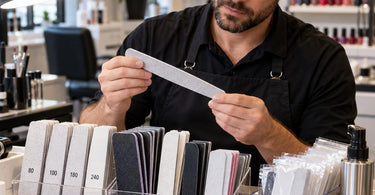
Grit describes how coarse or fine a nail file's abrasive surface is. Lower grit numbers generally indicate coarser abrasives, while higher numbers indicate finer surfaces.
Choosing the correct grit is essential because different nail services require different levels of abrasion. A coarse file that works efficiently on a thick acrylic enhancement may be unnecessarily aggressive on a thin natural nail.
80 to 100 Grit: Coarse Files for Artificial Enhancements
Files in this range are commonly used for reducing bulk and shaping harder artificial nail enhancements, particularly acrylic products. They remove material relatively quickly and can help technicians manage substantial shaping work.
These coarse surfaces are not appropriate for routine filing of natural nails. Using an unnecessarily aggressive abrasive can damage the nail plate.
From a purchasing perspective, coarse files should be evaluated for their ability to maintain cutting performance during enhancement services without excessive pressure or premature wear.
If your salon performs substantial acrylic work, browse Acrylic Nail Supplies alongside your file inventory so the tools match the enhancement systems your technicians actually use.
150 to 180 Grit: Versatile Shaping Options
Medium-grit files are widely used to refine artificial nail shapes and smooth enhancement surfaces. Depending on the condition of the nail and the manufacturer's directions, some finer options in this range may also be used carefully on natural nail free edges.
Dual-grit 100/180 files can be particularly practical for technicians who need a coarser shaping surface and a more refined finishing surface during the same enhancement service.
Buying a combination file can reduce unnecessary tool changes, although it will not automatically reduce consumption if one side wears out much faster than the other.
240 Grit and Higher: Fine Finishing and Natural Nail Work
Finer abrasives are generally better suited to natural nail edge refinement and smoothing tasks. Grit levels around 240 are frequently used for gentler shaping, while progressively finer surfaces serve specialized finishing and polishing purposes.
Very fine buffers may be used to create a polished finish, but excessive buffing can thin the natural nail plate. Technicians should follow appropriate product instructions and avoid removing unnecessary nail material.
For traditional manicure services, pairing suitable fine-grit files with other Manicure Essentials helps create a consistent workflow without forcing one abrasive to perform every job.
How to Calculate the True Cost Per Nail Service
Now for the part that makes purchasing managers smile: a little math that actually saves money.
The simplest starting calculation is:
Cost per file = Total package price divided by the number of files in the package.
Suppose a package of 100 disposable nail files costs $30.
$30 divided by 100 equals $0.30 per file.
If your sanitation policy requires one fresh file per client and each service uses exactly one file, your basic filing supply expense is $0.30 per service.
But what happens when a technician needs two files because the first becomes ineffective or because the service requires two grit types?
Your cost increases to $0.60 per appointment.
Over 1,000 appointments, that difference is $300.
And suddenly, the humble nail file has your accountant's attention.
For a more useful comparison, calculate:
Effective filing cost per service = File and abrasive consumable costs per appointment + allocated reusable equipment costs + applicable cleaning and disinfection costs.
When comparing products, include any disposable sleeves, replacement abrasive pads, or additional buffers required to complete the service.
If multiple files are needed for a manicure, calculate the combined expense rather than treating each product as an isolated purchase.
Durability Matters Even When Files Are Disposable
One common purchasing mistake is assuming durability matters only when a tool can be reused.
In reality, durability can be extremely important for single-use products.
Consider a nail file that becomes ineffective before a technician finishes shaping one full set of enhancements. The technician may need to open another file, increasing both product consumption and interruptions.
A stronger disposable file might provide more consistent abrasive performance throughout the appointment, even though it must still be discarded afterward.
When testing file durability, evaluate:
- How quickly the abrasive surface becomes noticeably less effective.
- Whether the backing bends excessively or breaks.
- Whether the abrasive coating separates from the core.
- How consistently the file performs across a complete service.
- Whether technicians must apply additional pressure as the surface wears.
- How many files are needed to complete the intended appointment.
A file that survives one service without losing its effectiveness may be a better value than a cheaper file requiring frequent replacement.
Just remember: durability measures useful performance, not permission to reuse a disposable tool.
Single-Use Requirements Can Change the Entire Cost Equation
This is where smart purchasing meets professional sanitation.
Many traditional emery boards, foam buffers, and other porous abrasive tools cannot be adequately cleaned and disinfected between clients. Depending on applicable state and local requirements, these items may be required to be discarded immediately after a single client service.
Some jurisdictions also have specific rules governing client-dedicated tools and storage. Salon operators should verify current requirements with their licensing authority rather than assuming that keeping a disposable file in a labeled envelope makes reuse acceptable.
The basic purchasing rule is straightforward: follow applicable regulations and the manufacturer's intended-use instructions. If a file is designated single-use, discard it after the client's service even when it still looks new.
Visible cleanliness is not a substitute for an approved disinfection process.
For salons that use properly reusable, nonporous implements, cleaning and disinfection must follow the relevant rules, product labeling, required contact times, and equipment instructions.
Professional sanitation supplies are an important companion purchase. Explore Professional Cleaners & Disinfectants for Salons and Spas when reviewing your overall nail-service hygiene workflow.
Comparing Disposable Files With Reusable File Systems
Not every professional nail filing system follows the same cost structure.
Traditional disposable boards typically have a simple per-client cost. Reusable systems may involve a durable handle or base paired with disposable abrasive surfaces, provided the components are approved for their intended use and can be processed according to applicable regulations.
Here is an illustrative comparison using hypothetical purchasing costs rather than current product prices.
| Cost Factor | Disposable File | Reusable Base With Disposable Abrasive |
|---|---|---|
| Initial purchase | $0.35 per file | $12 per reusable base |
| Consumable per client | $0.35 | $0.18 replacement abrasive |
| Illustrative service volume | 500 services | 500 services |
| Consumable expense | $175 | $90 |
| Base allocation | $0 | $12 |
| Illustrative total | $175 | $102 before processing costs |
In this example, the reusable-base system appears less expensive before accounting for cleaning supplies, disinfectant, labor, damaged handles, replacement bases, and any other required processing expenses.
That distinction matters. A reusable tool is only a worthwhile option if it can be safely and legally reprocessed and its total operating cost makes sense.
The $12 base in this example is assumed to remain serviceable through all 500 appointments. Actual replacement frequency may change the calculation.
Before choosing a system, verify that the handle is truly reusable, the abrasive is intended to be replaced between clients, and the complete workflow complies with relevant sanitation requirements.
Bulk Nail File Pricing: When Bigger Packs Make Sense
Wholesale purchasing can lower unit costs, but buying the biggest case is not automatically the smartest decision.
Imagine two purchasing options:
- Pack A: 50 files for $18, or $0.36 each.
- Pack B: 200 files for $60, or $0.30 each.
Pack B offers a savings of $0.06 per file.
If your salon uses 2,000 files annually, that difference could amount to $120 in annual product savings, assuming every file purchased is used.
However, bulk purchasing creates less value when supplies sit untouched because technicians dislike the shape, find the abrasive inconsistent, or need a different grit.
Before ordering large quantities, confirm your team's preferred grit, file shape, backing stiffness, and service-specific consumption rate.
For nail businesses managing multiple locations, standardizing frequently used files can simplify ordering and make inventory forecasting easier.
Pure Spa Direct offers professional Nail Care Collections that allow salon buyers to explore complementary supply categories while planning their purchasing needs.
Do Double-Sided Nail Files Really Save Money?
Double-sided files can be excellent practical tools, but the answer depends on how technicians use them.
A 100/180-grit file provides two different abrasive surfaces in one tool. During enhancement services, a technician may use the coarser side for initial shaping and the finer side for refinement.
That arrangement can reduce the need for separate tools and make workstation organization easier.
However, imagine a salon where technicians almost exclusively use the 180-grit surface. If the 100-grit side rarely touches a nail, the salon may be paying for a feature that adds little practical value.
Compare the cost of combination files with single-grit alternatives based on actual usage rather than simply counting abrasive sides.
Ask your technicians which grit combinations they use throughout a typical appointment. Their answers may reveal purchasing opportunities that are invisible on a price list.
And yes, this is an excellent excuse to ask the nail team for their opinions. As though nail techs ever needed encouragement to have opinions about their favorite tools!
Choose Nail File Shapes Based on the Services You Sell
Grit is essential, but the shape and construction of a file also affect efficiency.
Straight files: Useful for general shaping, refining sidewalls, and working along straight edges. Their simple construction may also make them economical for high-volume purchasing.
Banana-shaped files: Curved profiles can help technicians work around enhancement contours and certain sidewall areas, depending on technique.
Half-moon files: Combine a straight edge with a curved edge, offering flexibility during shaping and refinement.
Cushioned files: Provide a flexible abrasive surface that may offer greater comfort and control for certain techniques, although flexibility and durability differ among products.
Buffing blocks: Offer multiple working surfaces for smoothing and finishing tasks. Their cost must be evaluated alongside their disposable or reusable status.
If technicians regularly switch between several shapes during an appointment, track how many tools they consume and whether a more versatile design could reduce unnecessary changes.
Browse professional nail files and nail buffing blocks to compare options suited to your salon's service menu.
Five Hidden Costs Salon Owners Often Overlook
The price printed on the package is only one part of your total supply expense. Here are five less obvious costs worth tracking.
1. Extra Files Opened During One Appointment
If a file wears out, tears, or proves unsuitable for the service, the technician may need a replacement. Track the average number opened per client rather than assuming one file always equals one appointment.
2. Technician Time
An abrasive that performs poorly may increase filing time. Even a small delay can matter in a busy salon, particularly when repeated throughout the day.
For example, a hypothetical three-minute delay across 20 appointments adds up to one hour of technician time. That does not automatically equal one hour of lost revenue, but it is a meaningful workflow consideration.
3. Unused Inventory
Files purchased in the wrong grit or shape may remain in storage for months. Discounted supplies are not a bargain if nobody wants to use them.
4. Sanitation and Processing Expenses
Reusable systems can require cleaning, disinfection, drying, storage, and inspection. Factor those requirements into total ownership costs instead of comparing only the abrasive replacement price.
5. Service Quality and Rework
Using the wrong abrasive can make shaping less efficient and increase the risk of unnecessary nail damage. Poorly matched tools may also contribute to inconsistent results that require additional correction.
Choosing appropriate abrasives supports smoother services and protects the quality standards your salon works hard to maintain.
Build a Nail File Purchasing Plan Around Your Service Menu
Not every salon needs the same inventory mix.
A natural nail studio may use significantly more fine-grit files than an enhancement-focused business. A salon specializing in sculpted acrylics may require a larger assortment of coarse and medium abrasives.
Start by grouping your services into practical purchasing categories:
- Basic manicures: Fine-grit files appropriate for natural nail shaping and edge refinement.
- Gel polish manicures: Appropriate natural nail files and any additional preparation tools specified by the gel system manufacturer.
- Acrylic enhancements: Coarse and medium-grit options suitable for artificial product shaping.
- Hard gel enhancements: Abrasives matched to the product's hardness and manufacturer instructions.
- Pedicures: Suitable nail files and separate foot-care abrasives where required by the service and sanitation rules.
- Finishing services: Fine buffers and smoothing tools appropriate for the treatment being performed.
Related categories such as Professional Gel Polish, Dipping Powder Systems for Salons, and Pedicure Supplies can help purchasing managers coordinate abrasive choices with the services they offer.
The goal is not to stock every imaginable grit. It is to have the right files available without tying up unnecessary cash in products that rarely leave the supply cabinet.
A Simple 30-Day Nail File Cost Audit
Ready to turn all this information into actual savings? Run a short purchasing audit using your current inventory.
Week 1: Record your baseline. List the file types in use, package prices, grit specifications, and average number consumed per appointment. Note which items are single-use and which, if any, are approved reusable systems.
Week 2: Ask technicians to test alternatives. Compare appropriate file options on equivalent service types. Evaluate shaping performance, comfort, abrasive longevity within the service, and the number of tools required.
Week 3: Calculate effective costs. Use your actual purchase prices and consumption data. Include reusable-system processing costs where applicable.
Week 4: Standardize the winners. Select preferred files for each service category and establish a practical replenishment schedule.
Keep sanitation compliance as a nonnegotiable requirement throughout the evaluation. No purchasing savings justify improper reuse or shortcuts in disinfection.
For a salon performing 1,500 appointments each month, even a legitimate savings of $0.10 per service adds up to $150 monthly, or $1,800 annually.
That's a meaningful result from something small enough to disappear into a manicure drawer.
How to Forecast Monthly Nail File Inventory
Once you know your average consumption, estimating future supply needs becomes much easier.
Use this simple planning formula:
Monthly file demand = Expected monthly appointments multiplied by average files used per appointment.
For example, suppose your salon expects 800 manicure appointments and uses an average of 1.25 disposable files per appointment across its service mix.
800 multiplied by 1.25 equals 1,000 files.
If you choose to maintain an additional 10% buffer for unexpected demand, your planning target becomes 1,100 files.
That safety buffer is an inventory planning assumption, not a universal requirement. Your ideal reserve depends on supplier lead times, delivery reliability, storage capacity, appointment volume, and service mix.
For better accuracy, calculate demand separately for different grit categories. A salon might need 600 fine-grit files, 350 medium-grit files, and 150 coarse files rather than 1,100 identical files.
This helps prevent the frustrating situation where the cabinet is packed with nail files, but somehow not a single one is the grit your technician needs.
Should Nail Salons Prioritize Low Cost or Premium Quality?
The best purchasing strategy usually combines reliable quality with sensible unit costs.
Premium pricing does not guarantee better results, and inexpensive files are not automatically inferior. The real question is whether a file performs its assigned task efficiently, consistently, and safely.
For simple natural nail services, an economical fine-grit disposable file may be perfectly appropriate.
For extensive enhancement shaping, a more durable professional file may provide stronger performance and reduce interruptions.
For reusable-base systems, lower abrasive replacement prices may make sense when the base can be properly cleaned and disinfected, the system is permitted by regulation, and processing costs remain reasonable.
A balanced inventory can include several product types rather than relying on one file for every technique.
Salon owners can also coordinate their file purchases with complementary products such as Cuticle Oil, Nail Brushes & Tools, and Nail Treatments to keep professional nail stations well equipped.
Frequently Asked Questions About Professional Nail File Costs
Is 100 grit or 180 grit more economical?
Neither grit is inherently more economical. A 100-grit file may be appropriate for reducing hard artificial enhancements, while a 180-grit file may be more suitable for refinement. Compare costs only among files appropriate for the same service requirement.
Can nail salons reuse emery boards between clients?
Many jurisdictions treat porous emery boards as single-use items that must be discarded after a client service. Follow local licensing rules and manufacturer instructions. Never assume that storing or spraying a used porous file makes reuse acceptable.
Are washable nail files automatically reusable?
No. Washability does not automatically establish that a file can be adequately disinfected or reused between clients. Confirm the material, manufacturer instructions, applicable rules, and required cleaning and disinfection process.
Are 100/180-grit files a good wholesale investment?
They can be a practical choice for enhancement services that use both grit levels. Their value depends on whether technicians regularly use both sides and whether the files maintain adequate performance throughout the appointment.
Should salons purchase nail files individually or in bulk?
Bulk packs often reduce unit prices, but the best quantity depends on demand, cash flow, storage, and product preference. Test file performance before committing to large wholesale quantities.
What is the most important nail file cost metric?
Effective cost per completed service is generally more useful than purchase price alone. It reflects the number of files or abrasive replacements consumed and can incorporate appropriate reusable-system processing costs.
Make Every Nail File Purchase Work Harder for Your Salon
Great nail salon purchasing is about more than finding the lowest number on a price tag. It's about matching grit to the service, selecting files that maintain useful performance, complying with sanitation requirements, and understanding what each completed appointment actually costs.
Once you measure those factors, you can make purchasing decisions based on real operating value instead of guessing which package looks like the better deal.
Pure Spa Direct helps professional nail technicians, spas, and salon owners shop for the tools and supplies they need to support reliable, efficient services. As a professional wholesale distributor, Pure Spa Direct brings together a range of nail care products so businesses can compare options suited to their individual workflows.
Explore our professional nail files and buffers, browse manicure supplies, and discover more professional nail care essentials for your salon.
Because the goal isn't simply to spend less on nail files. It's to spend smarter, maintain excellent service standards, and keep your business beautifully polished from the first appointment to the last.
