
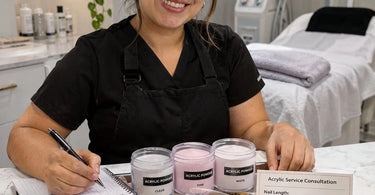
Maximize efficiency with this practical guide to estimating acrylic powder usage across different nail lengths, because beautiful enhancements should build your business without quietly eating your supply budget. Every nail professional knows that a short, natural-looking overlay and an extra-long sculpted coffin set are two very different appointments, especially where product consumption is concerned. Understanding how much acrylic nail powder your technicians use can help you establish realistic service costs, plan wholesale orders, and keep your favorite shades available when clients need them. And while nobody wants to turn a fabulous manicure into a math exam, a little measuring can make your inventory management surprisingly painless.
Acrylic powder consumption is not determined by length alone. Nail width, apex placement, extension shape, product consistency, application technique, and filing habits all influence how many grams end up in a finished set. The goal is not to force every technician to use an identical quantity. Instead, your salon needs a reliable estimating method that accounts for service differences while allowing enough flexibility for beautiful, structurally sound work.
Why Acrylic Powder Usage Matters to Your Salon
Small variations in product consumption become significant when multiplied across dozens or hundreds of appointments. A technician who regularly uses an additional gram of powder per service may barely notice the difference at the nail table. Across 300 appointments, however, that extra gram becomes 300 grams of additional product consumption.
Accurate estimates help salon owners establish service pricing, forecast inventory requirements, compare product performance, reduce unnecessary waste, and identify opportunities for technician training. They also make it easier to evaluate whether a particular nail length or specialty shape deserves a separate pricing tier.
For businesses purchasing professional acrylic powder in multiple colors and container sizes, knowing actual usage is especially valuable. A salon that specializes in short, natural enhancements will have different purchasing needs from one producing dramatic, extra-long extensions all day.
How Much Acrylic Powder Does Each Nail Length Use?
There is no universal gram requirement for a short, medium, long, or extra-long acrylic set. Product formulations, nail dimensions, and application styles vary too much for a single industry-wide standard. However, you can establish useful planning estimates by measuring representative services in your own salon.
For an initial inventory model, the following figures provide an illustrative starting point for powder used across a complete set of ten nails. They are budgeting assumptions, not manufacturer specifications or guaranteed application quantities.
| Nail Length | Illustrative Powder Usage Per Full Set | Typical Service Characteristics |
|---|---|---|
| Short | 3-5 grams | Natural-length overlays or modest extensions with compact structural requirements |
| Medium | 5-8 grams | Moderate extensions requiring additional length and carefully placed reinforcement |
| Long | 8-12 grams | Extended shapes with greater surface area and structural demands |
| Extra-long | 12-18+ grams | Dramatic extensions, specialized shapes, and potentially more complex architecture |
These example ranges are deliberately broad. Some experienced technicians may use less, while certain sculpted styles or wide nail beds require more. Treat them as preliminary estimates to test against actual product measurements rather than as targets that should override correct application techniques.
For example, a salon might initially budget 4 grams for a short set and 10 grams for a long set. After collecting actual service data, the business can replace those assumptions with averages specific to its technicians, products, and clientele.
Step 1: Measure Your Actual Acrylic Powder Consumption
The most useful way to determine powder usage is to weigh the product before and after a service. A digital scale with suitable gram-level precision makes this process much more reliable than counting scoops or estimating by eye.
Begin by choosing one commonly performed service, such as a medium-length square full set. Use the same acrylic powder formulation and application process you normally use for paying clients.
- Place the closed powder container on a clean, appropriately precise scale and record its starting weight.
- Perform the service using your standard professional technique, following the acrylic system manufacturer's instructions.
- Return any uncontaminated, properly stored product only according to the manufacturer's handling guidance. Never return used or potentially contaminated powder to the original container.
- Close the container and weigh it again under the same conditions.
- Subtract the ending weight from the starting weight to determine the amount removed from inventory.
- Record the nail length, shape, technician, service type, and any unusual product consumption.
If a container weighs 125.6 grams before an appointment and 118.9 grams afterward, the measured inventory consumption is 6.7 grams. That figure includes powder removed from the container, whether it became part of the finished enhancement or was discarded during application.
For more reliable results, repeat the measurement across at least five to ten representative appointments in each length category. Larger samples are even better, especially when multiple technicians perform the same service. Record each appointment separately before calculating an average.
Remember that a typical kitchen scale may not be precise enough for small differences. Choose an appropriate measuring instrument, keep it away from airborne filing dust, and follow your workplace's sanitation procedures.
Step 2: Separate Nail Length From Nail Shape
Length is important, but shape can change the amount of acrylic needed even when two sets have similar extension measurements.
A long, narrow almond set does not have exactly the same product requirements as a long, wide square set. Coffin shapes introduce different sidewall and free-edge geometry, while stiletto extensions require careful structural planning despite their tapered appearance.
Rather than assuming that every long set uses the same quantity, organize your measurements by both length and shape. Useful categories include short square, medium almond, medium coffin, long square, long stiletto, and extra-long sculpted extensions.
Over time, you may discover that some shapes consistently require more material or more filing than others. That information can support smarter appointment scheduling and more accurate specialty-service pricing.
Keep in mind that safe, durable enhancements depend on appropriate architecture, not simply applying the least possible acrylic. Product efficiency should never compromise the apex, sidewalls, stress area, or overall balance of the finished nail.
Step 3: Account for Nail Width and Natural Nail Conditions
Two clients requesting medium-length almond nails may still require different quantities of acrylic powder. One may have narrow natural nail plates, while the other has broader nail beds and more surface area to cover.
Natural nail shape, existing enhancement condition, and the need for structural correction can also influence consumption. A full set applied to ten relatively uniform nails may use less material than a service involving several damaged extensions or unusual architectural challenges.
Instead of charging clients based on individual nail width, use these differences to understand normal variation within your service categories. Establish a reasonable average, then maintain a modest inventory allowance for appointments that fall outside the usual pattern.
This approach keeps pricing straightforward for clients while preventing your supply estimates from becoming unrealistically precise. After all, your reception desk should not need a geometry textbook to quote a manicure.
Step 4: Understand How Bead Size Affects Powder Usage
Acrylic application technique influences how efficiently product moves from the container to the nail. Oversized beads can create excess bulk that must be filed away, while undersized beads may require repeated application and additional handling.
Consistent bead control begins with appropriate acrylic nail brushes, correct liquid-to-powder ratios, and familiarity with the specific system being used. Different acrylic systems may require different working techniques, so manufacturer directions should always take priority over generalized bead-count rules.
A technician who uses three carefully controlled beads may consume less powder than another who repeatedly adds material and files away the excess. However, bead count alone is not a dependable measurement of grams consumed.
During team training, focus on controlled product pickup, smooth placement, proper structure, and reduced unnecessary filing. The objective is consistent application quality with less avoidable waste, not rushing technicians or encouraging enhancements that are too thin.
Well-maintained Nail Brushes & Tools can support consistent application, while suitable Nail Files & Buffers help refine the finished structure without excessive removal.
Step 5: Calculate Acrylic Powder Cost Per Service
Once you know your average powder consumption, converting that information into a material cost is straightforward.
Powder cost per gram = Purchase price of powder divided by net powder weight in grams.
Powder cost per service = Average grams consumed multiplied by powder cost per gram.
Imagine your salon purchases a 16-ounce container of acrylic powder for $48. For this example, assume the listed net weight is 16 ounces by weight, equivalent to approximately 453.6 grams. Your estimated cost per gram would be $48 divided by 453.6, or approximately $0.106.
Using that hypothetical purchase price, the powder cost for different services would look like this:
| Service | Example Powder Consumption | Estimated Powder Cost |
|---|---|---|
| Short full set | 4 grams | $0.42 |
| Medium full set | 7 grams | $0.74 |
| Long full set | 10 grams | $1.06 |
| Extra-long full set | 15 grams | $1.59 |
These calculations are examples only, not current product prices or promises of typical salon consumption. Actual purchasing costs depend on the product, package size, supplier pricing, and other factors.
Notice that the powder cost difference between short and extra-long sets may be smaller than clients expect. However, acrylic powder is only one part of the service expense. Acrylic liquid, nail tips or forms, primer, preparation products, finishing products, disposable supplies, technician time, overhead, and potential rework must also be considered.
For a realistic pricing model, calculate the complete service cost rather than setting your prices based on powder consumption alone.
Step 6: Estimate Monthly Acrylic Powder Inventory
Once you establish average consumption by length, you can forecast monthly purchasing requirements using your expected appointment mix.
Suppose your salon anticipates the following full-set appointments next month:
| Length | Appointments | Average Grams Per Set | Total Powder |
|---|---|---|---|
| Short | 60 | 4 | 240 grams |
| Medium | 90 | 7 | 630 grams |
| Long | 40 | 10 | 400 grams |
| Extra-long | 10 | 15 | 150 grams |
The estimated monthly requirement is 1,420 grams of acrylic powder for these 200 full-set appointments.
If those averages already reflect actual container weight loss, they should include normal application waste. Adding another general waste percentage without checking could overstate your purchasing needs.
However, maintaining a separate reserve for demand fluctuations, spills, unexpected service volume, and supplier lead times can be sensible. For illustration, a 10% planning reserve would add 142 grams, producing a target of approximately 1,562 grams.
That reserve is an inventory planning choice, not a universal waste rate. Adjust it according to your historical demand, ordering frequency, available storage, and supplier reliability.
For a complete forecast, add powder used for fills, repairs, replacement nails, specialty designs, and training. A salon offering frequent maintenance appointments may consume substantially more acrylic than its full-set appointment count suggests.
Step 7: Track Fills and Repairs Separately
Acrylic fills typically require less powder than complete new sets, but consumption depends on regrowth, lifting, reshaping, missing extensions, and the amount of existing product that must be replaced.
Do not assume every fill consumes a fixed fraction of a full set. Instead, measure fills independently and organize the results by service type and nail length.
For example, track a routine two-to-three-week fill separately from a major rebalance, length change, or repair appointment. These services can have very different material and labor requirements.
Consider recording individual nail repairs as well. If your technicians regularly replace broken long extensions, those repairs can create meaningful additional powder demand over the course of a month.
Keeping full sets, fills, and repairs in separate categories gives you a clearer picture of which services consume your inventory and generate your revenue.
Step 8: Reduce Waste Without Sacrificing Nail Quality
Reducing acrylic powder waste does not mean stretching products beyond their intended use. It means improving everyday habits that prevent unnecessary material loss.
Start with organized Nail Tables and Manicure Stations that provide enough room for safe product handling. Keep containers closed when not in use, use appropriate dispensing practices, and maintain clean working surfaces.
Review these practical opportunities with your team:
- Improve bead control: Practice consistent product pickup and placement to reduce excess bulk.
- Choose appropriate brush sizes: Match tools to the service and acrylic system instead of relying on one brush for every application.
- Minimize unnecessary filing: Build correct architecture during application so technicians spend less time removing excess material.
- Store powder correctly: Follow manufacturer instructions for temperature, moisture protection, container closure, and shelf life.
- Prevent cross-contamination: Keep used brushes, filing dust, and potentially contaminated materials away from bulk powder.
- Monitor recurring service problems: Investigate excessive lifting, breakage, and repeated corrections that create avoidable product consumption.
Remember that acrylic liquid and powder must be handled according to the product manufacturer's directions and safety documentation. Appropriate ventilation, exposure controls, sanitation, and safe disposal procedures remain essential even when your primary goal is reducing waste.
Should You Buy Larger Containers of Acrylic Powder?
Bulk purchasing can reduce the unit cost of frequently used products, but larger containers are not automatically the best choice for every salon.
If your team consistently uses a particular clear, pink, or cover shade, purchasing a larger quantity may make sense. If a specialty color is requested only occasionally, a smaller container may be more practical.
Compare the actual price per gram, expected monthly consumption, available storage space, product shelf life, and supplier lead time before increasing your order size.
For salons managing multiple acrylic systems, it is also important to maintain compatible products. Avoid combining powders and liquids from unrelated systems unless their manufacturers explicitly approve the combination.
Explore Acrylic Nail Supplies and related Professional Nail Care Collections when evaluating options for your professional inventory.
How to Create a Simple Acrylic Powder Usage Tracking Sheet
You do not need complicated inventory software to begin collecting useful information. A spreadsheet or simple service log can help establish reliable averages.
Include the following fields for each measured appointment:
- Service date and technician
- Full set, fill, repair, or specialty service
- Nail length and shape
- Powder brand, system, and shade
- Starting and ending container weights
- Grams consumed
- Estimated powder cost
- Notes about repairs, unusual nail width, or product waste
At the end of each month, calculate average powder consumption for every service category. Review unusual results before including them in your normal service averages.
For example, a service involving three replacement extensions should not necessarily define your standard medium-length fill estimate. It may be better classified as a fill with repairs.
As your records grow, compare average consumption between technicians and identify opportunities for coaching. Approach these comparisons constructively. Different client requirements and service mixes can explain legitimate differences in material use.
Use Your Powder Estimates to Improve Service Pricing
One of the biggest benefits of accurate powder tracking is understanding how service length affects profitability.
Extra-long enhancements often require more material, additional structural work, greater shaping precision, and longer appointments. Even when the direct powder cost difference is relatively modest, the additional technician time can justify a meaningful service price difference.
Consider establishing clear pricing tiers for short, medium, long, and extra-long enhancements, with separate charges for specialty shapes, intricate designs, or extensive repairs where appropriate.
Evaluate your pricing against the complete cost of providing the service, including labor, consumables, overhead, and your desired profit margin. Review the results periodically rather than assuming a price structure will remain profitable forever.
And yes, clients may still arrive with a photo of nails long enough to qualify as tiny architectural projects. A transparent pricing menu makes those conversations much easier.
Common Acrylic Powder Estimating Mistakes
Using one estimate for every nail length: This can underestimate material requirements for dramatic extensions and overestimate requirements for shorter services.
Confusing powder used with powder remaining on the nail: Filing dust, discarded beads, and application waste affect inventory consumption even though they do not remain in the finished enhancement.
Ignoring nail width and shape: Surface area and structural design influence material requirements alongside length.
Estimating from bead count alone: Beads vary in size, consistency, and liquid-to-powder ratio, making them unreliable as a universal unit of measurement.
Forgetting fills and repairs: Full-set appointments represent only part of acrylic consumption in many busy salons.
Using hypothetical figures as permanent standards: Starting estimates should eventually be replaced with real measurements from your own business.
Prioritizing savings over structure: Underbuilding enhancements to save a small amount of powder can lead to service failures, dissatisfied clients, and more expensive corrective work.
Frequently Asked Questions About Acrylic Powder Usage
How many grams of acrylic powder are needed for a full set?
There is no fixed quantity for every full set. As an illustrative starting point, a salon might budget approximately 3-5 grams for short nails, 5-8 grams for medium nails, 8-12 grams for long nails, and 12-18 grams or more for extra-long nails. Actual usage should be verified through measurements of your own services.
Do longer acrylic nails always require more powder?
Longer enhancements generally require additional material because they cover more area and need appropriate structural support. However, nail width, shape, application technique, and the chosen acrylic system can influence the final amount.
How can I measure acrylic powder without wasting product?
Weigh a closed powder container before and after a normal appointment. The weight difference provides an estimate of inventory consumption without requiring you to discard additional product for testing.
Should acrylic fills be included in full-set averages?
No. Track fills, full sets, repairs, and major rebalances separately because their product requirements differ. Combining them can make your inventory forecasts less accurate.
Does buying acrylic powder in bulk always save money?
Not necessarily. Larger quantities may offer a lower price per gram, but savings depend on actual consumption, storage conditions, product shelf life, and how quickly your salon uses each shade.
How often should a salon update its powder usage estimates?
Monthly reviews are useful when establishing a baseline. Once consumption becomes predictable, quarterly reviews may be sufficient, with additional measurements whenever you introduce a new acrylic system, technician technique, or major service category.
Build a More Profitable Nail Service With Smarter Supply Planning
Estimating acrylic powder usage across different nail lengths becomes much easier once you stop relying on guesses and start collecting real service data. Measure representative appointments, calculate average consumption by length and shape, account for fills and repairs, and connect those figures to your actual purchasing costs.
The result is a more useful inventory forecast, a stronger foundation for service pricing, and fewer surprises when your most popular powder starts running low during a packed appointment schedule.
Pure Spa Direct is a professional beauty supply distributor serving spas, salons, nail professionals, and other beauty businesses. Explore our selection of Acrylic Nail Supplies, Nail Brushes & Tools, Nail Files & Buffers, and Manicure Essentials to support your next inventory order.
Because the only thing that should be extra about an extra-long acrylic set is the fabulous finished look, not the amount of product disappearing from your supply cabinet.
