
Pros love this for good reason: a client who actually follows aftercare is a client who rebooks, raves, and refers. But here is the thing nobody tells you when you are starting out in the lash world. Your client is not going to remember the eleven-step aftercare speech you delivered while she was still blissed out on the table. She is going to go home, wash her face like a normal human, and wonder why her lashes started looking crunchy by Tuesday. The secret is not to give her more information. It is to give her the right information, in the right order, at the right time, without turning your lash room into a college lecture hall.
Here is how to explain lash aftercare in a way that actually sticks, without making your client feel like she just signed up for a cosmetology certification.
Start The Aftercare Conversation Before The Client Lies Down
If aftercare is a surprise at checkout, it feels like a sales pitch. If it is part of the consultation, it feels like professional expertise. The difference is entirely in the timing.
During the consultation, ask what she currently uses to cleanse her eye area. You are not trying to catch her doing something wrong. You are gathering information. Her answer tells you whether she is already using a gentle lash cleanser or whether she is still reaching for that bar of lavender soap from the farmers market because it smells nice.
Then you say something simple, like: "To keep your lash line clean, I recommend washing your extensions every morning and evening with a foaming cleanser made for lash extensions. I will show you exactly how before you leave today." That single sentence does three things. It establishes cleansing as part of the service, it positions you as the professional, and it removes the element of surprise from the product conversation later.
The 24-Hour Rule Is Not A Suggestion, It Is A Bonding Period
The first 24 to 48 hours after application are when the adhesive is still curing. Water, steam, sweat, and tears (yes, even the ones from that sad dog commercial) can interfere with the bond before it has fully set.
But here is how to frame it so your client actually listens: "Think of your lashes like a fresh gel manicure. You would not go wash dishes immediately after leaving the nail salon, right? Same idea. Give them a day to settle, and they will stay put much longer."
Most clients understand the logic of protecting a fresh manicure. Borrowing that framework makes the lash rule feel familiar instead of restrictive. It also gives you a natural moment to mention that a silk pillowcase or a loose sleep mask can help protect the investment while she sleeps.
One Cleanser, One Brush, One Routine
Overwhelm happens when clients are handed seven products and a laminated card with forty-seven bullets. Do not be that artist. Be the artist who says: "Here is your cleanser. Here is your brush. Wash morning and night, rinse with lukewarm water, pat dry, and brush with a clean spoolie. That is it."
The Lash & Brow Service Supplies collection has everything you need to build a simple, effective aftercare kit without turning your retail shelf into a confusing maze. A foaming cleanser, a soft cleansing brush, a handful of spoolies, and a small pouch. Done.
If you want to make it feel even more special, package it as a ready-made take-home kit. Clients love things that are already assembled. It saves them from having to think, and thinking is the enemy of aftercare compliance.
Show, Do Not Tell (They Will Forget What You Told Them)
Clients remember about ten percent of what you say and about eighty percent of what they do. So do not just talk about cleansing. Demonstrate it.
After the appointment, walk her through the process in the mirror. Pump the foam, show her how to use gentle circular motions along the lash line, show her how to rinse with lukewarm water, and show her how to pat dry with a lint-free cloth. Let her hold the brush. Let her feel how much pressure is appropriate (spoiler: almost none).
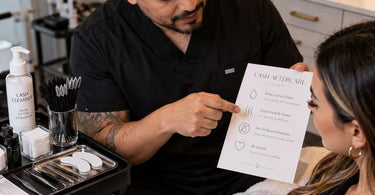
This takes maybe two minutes. Those two minutes are worth more than any printed instruction card you could hand her. And if you do want to send her home with something physical, a simple aftercare card with three bullet points works better than a novel. Keep the top three reminders only: keep dry for 24 hours, cleanse daily, do not pick.
The Retail Conversation Without The Ick
Nobody likes feeling sold to, especially when they are still admiring their new lashes in the mirror. But there is a way to offer aftercare products that feels helpful instead of pushy.
Try this: "I have the cleanser we used today available if you would like to take one home. It is the right formula for the routine I just showed you, so you do not have to guess what is safe for your extensions."
That is it. No hard sell. No urgency tactics. Just a clear, low-pressure option.
If you want to make the offer even more natural, mention it while you are doing the demonstration. "This is the cleanser I recommend. I have it at the front if you want to grab one on your way out." The product becomes part of the education, not a separate sales pitch.
For artists who want to create a more polished retail experience, a curated aftercare kit solves two problems at once. It gives the client everything she needs in one package, and it gives you a higher-value retail option that feels like a service rather than a transaction.
What To Do When A Client Comes Back With Poor Retention
It happens. A client returns after two weeks with more gaps than lashes, and you have to figure out why. Before you blame your adhesive or your technique, ask about her routine.
"Walk me through what you have been doing at home. How often are you cleansing? What products are you using around your eyes?"
Most of the time, the answer is not malicious. She used her regular face wash because she forgot. She rubbed her eyes because allergies. She slept on her face because she is a human being with sleep habits that were formed before lash extensions existed.
This is not a moment for judgment. It is a moment for a gentle reset. Re-explain the routine. Maybe this time she needs the kit in her hand instead of just the explanation. Maybe she needs the cleansing brush because she has been trying to wash her lashes with her fingers and a washcloth, which is basically the lash equivalent of scrubbing a silk blouse with a wire brush.
For clients who struggle with oil production or have particularly oily skin, an oil-free cleanser becomes even more important. Oil breaks down adhesive faster than almost anything else, so if she is already fighting her own skin, she needs a cleanser that works with her instead of against her.
Make Aftercare Feel Like A Gift, Not Homework
The artists who have the best retention and the fullest books are not the ones who give the longest lectures. They are the ones who make aftercare feel effortless.
Here is a simple formula that works:
Keep the routine to three steps maximum. Show, do not tell. Time the conversation around the service, not after it. Offer the products as part of the solution, not as an upsell. And follow up a few days later with a quick check-in text. "Hey, just checking in. How are the lashes feeling? Remember to wash morning and night with your foam."
That follow-up text takes thirty seconds. It also does more for client loyalty than almost anything else you can do. It shows her that you are thinking about her beyond the appointment, and it reinforces the routine without feeling like nagging.
Your clients want to keep their lashes looking good. They want to protect the money they spent. They just need you to make it easy for them. Give them one cleanser, one brush, one simple routine, and a little grace when they inevitably slip up. That is how you build a client who comes back, tells her friends, and keeps her lashes full between fills.
And honestly? That is also how you build a business that runs on referrals instead of advertising. Not bad for a two-minute conversation about foam.
