
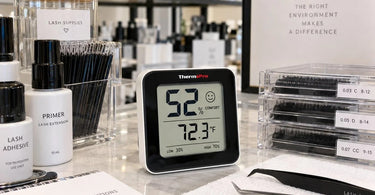
Your next success story starts here, in a treatment room where your lash adhesive actually cures the way the manufacturer promised instead of throwing a tiny hissy fit. You know the one: the client is relaxed, the playlist is perfect, you have your Premium Lash Extensions & Supplies for Pros laid out like a surgical tray, and then you notice your lash humidity tool is reading something that looks suspiciously like a random number generator. That is not the vibe we are going for. Lash artists do not need another diva in the room, and a moody hygrometer that refuses to be accurate or readable is absolutely the last thing you want competing for attention with your client's lash nap.
The thing is, humidity is not just a topic for small talk with the mail carrier. In a lash room, humidity is the silent business partner you never agreed to work with. It decides whether your adhesive cures in a crisp, reliable bond or turns into a sticky little mystery that leaves you explaining retention issues to a client who is already booking her next fill somewhere else. Keeping your lash humidity tools accurate and easy to read is not about being fussy. It is about protecting your work, your reputation, and your sanity. Let us make that hygrometer earn its keep.
Why Your Lash Room Is Basically a Science Lab With Better Lighting
Lash adhesive is moisture-sensitive. That means it needs humidity to cure, but it is extremely picky about the amount. Most professional adhesives perform best somewhere in the range of 40% to 70% relative humidity, with many artists finding their sweet spot between 40% and 60% . Go too high, and you get shock polymerization, which is a fancy way of saying your adhesive cures so fast it barely bonds to the natural lash and you end up with retention that could charitably be described as tragic . Go too low, and your adhesive takes forever to set, your lashes slip, and you find yourself in a staring contest with a client's closed eyelid at 9 p.m. wondering where your evening went .
Your lash humidity tools exist to give you data, not a gut feeling. A good hygrometer tells you whether your room is in the Goldilocks zone before you waste a set of Lash Extensions on conditions that were never going to cooperate. The problem is that hygrometers, like people, can be unreliable, dramatic, and occasionally in need of a stern talking-to. The goal is not just to own one. The goal is to keep it accurate, readable, and actually useful when you are mid-set and need a quick answer.
The Readability Problem: When Your Hygrometer Speaks in Riddles
Let us talk about readability first, because there is nothing more annoying than squinting at a tiny screen while your client is slowly drifting into a lash nap and your adhesive is quietly deciding your fate. Analog hygrometers with dials can look charming in a rustic spa photo, but in practice they can be harder to read quickly, and their accuracy tends to drift over time . Digital hygrometers are generally faster, more accurate, and easier to interpret at a glance, but even those can suffer from glare, poor placement, or the dreaded dead battery that turns your precise tool into a very expensive paperweight .
Placement matters more than most lash artists realize. If your hygrometer is sitting on a shelf across the room while your actual work zone is two feet away, you are measuring the climate of that shelf, not the climate where your adhesive is curing. The tool needs to be close to your working area, ideally at a height that lets you glance at it without breaking your lash flow. Avoid placing it directly in front of a vent, near a window that gets dramatic afternoon sun, or right next to your Facial Steamers if you happen to share a space with other services. Humidity does not distribute itself evenly, and your tool should be measuring the environment your adhesive actually lives in.
Calibration: The Spa Day Your Hygrometer Did Not Know It Needed
Here is the part that separates the pros from the hopeful: calibration. A hygrometer that has never been calibrated is basically a decoration with delusions of grandeur. Even factory-calibrated digital units can drift over time, and analog models can wander off like a toddler in a candy store . The good news is that you can perform a simple salt test at home or in your salon to check whether your tool is telling the truth.
The salt test is wonderfully low-tech. You take a small container, like a bottle cap, and fill it with table salt. Add just enough water to make a thick paste, not a dissolved solution. Put that cap and your hygrometer inside an airtight container, seal it, and wait at least six to eight hours. The environment inside should stabilize at 75% relative humidity . If your hygrometer reads 75%, congratulations, it is trustworthy. If it reads something else, you now know its deviation. For analog models, you can often adjust the needle with a screw on the back. For digital models without adjustment, simply note the offset, like plus three or minus four, and do the math in your head when you check it .
Calibrating your lash humidity tools once a month, or at least once a quarter, is a small investment of time that pays off in consistent adhesive performance. It also gives you a reason to feel smug the next time a colleague complains that her glue is acting weird and you know exactly why.
The Enemy of Accuracy: Temperature Tantrums and Placement Problems
Humidity does not exist in a vacuum, and neither does temperature. Your lash room temperature affects how your adhesive behaves just as much as humidity does. Most adhesives perform best between 18°C and 24°C, which is roughly 64°F to 75°F for those of us who prefer our thermometers in freedom units . A room that swings from chilly in the morning to toasty in the afternoon can send your adhesive on an emotional rollercoaster that no hygrometer reading can fully explain.
This is why a hygrometer that also displays temperature is worth the upgrade. You get two pieces of data from one tool, and you can spot patterns that would otherwise be invisible. Maybe your retention issues always happen after lunch, when the sun hits the window and the room warms up. Maybe your adhesive gets sluggish on rainy days when the humidity spikes. A combined humidity and temperature display turns guesswork into a manageable system .
If your lash room shares space with other services, you have an extra challenge. A nearby Towel Steamers or a hot towel cabinet can quietly pump moisture into the air, and a Professional Cleaners & Disinfectants routine that involves lots of spraying can do the same. Your hygrometer should be positioned to catch these fluctuations before they ruin a set. If you notice the humidity creeping up every time the wax room gets busy, you have a placement problem to solve, not a glue problem to blame.
Reading Your Tools Like a Lash Detective
Once your hygrometer is accurate and well-placed, the next step is actually using the information it gives you. This sounds obvious, but many lash artists check the reading once in the morning and then never look again. Humidity changes throughout the day, especially in smaller rooms or spaces with variable ventilation . A quick glance before each client is a habit worth building. It takes three seconds and can save you three weeks of retention complaints.
Here is a simple rule of thumb. If your hygrometer reads below 40%, your adhesive is likely curing too slowly. You might consider a humidifier to bring the moisture up, or you might switch to a faster-drying adhesive for that session. If it reads above 70%, your adhesive is at risk of curing too fast, which can cause brittle bonds and poor retention. A dehumidifier or better ventilation can help. If your room is in the sweet spot, pour yourself a sparkling water and lash with confidence.
Your lash humidity tools are not there to judge you. They are there to give you data, and data is the difference between a lash artist who hopes for the best and a lash artist who knows the conditions are right before the first extension is placed. That kind of confidence shows up in your work, and your clients feel it even if they cannot articulate it. They just know their lashes last longer and look better, and they keep coming back.
Keeping Your Tool Easy to Read in the Real World
Let us get practical. A tool that is accurate but impossible to read is still useless. Here are a few ways to keep your hygrometer user-friendly in the middle of a busy day. First, choose a model with a large, backlit display if possible. Lash rooms tend to have dim, cozy lighting, and a display that disappears into the shadows is not helping anyone. Second, mount it or place it at eye level near your work station so you do not have to lean over or squint. Third, keep spare batteries on hand. Nothing kills accuracy like a low-battery warning that you ignore for three weeks.
If you use an analog hygrometer because you love the aesthetic, that is fine. Just check it against a digital model periodically, or perform the salt test more often. Analog tools can drift, and a drifting tool is worse than no tool at all because it gives you false confidence . If you use a digital model, protect it from accidental splashes and sprays. A hygrometer that has been misted with Professional Cleaners & Disinfectants is not going to give you reliable readings, and it may not forgive you.
When Your Lash Room Shares Space With Other Services
Many lash artists work in multi-service salons, which adds a layer of complexity to humidity management. If your station is near a Vichy Showers or a Hydrodermabrasion room, moisture from those treatments can migrate. If you are near a waxing station, the Professional Wax Warmers for Salons & Spas can add heat, and heat changes how humidity feels and behaves. Your hygrometer becomes even more important in these shared environments because you cannot assume the room is stable just because it was fine yesterday.
Consider using a small, portable dehumidifier or humidifier right at your station if you notice frequent fluctuations. It is not a glamorous purchase, but it is a professional one. Your adhesive does not care about glamour. It cares about consistency. And you should care about whatever keeps your retention strong and your clients happy.
The Bottom Line on Lash Humidity Tools
Keeping your lash humidity tools accurate and easy to read is not complicated, but it does require a little attention. Calibrate regularly. Place thoughtfully. Read the numbers before every client, not just when something goes wrong. Choose a tool that gives you clear information without making you work for it. And remember that your adhesive is doing its best, but it needs the right environment to perform the way it was designed to.
Your lash room is your workspace, your creative studio, and your business all rolled into one. The small tools you use to monitor that space are not accessories. They are part of your professional toolkit, just like your tweezers and your Magnifying Lights. Treat them with the same respect, and they will reward you with consistent results, fewer retention headaches, and clients who leave with lashes that look as good in three weeks as they did on day one. That is the kind of success story worth building.
)