
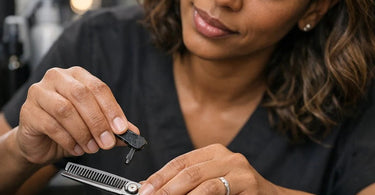
Your best work starts with the best tools... but even the crème de la crème of Professional Shears, Clippers, & Trimmers for Barbers will throw a full-on tantrum if you ignore the tension. You know the drill. You're cruising through a beautiful texturized lob, feeling like a hair goddess, and then... *crunch*. The hair folds. The shears snag. Your client winces. Suddenly, you're fighting your tool instead of creating art. It's enough to make you want to toss those expensive scissors out the window and take up Waxing Supplies for Professionals full-time. But don't grab the wax pot just yet. Maintaining the tension on your thinning shears isn't rocket science; it's actually pretty simple once you know the secrets. And lucky for you, we're about to spill all the tea. Welcome back to the Pure Spa Direct blog, where we save your hands, your sanity, and your bottom line.
Let's be real for a second. If you run a busy Hair Salon or a cool Barber Shop, your shears are basically an extension of your hand. When they're happy, you're happy. When they're out of whack, your wrist hurts, your cuts look fuzzy, and that perfect Professional Hair Color job you just did looks like it was cut with garden shears. A thinning shear (or texturizer) is a specific beast. It has teeth, which makes the pivot point even more critical. Those little teeth rely on perfect tension to slice cleanly. If the tension is off, those teeth will pull, snag, and leave you with a hot mess instead of a seamless blend. So, grab your oil, find your little screwdriver, and let's get this tension situation sorted out.
Why Your Thinning Shears Are Ghosting You (And Your Tension Is The Culprit)
Before we dive into the fix, let's diagnose the drama. Have you noticed your shears pushing hair away instead of cutting it? That, my friend, is the classic sign of tension that is too loose . When the blades don't squeeze together tightly enough, they separate microscopically, and the hair just bends and slides right through the gap. It's like trying to cut a tomato with a butter knife—frustrating and ineffective.
On the flip side, does it feel like you're trying to squeeze the life out of a stress ball every time you close your shears? Do your thumb and wrist ache after just one haircut? That means your tension is tighter than your schedule on a Saturday afternoon. Over-tightening doesn't just hurt your hand; it grinds down the blades, misaligns the teeth, and sends your expensive Professional Hair Brushes & Combs for Stylists budget up in smoke because you'll need new shears way sooner than expected .
Finding that "Goldilocks" zone—not too loose, not too tight, but JUST right—is the goal. When the tension is perfect, your shears will glide through Premium Hair Care Products-laden locks like a hot knife through butter. Your cuts will be sharper, your blending smoother, and your chiropractor bills lower.
The Drop Test: Your New Best Friend (No, Seriously)
How do you know if you've hit the tension sweet spot? You could guess, but guessing is for amateurs. We use the "Drop Test." It takes two seconds and it never lies .
Hold your thinning shears vertically by the finger ring with the tips pointing up toward the ceiling. Open the top (thumb) blade to a 90-degree angle. Now, let go. Watch it fall.
- The Winner (Correct Tension): The blade falls slowly and smoothly, stopping about halfway or two-thirds of the way down. It doesn't snap shut, and it doesn't freeze in place.
- The Party Animal (Too Loose): The blade closes completely and clacks shut instantly. This explains why your hair is folding!
- The Control Freak (Too Tight): The blade barely moves, or gets stuck where you left it. Your wrist is going to be screaming by lunchtime.
Perform this test at the start of every shift. It's faster than brewing your coffee, and it will save you hours of re-dos and frustration later.
Step-by-Step: How To Whip That Pivot Point Into Shape
Alright, let's fix it. Don't just start cranking screws willy-nilly. There is a method to the madness.
Step 1: Clean the Gunk
Before you touch that tension screw, you need to clean your shears. I know you're tired. I know you want to go home and watch trashy TV. But take 30 seconds. Product buildup, hair dust, and that mystery sticky stuff that gets everywhere love to hide around the pivot point . Use a soft cloth and wipe the blades and the screw area. If there's stubborn residue, a little isopropyl alcohol on the cloth works wonders. Just don't soak them! Once they are clean, grab your favorite High-Quality Towels to give them a final buff.
Step 2: Oil It Up, Buttercup
Dry metal on metal is a recipe for disaster. You need lubrication. Put ONE tiny drop of shear oil (or clipper oil) right at the pivot point . I said ONE drop. We aren't trying to deep fry the shears. Open and close the blades 10-15 times to work the oil into the bearings. Then, wipe away any excess that seeps out. Too much oil attracts dust, which turns into that black goo that ruins your tension. Looking for a reliable brand? Check out our friends at Fromm International for quality oils and accessories.
Step 3: The Micro-Adjustment Tango
Now, locate your tension screw or dial. Some shears have a cool thumb dial, while others require a small screwdriver (often called a tension key) .
- To Tighten: Turn clockwise. Do this in teeny, tiny increments. Think 1/16th of a turn or a single click.
- To Loosen: Turn counter-clockwise. Again, baby steps.
After every tiny adjustment, do the Drop Test again. Rinse and repeat until you hit that perfect halfway-fall mark. Patience is key here. You aren't fixing a car engine; you are tuning a precision instrument .
Step 4: Test Drive on Hair
The Drop Test is great, but the real test is on hair. Take a clean, detangled section of hair (preferably not on a paying client yet!). Make a few cuts. Does it feel smooth? Is the hair falling away cleanly? If it feels grainy or you hear a "crunch," you might be a hair too tight. Loosen it just a smidge. If the hair is folding or the shears feel wobbly, give it one more tiny click tighter.
The "Oops, I Broke It" Guide: Common Tension Tragedies
Let's troubleshoot some specific nightmares, shall we? Because we've all been there.
The Snaggletooth Snag:
If your thinning shear feels like it's catching or grinding in one specific spot, you likely have a nick in the blade or a bent tooth . No amount of tension adjustment will fix a bent tooth. Stop using them immediately! Using damaged shears will ruin the opposite blade and cost you a fortune in sharpening repairs.
The Constant Loosener:
Does your tension screw have a mind of its own, loosening up after three haircuts? This is common with shears that lack a locking mechanism. Try a tiny dab of thread-locker (the purple or pink low-strength kind, not the red permanent stuff!) on the screw threads. Or, it might be time to invest in a higher-quality pair of Professional Shears, Clippers, & Trimmers for Barbers from brands like Wahl or BaBylissPro that feature better engineering.
The Rust Bucket:
If you see rust or pitting near the pivot, you've been neglecting your cleaning duties (or storing them in a humid bathroom). Rust throws off tension by adding friction. You can try a rust eraser, but severe rust usually means it's time to visit a professional sharpener or replace the shears entirely. Humidity is a real issue in many Spa Essentials for Professionals environments, so keep those shears in a dry case!
Daily Habits That Save Your Sanity (And Your Wrists)
Maintaining tension isn't a "once a year" event. It's a lifestyle, honey. But don't worry, it takes less time than scrolling through Instagram.
- The Daily Wipe: Keep a microfiber cloth in your station drawer. At the end of the day, wipe down your shears. Get the hair off. Get the hairspray off. It takes 10 seconds .
- The Daily Oil: Before your first client, one drop of oil. Open and close. Wipe the excess. This is non-negotiable if you want to avoid Massage Table Warmers-level stress later in the day .
- The Daily Drop: Perform the Drop Test. Adjust if necessary. It takes two seconds.
- Storage Matters: Don't throw your shears loose in a drawer to bang against your Nail Files & Buffers and Mixing Bowls. Use a protective case or a magnetic strip. Dropping shears is the fastest way to ruin tension and alignment.
But Wait, My Thinning Shears Are Different!
Yes, thinning shears are special. Because they have teeth, the margin for error is actually smaller. A tension that is "okay" on your regular cutting shear might be a disaster on your thinner. The teeth rely on a precise, tight closure to cut the hair cleanly without crushing the strands that fall between the teeth.
If your texturizer is pushing hair, it is almost always a tension issue . However, if you've cleaned, oiled, and adjusted to the perfect Drop Test result, and it STILL pushes hair? Your teeth are probably dull. Thinning shears do need sharpening, but it's a specific art. Don't let just anyone sharpen them. A bad sharpening job will ruin the geometry of the teeth, and no amount of tension adjustment will fix it. If you need new gear, we have incredible options in our Professional Shears collection that will make your hand sing.
When To Fold 'Em (And Call A Pro)
Let's be honest: sometimes you just can't fix it. If you've cleaned, oiled, and adjusted until you're blue in the face, and the shears still feel wobbly, crunchy, or just "off," it's time to call in the cavalry.
Send them to a reputable sharpening service. A pro will not only sharpen the edge but will also reset the tension correctly and check the alignment of the pivot. They have special tools (like tension gauges) that we don't have in our station drawers. Investing in a professional sharpening twice a year is way cheaper than buying new Professional Shears every 12 months .
While your shears are away getting their spa day, why not browse our massive selection of Professional Hair Salon & Barber Shop Supplies? From Hair Styling Tools & Appliances for Salons to Training Manikins & Mannequins for Hairdressers, we have everything you need to keep your business thriving. And don't forget to grab some Protective Gloves & Masks for Salon and Spa Professionals to keep yourself safe while you work your magic!
So there you have it. Maintaining tension on your professional hair thinning shears isn't a chore; it's a superpower. It saves your money, saves your body, and saves your reputation. Now go forth, oil those pivots, nail that Drop Test, and give your clients the flawless, textured cuts they dream about. You've got this.
