
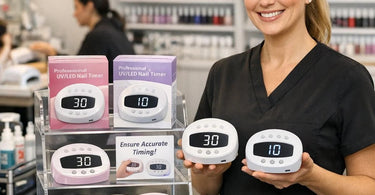
Tools designed to meet your needs...especially when those tools are digital timers and your need is to not have a client waving their hands in the air because their gel didn't cure. Let's be honest, the digital timer on your nail station is a lot like that one reliable friend who is always watching the clock so you don't have to. It tells you when the dip powder has set, when the gel polish is perfectly baked, and when you can finally stop holding that client's hand under the lamp. But what happens when that friend starts getting a little... flaky? What happens when those seconds start moving faster than a cheetah on espresso, or worse, the timer just blinks at you like a confused firefly? Chaos, that is what happens. You end up with sticky nails, over-cured matte finishes, or a client who develops superhuman patience while you stare at a blank screen. So, let's get down to business. We are going to rescue your workflow, save your client relationships, and dive deep into the very un-sexy but incredibly important world of maintaining the accuracy of your Digital Timers. I promise to try and make it fun, or at least as fun as cleaning battery contacts can possibly be.
Welcome to the thunderdome, nail techs. We work in environments that are essentially designed to destroy small electronics. Between the dust from acrylics, the sticky residue from monomer, the occasional splash of acetone, and the sheer frequency of use, our little digital buddies take a beating. A mis-timed cure on a gel top coat isn't just annoying; its a business hazard. It gums up your brushes, ruins your expensive Professional Gel Polish, and wastes precious minutes that you could be using to paint tiny flowers on a pinky nail. But before you throw that temperamental timer across the room and into the nearest trash can, let's look at how to keep these essential gadgets honest, accurate, and living a long, productive life at your Nail Tables and Manicure Stations.
The Sad Tale of the 'Fast' Five Seconds (Why Calibration Matters)
First, we need to talk about the ghost in the machine. I recently heard a horror story from a tech in Tampa who swore her lamp was haunted. She set it for 60 seconds, but her builder gel was coming out sticky. She set it again. Still sticky. Turned out her UV Sterilizers and lamps were fine, but the microprocessor in her digital timer had glitched. That 60 seconds was actually only 35 seconds in real time. Because our eyes are usually glued to the nail tip or the Nail Art Rhinestones we are placing, we assume the timer is doing its job. Spoiler alert: sometimes it lies.
To maintain accuracy, you need to test your timers weekly against a known good source. Use the clock on your phone or a verified online stopwatch. Set your nail station timer for 60 seconds and hit start on your phone at the exact same time. Look away. When your timer beeps, check the phone. Is it exactly 60 seconds? Give or take a half-second is usually okay. Is it 55 seconds? Or 65 seconds? If your timer is off by even 5%, that is the difference between a perfect, long-lasting Dipping Powder Systems for Salons application and a client returning next week with chipped tips. If the discrepancy is high, do not pass go, do not collect $200. Replace the batteries immediately. If new batteries dont fix the lag or the speed-up, it is time to retire that timer and buy a new one from a reputable brand.
Operation 'Stop The Stickiness' (Cleaning Protocols)
Here is the ugly truth: acetone is a horror movie villain for plastic casings. That little digital box that sits next to your Cuticle Oil and Nail Files & Buffers is constantly exposed to vapors and droplets. Over time, these chemicals cloud the screen, eat away at the buttons, and corrode the internal circuits. Cleaning your timer isnt just about making it look pretty for the health inspector; it is about preserving its brain.
You need a strict 'No Acetone Near The Timer' rule. Use a mild, electronics-safe cleaner. Dampen a microfiber cloth (do not spray the timer directly!) and wipe down the body. For the screen, a tiny dab of screen cleaner on a q-tip works wonders. And for the love of all that is holy, do not submerge it. I know you are tempted when you see dust in the crevices, but resist. Use compressed air to blow out the gunk around the buttons. If you use timer covers (little silicone jackets), wash the jacket weekly, but let it dry completely before putting it back on the device. Moisture trapped inside is just as bad as acetone spills. This level of care also applies to your other big-ticket electronics, like your Facial Steamers and LED Bright Lamps, though those have different cleaning specs.
Battery Blues: The Silent Saboteur of Accuracy
If your timer is acting sluggish, flashing weird symbols, or just turning off mid-count, it is screaming at you for fresh juice. Low batteries are the number one cause of timer inaccuracy in nail salons. A digital timer requires a specific voltage to track oscillations (the tiny vibrations that keep time). When the battery voltage drops, the oscillations slow down. Suddenly, your 60-second cure takes 75 actual seconds. You stand there, thinking you are being thorough, but really, the device is just moving in slow motion.
Change your timer batteries every three months. Put it in your calendar. Write it on your wall. Set a recurring alarm on your phone (ironic, I know). Do not wait for it to die. Buy high-quality alkaline batteries. Those cheapo bargain bin batteries might save you 50 cents, but they will cost you a client when your Advanced Facial Treatment Products processing times are thrown off because of voltage irregularities. When you change the batteries, check the contacts. Are they green or crusty? That is corrosion. Scrub it gently with a bit of vinegar on a cotton swab, dry it thoroughly, and then install the new batteries. This is also a great time to inspect the magnet on the back of your timer. A strong magnet keeps it stuck to your Nail Brushes & Tools rack or lamp casing, preventing drops that can shatter the internal crystal that keeps the time.
Placement is Power (Don't Cook Your Timer)
One of the funniest and most expensive mistakes I see is the 'Nesting Doll' placement. You know what I mean. The tech sets the digital timer right on top of the Professional Gel Polish lamp while curing a hand. Or right next to the exhaust vent of a Towel Steamer. Heat is the enemy of electronics. While your lamp has cooling fans and heat sinks, your little plastic timer does not. Placing it directly on a heat source will fry the LCD screen (turning it black) and warp the internal circuit board. Suddenly, your 90-second timer becomes a random number generator.
Keep your timer on a cool, flat surface. Or, use the magnetic back to stick it to the side of your metal tool caddy or the leg of your table. Keep it away from direct sunlight (which also fades the screen) and away from your Professional Wax Warmers for Salons & Spas (which radiate heat upwards). If you are using a Portable Massage Tables for a mobile nail service, keep the timer in the shade or under an umbrella. Treat your timer like you treat your Premium Skincare Products – keep it away from extreme temperatures.
Button Smashing is Not a Love Language
We have all been there. You have wet gel on three fingers, the phone is ringing, and the client is trying to show you a picture of her dog. In a panic, you smash the start button on the timer. You press it 47 times trying to get it to reset. Stop. Be gentle with your equipment. The tactile switches under those silicone buttons are delicate. Mashing them like you are trying to kill a spider will break the contact points, leading to missed presses or double presses. If you press 'Start' and it doesn't register, don't hit it harder. Take a breath, wipe your finger (because you probably have dust on it), and press firmly but deliberately. A gentle touch extends the life of the buttons exponentially, saving you from that annoying issue where the timer randomly resets itself halfway through a complicated nail art design.
Recognizing the Signs of Timer Dementia
Sometimes, no amount of cleaning or battery changing will save a timer. You have to know when to pull the plug. Here are the red flags that your timer is heading to the big salon in the sky:
- The Phantom Beep: It beeps when no button is pressed. This is a short circuit in the brain.
- The Slow Goodbye: The numbers fade in and out or segments of the digits are missing. You think it says '45' but it might be '65'.
- The Memory Wipe: You set a favorite time, turn it off, and the next day it is gone. The internal memory capacitor is fried.
- The Unresponsive Touch: You press buttons and nothing happens, or it does the opposite.
If you see these signs, do not pass the timer to a junior tech. Do not keep it as a 'backup'. Throw it in the e-waste recycling bin and order a new one. A broken timer is a liability. It creates Ingrown Hair Products level frustration, but for nails. When you buy a new timer from Pure Spa Direct, keep the receipt and register it if possible. Many quality timers have a warranty. And remember, we stock thousands of items, from ItalWax - Wax to Hair Styling Tools & Appliances for Salons, but we rely on those trusty timers to keep the flow moving.
The 'Reset' Ritual (Weekly Maintenance Schedule)
To keep things running like a well-oiled assembly line (or a calm, zen spa), institute a weekly 'Timer Reset' ritual. I suggest Monday morning before the first client. Take all your timers at the Stylish and Functional Nail Salon Furniture Essentials stations. Here is the protocol:
- Wipe Down: Use a disinfectant wipe (lightly squeezed out) to clean the case.
- Dry: Use a dry towel or let it air dry for five minutes. Moisture is the enemy.
- Test: Run the 60-second test against your phone.
- Battery Check: Pop the back. Look for corrosion. If batteries are 3+ months old, replace them regardless of charge.
- Button Test: Press every button to ensure crisp feedback.
While you are at it, check your other equipment. Ensure your Pedicure Chairs/Spas jets are clean and that your Towel Steamers are descaled. A little preventative maintenance on a slow Monday saves you from a catastrophic 'Help, my lamp won't turn on' meltdown on a busy Saturday. A well-maintained timer ensures that every Professional Hair Color bowl (if you dual-offer services) and every Dermaplaning session runs exactly on schedule.
Conclusion: Time is on Your Side (If You Work for It)
Look, nobody got into the nail game because they loved reading instruction manuals for Digital Timers. We got into it for the art, the connection with clients, and the joy of seeing someone look at their freshly done nails and smile. But the boring stuff—the cleaning, the battery changing, the accuracy checks—that is the scaffolding that holds up the fun stuff. A reliable timer means you never have to guess. It means you can confidently layer your Longwear Nail Polish and send that client out the door knowing their manicure will survive a trip to the grocery store, a workout, and a sink full of dishes.
So, give your digital timer a little hug today. Or at least a stern look and a fresh set of batteries. Your future self, rushing to finish a set of acrylics before the salon closes, will thank you. And if your timer is currently on life support and refusing to cooperate, don't panic. You know where to find a high-quality replacement that will actually beep when it is supposed to. Now go forth, beep accurately, and cure confidently!
)