
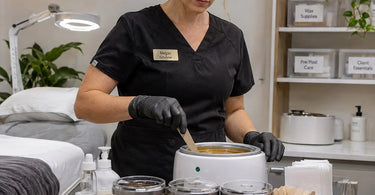
Impress clients every time... without turning your waxing room into a game of musical wax pots! Offering multiple professional waxing formulas gives estheticians the flexibility to handle different hair types, treatment areas, and client preferences. But that flexibility can become a scheduling nightmare when every appointment involves searching for the right wax, adjusting warmers, and digging through drawers for applicators. The secret is not necessarily having fewer formulas. It is creating an organized waxing station where every product has a purpose, every tool has a home, and every appointment flows smoothly from consultation to cleanup.
Whether your menu includes brow waxing, Brazilian waxing, full-body services, or specialty hair removal treatments, a smart organizational system can make your room feel more professional while reducing unnecessary movement. Your clients should experience a relaxing, efficient service, not watch you conduct an archaeological expedition through your supply cabinet.
Why Multiple Wax Formulas Can Complicate Your Schedule
Many professional waxing businesses carry several formulas because one wax does not necessarily perform equally well for every application. A flexible hard wax might be preferred for delicate facial areas, while a different formula may offer the working characteristics an esthetician likes for larger sections. Soft wax remains popular for efficient coverage of legs, arms, and other suitable treatment areas.
Problems begin when those formulas are introduced without a corresponding organization system. Containers accumulate, warmer settings become confusing, and employees start improvising their own storage methods.
Common workflow problems include selecting the wrong formula, waiting for wax to reach its proper working consistency, discovering an empty pot during a service, and walking across the room repeatedly for supplies.
Individually, these interruptions may seem minor. Repeated throughout a busy day, they can disrupt appointment timing and leave less room for proper sanitation, client consultation, and the careful application techniques that professional waxing requires.
The solution begins with organizing your inventory around how you actually perform services.
Assign Every Wax Formula a Clear Job
Before reorganizing your workstation, review every wax formula currently in use. Each product should have a defined role based on its manufacturer's instructions, application characteristics, and the services your estheticians perform.
For example, a salon might organize its working inventory into three functional categories:
- Primary hard wax: The formula regularly used for services where stripless application is appropriate, including many facial, underarm, and bikini-area treatments.
- Primary soft wax: A strip wax selected for efficient application across appropriate larger treatment areas.
- Specialty formula: A product reserved for specific applications, working preferences, or client needs, based on the manufacturer's directions.
This does not mean every salon needs exactly three formulas. A brow-focused studio might operate beautifully with two, while a full-service waxing business may need more. The important distinction is that each formula earns its place in the treatment room.
Explore Professional Stripless Hard Wax and Soft Strip Wax for Effective Salon Hair Removal when building a selection that matches your actual service menu.
Keep product instructions accessible to the entire team. Differences in heating requirements, application thickness, removal technique, and recommended use should be documented instead of left to memory.
Use a Dedicated Warmer for Each Frequently Used Formula
One of the biggest improvements a busy waxing studio can make is assigning frequently used formulas to dedicated heating equipment.
When an esthetician repeatedly empties, cleans, and refills a single warmer to accommodate different products, appointment preparation becomes unnecessarily complicated. Separate compatible warmers can reduce changeover work while helping maintain clear product identification.
Consider arranging Professional Wax Warmers for Salons & Spas in a consistent order. The most frequently used formula should occupy the easiest position to reach, with secondary formulas nearby.
For example, a station might feature a primary hard wax warmer, a soft wax warmer, and a designated specialty warmer when appointment demand justifies the additional equipment.
Each unit should be compatible with its assigned wax and operated according to the equipment and wax manufacturers' instructions. Different formulas may require different heating and working conditions, so identical dial positions should never be assumed to produce identical results.
Allow adequate preparation time before appointments, verify wax temperature and consistency according to product directions, and follow appropriate safety procedures before application. Never rush heating or increase temperature beyond recommended limits simply to recover lost preparation time.
Keeping frequently used products ready during attended operating periods, as permitted by the manufacturer's directions and applicable requirements, is far more reliable than scrambling to melt another formula after a client arrives.
Label Wax Pots So Nobody Has to Guess
A beautiful waxing room loses a little of its professional sparkle when three identical warmers contain three mystery substances.
Clearly identify each formula at its station. Labels should be easy to read without touching hot equipment or moving containers unnecessarily.
A useful workstation identification system can include the product name, wax type, designated use, and any essential preparation reminders. Keep more detailed manufacturer instructions and product records available separately.
Color coding can also help employees recognize different stations quickly. For instance, a salon might assign one color to its primary hard wax, another to soft wax, and a third to specialty products.
However, color should supplement written identification, never replace it. Different employees may interpret colors differently, and new team members should not need to memorize an elaborate system just to find the correct wax.
Make sure all original and transferred product containers are properly labeled in accordance with applicable regulations. Never place unidentified products into circulation.
Organize the Workstation Around the Order of Service
Efficient waxing room organization is about more than attractive shelves. The physical arrangement should follow the sequence of a real appointment.
Think about the typical workflow: consultation and preparation, cleansing, application, removal, finishing products, and cleanup.
Instead of grouping supplies only by package size or brand, place them where they are needed during that sequence.
A practical workstation might include a clean preparation area for Pre & Post-Waxing Products, a dedicated heating area, an organized applicator section, and a separate area for clean finishing supplies.
Waste containers and designated receptacles for used materials should be positioned conveniently while remaining separate from clean inventory.
Keep frequently needed disposable items within easy reach, but away from heat, splashes, and contamination risks. Reserve upper shelving or closed cabinets for backup inventory rather than supplies required every few minutes.
Every reach should feel deliberate. If an esthetician must walk around a treatment bed to retrieve a basic applicator, the layout deserves another look.
Separate Applicators by Formula and Treatment Area
Professional waxing requires different applicator sizes for different applications. A narrow applicator suitable for precise brow work is not necessarily the most convenient choice for covering larger body sections.
Organize Professional Wax Spatulas and Applicators for Salons & Spas into clearly identified compartments based on size or intended service.
For example, keep precision applicators, medium applicators, and larger body-waxing applicators in separate clean, protected storage sections.
Choose containers that allow staff to retrieve unused applicators without touching the remaining supply unnecessarily.
Most importantly, maintain strict single-use application procedures. A disposable applicator that has contacted a client's skin must not be dipped back into a shared wax supply. Discard used applicators immediately according to applicable requirements, even if the opposite end appears clean.
Separate organized supplies reduce confusion, but they do not replace proper infection-control practices. Waxing professionals must follow current state and local requirements, manufacturer instructions, and their establishment's sanitation protocols.
For soft wax services, position compatible Quality Wax Strips & Rolls for Effective Hair Removal alongside the appropriate clean applicators. Store strips where they remain protected and can be retrieved efficiently.
Create a Formula Selection Guide for Your Team
Even experienced estheticians can lose time when every employee follows a different product-selection routine.
A simple internal reference guide can help standardize decisions without removing professional judgment.
Your guide might identify the preferred formula for each menu service, appropriate alternatives, equipment requirements, and essential application reminders.
For example, the guide could distinguish the standard formula used for brow services from the one typically selected for larger body areas. It can also note specialty products that require additional preparation or are reserved for particular treatment circumstances.
Always evaluate the client's skin condition, relevant contraindications, service history, and applicable product guidance before proceeding. A selection chart is a workflow tool, not permission to ignore individual assessment.
When introducing a new product, schedule staff training before placing it into regular service. Manufacturers and professional wax brands such as ItalWax, Berodin, and Cirepil offer different product selections that professionals can evaluate for their particular techniques and treatment menus.
The goal is consistency without assuming that all formulas behave interchangeably.
Build Appointment Preparation Around the Booking Schedule
One of the simplest ways to prevent waxing-room delays is to review the appointment schedule before the first client arrives.
Look for services that require specialty formulas, different applicator sizes, additional treatment materials, or changes in workstation setup.
For example, if your morning includes several facial waxing appointments followed by a full-leg service, the esthetician can verify that the appropriate formulas and supplies are available before the schedule begins.
This preparation should include checking warmer condition, following approved heating procedures, inspecting clean inventory, confirming product identification, and ensuring sufficient disposable supplies are ready.
Do not assume that a warmer will reach the correct working conditions in a fixed number of minutes. Heating performance varies according to equipment, wax quantity, formula, room conditions, and manufacturer specifications.
For high-volume studios, a simple opening checklist can prevent the classic first-appointment surprise: discovering that the correct wax is still sitting on a storage shelf.
Keep Backup Inventory Close, but Not on the Counter
Bulk purchasing can support more predictable supply costs, but large quantities of wax do not belong scattered across the active treatment surface.
Divide inventory into two categories: working stock and backup stock.
Working stock includes the products needed for scheduled services and reasonable replenishment during the operating day. Backup stock belongs in a designated storage area that follows manufacturer requirements for temperature, cleanliness, packaging, and product protection.
Use clearly labeled shelves or bins to separate formulas and prevent employees from grabbing similar-looking products by mistake.
When exploring Bulk Wax Deals, consider actual consumption rates, product shelf life, storage capacity, and expected appointment demand rather than simply choosing the largest package available.
Use a first-expiring, first-out rotation method when appropriate, while respecting manufacturer storage and expiration requirements.
Check inventory regularly so partially used containers and forgotten backup stock do not turn into an expensive collection of wax-related surprises.
Set Reorder Points for Individual Formulas
Not every wax formula disappears at the same rate. Your primary Brazilian wax may move quickly, while a specialty formula could last much longer.
Using one reorder rule for every product can lead to overstocking slow-moving formulas and unexpectedly running out of popular ones.
Track how much of each wax you use over a representative period. Then consider supplier lead time, appointment volume, typical consumption, and a reasonable safety buffer.
For example, if a formula is consumed at an average of two containers per week and replenishment normally takes two weeks, the business should account for approximately four containers of expected lead-time demand, plus an appropriate safety allowance.
This is an illustrative planning calculation, not a universal stocking recommendation. Your actual reorder point should reflect your salon's usage history and supply conditions.
Review these numbers periodically, especially when service menus change or seasonal demand affects waxing appointments.
A simple inventory spreadsheet or salon management system can be enough to identify purchasing patterns without adding unnecessary administrative complexity.
Standardize Cleaning and Sanitation Between Appointments
An efficient waxing room is not simply a fast waxing room. It is a room where adequate sanitation time is already built into the schedule.
Establish clear cleaning responsibilities for each appointment transition. Used applicators and strips should be discarded promptly, soiled materials removed, and reusable equipment or contacted surfaces cleaned and disinfected as required.
Keep appropriate Professional Cleaners & Disinfectants for Salons and Spas accessible to trained staff. Follow product labels, required disinfectant contact times, equipment instructions, and applicable regulations.
Wax warmers should remain clean and properly covered when not in use. If shared wax becomes contaminated, follow applicable rules for discarding the product and cleaning and disinfecting the equipment. Heating contaminated wax does not make it acceptable to reuse.
Stock clean Hygienic Table Paper for Waxing, Spa & Massage Tables and other appropriate treatment-room disposables so resetting the bed does not require a trip to another room.
Organizing sanitation materials before the appointment begins allows staff to work methodically without cutting corners when the next client is due.
Consider Rolling Carts for Flexible Waxing Spaces
Not every salon has the luxury of a dedicated waxing room with endless counter space. Shared treatment rooms and multifunctional studios often require a more flexible approach.
A sturdy, cleanable professional cart can help organize supplies by service stage while keeping the primary work surface uncluttered.
For example, one level can hold protected clean disposables, another can accommodate appropriate finishing products, and a separate designated section can house backup materials.
Any heated equipment must be placed only on a stable, heat-resistant surface approved for its use, with proper clearance, electrical access, and protection from accidental contact or tipping. Do not place warmers on unsuitable cart surfaces or use extension arrangements that violate equipment instructions or electrical safety requirements.
For studios that alternate between facials, brows, and waxing, mobile organization can reduce setup changes without requiring a completely separate supply collection for every service.
Know When Another Wax Formula Is Worth Adding
Product variety is exciting, especially when a new formula promises a different texture, application experience, or specialty use. But more choices do not automatically create a better service menu.
Before introducing another wax, ask whether it solves a meaningful problem that existing products cannot adequately address.
Does it support a service you plan to offer? Does its working behavior suit your trained team's technique? Is there enough demand to justify additional inventory and equipment? Will it require new procedures or staff education?
New formulas should be tested and evaluated according to manufacturer instructions and professional training requirements before becoming part of standard appointments.
Consider whether the product adds operational complexity through different heating needs, storage requirements, consumables, or application techniques.
A thoughtful selection from professional waxing brands such as Waxness, Lycon, or Starpil can be useful when it fills a specific service requirement.
However, a new formula that duplicates an existing product without delivering a clear benefit may simply create another container to label, store, inventory, and explain.
Measure Whether Your New Setup Actually Saves Time
After reorganizing your waxing room, evaluate how the new system performs during real appointments.
Start with a basic time study. Record a representative sample of appointment preparation times, product retrieval interruptions, service durations, and cleanup times before making changes.
Then compare those measures after the new organization system has been implemented and employees have had time to learn it.
Pay particular attention to avoidable interruptions, such as missing applicators, unnecessary warmer changes, or repeated trips to storage.
Suppose a studio eliminates an average of two minutes of avoidable preparation and retrieval time across eight daily appointments. That represents sixteen minutes of potential daily capacity recovered. It does not automatically mean sixteen additional minutes of billable services, but it may improve scheduling flexibility and reduce pressure between appointments.
Keep client comfort, correct product selection, treatment quality, and sanitation standards as nonnegotiable measures of success.
Saving time by skipping an essential step is not efficiency. It is a problem wearing a very unconvincing disguise.
Build a Five-Minute Wax Station Reset Routine
A consistent reset routine can help prevent the treatment room from becoming disorganized as the day progresses. Five minutes can serve as an administrative planning target for checking and restocking supplies, but actual cleaning, disinfection, and equipment procedures must receive the time they require.
Create a concise checklist covering the following responsibilities:
- Remove and dispose of used single-use materials correctly.
- Clean and disinfect applicable surfaces and equipment according to required procedures and contact times.
- Confirm that clean applicators and strips are adequately stocked.
- Check that products remain properly labeled, covered, and stored.
- Verify that the correct formulas are available for upcoming appointments.
- Identify low inventory before it becomes an urgent problem.
- Return clean supplies to their assigned storage locations.
At closing, complete the additional cleaning, equipment shutdown, storage, and inventory tasks required by your facility's procedures and manufacturer guidance.
Consistency matters more than complexity. A straightforward routine that everyone follows is more valuable than an elaborate checklist nobody remembers.
Make Your Waxing Room Work as Hard as You Do
Learning how to organize multiple wax formulas without slowing down appointments is ultimately about designing a system that supports the way professional estheticians work. Dedicated equipment, visible labels, logical supply placement, thoughtful inventory planning, and consistent cleaning routines can transform a cluttered workspace into a more predictable service environment.
You do not need to eliminate every specialty wax or redesign the entire treatment room overnight. Start by identifying your most frequently used formulas, giving each one a clear purpose, and arranging essential supplies around the order of service.
Pure Spa Direct offers a broad selection of professional waxing products and salon supplies to help businesses build and maintain practical treatment-room setups. Explore Waxing Supplies for Professionals, Professional Wax Warmers, and Waxing Accessories & Removers for Professional Use when evaluating your workspace needs.
Because a busy appointment book should mean happy clients and a thriving business, not a frantic search for the missing wax spatulas. Give your formulas a home, keep your workflow consistent, and let your waxing skills take center stage.

