
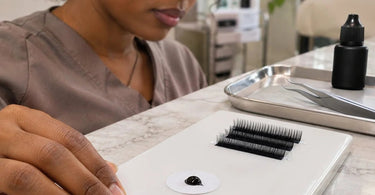
Clients rave about this pro essential... and sometimes the smallest details behind a beautiful set of lash extensions are the ones nobody notices. Take the humble adhesive drop, for example. One moment, you have a perfectly rounded little bead of lash glue sitting neatly on your palette. The next, it has spread into a mysterious puddle that seems determined to claim every available inch of workspace. Learning how to prevent lash adhesive drops from spreading across a palette can make professional lash application cleaner, more consistent, and significantly less frustrating. After all, your adhesive should be helping you create gorgeous lashes, not auditioning for a role in a miniature disaster movie.
For professional lash artists, maintaining a controlled adhesive drop is about more than keeping the workstation tidy. The shape, freshness, and placement of the adhesive can influence how easily extensions pick up the appropriate amount of product. A spreading drop can increase waste, complicate dipping, and make it harder to maintain a predictable application rhythm. Fortunately, several practical adjustments to your palette, dispensing technique, and treatment environment can help keep those drops exactly where they belong.
Why Lash Adhesive Drops Spread Across a Palette
Before solving the problem, it helps to understand why adhesive behaves differently from one surface or treatment session to another. Professional lash extension adhesives are commonly formulated with cyanoacrylate, a moisture-reactive ingredient that begins curing after exposure to humidity. However, curing and spreading are two different processes. A drop can spread because of its viscosity and the way it interacts with the palette surface, even before noticeable curing occurs.
Several variables contribute to adhesive spreading. These include the surface material and its finish, the adhesive formulation, the temperature of the product, the amount dispensed, and whether the palette is completely clean, dry, and level. A thin adhesive may naturally flow farther than a more viscous formula, while certain smooth or coated surfaces may encourage the liquid to flatten rather than remain rounded.
Humidity also matters, although primarily because it influences the adhesive curing process rather than directly determining how far the drop spreads. Understanding these differences prevents lash artists from chasing the wrong solution. Sometimes the problem is the room. Sometimes it is the palette. And sometimes the glue simply has a personality of its own.
Start With the Right Lash Adhesive Palette
Your palette provides the foundation for every adhesive drop. Choosing an appropriate surface is one of the easiest ways to improve control during a professional lash extension service.
Common options include jade stones, glass tiles, crystal palettes, disposable adhesive stickers, and specialized glue holders with individual wells. Each provides a slightly different working experience.
A traditional jade stone offers a solid, stable surface that many experienced lash technicians appreciate. Glass and crystal palettes provide smooth working areas that can be convenient to position and maintain when handled according to the manufacturer's cleaning instructions.
However, a perfectly flat surface does not guarantee that every adhesive formulation will hold a rounded shape. Some combinations of adhesive and palette materials encourage the drop to flatten. If this happens consistently, switching to a compatible disposable glue sticker or a recessed adhesive holder may provide more predictable results.
For studios offering a full menu of Premium Lash Extensions & Supplies for Pros, keeping more than one palette style available allows technicians to adapt their setup without changing their entire application routine.
Use Adhesive Stickers to Create a Consistent Working Surface
Disposable lash glue stickers are especially useful when technicians want a clean, designated location for each adhesive drop. These small accessories create a replaceable working surface and help prevent cured adhesive from accumulating directly on reusable palettes.
To use them effectively, choose stickers designed for professional lash adhesive applications. Apply the sticker to a clean, dry palette, making sure it sits flat without wrinkles or trapped air. Dispense the adhesive near the center, leaving adequate space around the drop.
Not all adhesive stickers behave identically. Their surface coatings and materials can affect how a particular glue spreads. If an adhesive still flattens excessively, compare another compatible sticker material rather than assuming every disposable surface will produce the same result.
Once the adhesive is no longer suitable for application, place a fresh drop on a new, unused area or replace the sticker as appropriate. Never dispense fresh adhesive directly onto a partially cured drop.
That little sticker may not be the most glamorous item in the lash studio, but neither is spending the afternoon scraping hardened glue off a favorite palette.
Dispense Smaller, More Controlled Adhesive Drops
One of the most common mistakes in professional lash application is dispensing more adhesive than necessary. A large drop can spread over a wider area, create additional waste, and become difficult to manage as its exposed surface begins curing.
Instead, aim for a modest, rounded bead that provides enough product for comfortable dipping without flooding the palette. The ideal amount depends on the adhesive, the holder, and the technician's working method.
Keep the bottle oriented according to its manufacturer's dispensing instructions, usually with the nozzle pointing downward and positioned close enough to the palette for controlled placement without touching the surface. Apply gentle pressure and allow the drop to form naturally. Avoid squeezing aggressively, dragging the nozzle across the palette, or placing the bottle tip into existing adhesive.
After dispensing, release pressure before lifting the bottle away. Keep the nozzle clean using the manufacturer's recommended method, then close the bottle promptly to limit unnecessary exposure to room conditions.
If the drop spreads immediately, test a smaller amount on a fresh, compatible surface. Compare the result before changing several other variables at once. A controlled test provides much better information than adjusting the room temperature, switching adhesive, and replacing the palette simultaneously.
Check Your Adhesive Viscosity and Product Condition
Viscosity describes how readily a liquid flows. It plays an important role in whether a lash adhesive forms a raised bead or spreads into a thinner layer.
Some professional adhesives are intentionally formulated with relatively low viscosity for rapid, precise application. These products may flow farther across certain surfaces than thicker formulas. That behavior does not automatically mean the adhesive is defective.
However, unexpected changes in consistency deserve attention. Adhesive that has become stringy, unusually thick, separated, or otherwise inconsistent with the manufacturer's description may no longer be performing as intended.
Before dispensing, prepare the bottle according to the product instructions. Many lash adhesives require thorough shaking to distribute their ingredients evenly. Follow the specific shaking duration and procedure recommended for your formula rather than relying on a universal rule.
Check the product's expiration information, opening date, storage requirements, and recommended period of use after opening. Never attempt to restore questionable adhesive by adding solvents, water, or other substances.
Explore professional eyelash extension glue options with viscosity, working speed, and environmental requirements suited to your experience level and treatment room.
Monitor Temperature and Humidity in the Lash Studio
Environmental conditions influence how lash adhesive behaves throughout an appointment. Temperature can affect viscosity, while moisture in the air influences the curing speed of cyanoacrylate-based formulations.
Warmer conditions can cause some adhesives to flow more readily, potentially contributing to a flatter drop. Higher humidity can accelerate curing, shortening the time a dispensed drop remains suitable for use. These effects may occur together, but they should not be confused.
A reliable digital hygrometer and room thermometer can help lash technicians monitor their working environment. Place the instruments near the actual lash workstation rather than relying entirely on a thermostat located elsewhere in the building.
Always follow the adhesive manufacturer's specified temperature and humidity ranges. Different formulas are designed for different conditions, and there is no single ideal setting that applies to every professional lash glue.
Keep palettes away from direct sunlight, heaters, air-conditioning vents, and sudden drafts. Avoid placing them where humidifier output, water spray, or other moisture sources can contact the adhesive directly.
Maintaining a consistent treatment environment supports predictable adhesive behavior and more comfortable application routines. Your lash studio should feel relaxing to clients, not like a tropical rainforest one afternoon and a desert the next.
Try Recessed Glue Holders for Better Drop Containment
If flat palettes repeatedly produce spreading problems, a glue holder with individual recessed wells may be a practical alternative.
Unlike an open, flat surface, a recessed well physically limits how far the adhesive can travel. This can be particularly useful for lower-viscosity formulas that naturally flatten when dispensed onto traditional tiles.
Several professional accessories use this design, including glue rings, multi-well adhesive holders, and specialized lash glue palettes. Some models provide multiple separated compartments, allowing technicians to move to a fresh adhesive location during longer appointments.
When selecting a holder, consider its stability, well depth, material compatibility, and whether it can be cleaned and disinfected appropriately or must be discarded after use. A holder that shifts while the technician dips an extension can create more inconvenience than it solves.
Search for lash glue holders and lash glue rings to compare options for your workstation.
Remember that a recessed well controls the physical location of the adhesive. It does not stop curing or extend the usable life of a drop indefinitely.
Keep the Palette Clean, Dry, and Level
Even a carefully chosen palette can behave unpredictably when its surface is contaminated. Residual adhesive, oils, cleaning product residue, moisture, and dust can alter the way a new drop settles.
Begin each treatment with a properly cleaned and disinfected reusable palette, following the surface manufacturer's instructions and applicable salon infection-control requirements. Allow the surface to dry completely before placing adhesive or applying a fresh disposable sticker.
Never place lash glue onto a palette that still has visible moisture or wet disinfectant residue. Avoid improvised cleaning chemicals that could damage the material or interact with the adhesive.
Inspect reusable stones and tiles for chips, scratches, or accumulated residue. Replace damaged items that can no longer be cleaned effectively.
Position the palette on a stable, level surface. Even a slight tilt can encourage a low-viscosity drop to migrate in one direction, especially when the initial bead is larger than necessary.
A dedicated lash station stocked with suitable Lash & Brow Service Supplies makes consistent setup easier across multiple appointments.
Refresh Adhesive Drops Before They Become Difficult to Work With
A beautifully rounded adhesive drop is not automatically a fresh one. Once exposed to room humidity, cyanoacrylate adhesive begins curing, and its working properties gradually change.
Many professional lash techniques involve replacing adhesive drops approximately every 15 to 20 minutes, but this is only a general starting point. The appropriate interval depends on the formula, treatment environment, and manufacturer's guidance. Some adhesives require more frequent replacement.
Watch for changes in consistency, including thickening, stringiness, surface skin formation, or unusual resistance when dipping an extension. If the adhesive behaves differently from a fresh drop, replace it rather than attempting to stretch its usefulness.
Do not add new adhesive to an old bead. Use a clean, separate dispensing location and dispose of used adhesive materials according to the product safety instructions.
For dipping, follow the adhesive manufacturer's recommended technique. Many lash professionals work from the center of a fresh bead rather than repeatedly disturbing its outer edges, which can begin changing consistency as the adhesive cures.
This approach supports more predictable pickup and helps avoid the temptation to use a drop simply because there is still plenty of liquid sitting on the palette.
Avoid Common Adhesive Palette Mistakes
Sometimes improving adhesive control means removing a few habits rather than adding more supplies.
Using too much adhesive: Oversized drops are more likely to create unnecessary spreading and waste. Dispense only what your technique requires.
Working on a contaminated surface: Residual products can influence how the adhesive settles. Always prepare a clean, dry surface.
Using the wrong palette material: Not every adhesive works equally well on every sticker, tile, or stone. Test compatible alternatives.
Ignoring room conditions: Temperature can influence adhesive flow, while humidity affects curing. Measure both rather than guessing.
Tilting the palette: A slight angle can cause a thin drop to move across the surface. Keep the workstation stable.
Reusing an old drop: Partially cured adhesive should be discarded, not refreshed by adding more glue.
Touching the nozzle to the palette: Contact can contaminate the bottle tip and interfere with controlled dispensing.
None of these corrections requires a complete workstation makeover. Often, a smaller drop, a different sticker, and a properly positioned palette are enough to make the application process feel noticeably more organized.
Build a Repeatable Lash Adhesive Station Routine
Professional consistency becomes easier when technicians follow a simple setup routine before every client.
First, verify that the lash adhesive is appropriate for the planned service and remains within its recommended usable period. Check the treatment room temperature and humidity against the product's requirements.
Next, prepare a clean, stable palette or fresh disposable holder. Confirm that its surface is completely dry and compatible with the adhesive formulation.
Shake or otherwise prepare the adhesive bottle as directed by the manufacturer. Dispense a modest drop onto the designated working area, keeping the nozzle free from contact with the surface.
Observe whether the drop maintains a workable shape. If it spreads excessively, test another compatible surface or holder before proceeding. Keep a fresh adhesive location available so the working drop can be replaced as needed.
During the appointment, monitor consistency and avoid using adhesive that has started behaving abnormally. Once the treatment is finished, dispose of used materials safely, clean reusable equipment appropriately, and prepare the station for the next client.
For studios with multiple technicians, documenting this routine can also help standardize service quality. The goal is not to make everyone use identical tools regardless of preference. It is to establish reliable practices that support clean application, product handling, and efficient treatment flow.
Professional Lash Supplies That Make Adhesive Management Easier
Thoughtful supply selection can improve workstation organization without overcomplicating the service process. Useful items include compatible adhesive palettes, disposable glue stickers, recessed glue holders, lint-free nozzle wipes, room monitoring instruments, and designated disposal supplies.
Quality lash extension tweezers also deserve attention. Well-maintained tools help technicians handle extensions precisely and avoid repeatedly disturbing the adhesive drop during pickup.
Additional supplies such as lash extension trays, eye pads, and application accessories should be organized so the technician can move comfortably between isolation, dipping, and placement without unnecessary reaching or repositioning.
Pure Spa Direct offers professional beauty supplies for spas, salons, lash studios, and other service businesses. Explore the Lash & Brow Enhancement Services for Professionals collection to find relevant service essentials and compare products suited to your team's workflow.
As a professional beauty supply distributor, Pure Spa Direct helps beauty businesses source equipment, tools, and consumables from available manufacturers. Always follow the individual product manufacturer's instructions for adhesive compatibility, handling, storage, and safe use.
Frequently Asked Questions About Spreading Lash Adhesive
Why does my lash glue spread immediately after dispensing?
Immediate spreading is often related to adhesive viscosity, palette surface characteristics, dispensing volume, or temperature. Start by testing a smaller drop on a fresh, compatible surface and checking whether the palette is level.
Does high humidity make lash adhesive spread more?
Humidity primarily affects the curing behavior of cyanoacrylate adhesives. It does not necessarily make a drop flow farther across a palette. Temperature, formulation, and surface characteristics are more directly relevant to immediate spreading.
Are glue stickers better than jade stones?
Neither is universally better. Glue stickers provide a convenient disposable surface, while jade stones offer a stable reusable base. The best option depends on adhesive compatibility, hygiene requirements, and the technician's preferred working method.
Can I use a glue ring instead of a flat palette?
Yes, provided the ring is designed for professional lash adhesive and used according to its instructions. A recessed glue ring can help contain the drop, although artists should consider comfort, stability, cleanliness, and their application technique.
Should I keep adding adhesive to the same drop?
No. Fresh adhesive should be dispensed in a clean location rather than added to a bead that has begun curing. Mixing new glue with partially cured material can make consistency and performance less predictable.
What if my adhesive suddenly becomes watery or unusually thick?
Check the product's age, storage history, preparation instructions, and current room conditions. If its behavior remains inconsistent with the manufacturer's specifications, stop using it and consult the supplier or manufacturer.
Small Adhesive Adjustments, Beautiful Professional Results
Preventing lash adhesive drops from spreading across a palette is ultimately about controlling the factors that are within your reach. The right surface, smaller dispensing amounts, proper bottle preparation, stable room conditions, and fresh adhesive drops all contribute to a more manageable application process.
For lash professionals, these adjustments can reduce wasted supplies, simplify cleanup, and help maintain a consistent workflow throughout appointments. They also allow technicians to spend less time troubleshooting mysterious glue puddles and more time concentrating on precise isolation, application, and beautiful finished lash sets.
Whether you prefer traditional jade stones, disposable adhesive stickers, or recessed glue holders, the best setup is one that works reliably with your chosen formula and professional technique. Explore professional lash and brow supplies at Pure Spa Direct to keep your workstation prepared for busy service days.
Because the only thing spreading across your lash studio should be your reputation for fabulous work, not your adhesive.
