
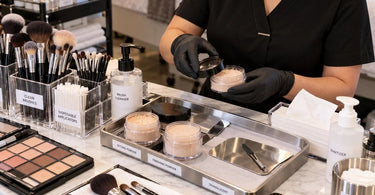
Quality drives growth with this tool, and honestly, nothing kills the vibe of a flawless makeup service faster than a loose powder explosion that turns your pristine makeup station into a dusty crime scene. You know the moment. You reach for your translucent setting powder, the lid decides to betray you, and suddenly every surface within a three-foot radius looks like it survived a flour fight. Your client is sitting there trying not to breathe too hard, your black leggings are now a weird matte beige, and you are mentally calculating how many minutes of your life you will spend wiping down every single product you own. It is not just annoying. It is a hygiene issue, a time suck, and a threat to the polished professional image you have worked so hard to build.
The good news? Loose powder chaos is entirely preventable, and you do not need to banish setting powder from your kit or develop lightning-fast ninja reflexes to keep things under control. A few smart habits, the right tools, and a workspace designed to work with you instead of against you can keep your station looking like a magazine spread instead of a dust bowl. Whether you are a mobile makeup artist, an esthetician who finishes every facial with a touch of powder, or a salon professional who juggles a dozen clients a day, keeping your station contaminant-free is not just about looking good. It is about protecting your clients, your products, and your peace of mind.
Why Loose Powder Contamination Is a Bigger Deal Than You Think
Let us get one thing straight. Loose powder is not just messy. It is a legitimate hygiene concern in a professional setting. Every time you dip a brush into a jar of setting powder and then touch it to a client's face, you are potentially introducing bacteria, oils, and dead skin cells back into that jar. If powder has spilled across your station and you are working around it, you are also spreading whatever was on the surface underneath it. In a busy salon or spa environment, where clients expect clinical-level cleanliness, visible powder dust on your workspace sends the wrong message. It says, "I did not have time to reset between appointments," even if you did.
Then there is the waste factor. Loose powder is not cheap, especially the professional-grade formulas you actually want to use on clients. Every spill is money literally floating away into the air. Over a month, those little accidents add up to real dollars lost, not to mention the time you spend cleaning instead of, you know, actually doing makeup or taking a much-deserved breath between clients. And let us not forget the retail angle. If a client sees your station looking like a powdered donut exploded, are they really going to trust your recommendation for that same setting powder as a take-home purchase? Probably not.
The Right Workspace Setup Is Your First Line of Defense
You cannot prevent loose powder from contaminating a makeup station if your makeup station itself is fighting against you. The foundation of a powder-proof workspace starts with having enough real estate to work on and a system for keeping products contained. If your station is a chaotic jumble of open palettes, loose brushes, and half-sealed jars, you are basically inviting powder to go wherever gravity takes it.
Start by evaluating your station layout. Do you have a dedicated zone for powder products that is separate from your liquid and cream products? If not, create one. Loose powder and liquids are natural enemies. The moment a drop of foundation or a smear of cream blush gets into your powder area, you have got a paste situation that is ten times harder to clean than dry powder alone. Keeping powders in their own section reduces cross-contamination and makes spills easier to contain. A well-organized setup is not just about aesthetics. It is about controlling the flow of product through your workspace.
Consider your station surface itself. Smooth, non-porous surfaces are infinitely easier to wipe down than textured ones. If your current setup has any kind of grain or texture where powder can settle into the cracks, you are going to spend way too much of your life trying to dig powder out of tiny crevices with a brush. A fresh sheet of hygienic table paper laid down before each client is a game-changer. It creates a barrier between your actual station surface and the inevitable powder fallout. When the service is done, you peel it up, toss it, and your station is instantly clean. No scrubbing, no digging, no wondering if you got every last particle. Just a fresh start for the next client.
Contain the Powder, Contain the Chaos
Here is the thing about loose powder. It does not respect boundaries. It does not care that you only opened the jar for two seconds. It will find a way to migrate across your station, onto your brushes, into your other products, and sometimes, somehow, into your shoes. The only way to win is to contain it before it ever gets a chance to escape.
First, look at your powder containers themselves. Are the lids secure? Do they actually close all the way, or are they the kind of loose-fitting lid that pops off the second you look at it wrong? If your powder jar has a shaker top with holes that are too large, powder is going to pour out faster than you can control. A container with a smaller sifter or a dial-up dispensing system gives you way more control over how much product comes out at once. You can always tap out more. You cannot put powder back in the jar once it is on your station. Well, you can, but please do not. That is how you introduce contaminants into your product.
Next, think about where you are storing your powder when it is not in immediate use. Is it sitting open on your station because you are going to need it in thirty seconds? That open jar is a powder spill waiting to happen. Get into the habit of closing the jar every single time you set it down, even if you are just reaching for a different brush. It feels tedious at first, but it becomes muscle memory faster than you would expect, and it will save you from countless tiny disasters. If you are working with multiple powder products during a single service, consider decanting a small amount into a dedicated mixing bowl or a small dish rather than working directly from the full-size jar. That way, if something gets contaminated or spilled, you are only losing a tiny bit of product, not the whole container.
And please, for the love of everything holy, do not tap your brush directly over the open powder jar. We have all done it. It feels efficient. It is not. Tap your brush into a separate area, or better yet, tap it against the edge of a small dish or the inside of the lid. The powder that falls off will land somewhere contained instead of flying back into the jar or scattering across your station like confetti at a very poorly planned party.
Master the Art of the Powder Dip (Yes, It Is an Art)
How you load your brush with loose powder has a massive impact on how much of it ends up on your station instead of on your client's face. The aggressive swirl-and-stab technique that feels satisfying in the moment is also the technique that sends powder flying in every direction. You are not trying to aerate the powder. You are trying to pick up a controlled amount of product on the bristles.
Try this instead. Tap a small amount of powder into the lid of the jar or into a separate dish. Then, gently press your brush into the powder and roll the bristles to pick up product. You will get a much more even coating on the brush, and you will avoid the powder cloud that comes from stabbing a brush into a full jar. When you are done loading, tap off the excess onto a paper towel or into a trash receptacle, not back into the jar and not across your station. It only takes a few extra seconds, and it makes a world of difference in how much powder stays where it belongs.
If you are working with a particularly fine, flyaway powder, consider using a slightly damp brush or a makeup sponge to press the powder into the skin rather than dusting it on. Pressing with a sponge or a damp brush dramatically reduces airborne powder. It also gives a more long-lasting finish, which is a nice bonus for your client. For areas where you really want to set makeup without any risk of powder migration, a pressed powder is always an option, but let us be real. For certain services and certain skin types, loose powder is just better. So it is worth learning to work with it cleanly.
Clean as You Go (Your Future Self Will Thank You)
The number one secret to preventing loose powder from contaminating your makeup station is not some fancy gadget or a magical product. It is a habit. Clean as you go. It sounds obvious, but in the middle of a busy service, when you are juggling brushes and products and trying to make sure your client's eyeliner is symmetrical, wiping down your station is probably the last thing on your mind.
Here is the thing though. A tiny wipe-down between steps takes seconds. Waiting until the end of the service to clean up a powder disaster takes minutes, and it usually happens when you are already running behind. Keep a professional cleaner or disinfectant and a lint-free cloth within arm's reach at all times. When you finish with your powder step, do a quick swipe across the surface. When you set a product down, wipe the bottom of the container before it touches your station. These micro-cleanings prevent powder from building up into the kind of mess that requires a full station overhaul. Think of it as flossing for your workspace. A little bit every day beats a painful deep clean later.
If you are working in a salon or spa where multiple professionals share a station, this becomes even more important. You do not want to inherit someone else's powder disaster, and they do not want to inherit yours. A quick wipe-down at the end of your service is just good professional citizenship. It also protects your products from picking up whatever might be lingering on the shared surface. Your disposable wipes and cotton products are your best friends here. Keep a stash handy and use them liberally. You are not being wasteful. You are being hygienic and efficient.
Storage Solutions That Actually Keep Powder Where It Belongs
How you store your loose powder products when they are not in active use matters just as much as how you handle them during a service. If your powder jars are rolling around loose in a bag or a drawer, they are going to get jostled, lids are going to loosen, and powder is going to escape. You need a storage system that keeps containers upright, secure, and separated from things that might knock them over.
A styling station cabinet with dedicated drawers and compartments is ideal because it gives every product a home. When things have a designated spot, they are less likely to get knocked around or buried under other items. If you are working from a mobile kit, consider a makeup train case with adjustable dividers. You can create a powder-specific section that keeps those jars upright and cushioned so they do not tip over in transit. The goal is to minimize the opportunities for powder to escape its container before you even open it.
For products you use constantly, having them within easy reach on your station is practical, but it needs to be done thoughtfully. A small tray or a shallow basket on your station can corral your most-used powder products so they are accessible without being scattered. When you reach for them, you are grabbing from a contained area, not fishing around a chaotic surface where one wrong move sends everything tumbling. It is a small change in setup that pays off in big ways over the course of a busy day.
The Bottom Line on Powder Prevention
Preventing loose powder from contaminating your makeup station is not about being perfect. It is about being intentional. It is about recognizing that the tiny habits you build into your daily workflow, the way you set up your space, the way you handle your products, the way you clean as you go, are what separate a station that works for you from a station that fights against you every single service.
You do not need to spend hours reorganizing or invest in a whole new setup to see a difference. Start with one change. Put down a fresh sheet of hygienic table paper before your next service. Close the powder jar every time you set it down. Tap your brush into the lid instead of over the open jar. Wipe your station surface between steps. Each of these tiny actions takes seconds, but together, they transform your workspace from a powder minefield into a clean, controlled, professional environment.
And here is the best part. When your station looks clean and organized, you feel more confident. Your clients feel more cared for. And you spend less time cleaning and more time doing the work you actually love. That is a win for everyone. So go ahead. Take a deep breath, dust off your station (literally), and build a powder-proof workflow that keeps your space, your products, and your sanity intact. Your future self, the one who is not scrubbing powder out of every crevice at the end of a long day, will thank you.
)