
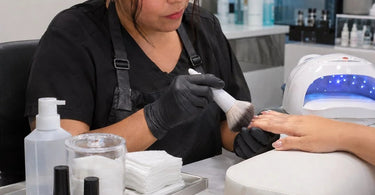
Revolutionize treatments with this game-changer: a dust-controlled finishing routine that keeps your manicures looking as smooth as your favorite glass of champagne. Learning how to prevent nail dust from settling on uncured top coat begins with investing in effective nail dust collectors, organizing your workstation, and adjusting the timing of your finishing steps. Even the most beautifully sculpted enhancements can lose their luxurious appearance when tiny particles become trapped in the final layer. Fortunately, preventing those unwanted speckles does not require rebuilding your entire salon or banning everyone from breathing near your manicure table.
For busy nail technicians, dust contamination can mean additional filing, wasted product, longer appointments, and frustrated clients. Whether your specialty is structured gel manicures, acrylic enhancements, builder gel overlays, or traditional manicures, establishing a cleaner finishing environment helps protect the quality of your work and keeps appointments moving efficiently.
Why Uncured Top Coat Attracts Nail Dust
Freshly applied top coat provides a wet surface that readily catches airborne particles. The problem is particularly noticeable with high-gloss gel finishes, where even a tiny imperfection can interrupt the reflection of light across the nail.
Fine particles generated by electric filing, hand filing, buffing, and enhancement removal can remain suspended in the surrounding air or settle on nearby equipment. Movement around the workstation can send those particles airborne again at precisely the wrong moment.
Common sources of contamination include:
- Residual filing dust on the manicure table.
- Particles trapped in towels and armrest covers.
- Dust remaining around the lateral nail folds.
- Airborne debris from neighboring nail stations.
- Dust-covered sleeves, aprons, and gloves.
- Dirty filters inside dust collection equipment.
- Lint released by cotton products and cleaning cloths.
Identifying where contamination originates makes it easier to address the problem rather than repeatedly repairing the finished manicure.
Capture Nail Dust Before It Becomes Airborne
One of the most effective improvements a nail salon can make is capturing filing dust close to its source. A professional manicure dust collector can help reduce the quantity of particles that escape into the surrounding workspace.
Position the client's hand according to the equipment manufacturer's recommendations so that filing takes place within the effective suction area. Working several inches outside that area can reduce the collector's effectiveness, even when the motor sounds impressively powerful.
When comparing dust collection equipment, consider the following features:
- Effective capture area: Choose equipment that accommodates your preferred filing positions.
- Filter accessibility: Easy access encourages consistent maintenance.
- Replacement filter availability: Make sure replacement filters can be obtained reliably.
- Noise level: Consider client comfort during longer enhancement services.
- Ergonomic design: Equipment should support comfortable hand positioning without forcing awkward wrist angles.
- Particle containment: Look for a design that minimizes dust leakage during normal operation.
Remember that a recirculating particle collector is not necessarily a substitute for compliant local exhaust ventilation or appropriate general salon ventilation. Evaluate the requirements applicable to your business and the materials used during services.
Create Separate Filing and Finishing Zones
Even a compact manicure station can benefit from dividing the available workspace into two functional areas. Think of one side as the construction zone and the other as the grand unveiling. Nobody wants construction debris at a grand unveiling.
Keep your nail files and buffers, electric filing equipment, and dust collection system within the primary preparation area. Reserve another clean area for gel polish, top coats, finishing brushes, and curing equipment.
If your salon is purchasing or replacing furniture, explore professional nail tables and manicure stations that provide adequate working space, accessible storage, and suitable equipment placement.
Clean finishing products should not share an open storage tray with dusty files or used drill bits. Keeping supplies physically separated reduces unnecessary cleaning and protects product packaging from accumulating debris.
Finish All Filing Before Opening the Top Coat
It sounds simple, but the order in which you complete manicure services can dramatically affect the appearance of the final finish. Nail technicians sometimes discover a small shaping issue after beginning their finishing application, creating a temptation to grab a file and make one quick adjustment.
Unfortunately, that quick adjustment can distribute fresh dust across several beautifully coated nails.
Establish a consistent finishing sequence:
- Complete enhancement shaping and refinement on both hands.
- Inspect the nail architecture, free edges, and sidewalls.
- Remove residual filing dust from the nails and surrounding skin.
- Clean the workstation and replace contaminated disposable coverings.
- Prepare the nail surface according to the product system instructions.
- Apply and cure color layers as required.
- Apply top coat without introducing additional filing debris.
- Cure the top coat according to the manufacturer's instructions.
This predictable order reduces interruptions and makes it easier for technicians to maintain consistent results throughout a busy appointment schedule.
Remove Hidden Dust Around the Nail Plate
Dust does not always remain conveniently visible in the center of the nail. Fine particles frequently collect along the sidewalls, around the cuticle area, underneath the free edge, and within the folds of the surrounding skin.
Use appropriate professional nail brushes and tools to remove loose debris gently while maintaining effective dust extraction. Inspect the nail from multiple angles before beginning the next application step.
Where the product system calls for cleansing, use the recommended nail cleanser and clean, lint-free nail wipes. Avoid substituting products that may leave moisturizing ingredients, oils, or incompatible residues behind.
Pay particular attention to the free edge. Particles hiding underneath the nail can transfer onto the top coat brush while sealing the edge, potentially contaminating both the manicure and the product bottle.
Choose Low-Lint Supplies for Finishing Services
Sometimes the mysterious little speck ruining a manicure is not nail dust at all. It is a fiber from a towel, cotton pad, or disposable covering that has decided to pursue a career in nail art.
Review the materials used during your finishing routine and identify which ones release visible fibers. Reserve low-lint materials for tasks performed immediately before gel application.
Professional supplies from the cotton, sponges, and wipes collection offer options for different salon applications. Select wipes specifically suited to nail preparation and finishing rather than assuming every disposable wipe performs identically.
Fresh towels should be stored in enclosed, clean areas instead of exposed shelving directly beside active filing stations. Replace dusty armrest coverings before beginning the finishing stage whenever necessary.
Manage Airflow Without Sacrificing Ventilation
Air movement plays an important role in determining where nail dust travels. A fan directed across the manicure table can redistribute particles that would otherwise remain captured or settled away from the finishing area.
Examine the relationship between your workstation, air conditioning vents, portable fans, doors, and neighboring service stations. If a strong draft consistently travels across uncured nails, consider repositioning the finishing area or having the airflow professionally evaluated.
Never solve a cosmetic dust problem by disabling required ventilation. Appropriate ventilation remains important for managing occupational exposure to nail service dust and chemical vapors.
Effective salon airflow should support contaminant removal rather than simply circulating particles between technicians. A comfortable room temperature is wonderful, but a tiny dust tornado traveling toward freshly applied top coat is considerably less charming.
Reduce Dust From Neighboring Nail Stations
Multi-technician salons face a challenge that independent nail professionals may encounter less frequently. One technician may be finishing a gel manicure while another is removing a full set of acrylic enhancements only a few feet away.
Every station performing filing services should have suitable dust control. Relying on a single collector for several active manicure tables can leave significant opportunities for cross-contamination.
Salon managers can also consider:
- Increasing separation between filing-intensive and finishing-focused stations where practical.
- Keeping shared walkways clear of dusty supplies.
- Scheduling equipment maintenance outside active finishing services.
- Establishing common expectations for workstation cleaning.
- Avoiding dry sweeping during appointments.
- Using appropriate vacuuming or damp-cleaning methods that minimize particle redistribution.
Consistent habits across the entire team are more effective than expecting one particularly organized technician to defend her manicure table against the entire salon.
Maintain Dust Collectors for Reliable Performance
A dust collector that worked beautifully when purchased may become less effective as its filters accumulate debris. Restricted airflow can reduce capture performance, leaving more dust around the manicure station.
Inspect equipment regularly and follow the manufacturer's maintenance schedule. Stock compatible nail dust collector replacement filters so technicians do not have to continue working with overloaded equipment while waiting for supplies.
Develop a maintenance routine that includes checking suction performance, inspecting filter seals, examining intake openings, and cleaning accessible surfaces. Disposable filters should be replaced as directed, while reusable components should only be cleaned using approved methods.
Avoid shaking dusty filters inside the treatment area or using compressed air to clean them near active manicure stations. Maintenance should remove contamination from the workspace, not provide it with a dramatic second entrance.
Keep Top Coat Bottles and Brushes Clean
Once dust enters a top coat bottle, contamination can affect multiple appointments. A technician may clean the workstation thoroughly but continue encountering imperfections because particles are already present inside the product.
Store professional gel top coats upright and securely closed when not in use. Avoid placing open bottles beside active filing equipment or allowing their brushes to touch dusty surfaces.
Inspect the brush and product during application. If contamination is suspected, isolate the affected bottle and follow the manufacturer's guidance rather than attempting to salvage the contents with solvents or improvised filtering methods.
For professional salons, keeping a backup bottle of frequently used top coat can prevent a contaminated product from disrupting the remainder of the day's appointments.
Minimize the Time Top Coat Remains Uncured
The longer a freshly coated nail remains exposed to airborne debris, the greater the opportunity for contamination. Prepare the curing equipment before opening the top coat so the transition from application to curing is efficient.
Position a compatible UV or LED nail curing lamp within comfortable reach of the client. Make sure the lamp is clean, functioning properly, and approved for the gel product system being used.
Work in manageable sections consistent with the manufacturer's application instructions. Avoid unnecessary delays between finishing application and curing.
Never shorten the required curing cycle to save appointment time. Proper curing is essential, and curing times and lamp compatibility vary between formulations. A surface that appears hard or glossy is not proof that the underlying gel has cured adequately.
What to Do If Dust Lands on Uncured Top Coat
Even with an excellent dust control routine, an occasional particle may find its way onto a freshly coated nail. Inspecting the finish before curing gives you an opportunity to address contamination without automatically committing to additional correction work.
If an isolated particle can be removed cleanly using a suitable uncontaminated implement, follow the product manufacturer's guidance and restore an even application before curing. Avoid touching uncured gel with bare skin.
If numerous particles are present, or removing the debris disrupts the coating, it may be necessary to remove the uncured layer and reapply it according to the gel system instructions. Protect the underlying color and surrounding skin during the correction process.
For contamination discovered after curing, use the manufacturer-approved refinement and recoating procedure. Do not assume that applying another thick layer of top coat will conceal every imperfection.
Also remember that bubbles, incompatible product residues, and application irregularities can resemble dust contamination. Repeated imperfections despite excellent dust control may indicate a different issue requiring investigation.
Build a Dedicated Manicure Finishing Kit
A designated finishing kit makes clean application supplies accessible without requiring technicians to search through drawers containing used implements and dusty equipment.
Consider assembling a kit that includes:
- Compatible professional gel top coats.
- Clean, low-lint nail wipes.
- Manufacturer-recommended nail cleansing products.
- Clean finishing implements.
- Fresh disposable workstation coverings.
- Suitable protective gloves.
- Backup top coat bottles.
- Appropriate professional cuticle oils for use after the finishing and curing process.
Store the kit in a clean, enclosed drawer or container. Keep used implements separate from clean supplies and replenish consumables before they run out.
Explore professional manicure essentials to build a finishing kit suited to your salon's most popular services.
Make Dust Control Part of Salon Sanitation
Dust removal and disinfection are related but distinct tasks. Visible debris should be removed before disinfecting appropriate hard surfaces and reusable implements according to applicable regulations and product instructions.
Use suitable professional salon cleaners and disinfectants, observing required contact times and material compatibility. Discard single-use items after service and store processed implements in a clean, protected location.
Technicians should also evaluate their protective equipment and work practices. Appropriate protective gloves and masks should be selected according to the hazards involved. Where respiratory protection is necessary, employers must meet applicable respiratory protection requirements.
A consistently clean environment supports professional service delivery while reducing opportunities for particles to migrate onto freshly applied nail products.
Track the Cost of Dust-Related Rework
Salon owners often focus on the purchase price of new equipment without considering the ongoing expense of correcting preventable finishing imperfections.
Imagine a nail technician who spends five additional minutes correcting dust contamination during three appointments each day. Across a five-day workweek, that amounts to 75 minutes of additional labor. Multiply that by several technicians, and the lost appointment capacity becomes increasingly significant.
Track the number of dust-related corrections, additional product applications, and unexpected service extensions over several weeks. Compare those observations after improving dust extraction, replacing worn filters, or reorganizing finishing supplies.
This information can help salon managers prioritize investments and evaluate whether their new routines are producing meaningful improvements.
Deliver the Glossy Finish Your Clients Expect
Preventing nail dust from settling on uncured top coat is ultimately about controlling the environment, preparing the nail carefully, and maintaining a logical service sequence. Effective dust collection, clean finishing supplies, compatible curing equipment, and thoughtful workstation organization all contribute to a smoother final appearance.
At Pure Spa Direct, we distribute professional salon supplies and equipment designed to support the everyday needs of beauty businesses. From professional gel polish and finishing products to manicure furniture, dust collection equipment, and cleaning essentials, our selection helps nail professionals build efficient service environments.
Give your finishing routine the same attention you give your shaping, color selection, and nail artistry. Your clients came for a beautiful manicure, not an accidental textured finish. Keep the sparkle intentional, the top coat smooth, and the nail dust exactly where it belongs: inside the collection system.

