
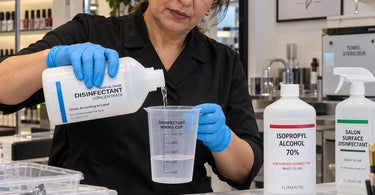
Efficiency meets quality here... until somebody turns the disinfectant station into a chemistry experiment. In a busy spa, salon, barbershop, nail studio, or waxing room, mixing errors usually happen because people are rushing, guessing at dilution, topping off containers, or assuming two products can play nicely together. The easiest place to start is with clearly organized Professional Cleaners & Disinfectants for Salons and Spas and a simple procedure that makes the correct method easier than improvising.
Disinfectants are professional tools, and just like shears, wax warmers, or facial equipment, they work best when everyone uses them exactly as intended. A concentrate that requires dilution should be prepared according to its label directions. A ready-to-use product should not suddenly become a staff member's invitation to create a custom formula. If the label does not specifically say products can be combined, the safest workplace rule is wonderfully uncomplicated: do not combine them.
Why Disinfectant Mixing Errors Happen in Busy Salons and Spas
Most incorrect mixing is not caused by someone deliberately ignoring safety. It is usually the result of speed, inconsistent training, unlabeled bottles, multiple products sitting next to one another, or the legendary salon measurement known as "that looks about right." Unfortunately, disinfectant chemistry is not impressed by confidence.
One employee may have learned to measure carefully while another was shown a shortcut years ago at a different workplace. Someone else may add concentrate to an existing container without knowing how much solution remains. Another person may see two products designed for similar surfaces and assume combining them will make a super-disinfectant. More is not automatically better, and different is definitely not automatically compatible.
The solution is to remove as much interpretation as possible from the process. Your sanitation system should tell staff which product to use, where to use it, how to prepare it, what protective equipment is appropriate, how long treated surfaces or implements must remain wet when required, and when prepared solutions need to be replaced.
Rule Number One: Follow the Product Label Every Single Time
The product label is the boss of the bottle. Staff should use the exact dilution, application method, contact time, surface restrictions, storage instructions, and safety precautions provided for that specific disinfectant. Do not create a universal house formula and assume it applies to every concentrate that enters the building.
This becomes especially important when changing brands or product types. Two disinfectants may look similar in their containers yet have completely different use directions. Train staff to stop and read rather than relying on memory. If you introduce a new disinfectant, treat it like a new procedure and review the directions with everyone before it goes into service.
Keeping your sanitation supplies together can make this process more manageable. Along with disinfectants, organize clearly designated Bottles & Jars, measuring supplies, protective equipment, and labeling materials so employees are not hunting through cabinets during a hectic turnover.
Never Mix Different Cleaning or Disinfecting Chemicals Unless the Label Specifically Allows It
This deserves its own rule because it is the mistake you want eliminated completely. Employees should never combine different cleaners or disinfectants in an attempt to improve performance unless the product directions expressly instruct them to do so. Certain chemical combinations can produce hazardous reactions or irritating vapors, while other combinations may simply interfere with the products' intended performance.
Bleach products deserve particularly careful handling. They should never be combined with ammonia or other cleaners. Rather than asking employees to memorize a giant chart of chemical combinations, establish the easier rule: one approved product, prepared exactly according to its own directions, in its own properly identified container.
That policy is easier to teach, easier to supervise, and dramatically harder to misunderstand. Nobody needs to earn an honorary chemistry degree between a brow appointment and a pedicure.
Create a Dedicated Mixing Station
If concentrates are used in your facility, designate one appropriate location for preparing them. Avoid letting employees mix solutions wherever an empty sink happens to be available. A dedicated station creates consistency and gives you control over which supplies are present.
Keep only the products and tools needed for the task at that station. Separate unrelated chemicals. Post the current manufacturer directions where employees can easily reference them, and make sure Safety Data Sheets are accessible according to your workplace procedures and applicable requirements.
Provide dedicated measuring equipment rather than expecting employees to estimate volumes using random cups, bowls, or treatment containers. Your beautiful facial mixing bowl has enough responsibilities already. Explore appropriate professional measuring cups or other measuring tools based on the directions for the products your facility actually uses.
Do Not Let Staff "Top Off" Mystery Containers
A partially filled disinfectant container can become a problem when nobody knows exactly what is inside, when it was prepared, or at what concentration. Adding fresh solution to an unknown remainder makes reliable preparation much harder.
Establish a no-topping-off rule. Empty, clean, and prepare containers according to the applicable product instructions and your facility procedures rather than pouring new solution into an unidentified leftover mixture. Staff should never have to sniff a bottle, examine its color, or ask three coworkers whether anyone remembers what is in it.
Every secondary container used for a prepared product should be labeled appropriately. Follow the product manufacturer's directions and applicable workplace labeling requirements. A useful internal system can also record preparation information such as the date or time when relevant, especially when a diluted product has a specified usable life.
Use One Product Per Clearly Defined Job Whenever Practical
Complex sanitation systems invite mistakes. If five disinfectants are sitting beside one sink and employees are expected to remember which one belongs in which container, you have created a pop quiz nobody requested.
Standardize your product selection whenever practical. Define what is used for implements, treatment surfaces, workstations, equipment surfaces, and other relevant areas based on product labeling, surface compatibility, manufacturer instructions, and regulations applicable to your business.
Centralizing purchasing can help too. When every room orders its own preferred formula, managers eventually end up supervising a miniature chemical convention. A consistent inventory of approved products from your Must-Have Supplies for Salon & Spa Business Success area can make training and replenishment more predictable.
Train Staff on Dilution, Not Just "Cleaning"
Telling a new hire where the disinfectant lives is not training. Employees responsible for preparing concentrated products should understand that dilution is part of the product's directions for use, not a suggestion.
Too little concentrate may result in a solution that does not perform as intended. Using more than directed is not a clever shortcut either; it can increase chemical exposure, residues, waste, or surface compatibility problems without providing an approved benefit. The target is the labeled concentration, not the strongest potion your team can create.
Have each employee demonstrate the preparation procedure during onboarding. Ask them to locate the directions, identify the correct measuring equipment, explain the procedure, prepare the solution under supervision when appropriate, label the container, and describe where it will be stored. Demonstration catches misunderstandings that a signature on a training sheet can miss.
Keep Safety Data Sheets Accessible
Professional environments that use hazardous chemicals may have workplace hazard communication responsibilities, including access to Safety Data Sheets and employee training. SDS information helps workers understand hazards, protective measures, storage considerations, first aid information, and what to do in the event of an accidental exposure or spill.
Do not bury this information in a mysterious binder that last appeared during the previous remodel. Staff should know where it is and how to access it. Managers should periodically review the products currently in use and make sure the corresponding information is available.
Give Staff the Right Protective Supplies
Follow each product's label and SDS when determining appropriate protection during preparation and use. Depending on the product and task, precautions may include gloves, eye protection, ventilation, or other measures.
Keep required protective supplies close enough to the mixing area that employees will actually use them. A box of gloves located on another floor is technically a supply but functionally an archaeological artifact. Stock convenient Protective Gloves & Masks for Salon and Spa Professionals and any additional protective equipment specified for the chemicals used in your workplace.
Teach the Difference Between Cleaning and Disinfecting
Another common source of confusion is treating cleaning and disinfecting as interchangeable. Cleaning removes visible soil, oils, product residue, and debris. Disinfection uses an appropriate product to kill specified microorganisms on suitable surfaces when the product is used according to its directions.
A disinfectant may require a surface or implement to be cleaned first because debris can interfere with effective disinfection. Staff also need to understand contact time. If a label requires a surface to remain visibly wet for a particular amount of time, spraying and immediately wiping it dry may not satisfy the directions.
Create station instructions that include the entire process rather than simply writing "disinfect after every client." Spell out the cleaning step, disinfectant product, application procedure, required contact time, and final handling steps relevant to that station and product.
Make Labels Impossible to Ignore
Good labels prevent the sentence every manager loves hearing: "I thought that was the other bottle." Use durable, legible identification and never rely solely on bottle color. Containers get moved, caps get switched, and memories get surprisingly creative on a busy Saturday.
Do not put disinfectants into beverage containers, food containers, or anything else that could create confusion. Use containers appropriate for the product and follow labeling requirements. If staff use spray bottles or other secondary containers, make sure the product remains clearly identifiable and the container is compatible with its contents.
Post a Simple Mixing Procedure Beside the Station
Create a short procedure specific to each concentrate your business uses. It might remind staff to read the current label, gather required protective equipment, use the designated measuring tools, prepare only the product specified, label the finished container appropriately, store the concentrate correctly, and clean the work area afterward.
A printed guide should support the manufacturer's directions, not replace them. If a manufacturer changes a formula or usage instructions, update your workplace materials immediately. Date your internal procedures so managers can tell whether the copy hanging on the wall is current or has been quietly surviving since flip phones were exciting.
Assign Responsibility Instead of Assuming "Someone" Will Handle It
One of the easiest ways to reduce mixing errors is to limit who prepares concentrates. Depending on your operation, you might assign trained opening staff, closing staff, shift leaders, or designated sanitation coordinators to prepare solutions.
This does not mean other team members should remain uninformed. Everyone who handles disinfectants needs the training appropriate to their responsibilities. However, limiting preparation to employees who have demonstrated the procedure can reduce inconsistencies and make accountability clearer.
Audit the System With Quick Spot Checks
Training once is not enough. Procedures drift over time, especially when new employees learn shortcuts from coworkers. Managers should periodically inspect storage areas, secondary containers, labels, measuring tools, and disinfectant stations.
Ask simple questions during these checks. Is every container identifiable? Are employees following current directions? Is anyone topping off old solutions? Are incompatible products stored carelessly together? Are measuring tools being used for their designated purpose? Are required protective supplies available? Are contact times understood?
Correct problems as soon as you find them. A two-minute coaching conversation today is far more pleasant than discovering six months from now that half the staff learned an incorrect procedure from the same well-meaning coworker.
Have a Plan for Mixing Mistakes and Exposure
Employees should know what to do if they accidentally combine products, spill a concentrate, splash themselves, experience irritation, or discover an unidentified solution. The correct response depends on the products involved, so your emergency procedures should be based on product labels, Safety Data Sheets, workplace requirements, and appropriate professional or emergency guidance.
If an unintended chemical mixture produces fumes or someone develops symptoms after exposure, staff should not lean over the container to investigate. Move away from the exposure as appropriate, follow the relevant safety information, and seek emergency or poison control assistance when indicated. Never attempt to neutralize an accidental mixture by adding yet another chemical unless specifically directed by qualified guidance.
Build a System That Makes the Right Choice the Easy Choice
The best sanitation program does not depend on every employee having a flawless memory during the busiest hour of the week. It uses standardized products, accessible directions, designated measuring supplies, clear labels, appropriate protective equipment, documented training, and routine supervision.
For spas and salons, that structure protects more than a cleaning routine. It supports consistent services, professional standards, staff confidence, responsible chemical handling, and a workspace that is easier to manage day after day.
Stock the supplies your team needs before the disinfectant bottle is empty and the 4:00 appointment is already checking in. From Professional Cleaners & Disinfectants for Salons and Spas and Protective Gloves & Masks to Professional Cotton, Sponges, and Wipes for Salons & Spas, keeping sanitation essentials organized and available makes following your procedure much easier. Because the goal is wonderfully boring: nobody improvises, nobody plays chemist, and everybody knows exactly what belongs in that bottle.
