
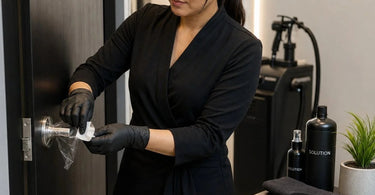
Your clients deserve better than a sticky, orange-tinted handshake. Imagine this: you just gave your client the most flawless, sun-kissed glow of their life. They are feeling like a million bucks, strutting out of your spray tan room, ready to take on the world. And then it happens. They grab the door handle, and as they walk away, you see it—a faint, tell-tale, orange smear right where their palm was. It is the unsung villain of the spray tan world. That innocent-looking smudge is a monument to the battle we wage daily against overspray. But today, we are not just cleaning up the mess; we are going to win the war and make sure those handles stay as pristine as your reputation.
Let us be real for a second. Door handles are the unsung heroes (and victims) of our salons. They see every client, every day, and they take a beating. Professional sunless tanning solutions are formulated to bond with skin, and if we are not careful, they will bond with every surface they touch. But do not panic; this is not just another chore to add to your list. With a little know-how and a few pro tips, you can keep your handles gleaming and your clients leaving without a trace of their tan behind. And if you are looking for the ultimate arsenal of professional gear, remember that Pure Spa Direct is your one-stop shop for everything you need.
Why Your Door Handles Look Like an Oompa Loompa Touched Them
So, what is the deal? Why does spray tan solution stick to metal and plastic like it is going out of style? The answer lies in science, my friend. The active ingredient in sunless tanners is DHA (dihydroxyacetone), a colorless sugar that reacts with the amino acids in the dead layer of your skin to produce a brown color . It is brilliant for our clients because it is safe and looks natural. However, this same chemical reaction happens on a molecular level. When the mist settles on a handle, the DHA sits there, and over time, with exposure to moisture and oils from countless hands, it oxidizes, turning into that tell-tale orange stain .
Not all handles are created equal, either. That beautiful brushed nickel or brass finish? Tarnishing is a chemical reaction you do not want . The natural oils from our hands can build up, attracting the sticky residue and causing it to set in even deeper . Before you know it, you are dealing with a handle that looks permanently stained. But, like any good beauty pro knows, prevention is way easier than trying to correct a disaster.
Proactive Protection: How to Stop the Stain Before It Starts
The best way to prevent tanning solution from staining door handles is to create a barrier. Think of it like applying a primer before foundation. You want to protect your surfaces just like you protect your clients' skin. Professional sunless tanning equipment can be a big investment, and a little prep goes a long way.
A game-changing secret from the pros is to use a barrier cream. Yes, the same barrier cream you use on your clients' palms, elbows, and heels to prevent them from getting too dark. You can apply a light layer of this cream to your door handles and other frequently touched surfaces. It creates a protective film that repels the DHA before it can bond. It is a simple, effective trick that can save you hours of scrubbing. Look for barrier creams like those from Norvell, which are designed to prevent over-darkening and over-staining of susceptible areas .
Another fantastic strategy is to cover your handles. There are several stylish and practical options available, from clear plastic covers that are easy to wipe down to fabric covers that can be thrown in the wash with your towels. Think of it as accessorizing your salon. You can even use disposable gloves to cover the handles during peak hours, but a more permanent cover is a much better look.
The Clean-Up Crew: How to Remove Existing Stains
Okay, so maybe you are reading this a little too late, and your handles have already seen better days. Do not worry, we have all been there. But before you start freaking out, take a deep breath. We are going to get those handles sparkling again with a few different methods, depending on how stubborn the stain is.
For general maintenance, your best friend is a gentle, professional-grade cleaner. We recommend looking into professional cleaners and disinfectants for salons and spas. Products like Barbicide are fantastic because they are hospital-grade disinfectants that are safe for stainless steel and other surfaces, and they will not stain your handles . Just mix according to the directions, spray on, and wipe off. It is that simple.
For those more stubborn stains, it is time to break out the big guns. An enzyme-based cleaner is a miracle worker for breaking down organic matter like DHA . These cleaners digest the residue, making it easy to wipe away without scratching the surface. Spray it on, let it sit for a minute or two (do not let it dry!), and then wipe it off with a clean, damp cloth. If your handle is looking a little worse for wear, a magic eraser can be effective, but be careful! On some finishes, they can be abrasive and remove the top coat .
A highly effective strategy for some metal finishes is a simple DIY paste. For brass or copper handles, a paste of equal parts salt, flour, and white vinegar works wonders . Apply it to the handle, let it sit for a few minutes, then wipe it off and buff with a soft cloth. It is chemical-free, cheap, and incredibly satisfying to watch the orange gunk disappear.
For stainless steel, you are in luck because it is the most resilient. Usually, a damp cloth with warm water will do the trick. For more stubborn marks, a mix of equal parts white vinegar and olive oil will cut through the residue and leave your handle with a brilliant shine .
Long-Term Love: Choosing the Right Products
If you are still struggling, it might be time to rethink your products. Not all tanning solutions are created equal. Some higher-quality formulas are designed to be less sticky and have better binders that reduce overspray in the first place.
Also, consider what you are using to clean your professional salon equipment and surfaces between each client. A dedicated tanning bed cleaner, formulated for acrylics and plastics, will not only keep your equipment looking new but can also be used on handles . They are often low-foam, streak-free, and designed to remove oils and residues without damaging the finish.
Prevention is always better than a cure. Regular, daily cleaning of your handles is key to preventing stains from becoming permanent. Wipe them down at the end of every shift, and you will never have to deal with a major disaster. It is just a matter of building it into your routine. And by choosing the right protective gear and maintenance products, you are not just saving yourself time; you are showing your clients that you care about every single detail of their experience. After all, a clean, professional environment is the foundation of a great salon.
Remember, your clients are paying for a luxury experience. The last thing you want them to remember is that weird sticky handle. So, take the reins, protect your surfaces, and keep everything looking as beautiful as your clients feel. You have got this.
)