
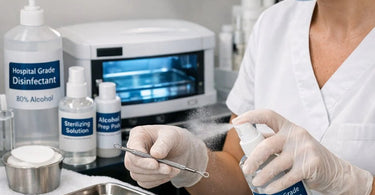
Let your work do the talking... but please, for the love of all that is holy, let your comedone extractor do the silent, sterile, squeaky-clean work it was built for. We get it—you are an artist. You sculpt brows, tame flyaways, and coax glowing skin out of tired faces. But nothing kills the vibe of a luxurious facial faster than a client spotting a funky-looking tool heading toward their T-zone. We are in the business of making people feel safe, relaxed, and beautiful, not sending them into a panic spiral about what germs might be hiding in that last blackhead. So, let us talk about the dirty (and subsequently sparkling clean) truth about sanitizing your favorite skin-smoothing sidekick.
Here at Pure Spa Direct, we distribute thousands of professional tools to spas and salons across the country. While we love providing you with the best esthetic supplies, we refuse to let you leave here without the 411 on safety. A metal comedone extractor is a marvel of modern skincare, but if it is not cleaned right, it is basically a souvenir from the last client’s pores (and nobody wants that souvenir). Let us dive into the step-by-step ritual of making that metal loop shine like a diamond and stay as sterile as a surgeon's scalpel.
Why Your Extractor Needs an Intervention (and a Bath)
First, a little tough love. If you think wiping that extractor on your smock or dipping it in a bit of alcohol is enough, we need an intervention. Professional disinfectants exist for a reason. State boards are watching. Your clients are watching. And frankly, the bacteria are laughing at you if you are only using a dry tissue. A comedone extractor touches everything: sebum, dead skin cells, sometimes a bit of blood. If you do not break down that biofilm, you are just smearing yesterday’s face on today’s client. Gross, right? We thought so. So, strap on your protective gloves, because we are going to war against the gunk.
Step 1: The Pre-Clean (Rinse Away the Evidence)
Before you can kill the germs, you have to remove the goo. Immediately after use, take that blackhead extractor tool and rinse it under warm running water. Do not just wave it around—scrub it. Using a soft brush (not your toothbrush, please) or a lint-free wipe, physically remove any visible debris. This step is crucial because organic matter (like that lovely sebum plug you just popped out) can shield microorganisms from the disinfectant. Think of it like doing the dishes before you put them in the dishwasher; you would never put a plate full of lasagna chunks in there and expect it to come out perfect. Same logic applies to your spa tools.
Step 2: The Soap Opera (Wash That Metal)
Once the chunks are gone, it is time for a bubble bath. Wash the extractor thoroughly with warm water and a low-residue detergent. Rinse it again. And again. You want that metal to be completely free of any soap film because soap residue can actually deactivate some hospital-grade disinfectants. It is like putting on hand lotion right before trying to glue something together—nothing sticks. Your professional comedone extractor should look like it just came out of the box: shiny, clean, and reflecting the overhead light like a laser beam.
Step 3: The High-Stakes Dip (Disinfect or Bust)
Here is where the magic happens. Now that your tool is physically clean, you need to chemically sterilize or high-level disinfect it. Check your local state board regulations because the requirements vary. Some boards require a steam autoclave . Others allow for immersion in an EPA-registered, bactericidal, virucidal, and fungicidal disinfectant . If you are using a wet method, fully submerge the extractor tool in the solution for the full contact time listed on the label (usually 10 minutes). Do not cheat the clock! Pulling it out early is like taking a cake out of the oven when it is still batter. It is not done, and it is going to make a mess of things later. We carry a wide range of mixing bowls and containers perfect for soaking.
Step 4: The Rinse Cycle (No Fabric Softener Needed)
If your disinfectant requires it (read the dang label!), give the tool a final rinse with sterile water, distilled water, or 70% alcohol. This removes any chemical residue that could irritate your client's freshly exfoliated skin. You have worked hard to clear those pores; do not clog them up again with chemical burns. Shake off the excess water, but do not wave it around like a conductors baton unless you want to poke someone's eye out. Which, by the way, we do not recommend for client retention.
Step 5: Air-Dry and Store (The Cleanse-cation)
Wet tools are bacteria hotels. Never put a damp comedone extractor into a closed drawer or pouch. Let it air-dry completely on a clean, covered surface or in a UV sterilizer cabinet. Once dry, store it in a sealed, clean container or a sterile pouch. This ensures that it stays perfect for the next advanced facial treatment. If you are using an autoclave, follow the manufacturer's instructions for temperature and pressure. For dry heat, we are usually looking at two hours at 340°F . Yes, two hours. Patience is a virtue, and it is also a requirement for not getting sued.
Pro-Tips for the Tool-Obsessed Professional
Let us level up your game. While you have your sanitizer out, look around your station. When was the last time you cleaned your Facial Steamer nozzle? Are your Magnifying Lights dust-free? A clean tool is only as good as the clean environment it lives in. Also, consider the material of your tools. High-quality stainless steel (like the brands we distribute) is non-porous and much easier to sanitize than cheap, junky metals. If your tools have hinges (like tweezers or extractors with moving parts), open and close them while they are submerged in the disinfectant to ensure the solution reaches every crevice. We love a good High Frequency Machine as much as the next esthetician, but even those electrodes need a proper wipe-down with the right solution.
The State Board Won't Laugh at This
We know you are busy. You have back-to-back Lash & Brow Enhancement appointments, a Hydrodermabrasion machine whirring, and a client asking about Dermaplaning. Skimping on sanitation feels like a time-saver, but a single infection control violation (or worse, a client infection) will cost you far more time and money than the 10 minutes it takes to soak a tool properly. States like Indiana, Maine, and Iowa are cracking down hard, specifically mandating that comedone extractors must be sterilized prior to use on a customer . Texas requires them to be cleaned and disinfected after every single client . Don't let your license lapse because you got lazy with the skincare products side of your kit.
Which Tools Need the VIP Treatment?
It is not just the comedone extractor that needs this love. If you are using barber supplies, cuticle oil applicators, or nail files and buffers (if they are metal and reusable), they need the same treatment. Your Pedicure Chairs/Spas need their jets flushed. Your Towel Steamers need to be wiped down to prevent mildew. Hygiene is a full-body commitment, people. And when it comes to hair removal, make sure you are using the proper ItalWax and waxing supplies to keep the skin safe, but remember those extractors are for post-waxing milia too!
But Abigail, I use a UV sterilizer!
We hear you. And we love the enthusiasm. However, UV light is great for maintaining sterility on a clean tool, but it struggles to penetrate shadows and crevices if the tool is already dirty. UV should be the final step or a storage solution, not your only line of defense against hepatitis or staph. Always, always pre-clean. Do not just wave a magic light wand over a dirty extractor and call it a day. The universe (and your local inspector) expects more from you. While you are upgrading your protocols, look into our UV Sterilizers for that final touch of security.
What About The Product Link?
Now, because we feature a specific collection, you might be wondering, What extractor should I be sanitizing? We have a stunning selection of Spa Tools & Implements that are built to last. But since we are on the topic of extraction, let us look at the tech that supports it. While we are talking about clearing pores, you cannot ignore the heavy lifter: The Machine. Specifically, the Vacuum and Spray Machine. This dynamic duo (suction and spray) is a facialists secret weapon. The suction cup acts exactly like a comedone extractor on steroids—pulling debris from the follicle without as much manual pressure . But remember, if you are using the glass cup extractor attachment on that machine, you still have to sanitize it! The same rules apply. Don't let that spray bottle get musty, either. Fill it with distilled water and astringent for a refreshing, pore-flushing follow-up .
The Final Pow-Wow
Look, running a wellness business is hard. You are tired. Your feet hurt. But cutting corners on sanitation is like putting Sugar Scrubs on a sunburn—it just makes everything worse. Treat your professional comedone extractor with the respect it deserves. Clean it. Disinfect it. Dry it. Store it safely. Your clients will trust you more. Your state board will smile upon you. And those little blackheads won't stand a chance against your safe, sterile, absolutely lethal extraction game. Now go forth and clean those loops, you beautiful germaphobe, you. And remember, if you need the tools or the cleaning solutions, we have got your back. From Compressed Sponges to Applicators & Spatulas, we are your wholesale partner in crime—the clean kind of crime.
)