
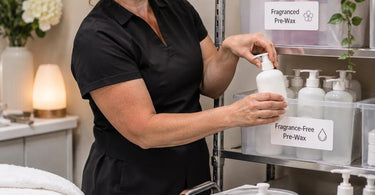
Your work deserves the best tools... and that includes a storage system that knows the difference between lavender-scented luxury and fragrance-free simplicity! For busy waxing professionals, organizing pre-wax and post-wax products is about more than keeping shelves Instagram-worthy. Separating fragranced and fragrance-free formulas helps protect product integrity, reduces dispensing mix-ups, and makes it easier to respect individual client preferences. After all, the last surprise a client needs before a Brazilian wax is discovering that the fragrance-free product they requested has accidentally become part of the salon's unofficial perfume collection.
Whether you manage a bustling waxing studio, a full-service spa, or a cozy treatment room, a thoughtful storage system can make daily operations smoother. The best part? You do not need a massive renovation, a complicated inventory program, or a storage closet worthy of a luxury department store. A few practical organization strategies can make an impressive difference.
Why Separate Fragranced and Fragrance-Free Pre-Wax Products?
Professional pre-wax products prepare the skin for hair removal. Depending on the formula, they may help remove surface oils, makeup residue, perspiration, and other impurities before waxing. Some offer pleasant botanical or cosmetic fragrances, while others are formulated without added fragrance ingredients.
Both categories have a place in a professional waxing business. Fragranced products may appeal to clients who enjoy a particular sensory experience, while fragrance-free options are important for clients who prefer to avoid added fragrance or have concerns about fragrance sensitivity.
Keeping these products organized separately offers several practical advantages:
- Clearer product identification: Estheticians can locate the appropriate formula without reading every bottle during a busy appointment.
- Reduced dispensing errors: Clearly separated supplies make accidental product substitutions less likely.
- Better inventory management: Staff can see which category needs replenishment before supplies run out.
- Improved handling practices: Dedicated supplies and organized stations help limit accidental mixing and contamination.
- More consistent client experiences: Teams can follow fragrance preferences throughout the preparation and waxing process.
One important distinction: properly sealed, intact containers do not ordinarily contaminate one another simply because they share a room or shelf. The greater operational risks involve leaking packaging, product transfer, shared dispensing equipment, spills, and selection mistakes. Separation is an additional organizational safeguard, not a substitute for proper packaging and hygiene.
Step 1: Create Clearly Defined Storage Zones
The simplest way to separate fragranced and fragrance-free pre-wax products is to establish two dedicated storage areas. These might be individual shelves, separate drawers, labeled bins, or distinct sections of a supply cabinet.
Choose a system that fits your available space and is immediately recognizable to every employee.
Zone A: Fragranced Pre-Wax Products
Reserve this area for formulas containing added fragrance ingredients, including scented cleansing lotions, preparation products, and other relevant waxing supplies.
Zone B: Fragrance-Free Pre-Wax Products
Use this space exclusively for products whose ingredient information supports their fragrance-free designation. Keep the containers closed and clearly identified.
For additional convenience, use separate washable trays or bins to contain accidental leaks. This physical separation also makes restocking faster.
For a compact treatment room, two labeled bins on the same shelving unit may be sufficient. Larger businesses can dedicate different cabinet sections to each category.
There is no universal minimum distance required between ordinary sealed fragranced and fragrance-free cosmetics. The goal is to maintain appropriate storage conditions while preventing confusion, leaks, and accidental product mixing.
Step 2: Use a Simple Color-Coding System
Color coding is one of the easiest ways to make professional storage intuitive. Even the busiest esthetician should be able to identify the correct product category at a glance.
Consider a straightforward approach:
- Blue labels: Fragrance-free pre-wax products.
- Pink labels: Fragranced pre-wax products.
- Matching shelf markers: Identify where each category belongs.
- Matching inventory labels: Help staff return products to their designated location.
Colors should supplement written labels rather than replace them. Clearly printed words remain important for accessibility and accurate identification.
Include product names, intended uses, and relevant manufacturer information on inventory labels. Never cover expiration dates, warnings, directions, or original ingredient information.
The objective is to make choosing the wrong bottle considerably harder than choosing the right one. Think of it as giving every product its own little backstage dressing room, minus the celebrity demands.
Step 3: Understand Fragrance-Free Versus Unscented
Before assigning products to separate storage zones, carefully review their labels and ingredient information.
Fragrance-free generally indicates that no fragrance ingredients have been intentionally added to provide or mask scent. However, the product may still have a natural smell from its other ingredients.
Unscented generally means that the finished product has no noticeable scent. Some unscented cosmetics contain fragrance ingredients used to mask the odors of other ingredients.
These descriptions are not automatically interchangeable.
When a client specifically requests fragrance-free products, do not assume an unscented formula meets that requirement. Check the manufacturer's ingredient information and contact the manufacturer when the designation is unclear.
Similarly, botanical extracts and essential oils are not automatically appropriate for fragrance-sensitive clients merely because they come from plants. Natural origin does not guarantee freedom from irritation or allergic reactions.
Fragrance-free products can also contain other ingredients that cause reactions, so fragrance-free should never be interpreted as universally hypoallergenic.
For professionals comparing formulations, explore ItalWax Pre-Wax and Post-Wax Products and the broader selection of professional waxing supplies. Always verify the individual product description and ingredient list before assigning it to a storage category.
Step 4: Keep Products in Their Original Containers Whenever Possible
Original packaging provides important information about a product's identity, intended use, ingredients, storage requirements, lot number, and expiration or period-after-opening guidance.
Keeping pre-wax products in their original containers helps preserve that information and reduces unnecessary handling.
If transferring a product to a smaller dispensing bottle is permitted by its manufacturer and applicable rules, use a compatible, clean container and ensure it is properly labeled. Follow applicable workplace and salon regulations, including any requirements for secondary containers.
Never transfer a fragrance-free formula into a bottle that previously held a fragranced product without manufacturer-approved cleaning and compatibility procedures. In many cases, using a new, dedicated bottle is the more reliable choice.
The same principle applies to pumps, spray heads, funnels, and other dispensing accessories.
For organization supplies, browse Bottles & Jars, selecting containers only when they are suitable for the specific formula and professional application.
Step 5: Prevent Cross-Contamination During Daily Services
Separate shelves are helpful, but they will not accomplish much if employees use the same dispensing accessories for every formula.
Establish consistent handling procedures that extend from the storage cabinet to the treatment table.
- Keep containers securely closed whenever products are not being dispensed.
- Use separate, appropriately labeled dispensing equipment for each formula.
- Never return dispensed or unused product to its original supply container.
- Use clean hands and appropriate single-use or properly disinfected implements according to product instructions and salon regulations.
- Clean spills promptly using procedures appropriate for the specific product.
- Avoid placing fragrance-free supplies on surfaces contaminated with fragranced oils, lotions, or other residues.
When using treatment-room trays, consider dedicated trays for each product category. These trays can be cleaned according to the manufacturer's instructions and applicable infection-control standards.
Disposable professional cotton, sponges, and wipes and suitable wax spatulas and applicators can help support hygienic dispensing practices when used appropriately.
Remember that fragrance separation and infection prevention are related but distinct goals. Separate storage does not replace proper sanitation, hand hygiene, or single-use applicator rules.
Step 6: Store Everything Under Appropriate Environmental Conditions
Organization matters, but temperature, moisture, sunlight, and packaging integrity also affect product quality.
Follow the storage requirements printed on each product label or provided by its manufacturer. Different pre-wax preparations may have different needs depending on their ingredients, packaging, and intended application.
As a general practice, protect products from unnecessary heat, freezing conditions, direct sunlight, and excessive moisture unless the manufacturer specifies otherwise.
Avoid storing routine cosmetic supplies beside heat-producing appliances or where containers may be exposed to frequent temperature changes.
Although professional wax warmers are essential to many waxing services, unopened preparation products should not automatically be stored directly beside them. Keep products within their recommended temperature conditions and follow equipment clearance requirements.
If a formula changes color, develops an unusual odor, separates unexpectedly, leaks, or shows other signs of deterioration, stop using it and consult the manufacturer's guidance.
Do not assume that a product remains suitable simply because its expiration date has not passed.
Step 7: Organize Inventory by Product Type and Expiration Date
Once fragranced and fragrance-free products occupy separate zones, organize each zone by product type and expiration information.
For example, place pre-wax cleansers together, keep appropriate skin preparation products in another section, and maintain a separate area for post-waxing care products.
Use a first-expiring, first-out approach wherever expiration dates are available. This means prioritizing properly stored products with the nearest valid expiration dates, provided they remain suitable for use.
For products with period-after-opening instructions, record the opening date and calculate the applicable use period according to the manufacturer's guidance.
A simple inventory record might contain:
- Product name and manufacturer.
- Fragranced or verified fragrance-free classification.
- Container size and quantity on hand.
- Lot number, when available.
- Expiration date or applicable period after opening.
- Date opened, when relevant.
- Assigned storage location.
- Reorder threshold based on actual usage.
Review these records regularly. There is little point in maintaining twelve bottles of scented cleanser if most clients request fragrance-free options, or vice versa.
For businesses purchasing larger quantities through Bulk Wax Deals, planned rotation and accurate inventory counts become especially valuable.
Step 8: Build Fragrance Preferences Into Your Client Consultation
Storage organization becomes even more useful when paired with consistent client communication.
During consultations, ask whether clients have ingredient allergies, previous cosmetic reactions, fragrance sensitivities, or preferences regarding scented products.
Document relevant information according to your business's privacy practices and use it to guide product selection.
A client who requests fragrance-free preparation may also want to avoid fragranced post-wax lotions, cleansers, or other products used during the same appointment.
Review the complete service routine rather than concentrating exclusively on the pre-wax cleanser.
For clients with reported allergies or significant previous reactions, review ingredient details carefully and follow manufacturer guidance, professional protocols, and appropriate referral procedures. Do not promise that any formula is allergy-proof.
Providing choices demonstrates attentiveness without turning a routine waxing appointment into an interrogation worthy of airport security.
Step 9: Train Every Employee to Follow the Same System
A beautifully organized cabinet is only effective when everyone knows how to use it.
Develop a brief written procedure covering product classification, storage locations, labeling, dispensing practices, and restocking responsibilities.
During onboarding, demonstrate how to:
- Identify fragranced and fragrance-free formulations using product information.
- Locate the correct product before starting a service.
- Handle dedicated dispensing equipment.
- Return containers to their assigned shelves.
- Check product dates and packaging condition.
- Report unclear labels, leaks, or suspected contamination.
Make these procedures part of routine training rather than assuming employees will figure everything out independently.
Post a small reference chart inside the storage cabinet if needed. Clear procedures reduce guesswork when several estheticians share supplies or work different shifts.
Step 10: Keep Fragranced Products Away From Your Fragrance-Free Service Setup
Some clients prefer a service environment with minimal noticeable fragrance, not just fragrance-free products applied directly to their skin.
If your business offers fragrance-conscious waxing appointments, consider additional factors such as room sprays, scented cleaning products, diffusers, and strongly fragranced cosmetics used nearby.
For example, an open essential oil diffuser beside a fragrance-free preparation station may undermine the sensory experience a fragrance-sensitive client requested, even though it does not necessarily alter the ingredients inside a sealed pre-wax bottle.
If using aromatherapy supplies elsewhere in the spa, evaluate their placement and operation with client preferences, ventilation, and product instructions in mind.
Dedicated fragrance-conscious service areas may be particularly useful for businesses that regularly accommodate clients with fragrance sensitivities.
However, do not describe a treatment room as completely fragrance-free unless the business can genuinely support that claim throughout the relevant environment and service.
Common Storage Mistakes to Avoid
Even experienced professionals can encounter preventable organizational problems. Watch for these frequent mistakes:
- Assuming unscented means fragrance-free: Check the actual formulation information.
- Relying only on bottle color: Packaging designs can change, and colors do not reliably establish ingredients.
- Using shared pumps or funnels: Residual formula can transfer between containers.
- Leaving caps loose: Improper closure increases the risk of spills, contamination, and product deterioration.
- Ignoring manufacturer storage instructions: Different formulas may require different conditions.
- Combining leftover products: Never mix partial containers simply to save shelf space.
- Overstocking treatment stations: Keep the working inventory manageable and store backup supplies appropriately.
- Skipping team training: A storage plan needs consistent execution.
These small details make an enormous difference in how smoothly a waxing room operates throughout the day.
How to Set Up a Simple Fragrance-Separated Waxing Supply Cabinet
Ready to reorganize without spending your entire afternoon playing musical bottles? Start with a practical, repeatable process.
- Empty and inspect the storage space. Check shelving, cabinet interiors, and storage bins for spills, residue, and damaged surfaces.
- Clean the area appropriately. Use suitable cleaning products and follow applicable sanitation procedures.
- Review every product label. Classify products based on verified ingredient and manufacturer information rather than scent alone.
- Create dedicated sections. Assign separate labeled shelves, drawers, or trays for fragranced and fragrance-free products.
- Check packaging and dates. Remove questionable products from service pending evaluation or disposal.
- Arrange supplies by function. Keep products used for similar tasks together within their respective fragrance categories.
- Assign dedicated dispensing accessories. Identify compatible pumps and containers so they do not move between formulas.
- Update inventory records. Record quantities, relevant dates, and reorder needs.
- Train the team. Explain how products should be selected, used, and returned.
- Review the setup regularly. Adjust shelf space based on actual client preferences and product consumption.
For a busy studio, a quick visual check at the end of each workday and a more detailed periodic inventory review can help maintain the system.
Choosing Professional Pre-Wax Products for Both Categories
Reliable storage begins with purchasing products that match the services your business offers.
When comparing pre-wax formulas, consider their intended use, compatibility with your waxing system, ingredient information, dispensing format, manufacturer instructions, and client preferences.
Some products are designed for particular waxing techniques or professional protocols, so avoid assuming that every preparation formula works identically with every type of wax.
Pure Spa Direct offers a broad selection of professional waxing supplies from manufacturers serving spas, salons, and estheticians. Explore brands such as ItalWax, Berodin, Cirepil, and Lycon while evaluating the specific preparation products suitable for your services.
For more focused browsing, search Pre-Wax Cleansers, Fragrance-Free Waxing Products, and Pre-Wax Oils.
Product availability and formulations can vary. Always verify fragrance claims and individual product specifications rather than assuming that an entire brand or collection belongs in one category.
Frequently Asked Questions About Separating Pre-Wax Products
Can fragranced and fragrance-free pre-wax products be stored in the same cabinet?
Yes, when manufacturer instructions and applicable storage requirements permit it. Use separate, clearly labeled sections and keep containers securely closed. Dedicated bins or trays offer additional protection against spills and mix-ups.
Will a sealed fragrance-free bottle absorb fragrance from nearby products?
Properly sealed, compatible packaging is designed to protect its contents. Ordinary proximity to another closed cosmetic bottle does not automatically cause fragrance contamination. Problems are more likely to involve damaged seals, leaks, unsuitable packaging, or direct transfer between products.
Should fragrance-free products have separate pumps and applicators?
Dedicated dispensing accessories are a sensible practice when reusable equipment could retain residue from another formula. Follow manufacturer instructions and applicable sanitation requirements. Use single-use applicators where required.
Is fragrance-free always better for sensitive skin?
Not necessarily. Avoiding added fragrance can be helpful for people with fragrance sensitivities, but other ingredients may still cause irritation or allergic reactions. Product selection should consider the full formulation and individual client circumstances.
How often should pre-wax storage areas be inspected?
Check working supplies routinely for correct placement, secure closures, cleanliness, and visible damage. Schedule more detailed inventory and expiration reviews according to your business volume and manufacturer requirements.
Can I use the same preparation product with every waxing system?
Not automatically. Confirm compatibility with the wax, treatment area, and manufacturer's recommended procedure. Different waxing protocols may require different skin preparation methods.
Make Better Organization Part of Every Waxing Service
Separating fragranced and fragrance-free pre-wax products is a manageable improvement that can support more consistent professional services. Clearly defined storage zones, accurate labels, dedicated dispensing equipment, appropriate environmental conditions, and thoughtful client consultations all contribute to a more organized treatment room.
The goal is not to create a storage system so complicated that employees need a treasure map to find the cleanser. It is to make the correct product easy to locate, easy to verify, and easy to use according to professional standards.
Whether you are updating a single waxing station or organizing supplies across multiple treatment rooms, Pure Spa Direct can help you explore the professional waxing supplies, pre- and post-waxing products, and spa essentials that fit your business.
Give every formula a proper home, keep your team informed, and make room for a smoother waxing experience. Your storage shelves will look better, your workflow will feel easier, and your clients will appreciate the attention to detail. Now that is what we call a beautifully organized business!
