
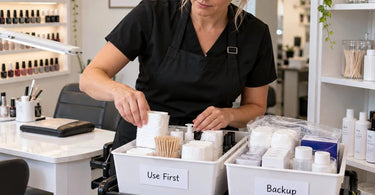
Quality wins every time... but even the most talented beauty professional cannot deliver a flawless service when the essential supplies have mysteriously disappeared. One minute, your treatment room is running like a dream. The next, someone is opening every cabinet looking for the last box of disposable gloves while a client waits patiently on the treatment table. Sound familiar? A simple two-bin inventory system for salon supplies can turn those frantic supply searches into a predictable, organized routine. Better yet, you do not need expensive software, a warehouse manager, or a spreadsheet with seventeen mysterious tabs to make it work.
For busy salons, spas, waxing studios, nail salons, barbershops, and massage practices, inventory management should support the services happening every day, not become another full-time job. The two-bin method offers a surprisingly practical solution: keep working supplies in one container, backup supplies in another, and use an empty container as your automatic reminder to reorder.
It sounds almost suspiciously simple. That is exactly why it can work so well.
What Is a Two-Bin Inventory System?
A two-bin inventory system is a visual method for managing frequently used supplies. Each product has two designated containers or storage sections. The first holds the working stock that employees use during regular appointments. The second holds reserve stock that keeps services running while replacement supplies are being ordered and delivered.
Once the first bin becomes empty, employees switch to the second bin and immediately trigger a replenishment request. When the new supplies arrive, the appropriate quantity is placed back into the inventory rotation.
The basic sequence looks like this:
- Use products from Bin One during everyday services.
- When Bin One is empty, activate the reorder signal.
- Begin using the reserve supplies in Bin Two.
- Place the replenishment order promptly.
- Restock the system when the shipment arrives.
- Repeat the process as supplies are consumed.
The empty bin becomes a visual purchasing reminder. Instead of asking employees to remember what is running low, the storage system communicates that information automatically.
Think of it as giving your supply cabinet a tiny administrative assistant. It cannot answer the phone, but it can help keep the cotton rounds from disappearing.
Why Two-Bin Inventory Works So Well for Beauty Professionals
Professional beauty businesses often consume substantial quantities of inexpensive supplies during normal appointments. These items may not individually represent major expenses, but running out can create frustrating interruptions.
Consider the daily demand for professional cotton products, wax applicators, disposable towels, facial sponges, nail files, and protective gloves. Multiple technicians may use these products throughout the day, sometimes without knowing how much stock remains elsewhere in the business.
A two-bin system helps create consistency because everyone follows the same straightforward process. Employees know where to retrieve supplies, when to report low inventory, and which products must remain available for upcoming appointments.
Additional advantages include fewer unexpected stockouts, faster supply checks, clearer purchasing responsibilities, and less time spent counting every individual disposable item.
It also makes onboarding easier. A new employee does not need to memorize an elaborate inventory procedure when the bins themselves explain what happens next.
Step 1: Choose the Right Salon Supplies for Your Two-Bin System
Start with frequently consumed products that are relatively inexpensive, easy to store, and predictable in their usage. These are usually the best candidates for a simple two-bin approach.
For waxing studios, excellent starting points include disposable wooden applicators, wax strips and rolls, protective gloves, cotton products, and selected waxing accessories.
Nail salons might begin with nail files and buffers, disposable toe separators, cotton pads, and other single-use manicure essentials.
Facial treatment rooms may benefit from organizing compressed sponges, facial wipes, disposable headbands, and applicators.
Hair salons and barbershops can use the method for neck strips, disposable processing caps, gloves, and other regularly consumed items found among professional hair salon and barber shop supplies.
Massage practices may find it helpful for disposable face cradle covers, single-use applicators, and selected hygiene consumables.
Avoid starting with expensive equipment, highly seasonal products, slow-moving retail inventory, or products with unpredictable consumption. Specialized hair colors, premium skincare formulas, and infrequently requested treatments may require more detailed inventory tracking.
Begin with five to ten dependable consumables. Once your staff understands the process, expand gradually.
Step 2: Select Two Containers and Create Clear Labels
You do not need elaborate storage equipment. Two appropriately sized containers, baskets, drawers, or clearly divided shelf compartments can work.
Choose containers that fit your existing storage space and protect the contents from contamination, damage, or environmental exposure. The original product packaging should remain intact wherever required for safe handling, identification, and storage.
Each pair of bins should have matching product information, including the product name, size or specification, supplier information, reserve quantity, and reorder instructions.
For example, a waxing station might have two labeled compartments for medium wooden applicators. One compartment is marked ACTIVE STOCK, and the second is marked RESERVE STOCK.
Color-coded labels can make the system even easier to understand. You might use green for active inventory and blue for reserve inventory, with a bright reorder card that becomes visible when the active supply is exhausted.
Keep the labels readable and consistent across stations. A beautifully organized cabinet is lovely, but nobody should need detective training to locate a cotton ball.
Step 3: Calculate How Much Reserve Stock You Actually Need
This is the most important part of setting up a dependable two-bin inventory system. Your reserve bin needs enough supplies to cover expected demand while a replenishment order is processed, shipped, received, and made available for use.
A practical starting formula is:
Reserve Stock = Average Daily Usage x Replenishment Lead Time + Safety Stock
Suppose your salon uses approximately 40 disposable applicators per business day. If replenishment normally takes five operating days, expected consumption during that period is 200 applicators.
Now add a safety allowance of 80 applicators to account for appointment fluctuations or reasonable shipping uncertainty.
Your reserve stock target becomes 280 applicators.
That means when your active stock runs out and the reorder is triggered, your reserve should contain approximately 280 applicators to support normal operations until replacements arrive.
Importantly, safety stock is not a random extra handful of supplies. It should reflect factors such as variable appointments, delivery delays, and how disruptive a stockout would be.
Also distinguish between operating days and calendar days. A supplier lead time of five calendar days is not necessarily the same as five business days of salon consumption. Build your estimate around actual ordering and delivery patterns.
Your active bin does not necessarily need to hold the same quantity as your reserve bin. Size it for a convenient replenishment cycle, storage capacity, supplier pack sizes, and the frequency at which you want purchasing signals to occur.
Step 4: Establish One Clear Reordering Rule
A two-bin system only works if an empty active bin triggers a real purchasing action. Simply moving to the reserve bin and hoping someone remembers to reorder defeats the entire purpose.
Decide exactly what employees should do when the active bin becomes empty.
For a small salon, the process might be as simple as placing a labeled reorder card into a designated purchasing tray. A manager reviews that tray daily and places the required orders.
Another option is to scan a QR code that opens an internal inventory request form or shared purchasing list.
Whichever method you choose, assign responsibility to a specific person or role. Employees should know who submits orders, who confirms they were placed, and who checks incoming deliveries.
A particularly useful safeguard is to mark each replenishment request as REQUESTED, ORDERED, or RECEIVED. This helps prevent three well-meaning employees from independently ordering the same product.
Because there is nothing quite like discovering that your salon has enough wooden spatulas to supply an entire county.
Step 5: Create a Simple Receiving and Restocking Routine
The system does not end when your shipment arrives. Proper receiving and restocking are essential for keeping the two-bin cycle accurate.
Check deliveries against the purchase order, confirm quantities, and inspect packaging before updating inventory records.
Replenish the designated bin according to your chosen rotation method. If the reserve bin has become the active bin, the newly replenished container can become the next reserve. The labels or physical positions should make the distinction obvious.
For products with expiration dates or lot requirements, use appropriate first-expiring, first-out practices rather than assuming every incoming product should automatically be used last.
Do not combine incompatible products, remove required identification, or transfer regulated chemicals into unsuitable containers simply to make the shelving look uniform.
For professional cleaners and disinfectants, follow product-label instructions, applicable storage requirements, and any relevant workplace safety rules.
Clean storage surfaces regularly and inspect containers for damage, spills, or contamination.
Step 6: Set Up Two-Bin Inventory Across Multiple Salon Stations
Busy businesses with several service areas may need more than one storage strategy. The key is to avoid creating disconnected stockpiles that nobody can track.
One approach is to maintain a central two-bin system for shared consumables. Technicians obtain supplies from that location, and the purchasing manager monitors the central reorder signals.
Another approach is to establish individual two-bin systems at high-volume workstations. This can be practical when multiple treatment rooms consume the same supplies independently.
For example, three waxing rooms may each have working stock for daily appointments, while a centrally managed reserve supports replenishment across the rooms.
However, that arrangement requires a clear rule about when the central reserve is reordered. Otherwise, technicians may repeatedly refill their stations until the shared backup suddenly disappears.
If you operate multiple locations, designate separate reorder points for each location or use a coordinated purchasing process that accounts for transfers and delivery schedules.
What About Wax, Hair Color, and Other Professional Treatment Products?
Not every product belongs in an identical two-bin setup.
High-volume professional hard wax and soft strip wax may be suitable for a two-stock arrangement when usage and replenishment timing are consistent.
However, wax is often purchased in larger packages, so the two bins may represent designated storage zones rather than literal plastic containers.
Similarly, frequently used massage creams or lotions from the massage oils, lotions, and creams category may be tracked using unopened working stock and reserve stock, provided storage requirements are respected.
For professional hair color, individual formulas can vary dramatically in demand. A salon might use certain popular shades regularly while others remain untouched for weeks. In that situation, a product-specific minimum and maximum inventory system may provide better control than equal-sized bins.
Expensive lash adhesives, specialized brow solutions, and products with relatively short shelf lives also deserve careful expiration and turnover tracking.
The goal is not to force every product into the same system. It is to choose the simplest reliable control method for each type of inventory.
How to Know Whether Your Two-Bin Inventory System Is Working
After implementing the system, review its performance rather than assuming the initial quantities will remain perfect forever.
Start by tracking how often a product runs out before replenishment arrives. A properly sized reserve should generally prevent this under normal operating conditions.
Next, review how frequently employees trigger reorder requests. If a bin empties almost immediately after restocking, the active quantity may be too small for practical purchasing.
Also pay attention to excess inventory. If products consistently sit unused for long periods, you may be storing more than the business realistically needs.
Useful measures include stockout incidents, emergency purchases, average replenishment time, expired or damaged product quantities, and time spent managing supplies.
Review your initial quantities after approximately four weeks, then adjust based on actual consumption and ordering experience.
A growing appointment book, additional technicians, or a new service menu can change demand considerably. Your inventory system should evolve with the business.
Common Two-Bin Inventory Mistakes to Avoid
Even a simple system can develop problems when employees use it inconsistently.
Using reserve supplies too early: Employees should not casually take supplies from the reserve bin while active stock remains available. The reserve exists to protect the replenishment window.
Waiting too long to reorder: The reorder request should happen immediately when the designated trigger occurs, not whenever the manager happens to remember.
Ignoring delivery delays: Reserve quantities based on unrealistic shipping assumptions can leave a salon exposed to unexpected shortages.
Mixing similar products: Different glove sizes, applicator dimensions, nail file grits, or product formulations should have distinct labels and inventory controls.
Overfilling containers: Excess stock ties up money and can increase the risk of damaged, obsolete, or expired inventory.
Skipping staff training: Every employee needs to understand the basic rule, especially when several technicians share the same supplies.
Fortunately, most of these issues can be corrected with clearer labels, a designated purchasing owner, and occasional inventory reviews.
A Practical Two-Bin Inventory Example for a Busy Waxing Studio
Imagine a waxing studio with four service rooms and a steady schedule of brow, facial, and body waxing appointments.
The owner chooses three frequently used products to pilot the system: disposable gloves, wooden applicators, and wax strips.
Each product receives labeled active and reserve storage. The team reviews typical weekly consumption and supplier delivery timing to determine appropriate quantities.
When the active applicator supply runs out, a technician places the corresponding reorder card in the purchasing tray and begins using the reserve supply.
At the end of each day, the studio manager reviews purchasing requests and confirms that required products have been ordered.
Once shipments arrive, quantities are checked and the containers are replenished according to the established rotation procedure.
The manager also keeps an eye on upcoming promotional events and unusually busy appointment periods. If the studio expects higher consumption, temporary inventory adjustments can be made before demand increases.
This small pilot establishes a repeatable process that can later be expanded to pre- and post-waxing products, appropriate treatment-room consumables, and other reliable inventory categories.
Make Salon Supply Ordering Easier With a Consistent Purchasing Routine
An organized inventory system becomes even more useful when paired with a dependable purchasing process.
Instead of placing scattered emergency orders throughout the week, consolidate replenishment requests whenever practical while still protecting the reserve stock needed during supplier lead times.
Group compatible purchases by category, compare package sizes, and consider whether bulk wax deals or larger professional supply packages make financial sense for your actual usage.
Remember that a lower unit price is not automatically a better purchase if the quantity creates unnecessary storage costs or expiration risks.
Pure Spa Direct helps beauty and wellness professionals source supplies across a wide range of service categories, including professional waxing supplies, manicure essentials, spa essentials, and professional massage and wellness products.
Having access to a broad professional supply assortment can make it easier to organize purchasing lists and identify suitable replacements when service needs change.
Frequently Asked Questions About Two-Bin Salon Inventory
Do both inventory bins need to contain the same quantity?
No. Equal-sized bins can be convenient, but the reserve quantity should reflect expected consumption during replenishment lead time plus an appropriate safety allowance. The active quantity can be chosen based on ordering frequency and storage needs.
Can a small salon use a two-bin system?
Absolutely. Small operations may benefit substantially because owners often manage purchasing alongside appointments, staffing, and client service. A few well-labeled containers can simplify daily operations.
Does a two-bin system eliminate inventory counting?
No. It reduces the need for constant manual counting of suitable consumables, but businesses should still conduct periodic checks, reconcile purchases, and monitor waste, expiration dates, and unusual consumption.
What happens if reserve stock runs out before delivery?
Review the reorder timing, supplier lead time, consumption rate, and safety allowance. A stockout indicates that at least one assumption or process needs attention. Temporary emergency purchasing may be necessary while the system is corrected.
Can salons use this approach with multiple suppliers?
Yes, provided each product has clear replenishment instructions. Different suppliers may have different lead times, minimum orders, and availability patterns, so reserve quantities should be calculated accordingly.
Start Small, Stay Organized, and Keep Your Salon Running Smoothly
A successful two-bin inventory system does not require a complete storage-room renovation or an elaborate technology investment. It requires selecting appropriate products, establishing sensible reserve quantities, labeling supplies clearly, and making sure every employee follows the same replenishment process.
Start with a handful of everyday consumables. Test the process, adjust quantities, and expand only when the system is working reliably.
The reward is not simply a prettier supply cabinet. It is fewer service interruptions, more predictable purchasing, reduced administrative frustration, and a team that can focus on delivering excellent client experiences.
Explore must-have supplies for salon and spa business success at Pure Spa Direct and build an inventory routine that works as hard as your team does.
Because the only surprise you want during a fully booked Friday is a wonderful client review, not an empty box of gloves.
