
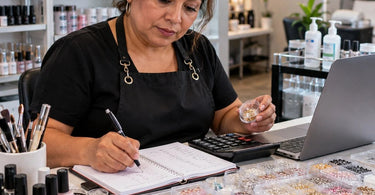
Pros choose this daily... beautiful, eye-catching Nail Art Supplies that turn an ordinary manicure into a miniature masterpiece. From dazzling rhinestones and delicate pearls to metallic charms, foil accents, and dimensional decorations, embellishments help nail professionals create the customized looks clients love. But there is one tiny detail that can quietly nibble away at your profits: knowing exactly what those embellishments cost every time you use them. Those little crystals may look innocent, but without a proper cost-tracking system, they can develop a surprisingly expensive personality.
For busy nail salons, tracking the real cost of nail art embellishments per appointment is about much more than counting rhinestones. It means understanding material consumption, product waste, application time, supporting supplies, and the difference between an attractive service price and a genuinely profitable one. A nail design that looks spectacular on Instagram should also make financial sense behind the manicure table.
The good news? You do not need a complicated accounting department or a spreadsheet worthy of a rocket scientist. With a few practical habits, consistent measurements, and a straightforward pricing formula, you can transform your nail art inventory into a predictable part of your business.
Why Nail Art Embellishment Costs Are Easy to Underestimate
Unlike a bottle of polish or a package of disposable files, nail art embellishments are often purchased in small containers, mixed assortments, or bulk packages containing dozens or hundreds of individual pieces. One container might hold inexpensive accent stones, while another contains premium crystals that cost significantly more per piece.
During a busy appointment, it is easy to select a few crystals, add another charm, sprinkle on some decorative flakes, and finish with a little extra adhesive. The design looks fabulous, the client is delighted, and everyone moves on with their day.
Unfortunately, the financial calculation often stops at the visible embellishments. The adhesive, application time, accidentally dropped pieces, product waste, and additional finishing materials may never enter the equation.
Multiply those unrecorded expenses across several appointments a day, and the total becomes meaningful. The problem is not necessarily that nail art supplies are expensive. The problem is that salons may charge for a design without accurately measuring what it takes to create it.
Professional nail art deserves professional cost accounting, even when the decorations are smaller than a grain of rice.
Start With the Actual Cost of Each Embellishment
The first step is calculating the real landed cost of individual embellishments. This means starting with the purchase price and including applicable shipping, handling, and other acquisition expenses that are not already accounted for elsewhere.
Suppose your salon purchases a container of 500 rhinestones for $20. If there are no additional acquisition costs, the basic calculation is simple:
$20 divided by 500 rhinestones = $0.04 per rhinestone.
If a client requests a design using 12 rhinestones, the direct rhinestone material cost is $0.48.
Now imagine purchasing a specialty assortment of 40 decorative charms for $24. Each charm costs $0.60. Using just four charms adds $2.40 in direct material costs before accounting for anything else.
That difference is why treating every embellishment as interchangeable can cause problems. Twelve ordinary accent stones and twelve premium decorative pieces may have dramatically different costs.
Create a simple inventory record that includes the product name, package purchase price, number of usable pieces, additional acquisition expenses, and calculated unit cost.
Whenever possible, calculate costs using actual usable quantities instead of assuming every item in a package will make it onto a client's nails. Damaged pieces, manufacturing irregularities, and unavoidable handling losses can change the effective cost.
Build a Simple Nail Art Cost Tracking Sheet
A practical spreadsheet is one of the easiest ways to manage embellishment expenses without slowing down your service schedule.
Start with separate entries for each embellishment category. Your inventory might include standard rhinestones, premium crystals, metal charms, pearls, studs, foil flakes, dried flowers, decals, and specialty dimensional accents.
For each item, record the following information:
- Product description: Identify the embellishment by type, size, color, or finish.
- Supplier or brand: Record where the product was purchased.
- Package cost: Enter the actual purchase price.
- Usable quantity: Record the number of pieces available for appointments.
- Unit cost: Divide total landed cost by usable quantity.
- Quantity used: Record how many pieces were consumed during the appointment.
- Extended cost: Multiply the unit cost by the quantity consumed.
- Waste: Record pieces that were damaged, contaminated, or otherwise unusable.
- Reorder information: Note current stock and when replenishment is needed.
If you use salon management software with inventory features, see whether it supports service-level product consumption. Otherwise, a basic spreadsheet can work beautifully.
The goal is not to create more paperwork than nail art. It is to build a system your technicians can maintain consistently.
Include Adhesives, Finishing Products, and Supporting Supplies
Rhinestones do not magically attach themselves to nails, although that would certainly make appointment scheduling interesting.
Every embellished design requires supporting products. Depending on the service, these may include rhinestone adhesive, builder gel, finishing gel, top coat, detail brushes, applicators, wipes, and other materials.
For example, suppose a $15 container of embellishment adhesive provides approximately 100 comparable applications under your salon's normal usage conditions. Your estimated adhesive cost is $0.15 per application.
If the design also consumes $0.20 in additional finishing product and $0.10 in disposable supplies, those materials contribute another $0.30.
In this example, the total supporting product cost is $0.45.
These numbers are illustrations, not universal consumption rates. Your actual costs should reflect the products, application methods, and amounts used by your technicians.
Explore professional Nail Brushes & Tools and Professional Gel Polish when evaluating the supplies that support your embellishment services.
For reusable tools, avoid charging the full purchase price to one appointment. Instead, spread the cost over a reasonable expected number of uses and include appropriate cleaning, maintenance, and replacement expenses.
Account for Waste Without Double Counting
Even careful nail professionals lose an occasional rhinestone. Tiny pieces can slip from tweezers, disappear during transfers, become contaminated, or suffer damage before application.
The important distinction is between materials successfully applied and materials actually consumed.
Suppose a technician uses 15 rhinestones in a finished design but accidentally damages two additional stones during placement. If each stone costs $0.04, the total consumption is 17 stones, or $0.68.
Recording only the 15 finished stones would produce a cost of $0.60 and understate the actual material expense by $0.08.
That might not sound significant for one appointment, but repeated losses can affect profitability over time.
There are two sensible ways to handle waste. You can record actual losses during each appointment, or you can calculate an average waste allowance using historical consumption.
For example, if your salon consistently loses approximately 5% of purchased embellishments before they can be used in services, you can incorporate that loss into the effective unit cost of usable inventory.
However, do not include the same waste twice. If your adjusted unit cost already accounts for a standard loss allowance, adding that allowance again to every appointment will exaggerate expenses.
For everyday operations, choose one method and apply it consistently.
Measure the Extra Time Nail Art Adds to Appointments
Here is where many salons discover that their most expensive embellishment is not actually a crystal. It is the additional time required to place it.
A handful of carefully arranged stones might take only a few minutes. A detailed, symmetrical design involving multiple charms, specialty gel, and intricate placement can require considerably longer.
That extra time has real value.
To estimate labor cost, establish an appropriate hourly labor rate that includes wages and applicable employer-related labor expenses. If you are an independent nail technician, assign a realistic compensation rate for your own working time.
Suppose your fully loaded labor cost is $24 per hour and an embellished design adds 15 minutes to the appointment.
$24 divided by 60 minutes = $0.40 per minute.
15 additional minutes multiplied by $0.40 = $6.00 in additional labor cost.
This calculation does not include salon overhead or profit. It simply establishes the direct cost of the extra working time.
For accurate tracking, distinguish between time spent performing the standard manicure and time specifically added by the embellishment service. If the base manicure price already covers the standard service, avoid counting that labor twice when calculating your nail art upgrade.
Some technicians work faster than others, particularly when using specialized placement tools. Track actual appointment times rather than assuming every technician completes every design at the same speed.
Calculate the Complete Cost of One Embellished Appointment
Now bring the numbers together using a realistic example.
Imagine a client requests a decorative accent design featuring rhinestones and specialty charms. The salon records the following incremental costs beyond the standard manicure:
- 12 rhinestones at $0.04 each: $0.48
- 4 specialty charms at $0.60 each: $2.40
- Embellishment adhesive: $0.15
- Additional finishing product: $0.20
- Disposable application supplies: $0.10
- Recorded damaged or wasted embellishments: $0.20
- Additional labor for 15 minutes: $6.00
Total direct incremental cost: $9.53.
This $9.53 is not the price the salon should automatically charge. It is the direct incremental cost under the assumptions in this example.
The salon must still consider relevant overhead, payment processing expenses, and the profit it wants to earn from the service.
For illustration, suppose you allocate another $1.47 of relevant overhead and transaction-related expenses to the upgrade. The fully allocated example cost becomes $11.00.
If your target gross margin on that defined cost basis is 45%, a simplified pricing calculation is:
Required selling price = $11.00 divided by (1 - 0.45) = $20.00.
At a $20 upgrade price, the difference between revenue and the defined $11 cost base is $9. This represents a 45% margin on that particular calculation, before any additional expenses not included in the cost base.
Your actual pricing must use your own labor rates, overhead structure, competitive positioning, and desired financial results.
Understand the Difference Between Markup and Margin
Markup and margin are often confused, and the difference matters when calculating nail art prices.
Markup compares profit to cost. Margin compares profit to the selling price.
For example, if an upgrade costs $10 and sells for $15, the markup is 50%, while the margin is approximately 33.3%.
Those percentages are not interchangeable.
If your goal is a particular profit margin, use a pricing formula based on that margin rather than simply adding the same percentage to your cost.
This becomes especially important for elaborate embellishment services because a small pricing mistake can be multiplied across many appointments.
Create Nail Art Pricing Tiers Based on Actual Complexity
Once you understand your average service costs, you can simplify your menu without calculating every sparkle from scratch in front of the client.
Many professional nail salons benefit from a tiered nail art menu based on material usage and application time.
Basic Accent Art: Simple designs featuring a limited number of standard rhinestones, decals, or small decorative elements. These services generally require minimal additional materials and labor.
Intermediate Embellishment Art: More detailed arrangements incorporating multiple decorative elements, specialty finishes, or several accent nails. These designs require greater material consumption and application time.
Premium Dimensional Art: Elaborate designs featuring larger crystals, multiple specialty charms, intricate arrangements, or substantial additional labor. These services should receive a higher price that reflects their actual complexity.
Custom Statement Art: Highly customized designs that require consultation, special ordering, unusual embellishments, or extensive artistic work. These are often best priced individually.
Each tier should have clear internal guidelines for expected material consumption, time requirements, and pricing.
If a client requests a design beyond the standard tier allowance, explain the additional charge before beginning the work.
Clients usually appreciate transparent pricing far more than a surprise charge after their nails are finished.
Use Product Categories to Improve Purchasing Decisions
Cost tracking also helps salons purchase supplies more intelligently.
For instance, your most frequently requested designs may use small clear rhinestones, neutral pearls, and popular metallic accents. These products may justify larger purchases because inventory turns over consistently.
Less frequently requested specialty charms may be better purchased in smaller quantities, even if the price per piece is higher.
Browse Nail Art Rhinestones to compare options for crystal-focused designs, or explore the broader selection of Nail Art Supplies when planning a varied embellishment menu.
Do not automatically assume a larger package is the better deal. The lowest unit price means little if half the inventory sits unused for months.
Consider product quality, consistent sizing, ease of application, storage requirements, client demand, and the amount of stock your salon can realistically use.
Bulk purchasing should improve your economics, not turn your supply cabinet into a museum of forgotten nail trends.
Track Inventory Consumption Alongside Appointment Records
One of the most useful habits for nail salon profitability is connecting material consumption directly to the service performed.
After completing an appointment, technicians can record the embellishment category, quantity used, additional application time, and charged upgrade price.
For example, an appointment entry might include a basic gel manicure, premium crystal accent upgrade, 18 rhinestones, two charms, and 12 additional minutes.
This information allows management to compare actual material and labor costs against the revenue collected.
Over time, you may discover that certain designs generate healthy returns while others consume significant time without producing enough revenue.
You may also find that a specific technician consistently uses more adhesive or embellishments than expected. That observation can indicate an opportunity for training, improved portion control, or a better application process rather than a problem with the technician.
Keep the system simple enough to use during a busy workday. A short entry completed immediately after the service is generally more accurate than trying to reconstruct every appointment at the end of the week.
Review the Cost of Specialty Nail Art Tools
Precision tools can influence both application time and material waste.
Rhinestone pickers, detail brushes, dotting tools, storage containers, and appropriate lighting may help technicians handle small embellishments more efficiently.
Explore professional Rhinestone Pickers, Nail Brushes & Tools, and LED Bright Lamps when evaluating your embellishment workstation.
For instance, if a precision tool reduces average application time by three minutes, that time savings can have measurable value across repeated appointments.
At a fully loaded labor cost of $24 per hour, three minutes represents $1.20 in labor expense. Across 50 comparable applications, that is $60 in potential labor savings, assuming the saved time translates into productive capacity or reduced paid labor requirements.
The actual business benefit depends on scheduling, staffing, and how that time is used.
Remember to follow manufacturer instructions for cleaning, disinfecting, maintaining, and replacing reusable implements. Proper hygiene is a necessary operating expense, not an optional cost-cutting opportunity.
Watch for Hidden Expenses in Custom Nail Art Requests
Custom nail art appointments can introduce expenses that standard service menus do not fully capture.
A client may request a specific charm color, unusual crystal size, specialty decorative material, or design that requires additional preparation before the appointment.
In those cases, remember to account for consultation time, sourcing time, special-order shipping, unused materials purchased specifically for the design, and additional application or removal requirements.
Suppose a client requests a specialty charm design requiring a $16 package that contains more pieces than the appointment will use. Whether you allocate the entire package cost to that client depends on whether the remaining pieces have realistic future value.
If the unused charms are popular and can be incorporated into other services, allocate their costs across expected future applications. If the product is an unusual one-time purchase unlikely to be reused, your custom quote may need to recover more of the acquisition expense.
Setting expectations before ordering specialty materials helps protect the salon from absorbing costs that were never included in its service price.
Review Your Most Profitable Nail Art Designs Monthly
A monthly review provides valuable insight into which services deserve more attention on your menu.
Start by comparing total nail art upgrade revenue with corresponding direct material costs, additional labor expenses, and the relevant overhead allocated to those services.
Then look at individual design categories.
Which embellishments are requested most frequently? Which designs generate the strongest contribution after direct costs? Which services regularly exceed their scheduled time? Are certain materials consistently wasted or overused?
Consider tracking a few practical performance measures:
- Average embellishment material cost per appointment.
- Average additional labor minutes per nail art upgrade.
- Average upgrade revenue per appointment.
- Average contribution after direct incremental costs.
- Embellishment waste as a percentage of purchased units.
- Inventory turnover for major embellishment categories.
- Percentage of nail art appointments exceeding estimated service time.
Look for patterns across multiple appointments rather than reacting to one unusually complicated design.
These numbers can help you refine pricing tiers, adjust purchasing quantities, update service timing, and provide focused training.
Make Cost Awareness Part of Your Salon Culture
Successful cost tracking does not mean asking technicians to become stingy with their creativity. It means giving talented professionals the information they need to create beautiful work profitably.
Teach your team the approximate cost differences between standard accents and premium embellishments. Keep frequently used supplies clearly labeled, establish reasonable usage guidelines, and explain how material consumption influences menu prices.
A well-organized Nail Table or Manicure Station also supports accurate tracking by keeping product categories separated and minimizing accidental spills or misplaced inventory.
Encourage technicians to discuss pricing expectations with clients before beginning elaborate designs. If a client wants additional crystals, larger charms, or a more intricate layout, the technician should feel comfortable explaining how those additions affect the service price.
Cost awareness should support artistic confidence rather than limit it.
Build a More Profitable Nail Art Menu With Better Supply Planning
Tracking the real cost of nail art embellishments per appointment is one of those behind-the-scenes habits that can make a meaningful difference in a professional salon. Accurate unit costs, consistent consumption records, realistic labor calculations, waste monitoring, and thoughtful pricing tiers work together to turn nail art into a measurable business opportunity.
Start small. Select your ten most frequently used embellishments, calculate their true unit costs, and track consumption across your next several nail art appointments. Use the results to compare your current pricing with the actual expenses involved.
As your records improve, expand the system to specialty charms, premium crystals, decorative finishes, and custom design requests.
Pure Spa Direct helps beauty professionals source the supplies they need to support creative, organized, and efficient services. Explore Professional Nail Care Collections, Manicure Essentials, and Nail Art Rhinestones as you plan your inventory and refine your nail art offerings.
Because your clients deserve nails that sparkle, your technicians deserve to be paid for their artistry, and your salon deserves profits that shine just as brightly. The rhinestones may be tiny, but the business decisions behind them should be anything but.

