
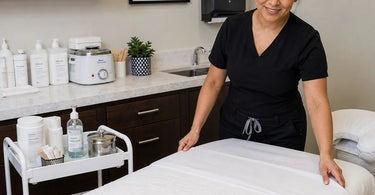
Clients rave about this pro essential... but let's be real, we've all had that moment where we walk into the treatment room to prep and our eyes lock onto a dust bunny that looks like it's been living under the massage table since the Bush administration. Or worse, you watch your star employee “clean” a wax pot by wiping it out with a dry paper towel and calling it a day. Bless their heart. They tried. But the reality is, in our world of professional wax warmers, pedicure chairs, and endless nail tools, clean isn't just a suggestion—it's the foundation of our entire business. And yet, many of us have never actually stopped to define, teach, and—most importantly—inspect what the word truly means. This blog is your friendly (and slightly snarky) guide to transforming your team from casual cleaners into sanitation superstars, because let's face it, nobody wants to be the salon that goes viral for the wrong reasons.
So, you’ve hired a fantastic team of estheticians, nail techs, and massage therapists. They are talented, personable, and their waxing techniques are smoother than a baby's bottom. But when you ask them to wipe down the facial steamer after a client, do they just do a quick swipe and call it good? We love them, we do, but the concept of “clean” is surprisingly subjective. One person's “sparkling” is another person's “that’s definitely still a little sticky.” And in the beauty industry, sticky is not the vibe we are going for. It’s time to get specific, get visual, and get your entire staff on the same page regarding hygiene standards.
Why You Need to Define What Clean Actually Looks Like
Imagine you ask two different employees to clean the nail station after a gel polish service. One wipes down the surface, tosses the trash, and puts the polish away. The other wipes down the surface, checks the magnifying lamp arm for dust, disinfects the nail files, and scrubs the pedicure basin with an EPA-approved disinfectant. Both think they did a good job. Who is right? Well, technically only one of them. But without a clear, documented standard, the first employee is just operating under a “good enough” mindset, which we all know is about as useful as a chocolate teapot .
This lack of clarity is how germs spread, infections happen, and state board violations occur. When you don't define what the finish line looks like, every employee draws their own—and you can bet some of them are drawing it in crayon. A standard isn't a suggestion; it's a non-negotiable checklist. It’s the rulebook that protects your clients, your reputation, and your license. As a distributor, we see the aftermath of subpar cleaning in the constant need for replacements, but we'd much rather see you succeed with a system that works.
Creating a “Clean” Standard That's Foolproof
In the complex ecosystem of a spa or salon, where you're juggling everything from hair bleaches to hard wax, your cleaning protocols need to be as precise as your beauty services. You can't just say “clean the room” and expect the same result from a 22-year-old fresh out of school and a 15-year veteran. You need a visual standard. We aren't just talking about a dusty memo on the breakroom fridge; we're talking about the must-have tool for your management arsenal.
Define the Levels of Clean
Not all cleans are created equal. There is the “in-between” clean, and there is the “end-of-day” or “deep” clean. You need to train your staff on the difference and document what each entails. The standard needs to be as clear as a Wood's lamp skin analysis.
- Visually Clean: This is the baseline. Are there visible chunks of wax on the warmer? Is there dust on the shelf? Are there smudges on the mirror? This is about the immediate physical appearance . For example, after a waxing service, the waxing accessories should be free of any visible residue. This level is the minimum standard for a space to look “presentable” to the next client.
- Residually Clean: This is where the science kicks in. Even if you can't see it, there are oils, creams, and biological fluids left behind. Think about cleaners and disinfectants that remove these invisible residues to prevent cross-contamination. Your staff needs to understand that “visually clean” isn't enough to stop the spread of germs or the degradation of tools.
- Microbially Clean: This is the gold standard. This means the surface has been sanitized or disinfected to a point where it's safe to use on the next client. Using proper UV sterilizers or hospital-grade disinfectants on tools ensures that any lingering microbes are eliminated, keeping everyone safe .
Build a Visual Standards Guide
Words are subjective. Pictures are objective. Create a binder or a digital folder for your staff that shows what “clean” looks like.
- Take before-and-after photos of a spa treatment room.
- Highlight what a sanitized wax spatula looks like compared to a used one.
- Show the correct setup of a clean nail table with fresh linen and organized tools.
If they can see it, they can replicate it. This is your visual anchor. When in doubt, they can flip to the standard and see exactly what is expected. It also protects you during inspections—you can show the board exactly how you train your staff .
How to Train Your Staff on Sanitation Protocols
You’ve got the standards, now comes the fun part: training people who think a quick spray of water is a deep clean. It’s time to move beyond the classic “watch me and copy me” method and build an actual infection control course for your specific business. This doesn’t have to be boring, and it absolutely must be mandatory.
Make it Structured, Not Chaotic
Throwing a new hire into a busy Saturday shift and hoping they absorb the cleaning routine is a recipe for disaster. Build a structured program .
- Company Induction: Beyond the uniform, this is where you lay down the law. This is who we are, this is how we serve, and this is how we keep things clean.
- Service Overview: Tailor the training to their specific role. A nail tech has very different cleaning needs than a hair stylist. A waxer's cleaning process is vastly different from a massage therapist’s.
- Shadow Shifts: Pair your new recruit with your most obsessive cleaner. Let them watch the master at work, learning the little hacks that make the difference between a spotless station and a passable one.
- Sign-Off: Don't just hope they got it. Have a checklist for the trainer to sign off on, proving the newbie can clean a towel steamer or a hot stone heater to your standard .
Teach the “Why,” Not Just the “How”
If you just tell someone to wipe down the high frequency machine because “I said so,” they will comply—slowly and poorly. If you explain that failing to disinfect the machine can lead to bacteria buildup that causes breakouts, they will comply—quickly and thoroughly. Teach the science. Explain the risks of cross-contamination between clients.
We all know the industry is evolving, and clients are more educated than ever about hygiene. A 2025 article on contamination control stressed that operators must be qualified to perform visually clean assessments, taking into account lighting, surface condition, and even their own visual acuity . Point out to your staff that they are the instrument of measurement, and they need to be calibrated to your standards. This makes them feel like professionals, not just people who mop floors.
Combatting the “Good Enough” Mindset
This is the silent killer of sanitation. We've all seen it: the employee who thinks that because the room looks okay, it is okay. The expert in this area, a commercial cleaning consultant, coined it the “Toxic Mentality of Good Enough”—where staff view any improvement as sufficient simply because it’s better than the starting point .
If a massage table is covered in oil stains and sheet lint, and someone wipes it down but leaves a smudge, they might think, “Well, at least it's not as bad as before.” We have to break this mindset. To overcome this, you need to be the Queen or King of Feedback.
- Checklists are your friend: Make them use a checklist for every clean. It's much harder to mentally check out when you are physically checking boxes. You can have a simple checklist for your spa bedding or a more complex one for your chiropractic equipment.
- Regular Inspections: Don't just inspect at the end of the day. Do random spot checks. Use a white glove—or, if you want to be really high-tech, an ATP testing swab to check for organic residue. This sends a clear message: you are paying attention .
- Celebrate Wins: When someone nails the clean, shout it from the rooftops. Give them a shoutout in the group chat, a free coffee, or the coveted “Cleanest Station” award. Positive reinforcement creates a culture of pride.
Leverage Your Tools and Products
Your cleaning is only as good as your supplies. You can't train a team on what clean looks like if they don't have the right tools to get there. As the one-stop-shop for all things spa, we are your best resource.
- Hygienic Table Paper: The simplest way to ensure a fresh surface for every client. We have a full collection to make restocking easy.
- Industrial-Grade Disinfectants: You need products that kill the germs that matter. We offer a range of professional cleaners that your staff can rely on.
- Protection for Your Staff: A clean spa starts with clean hands. Ensure your team has protective gloves and masks to keep themselves safe while they scrub.
The training must extend to how to use these supplies effectively. Do your staff know the proper dwell time for a disinfectant to actually work? This isn't common knowledge, and it's why you need to make the training a core part of your onboarding and professional development . The goal isn't to perform a clean; it's to validate that the clean was effective .
Make Hygiene a Part of Your Brand Identity
Finally, don't hide your cleanliness under a bushel! Your dedication to sanitation is a marketing tool. When clients see you meticulously clean the hair styling tools or sanitize the lash and brow supplies in front of them, they feel safe. They know they are in good hands. This level of transparency builds trust and encourages loyalty.
Showcase your training in your hiring process. Let potential employees know that your standards are high and you have the system to back it up. This attracts the type of A-players who take pride in their work and are willing to go the extra mile to keep the space sparkling.
Running a spa or salon is a work of art, and the canvas is your space. Train your staff to see clean not as a chore, but as the very first step to a perfect service. When you define “clean,” teach it diligently, and inspect it routinely, you are protecting your clients, protecting your staff, and protecting the pristine reputation of your beautiful brand. Now go forth and sanitize!
