
Better solutions, better outcomes. Let’s be real, bestie: there is nothing quite like the panic of watching a perfect, glassy-smooth keratin treatment slowly turn into a poofy, cloud-like disappointment right before your eyes. You did everything right. You used the expensive product, you followed the ironing technique to a T, and you even gave your client the lecture about not washing their hair for three days. And yet, Mother Nature walked right through your salon door, sat down in your chair, and laughed. That villain? Humidity. If your salon specializes in frizz-taming miracles, you need to become a master of the atmosphere. We aren’t just hairstylists; we are indoor climate engineers now. Grab your professional hair brushes and hold onto your straighteners, because we are about to dive deep into the science of sweat, steam, and silky strands.
First, let’s talk about why keratin treatments are such divas when it comes to the weather. Keratin works by bonding to the hair cuticle to fill in the porous gaps where frizz lives. It’s a protein seal. When the air is too dry, the hair loses moisture too quickly, and the treatment can become brittle and snap. When the air is too wet, the hair swells up like a sponge, lifting that seal right off and waving goodbye to your hard work. You need that perfect Goldilocks zone of humidity. Not too much, not too little. Most manufacturers recommend a relative humidity (RH) level between 40% and 60% during application and the curing process. Anything above 70%? You might as well be ironing in a sauna. Anything below 30%? Static electricity central.
So, how do you wrestle a ghost (aka humidity) into submission? You need hardware. You need a hygienic table paper to catch the drips, but more importantly, you need air management tools. First up on the chopping block: the Dehumidifier. If you live in Florida (we see you!), the Gulf, or literally anywhere east of the Mississippi, you need one of these bad boys in the treatment room. Keep it running while you apply the product to suck that sticky, curling-agent moisture out of the air.
Conversely, if you live in Arizona or a high-altitude desert, you need a Humidifier. Yes, you read that right. If the air is too thirsty, it will literally pull the water out of your keratin solution before it bonds. A cool mist humidifier near the station keeps the cuticle calm and open for absorption.
Now, I know what you’re thinking. “Kelly, that sounds expensive.” Honey, replacing a ruined keratin treatment because the weather changed is expensive. Refunding a client because their $300 smooth-out lasted two weeks is expensive. Losing a regular to the salon down the street who has a climate-controlled room is expensive. Investing in a $200 dehumidifier? That’s a steal.
Your Salon’s Hidden Humidity Culprits
Before you run out and buy a giant machine, let’s look at the obvious suspects in your own salon. You might be creating the humidity problem yourself! If you have a towel steamer located right next to your keratin application chair, move it. That thing is a dragon breathing hot vapor directly into your work zone. Same goes for your facial steamers. We love them for extractions, but they are enemy number one for keratin. Keep the steamers in the facial treatment room and the keratin station in a dry zone.
Also, check your ventilation. If you do soft strip wax in the same open area, the heat from professional wax warmers can create a microclimate of heat. Heat rises, carrying moisture with it. Keep your ItalWax station on the opposite side of the room, or schedule waxing and keratin services at different times of the day.
The Holy Grail: The Drying & Curing Suite
If you are really serious about being the keratin queen of your town, you need to set up a dedicated curing suite. This doesn’t have to be a separate room, but it should be a corner of the salon that is sealed off by a curtain or partition. In this suite, you are going to place your secret weapons.
First, invest in a quality hot stone heater? No, silly, not for massages! I’m talking about using a Hair Steamer strategically. Wait, didn’t I just say steam is the enemy? For processing, yes. But for the initial application, a controlled hooded steamer under a dryer helps the keratin penetrate deeply. The trick is to follow the steam with a blast of cool, dry air from a professional hair dryer on a cold setting to lock it in. You need a high-quality professional salon equipment setup that allows you to switch from heat to cool instantly.
You also cannot forget about your tools. The flat iron you use for sealing is crucial. If your iron has hot spots or inconsistent heat, the keratin won’t seal evenly, creating weak spots where humidity will attack first. Pair your technique with a premium hair care shampoo specifically designed for keratin-treated hair to send home with the client.
The Client Take-Home Battle Plan
You can control your salon, but you can’t follow them into their steamy bathroom. (Please don’t; that’s a HIPAA violation and just creepy). You need to retail them the armor they need. Explain to them that a high-quality towel is their best friend. Microfiber towels absorb water faster and rough towels create friction, which lifts the keratin. Sell them a professional cleaner? No, but similar logic: their shower head is the enemy. Recommend a filtered shower head to remove chlorine and hard minerals that strip keratin.
Encourage them to avoid salon quality salt sprays and ocean water for at least two weeks. While sugar scrubs are great for legs, salt on the head is a keratin killer. And for the love of all that is holy, tell them to stop touching their hair while it air-dries. Frizz is just wet hair that got bored and decided to misbehave.
Monitoring the Madness: Thermometers and Hygrometers
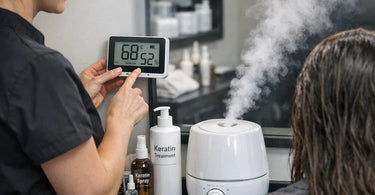
You can’t fix what you don’t measure. You need a digital Hygrometer on your station. They cost about ten bucks. Place it right next your mixing bowls and bottles and jars of product. Check it before you mix your formula. If it’s over 60% RH, grab the dehumidifier. If it’s under 30%, grab the humidifier.
This also helps with your other services. Ever notice how your professional gel polish gets sticky or doesn’t cure right? Humidity affects that too! Same with acrylic nail supplies. A dry environment makes acrylic dry too fast (cracking), and a wet environment makes it not dry at all (smudging). Managing the air quality in your nail salon furniture area helps your nail techs stop yelling at their monomer, too.
If you run a busy professional hair salon and barber shop supplies business, you likely have a Barco Uniforms budget. You invest in Boca Terry robes and high-end spa body treatments. Don’t let your equipment fall behind. A Serenity Essentials vibe is great, but if the air feels like a swamp, nobody feels serene.
For those of you doing lash and brow service supplies, listen up. Humidity destroys lash glue adhesion. If you are doing brow lamination supplies and the humidity spikes, the perming solution works too fast or too slow. The same science applies. Keep that hygienic paper fresh and the air crisp.
Equipment Maintenance: Don’t Let Dust Win
You bought the Earthlite massage tables and the fancy Equipro machines. But when did you last clean the filters on your HVAC unit or your dehumidifier? A dirty filter lowers efficiency and blows mold spores into the air. Those spores land on the keratin solution. Ew. And also ineffective.
Clean your wax spatulas, sure, but also schedule a monthly deep clean for your vents. Use professional cleaners and disinfectants for salons and spas on your air conditioning units. Your lungs will thank you, and your keratin results will too.
Seasonal Adjustments for the Keratin Queen
You change your salon and spa bedding with the seasons (flannel in winter, percale in summer), so change your humidity strategy.
Summer/Wet Season: Keep the AC blasting. AC naturally dehumidifies. Supplement with a portable dehumidifier near the chair. Keep windows CLOSED. Opening a window in August is an invitation for frizz. Store your compressed sponges and professional cotton products in an airtight container so they don’t absorb ambient moisture.
Winter/Dry Season: Turn on the humidifier. If you don’t have one, place a bowl of water near the radiator. Use a spray bottle with distilled water to lightly mist the air (not the client!) to bring the RH up to 40%. Static electricity will ruin your blowout faster than a rainstorm. Keep a Wet Brush handy to smooth things out without snagging.
And please, for the sake of your arms, do not over-iron. If the air is dry, you don’t need to go over the section 8 times. 5 times is fine. If the air is wet, you might need 10 passes. Listen to the hair. It will tell you when it stops squeaking.
The Ultimate Pure Spa Direct HVAC Shopping List
If you take nothing else away from this, remember this shopping list for your wishlist:
1. A quality hygrometer. Don’t guess. Know.
2. A 30-pint dehumidifier. For the sticky months.
3. A cool mist humidifier. For the dry months.
4. High-quality towels (Boca Terry is a fave) to reduce friction.
5. A good vent fan. To suck out steam from towel warmers.
6. Professional hair brushes with boar bristles. They distribute natural oils and smooth the cuticle better than plastic, which reduces the impact of humidity changes.
Look, running a waxing supplies for professionals business or a keratin studio is hard. You are basically a chemist, a physicist, and a therapist all rolled into one. But when you nail the humidity? When a client walks out into a rainstorm and comes back the next week with hair so straight it looks like a mirror? They will name their firstborn after you. Okay, maybe not, but they will tip you fat.
Managing humidity isn’t sexy. It isn’t as fun as buying new nail art rhinestones or testing ItalWax pre/post products. But it is the invisible magic that separates a good service from a legendary one. So go forth, control your climate, and keep that frizz in the dumpster where it belongs. You’ve got this!
)