
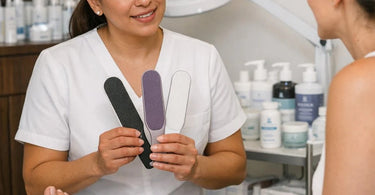
Stay ahead, stock this: the secret to a flawless pedicure isn't just in the polish—it is in the prep. And nothing screams 'unfinished business' like a rough heel snagging a fresh pair of stockings. As beauty professionals, we know the struggle is real. One client walks in wearing combat boots with heels that look like they have survived a zombie apocalypse, and the next slides in wearing flip-flops with skin soft as a baby's bottom. You cannot treat all dogs like cats, and you absolutely cannot treat all callus types with the same gritty mentality. Using the wrong foot file on the wrong foot is like using a chainsaw to perform surgery—effective, sure, but highly inappropriate and bound to end in tears (or, in this case, lawsuit). Let us crack the code on grit and get those tootsies ready for their close-up without any drama. As a distributor of top-tier professional supplies, Pure Spa Direct is your go-to for the right tools for the job.
Ladies, let me paint you a picture. It is Saturday, the busiest day of the week. You are running on coffee and vibes. A client sits down, apologizes for her 'monster feet' (we have all heard it), and shoves a foot toward you that feels like 60-grit sandpaper itself. Meanwhile, the next client in your chair has feet so delicate a harsh look might bruise them. You reach for the same trusty file you use for everyone. Stop right there. Put the file down and back away slowly. This, my friends, is a recipe for either an ineffective service or a raw, screaming heel. This is why we need to talk about foot file grit, and we need to do it loud and clear for the people in the back.
The Grit Scale: Not Just a Number, A Love Language for Feet
In the world of professional pedicure supplies, grit is the measurement of the abrasive particles on your file. Think of it like sugar. You wouldn't use raw sugar cane chunks in a delicate tea, right? Similarly, you wouldn't use powdered sugar to crust a creme brulee. Foot file grit works exactly the same. The lower the number, the bigger and angrier the chunks. The higher the number, the finer and more polite the texture . A standard foot file usually lands somewhere between 80 and 240 grit, and knowing which one to grab when will turn you from a 'technician' into a 'foot whisperer'.
The Heavy Lifter (80-100 Grit): For the Adventure Seekers
We have all seen the 80-grit file. It is the Hulk of the pedicure world. It is coarse, it is rough, and it gets everywhere—especially dead skin cells. This grit is for heavy-duty use only. We are talking about the marathon runner, the construction worker, or the hiker who thinks boots are a year-round fashion statement. These calluses are thick, often cracked, and could probably be used as shoe leather themselves. When selecting the correct foot file grit for these callus types, you need something that means business. However, a word to the wise: treat this tool with respect. Use a light touch, because 80-grit does not know the meaning of 'gentle.' It is there to do the heavy lifting, not to draw blood. Pair this weapon with a good soak in some massage oils and creams to soften the battlefield first, and you will be golden. If you do this right, you will look like a miracle worker . For those really tough cases, maybe check out our professional waxing supplies for other hair removal needs, but keep the file away from the wax pot!
The Sweet Spot (100-150 Grit): The MVP of Your Trolley
This is your daily driver. The reliable best friend. The 100-150 grit range is the 'Goldilocks' zone for about 90% of your clients. It is aggressive enough to remove the rough, dry skin that builds up from daily life (sandals, flats, general walking) but not so aggressive that it shreds the healthy skin underneath. When you are selecting the correct foot file grit for different callus types, this is your 'medium salsa'—perfect heat for everyone. It works efficiently to smooth out those dry patches on the heels and the balls of the feet without leaving the client feeling like you sanded them down with asphalt. I like to call it the 'confident whisper.' It gets the job done quietly and effectively, leaving the skin prepped for the next step. Make sure you have a high-quality nail file and buffer ready for the toenails after you finish the footwork.
The Finishing School (180-240 Grit): The Glass Slipper Effect
Okay, so you have removed the boulders with the 80 grit and smoothed the gravel with the 120 grit. Now what? Now we get fancy. The 180-240 grit range is for refinement. It is the difference between a foot that feels 'okay' and a foot that feels like a dolphin. This grit is almost soft to the touch. It removes any remaining texture, buffs out the lines from the coarser files, and leaves the skin with that highly coveted 'baby-bottom' smoothness. Nobody wants to cross their legs and feel velcro sticking to their calf. A pass with a fine grit file or buffer eliminates that. If you are using a product like a sugar scrub or a chemical exfoliant, this physical prep opens the pores and allows those products to penetrate deeper, giving you a longer-lasting result . It is the glass slipper moment for Cinderella’s foot.
Stainless Steel vs. The World: Why Your Tools Matter
While we are deep in the trenches of foot care, let's talk about the actual files themselves. Please, for the love of all that is holy and hygienic, step away from the porous pumice stone. Those things are petri dishes. In a professional setting, we need durability and sanitation. This is why stainless steel files are the Queen Bee of the pedicure world. They are non-porous, meaning they do not trap dead skin cells and bacteria, and they can stand up to the rigorous cleaning standards of a busy spa . You can toss them in an autoclave or a UV sterilizer without them rusting into oblivion. Some of the best options out there, like the Footlogix Double Sided Foot File, offer a multidirectional stainless steel grit that is both gentle and effective. Plus, the ergonomic design saves your wrists from repetitive strain injuries—because carpal tunnel is not a good look on anyone . If you are really looking for the pinnacle of 'no cross-contamination,' some files have disposable abrasive heads. You use it once, peel it off, toss it, and snap on a fresh one for the next client. It is the ultimate power move for the hygiene-obsessed professional .
Reading the Callus: Matching the Tool to the Terror
Let’s do a quick triage drill. You sit the client down, you look at the feet, and you assess the damage. Is it a hard, yellow, cracked callus that looks like dried mud? That is your 80-100 grit scenario. Approach with caution and a steady hand . Is it a diffuse callus—a wider area of evenly distributed thick skin, usually on the ball of the foot? This is a textbook case for the 100-150 grit range. You need width and medium aggression. Is the skin merely dry, flaky, and lacking hydration, but not necessarily 'thick'? Skip the heavy grit entirely. You need a soak, a scrub, and a fine 180 grit buff to stimulate blood flow and help your moisturizer absorb. If you try to use a coarse rasp on dehydrated skin, you are just going to cause micro-tears and irritation, and the client will leave limping. For those with specific foot issues, sometimes you need a massage table that adjusts so they are comfortable while you work, especially if they are pregnant or have sciatica.
The Art of the Follow-Through
Congratulations! You have selected the correct foot file grit for the different callus types on your table. You have sloughed, smoothed, and perfected. But your job is not done yet. Filing the skin is an aggressive act. You have essentially created thousands of micro-channels in the skin. If you stop there, those channels are just open wounds crying out for moisture. You need to lock in that hydration immediately. Slather on a thick, occlusive cream, preferably something with urea or shea butter. Throw some warm, moist towels from your towel steamer on those feet to drive the product in. It feels like a hug for their soles—literally. Then, and only then, do you finish with the polish or the maintenance oil. This follow-through is what turns a 'pedicure' into a 'therapeutic experience.' It prevents the skin from drying out and cracking again within two days. You are not just a file jockey; you are a skin therapist. Speaking of products, using a high-quality cuticle oil after the service seals the nail bed and prevents hangnails, finishing the look perfectly.
Avoiding the 'Oopsies' (Client Relations 101)
Let’s be real for a second. We have all had that moment where we pressed a little too hard or grabbed a file that was two steps too aggressive. The client flinches. You see a red mark forming. Internally, you scream. Externally, you smile and pivot. This is why 'selecting the correct foot file grit for different callus types' is not just technical jargon—it is survival. A bad file job leads to infection, irritation, and a Google review that says, 'She tried to scrape my skin off!' Yikes. Always start with the least aggressive method possible. You can always take off more skin, but you cannot put it back. If the client has diabetes or circulatory issues, you should be using nothing harsher than a 180 grit, preferably just a chemical exfoliant and a lot of love. Safety first, smoothness second. Keep those protective gloves and masks handy for protection during this process as well!
So, the next time you set up your station, don't just grab the shiny tool. Respect the grit. Look at the feet, analyze the landscape, and choose your weapon wisely. Whether it's the heavy lifter, the sweet spot, or the finishing school, using the correct foot file grit elevates your service from a basic maintenance appointment to a transformative treatment. Your clients will feel the difference, and they will come back—smooth heels and all. And when they do, make sure you have the hygienic table paper fresh and ready for their return visit. Now go forth and conquer those calluses, you beautiful, grit-savvy professional, you!
)