
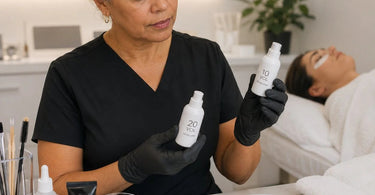
Tools built to perform... but only if you know which button does what. Think of your developer volume like the volume knob on a stereo. Zero is silence (no tint), ten is a full-on neighbor-waking bass drop (fried lashes). As a professional, you want the sweet spot where the color pops, the client leaves happy, and their natural Eyelashes don't snap off like stale breadsticks. We see it all the time in the Spa Essentials aisle: a well-meaning lash artist grabs the highest volume developer because they want that tint to be DARK. But let me stop you right there, queen. Using 40 volume on a set of baby fine lashes is like taking a flamethrower to a piece of toast. You might get brown, but you are also getting ash.
Here at Pure Spa Direct, we distribute the good stuff from brands like Refectocil Original, Intensive Tint, and Berrywell Cream Dye. But even the fanciest tube of tint is useless if you mix it with rocket fuel. Today, we are breaking down how to pick your fighter—whether it is Cream vs. Liquid—and exactly which volume (3%, 6%, or that whisper-soft 1.5%) keeps the hair healthy while delivering that high-definition pop.
The Chemistry Lesson (Don't Worry, There Won't Be A Quiz)
At its core, developer is just hydrogen peroxide with some conditioning buddies mixed in. Its job is to gently lift the outer layer of the hair—what we call the cuticle—so the tint pigment can slide inside and throw a party. The higher the volume (or percentage), the wider the cuticle opens and the faster it happens. Low volume? Gentle nudge. High volume? Aggressive shove. If you shove too hard, that cuticle slams shut damaged, leaving the hair dry, brittle, and prone to snapping off at the root. Nobody wants patchy lashes, honey. When shopping for Lash & Brow Enhancement Services, you have to think like a surgeon, not a bodybuilder.
The Volume Breakdown: Low, Slow, And The Danger Zone
We are mostly talking about tinting here, but the rules apply to perms and lifts, too. If you are browsing the Lash Lift & Perm section, remember that the health of the hair starts with the chemical prep. Let's look at your options.
1.5% to 3% (5 to 10 Volume): The Gentle Guardian
This is your ride-or-die for lashes and sensitive brows. Most professional lash tints, like those from Intensive Tint, are formulated specifically for a 3% (10 Vol) cream. Why? Because the natural lash is already a delicate little diva. It doesn't need a harsh chemical peel; it just needs a sheer wash of color . Using a 1.5% (5 Vol) developer, like the ones often paired with Professional Lash and Brow Tint systems, is fantastic for clients with existing damage, very fine hair, or if you are doing a Brow Lamination where the hair has already been processed and is feeling fragile . This volume won't lift the natural color much—it is purely for deposit—but it adds zero stress. If your client asks for Premium Lash Extensions & Supplies, remember that the natural lash must be intact to hold that extension. Don't melt it off with strong juice.
6% (20 Volume): The Bouncer
Twenty volume is the workhorse of the hair world, but it is usually too spicy for lashes. I am going to say it loud for the people in the back: Do not use 6% (20 Vol) on eyelashes unless you are prepared for a lawsuit or a sobbing client. The cuticle on a scalp hair is armor-plated compared to an eyelash. 6% is reserved for stubborn Grey Brow Henna or coarse facial hair that just refuses to cooperate . If a client has thick, wiry, Italian grandpa-style brows, 6% might be necessary to get that true, deep black. But for lashes? Keep it on the shelf. It breaks the disulfide bonds too aggressively. You will see the lashes look "frizzy" post-tint. That is the sound of their integrity crying.
Higher Volumes (30-40 Vol): Absolutely Not.
I shouldn't have to say this, but here we are. Just because you have Hair Bleaches and Lighteners on your shelf doesn't mean you use them for brow lightening without a serious consultation and patch test. 30 and 40 volume are for lifting virgin scalp hair four levels. On a lash, it would dissolve the hair. Literally. Stick to the low and slow method. Your client retention (and your insurance premium) will thank you.
Cream vs. Liquid: The Texture Tango
Once you pick your percentage, you have to pick your texture. This is where the Mixing Bowls come out.
The Cream Developer (The Bodybuilder): This is thick, pasty, and stays exactly where you put it. If you are doing a brow tint on a client who talks with their eyebrows (we all have that one client), cream is non-negotiable. It won't drip into their eyes. It holds moisture longer, which is great for processing coarse hair. Brands like Refectocil Original usually use a cream oxidant that you mix at a 1:1 ratio or a specific drop count (usually 15-20 drops per 1-2cm of tint) .
The Liquid Developer (The Marathon Runner): This is watery and mixes instantly. It is popular for Lash Lift & Perm services where you need the tint to wick down the length of the natural lash quickly. However, it is messy. One sneeze, one blink, and suddenly your client looks like they lost a fight with a felt-tip pen. If you use liquid, you need a steady hand and a Professional Cotton square ready for drips.
The Math: Getting The Ratio Right
This is where so many of you go wrong. You are eyeballing it like you are pouring cheap wine at a party. Stop that. Applicators & Spatulas are not just for show.
- \n
- For Cream Developer: Usually a 1:1 ratio or 2:1 (Tint to Developer). For Refectocil, you take 2cm of tint and mix with 15-20 drops of the cream oxidant . It should look like thick toothpaste. If it is runny, you added too much developer. Do not add more tint to fix it—you will ruin the chemical pH balance. Throw it away and start over. Yes, it hurts the wallet, but not as much as an allergic reaction or a bad tint job. \n
- For Liquid Developer: Usually 1 part tint to 2 parts liquid OR a specific drop count. Most liquid systems only need 10 drops of liquid for the same amount of tint . Because liquid is more concentrated per drop, if you pour it like you are making a cocktail, you will end up with a soup that stains the client's skin for a week. Use a Professional Lash and Brow Tint measuring tool if you have to. \n
Brand Spotlights: How The Pros Do It
Since we distribute hundreds of brands, let me give you the cheat sheet for our best-sellers in the Lash & Brow Service Supplies category.
- \n
- Intensive Tint: Stick strictly to 1:1. Mix equal parts Intensive 3% Developer with your chosen tint (like Middle Brown or Blue Black) until it forms a creamy paste . This is your safest bet for minimal lash damage. \n
- Berrywell Cream Dye: This formula is rich. Use a 2:1 ratio (2 parts dye to 1 part developer) if you want a super-pigmented, intense stain that looks like microblading. Use 1:1 for a standard tint. \n
- Refectocil Original: As mentioned, stick to the 15-20 drops rule for the cream oxidant. If you overdo the drops, the color will bleed into the skin. Nobody needs brows that look like a Sharpie drawing. \n
Real Talk: Reading The Natural Lash
Not all lashes are created equal. Before you even open the Lash & Brow Service Supplies drawer, look at your client's face.
- \n
- The Baby Hair (Anagen Phase): These are short, soft, and wispy. Do not overload them with product or high volume. Use a 1.5% developer or a very short processing time. If they are Premium Lash Extensions & Supplies clients, do not tint these at all if they are brand new extensions; the adhesive hates wet chemicals. \n
- The Teenager (Catagen Phase): Stronger, medium length. You can use a standard 3% here safely. \n
- The Senior (Telogen Phase): These lashes are long but ready to fall out. They look great, but they are brittle. Treat them gently. If you use a harsh developer, you are essentially pulling them out early. Stick to 3% max . \n
Equipment Matters: Don't Be A Drip
You cannot control your developer if your tools are trash. We sell a ton of Hygienic Table Paper because things get messy, but for tinting, you need precision.
- \n
- Use Magnifying Lights to see if the tint is bleeding onto the skin. \n
- Keep Professional Cotton, Sponges, and Wipes right next to your Mixing Bowls to catch drips immediately. \n
- Never mix tints without Protective Gloves & Masks. You may have tough skin, but developer doesn't discriminate. It will burn your fingerprints off if you leave it there too long. \n
So, remember: When you are selecting the right developer volume for minimal lash damage, think of it like dating. You want a gentle, steady partner (3% cream) who respects your boundaries, not a chaotic, high-octane speedster (40 vol) who ruins your credit score and leaves you crying in the bathroom. Keep it low, keep it slow, and shop smart at Pure Spa Direct. We have the Bulk Wax Deals for your body, and the gentle touches for your eyes. Now go make some money without the ouch!
)