
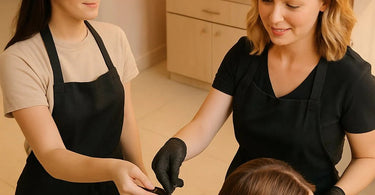
Simplify your workday with... a well-choreographed color service that flows like a perfectly executed ballet. Let’s be honest—we’ve all witnessed (or been part of) that awkward salon moment where the assistant hovers uncertainly while the colorist tries to telepathically communicate “more foils” or “shampoo now.” It’s like watching two people trying to assemble IKEA furniture without the instructions—someone’s definitely going to end up with leftover parts and frustration. But when the handoff between assistant and colorist is seamless? Magic happens. Clients feel like royalty, services move with effortless precision, and your salon earns that coveted “this place has their act together” reputation that keeps booking sheets full.
The graceful handoff isn’t just about passing tools—it’s about creating an uninterrupted luxury experience where the client never feels like they’re witnessing behind-the-scenes mechanics. It’s the difference between a disjointed service and what clients describe as “the most relaxing color appointment ever” because they were never left wondering what comes next.
Why the Handoff Matters More Than You Think
Think of your color service as a relay race rather than a solo sprint. The baton pass between team members can make or break your entire timing. A smooth transition means: clients don’t sit with processing color for unpredictable lengths, colorists can maintain their creative flow, and assistants feel valued and integral to the process. Plus, let’s address the elephant in the room—nothing murders salon efficiency faster than that five-minute search for the right color brush while development time ticks away.
When handoffs are clumsy, it’s not just timing that suffers. Clients notice. They might not understand why they feel slightly uneasy, but they’ll sense the disorganization. Meanwhile, smooth handoffs create such a luxurious experience that clients literally relax into the process, trusting your team completely.
The Pre-Service Huddle: Your Secret Weapon
Before you even touch a single strand of hair, the magic begins. The pre-service huddle takes two minutes but saves ten in confusion. This isn’t a formal meeting—it’s a quick connection where the colorist shares the game plan: “We’re doing a shadow root with balayage ends, using three different formulas, and we’ll need the blow dryer ready for a diffused finish.”
This is also where the assistant can confirm they have all necessary supplies—from the right professional hair color shades to sufficient foils and applicator bottles. Nothing kills momentum faster than realizing mid-service that you’re out of mixing bowls.
The Non-Verbal Communication Dance
In a busy salon, verbal communication isn’t always practical. That’s where developed non-verbal cues become your superpower. A subtle head nod toward the shampoo area, a specific tool placed in a certain position, or even eye contact can communicate volumes without disrupting the client’s relaxation.
One particularly brilliant system we’ve seen: colorists use different colored sectioning clips to indicate what stage each section is in. Red might mean “processing,” blue could mean “ready for toner,” and green might signal “completed.” It’s like traffic lights for hair color—everyone knows when to stop, go, or proceed with caution.
Timing is Everything: The Development Dance
This is where many handoffs stumble. The colorist applies, then... waits? No! The graceful handoff means the assistant is already preparing the next phase. While color processes, the assistant isn’t just twiddling their thumbs—they’re setting up the shampoo station with precisely warmed towels (thank you, towel steamers), testing water temperature, and having the correct post-color shampoo and conditioner ready.
The most impressive teams we’ve observed use timers strategically—not just one, but multiple timers that give five-minute warnings so the assistant can begin preparations before the colorist even needs to ask. It’s this anticipatory service that separates good salons from great ones.
Tools of the Trade: Setting Your Team Up for Success
The right equipment makes graceful handoffs infinitely easier. Imagine trying to execute a perfect transition without a well-organized salon station or sufficient mobile carts to bring supplies where they’re needed.
Invest in duplicate tools so assistants aren’t constantly waiting for the colorist to finish with that one perfect tail comb. Organization systems like clearly labeled storage containers and color-specific carts eliminate the “where is it?” dance that wastes precious processing time.
The Client Transition: Making Movement Feel Like Luxury
How you move clients between stations speaks volumes about your salon’s attention to detail. The graceful handoff means the assistant approaches at the exact right moment—not too early (which feels rushed) and not too late (which leaves clients wondering what’s next).
The best transitions include a brief introduction: “Sarah, I’m Jessica and I’ll be taking you to shampoo now. We have warmed neck pillows and we’ll be using a scalp massage technique that most clients describe as heavenly.” This isn’t just handing off a client—it’s handing off an experience.
Troubleshooting Together: When Plans Change Mid-Service
Even with perfect planning, hair can surprise us. That’s when the true test of teamwork emerges. The graceful handoff includes a quiet, discreet check-in when something unexpected occurs—maybe the color is processing faster than anticipated or a client mentions new sensitivity.
Having a pre-established “time-out” signal allows the colorist and assistant to step aside briefly without alarming the client. This quick consultation ensures everyone adjusts to the new plan simultaneously, maintaining that seamless experience clients pay premium prices for.
Building a Culture of Mutual Respect
The foundation of every graceful handoff is genuine respect between colorist and assistant. This means colorists who verbally appreciate their assistants in front of clients, and assistants who take pride in making their colorists look brilliant.
Consider implementing a “team compliment” system where colorists and assistants can recognize each other’s seamless handoffs. When the entire salon culture values these transitions, they naturally become more polished and instinctive.
Training for Perfection: Practice Makes Permanent
Graceful handoffs don’t happen by accident—they happen by design. Dedicate time in team meetings to practice transitions. Role-play different scenarios, from standard single-process color to complex corrective work.
Use training mannequins to simulate services without the pressure of a live client. Film your practice sessions—watching yourselves objectively reveals habits you might not notice in the moment.
The Payoff: When Handoffs Become Habit
When your team masters the art of the graceful handoff, something beautiful happens: services feel effortless, clients become loyal advocates, and your salon develops a reputation for exceptional organization. The time you save on each service means more clients per day or more attention to detail—either way, it’s a win.
Plus, let’s not underestimate the team morale boost. There’s a special kind of professional satisfaction that comes from executing a complex service with such synchronicity that clients comment on how “in sync” your team seems. That’s not just good business—that’s salon artistry at its finest.
Ready to elevate your team’s coordination? Start with the tools that make seamless service possible. From perfectly organized salon equipment to the finest hair color products, every element contributes to that graceful handoff that keeps clients coming back. Because in today’s competitive market, it’s not just about great hair color—it’s about the unforgettable experience that surrounds it.
